Speech by FS at HKU Business School 25th Anniversary Gala Dinner
Following is the speech by the Financial Secretary, Mr Paul Chan, at the HKU Business School 25th Anniversary Gala Dinner today (March 15):
Professor Zhang Xiang (Vice-chancellor of the University of Hong Kong (HKU)), Professor Richard Wong (Provost and Deputy Vice-Chancellor of the University of Hong Kong), Professor Cai Hongbin (Dean and Chair of Economics, the University of Hong Kong Business School), Ms Guo Jingjing (Olympic gold medalist), distinguished guests, ladies and gentlemen,
It is my great pleasure and honour to join you this evening at the HKU Business School's 25th Anniversary Gala Dinner. First of all, allow me to extend my warmest congratulations to the School on this much-celebrated silver jubilee.
Over the past 25 years, HKU Business School has grown into a globally prominent institution in business education, earning strong recognition both internationally and locally. More importantly, you have nurtured generations of leaders, innovators and entrepreneurs – people who have gone on to shape policy, finance and commerce, and who continue to drive our city forward as an international financial, trade and business centre.
The tech-driven economy ahead
Tonight, as we celebrate the School's achievements, I would like to speak about the wider context in which the future will unfold.
AI is advancing at a breathtaking pace, faster than many of us anticipated. It is already reshaping virtually every industry and every walk of life: from personal applications to business operations and public services; from retail and financial services to logistics, healthcare and advanced manufacturing.
While we witnessed the Deep Seek Moment just a little over a year ago, a new wave is emerging: agentic AI. If earlier generations of AI focused mainly on dialogue and content, AI agents have moved from conversation to execution. They can plan, co-ordinate tasks and act across systems. They enhance productivity, expand processing capacity and enable new kinds of services.
We must admit that these developments bring new risks. Risks relating to cybersecurity, privacy, misinformation, operational resilience and, ultimately, the risk of losing human oversight and mastery over important decisions.
Yet we never stop sailing the seas simply because of storms. New technologies inevitably carry risks, but they also bring immense opportunities. The key question is not whether we should embrace technology, but whether we can manage the risks well, so that we can unlock the growth potential in a responsible and sustainable manner.
Compare this wave of AI development to the personal computer, the Internet or smart mobile devices when they first emerged. Each of those breakthroughs brought profound changes: hardware upgrades, new software applications, new management practices, and shifts in consumer behaviour and expectations. AI is similarly transformative, and possibly even faster in its diffusion.
That is why businesses, regulators, educators and citizens all need a clearer and more informed understanding of the AI trend. The pace of change will be rapid, and the winners will be those who adapt early, learn quickly and execute decisively. Hong Kong must stay ahead of the curve. That is why we have put AI+ at the core of this year's Budget, including an initiative on "AI Training for All".
Three levels of change
Against this backdrop, I would like to suggest three levels at which, in my view, AI and technological innovation are reshaping our economy.
First, the market level. Technological change reshapes market structure and market behaviour, on both the supply side and the demand side. We have seen this before. For instance, as e-commerce platforms rose and online shopping became mainstream, products and services evolved quickly. Entire industries adjusted accordingly: logistics networks expanded, digital payments flourished, last-mile delivery transformed customer expectations, and even new forms of marketing, such as livestream commerce, became major channels.
AI will likely trigger a similar dynamic. It can reduce search and transaction costs, personalise services at scale, and create entirely new categories of products and experiences. At the same time, it may also concentrate market power in certain segments, intensify competition in others, and test existing regulatory frameworks. Understanding these shifts is essential for businesses seeking opportunities, and for policymakers safeguarding fair, open and competitive markets.
Second, the enterprise level.When markets, products, and customer habits change, firms must adapt internally. Or growth will suffer. Technology adoption is not merely an IT project; it is an operating model transformation. It requires changes in workflow, talent strategy, governance, risk management and corporate culture.
In times of rapid change, a company's ability to foster exploration and innovation becomes a decisive factor for resilience, competitiveness and long-term success. That includes creating room for experimentation, learning quickly from setbacks, and scaling what works, while maintaining strong controls, ethical standards and accountability.
Third, the business model level.The effective use of technology to create new business models and new services is, quite simply, the key to value creation. Over the past decade, many fast-rising and well-performing brands succeeded not only because they had strong products, but because they built smarter models: using data, platforms and new forms of customer engagement to scale efficiently and differentiate from others successfully.
AI will open the door to a new generation of business models: more predictive, more customised, more automated and potentially global from day one. Those who succeed will combine technological capability with strategic clarity, sound governance, and a commitment to responsible innovation.
New expectations
Ladies and gentlemen, in this new era of technological progress and business innovation, I believe business schools has new roles to play. Business management education matters more than ever, because the challenge is not just about knowing what technology can do, but about leading people through change.
HKU Business School is exceptionally well placed to play this role.
You bring together outstanding talent across the business community and beyond. Your alumni and students come from business, technology, finance and public administration. The School is a place where ideas are translated into real-world impact for companies, markets and the wider community.
And you are also a good curator of Hong Kong stories. I trust you will continue to articulate Hong Kong's perspective to the world: a perspective shaped by our role as a global financial centre, a bridge between East and West, a city that values openness, free trade, the rule of law, and international connectivity. Through research, global exchange, and partnerships with institutions and industry worldwide, I trust you will continue to help ensure that Hong Kong's uniqueness is understood, and our strengths are recognised. That our views are heard in the conversations that shape the future of business and policy.
Concluding remarks
Ladies and gentlemen, anniversaries are for celebrating the achievements you have made and the dreams you are yet to build.
Hong Kong's continued success depends on our ability to navigate transformation, be it economic, technological and geopolitical. It requires us to keep moving forward: to attract and develop the best talent, to generate and apply the best ideas, and to build an economy that is innovative, competitive and resilient. Above all, it requires us to constantly rediscover ourselves and unleash our new potential.
For all these endeavours, we look to the HKU Business School for your unfailing support.
I wish the School every success in the years ahead, and all of you the best of health and business in the time to come.
Thank you very much.
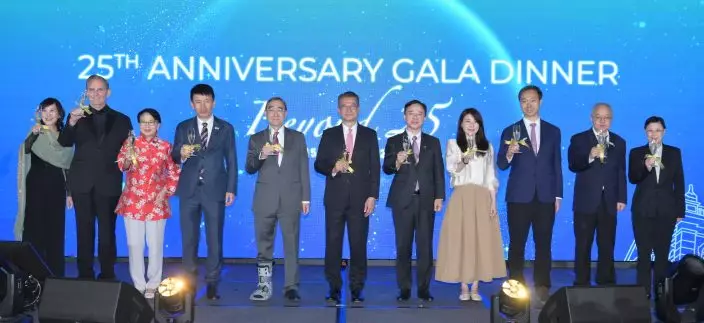
The Financial Secretary, Mr Paul Chan, attended the HKU Business School 25th Anniversary Gala Dinner today (March 15). Photo shows Mr Chan (centre) with the Vice-chancellor of the University of Hong Kong (HKU), Professor Zhang Xiang (fifth right); the Provost and Deputy Vice-Chancellor of the University of Hong Kong, Professor Richard Wong (fifth left); the Dean and Chair of Economics, the University of Hong Kong Business School, Professor Cai Hongbin (fourth left); Olympic gold medalist Ms Guo Jingjing (fourth right), and other guests at the event. Source: HKSAR Government Press Releases
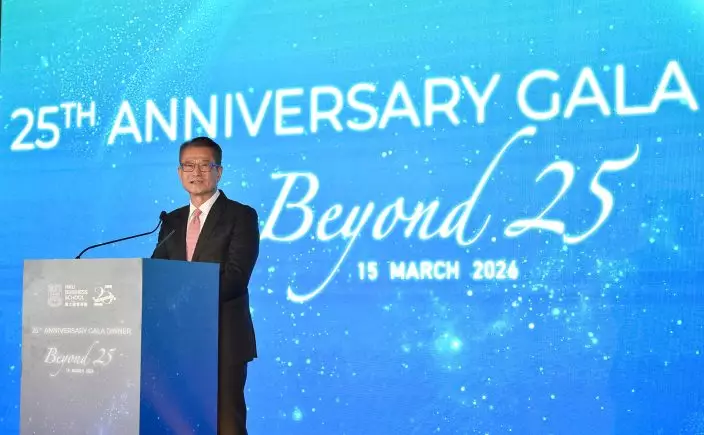
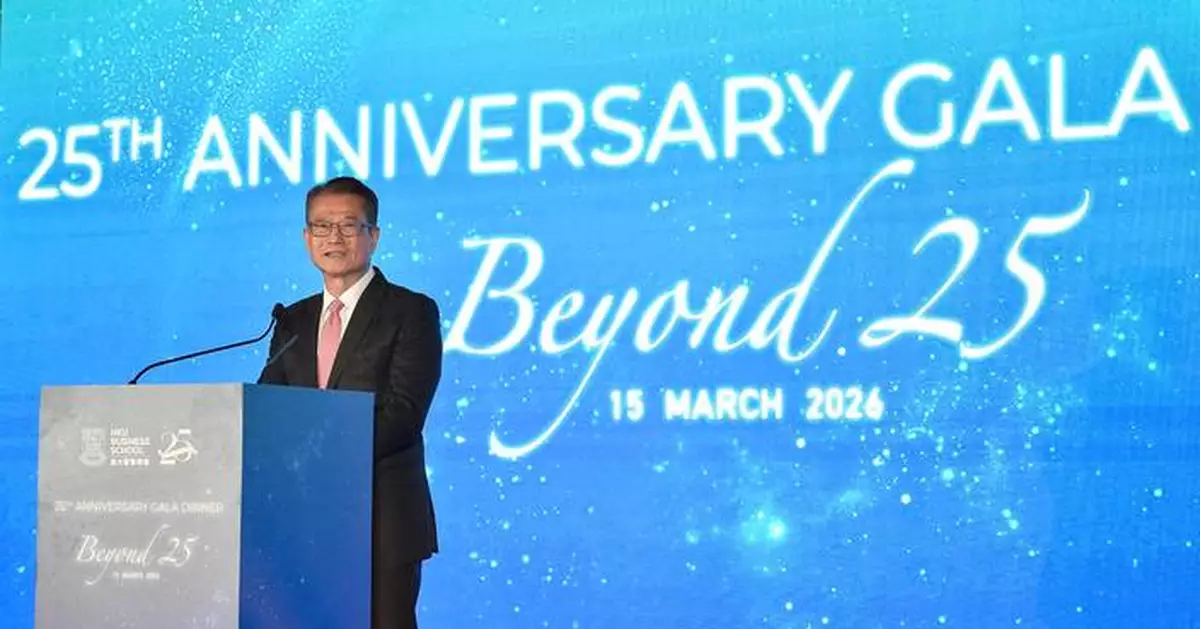
The Financial Secretary, Mr Paul Chan, attended the HKU Business School 25th Anniversary Gala Dinner today (March 15). Photo shows Mr Chan giving a speech at the event. Source: HKSAR Government Press Releases