Skip to Content Facebook Feature Image

IPC president disappointed with Ukraine for shifting focus to politics at Milan Cortina Paralympics

Sport

IPC president disappointed with Ukraine for shifting focus to politics at Milan Cortina Paralympics
Sport

Sport

IPC president disappointed with Ukraine for shifting focus to politics at Milan Cortina Paralympics

2026-03-16 00:52 Last Updated At:01:00

CORTINA D'AMPEZZO, Italy (AP) — The president of the International Paralympic Committee was disappointed with the complaints made by Ukraine's National Paralympic Committee during the Milan Cortina Games, saying they appeared to be an attempt to shift the focus from sports to politics.

Andrew Parsons spoke with The Associated Press on the final day of the Winter Paralympic Games on Sunday, praising the outcome of the competition and discussing the return of the Russian flag and anthem, the effects of the warmer weather and the challenges of organizing the event at widespread venues.

Parsons called it “disappointing” that the Ukrainian National Paralympic Committee and the national committees of other nations tried to turn the focus away from sports.

He said he was “super empathetic” with the situation in Ukraine and can “only try to imagine the horror,” but as a sports organization, the IPC must make sure that rules are not broken, even by the Ukrainian committee.

“Yes, I think there was an attempt to always take the focus from sport,” Parsons said. “And I think at the end, even the other national Paralympic committees responded really well, focusing on sports. I understand, but it is disappointing to some extent.”

He said it was expected to see governments attempting to shift the focus toward politics, but it was regrettable that sports bodies were doing it.

“I do hope this is a lesson learned also for those NPCs that have chosen to focus more on the political side than on the sport side, because sport has prevailed,” he said.

Valerii Sushkevych, president of the Ukraine National Paralympic Committee, told the AP in a telephone interview on Sunday that calling for peace and to stop the war was not a political statement, but a human-rights issue.

“If people in the world want to live in peace, it's human rights, it's not political,” Sushkevych said.

Ukraine and a few other nations boycotted the opening ceremony — and were set to boycott Sunday's closing ceremony as well — because of the IPC's decision to give Russian athletes wildcard entries for the Games and allow them to compete under their own flag for the first time in more than a decade.

Sushkevych said the ceremonies are not sporting competitions and are used as a political event by the IPC, which was allowing the participation of a nation that "can't be present here” because of the occupation of another country.

Russia’s invasion of Ukraine four years ago ignited Europe’s biggest conflict since World War II, causing suffering for civilians and harrowing ordeals for soldiers while rewriting the post-Cold War security order. The fighting has entered its fifth year, with the number of casualties — people killed, wounded or missing — combined from both sides estimated in the millions.

Ukraine’s Paralympic committee accused the IPC and Milan Cortina organizers of subjecting Ukraine’s athletes and coaches to “systematic pressure.” It said the incidents included the alleged forceful removal of a Ukrainian flag, the breaking up of planning meetings by the Ukrainian team, and the prohibition of a Ukrainian athlete from wearing an earring with the words “Stop War” at a podium ceremony. The IPC and local organizers defended their actions.

Sushkevych said the complaints were made to the IPC to defend its athletes because they were being subjected to what he called “discrimination” and biased behavior against the Ukrainians. He said they were only complaining about “facts.”

Parsons said it was expected that some nations weren't happy with the return of the Russian flag, but he felt that the “vast majority” of the national Paralympic committees focused on sport, “because the sport element of it is what helps us fulfill our mission, which is to make for a more inclusive world through Para sport, and not external politics.”

“There was still some voices out there trying to continue focusing on what, in our opinion, should not be the focus of these games, but I think the overall impression of the people, especially people at home watching on TV or following the media, following the news, is (the focus) was more on athletes, more on sport, records, than in politics,” he said.

The Russian flag flew at the Paralympics for the first time since the 2014 Winter Games in Sochi, and the anthem was played for the first time at a major global sporting event since Russia’s invasion of Ukraine in 2022.

The return of the Russian flag and anthem was seen by some as a signal of a possible full-fledged return to Olympic circles ahead of the 2028 Summer Games in Los Angeles.

Parson said the general assembly made the vote to lift the suspension solely with the best interests of the Paralympic movement in mind.

“We don’t think that we are going to initiate processes,” he said. “I know some people believe that this might have the impact on another sporting body, but that’s not what we’re focusing on. It’s for the IOC to make their decisions, it’s for FIFA to make their decisions, and every other international organization to make their decisions."

Parsons said discussions will continue about the effect of warmer weather on the Paralympics. Milan Cortina organizers had to change the schedule of some events because of high temperatures, and some athletes competed in shorts, T-shirts and tank tops.

“Unfortunately, global leaders are not responding in the speed that is necessary to slow down the process," he said. "So this is probably a trend that we will see in 2030, ‘34, ’38 '42 and so on. So we need to have those discussions, and we are having those discussions” within the IPC and together with the IOC and international federations.

“It’s a very big jigsaw puzzle,” Parsons said. “It’s not only, ‘OK, let’s move the Games one month in advance — Olympics in January, Paralympics in February.' That is also an impact on the regular season of those sports. So we need to consider all these different elements. These discussions are taking place. We are not sitting on our hands.”

Parsons said the model of spread-out Games — with competitions and venues in different clusters to reduce the cost of building new facilities — is “here to stay.”

“I think the biggest learning is that it is possible to have great Games, even with that widespread venue master plan. It does not compromise the spirit of the Games, but, yes, brings additional complexity to the operations that needs to be mitigated, and needs to be well understood, and I think having this first experience here, we have a lot of learning to take to 2030, 2034.”

AP Winter Paralympics: https://apnews.com/hub/paralympic-games

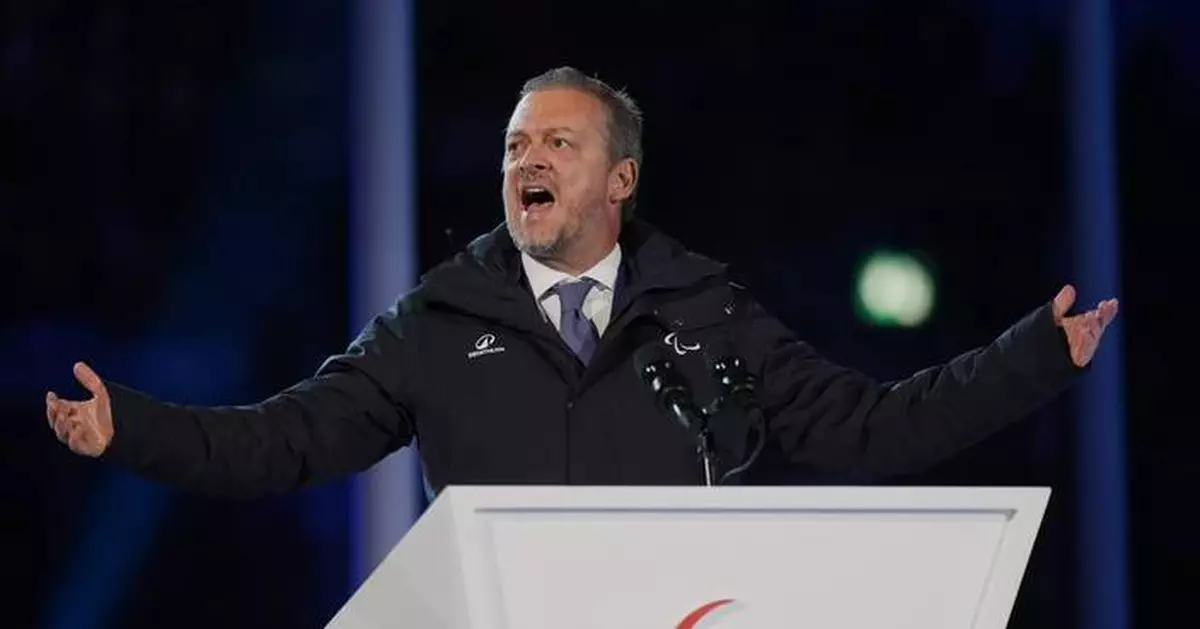
Andrew Parsons, President of the International Paralympic Committee, speaks during the opening ceremony at the 2026 Winter Paralympics, in Verona, Italy, Friday, March 6, 2026. (AP Photo/Antonio Calanni)

Andrew Parsons, President of the International Paralympic Committee, speaks during the opening ceremony at the 2026 Winter Paralympics, in Verona, Italy, Friday, March 6, 2026. (AP Photo/Antonio Calanni)
WASHINGTON (AP) — John Wrory Ficklin was 7 when he learned that his father, the son of a slave, was important.

It was 1963, and the nation was mourning President John F. Kennedy. Wrory Ficklin was sitting with his mother and brother, watching funeral coverage on TV in the family's Washington apartment, when she gasped.

His father, John Woodson Ficklin, was wearing a morning suit and standing beside Kennedy's casket with other White House ushers. He was a White House butler at the time, but Kennedy's widow, Jacqueline, asked that he join the ushers that day.

Woodson Ficklin worked a remarkable 44 years on the White House residence staff. His son, Wrory Ficklin, had a lengthy White House career, too — 40 years on the staff of the National Security Council.

Presidents come and go from the White House every four years or eight years, but the Ficklin family — Woodson Ficklin, his wife, some of his brothers and sisters, and son Wrory Ficklin — was a constant presence there for nearly eight decades, serving 13 presidents from Franklin D. Roosevelt to Barack Obama.

One family by the president’s side for one-third of America’s 250-year existence.

With his 2015 retirement, Wrory became the last Ficklin employed there full time, capping a record of family service documented in his book, “An Unusual Path: Three Generations from Slavery to the White House.”

“The book is my family’s history, it's African American history and it's our country’s history," he told The Associated Press in an interview. “My dad and I both stand on my grandfather's shoulders, and I like to think that we both contributed a lot to our country."

The first chapter in what Wrory Ficklin described as a “truly American story” opens with his grandfather, James Strother Ficklin, who was born a slave around 1854 in Rappahannock County, Virginia.

Strother was a water boy for the Confederate army during the Civil War. After emancipation, he did odd jobs for the family that used to own him.

He remarried in 1894 after his first wife died during childbirth, and moved to Youngstown, Ohio, to escape racism in Virginia and earn a living in the booming coal and steel industries. Records showed they returned to Rappahannock some years later, though it was unclear why.

Strother and his second wife, Helen, had saved enough money to buy 37 acres (0.15 square kilometers) of land in Amissville, Virginia, in 1901. He built a house and farmed the land to help feed the family. After Helen died while giving birth, Strother married his third wife, Vallie Lee Davenport, in 1907. They had 10 children — five girls and five boys.

One of those boys was John Woodson Ficklin.

Woodson Ficklin was 15 when he moved to Washington in 1934 to live with an older sister and her husband. He worked odd jobs and went to high school at night, graduating in 1939 — the year an older brother, Charles, began work as a White House butler. Charles Ficklin helped him land a part-time position washing dishes and doing whatever the butlers did not have time to do themselves.

Military service during World War II briefly interrupted their White House careers, but they received promotions after they came home, with Charles Ficklin and Woodson Ficklin becoming head butler and butler, respectively. Woodson Ficklin met President Harry Truman and first lady Bess Truman on his second day as a butler when he served the couple breakfast.

New promotions followed under Dwight Eisenhower, with Charles Ficklin becoming maître d’ — the most senior butler — and Woodson Ficklin taking over as head butler, putting him in charge of six full-time butlers.

Woodson Ficklin succeeded his brother again in March 1967, when Charles Ficklin retired.

Woodson Ficklin was now responsible for the planning and execution of White House social events, ranging from luncheons and state dinners to birthday parties and South Lawn barbecues.

There were visits by British royals and the annual round of Christmas parties, the White House wedding of Richard Nixon's daughter Tricia in 1971, and Gerald Ford's daughter Susan's decision to host her senior class prom at the White House.

Along the way, Woodson Ficklin earned the trust and confidence of the presidents and first ladies who relied on his expertise. Some sent thank-you notes after flawlessly executed events.

First lady Patricia Nixon wrote in October 1969 about “the great number of complimentary remarks we receive following each White House social event,” according to a copy of the letter reprinted in the book. “Our family is most grateful to you for the time and interest you devote to make each occasion so enjoyable and memorable for our guests and for us.”

President Jimmy Carter expressed appreciation in a March 1979 letter for the work Woodson Ficklin and his team did surrounding the signing of an Egypt-Israel peace treaty.

“Everything was perfect and we are grateful,” Carter wrote.

Woodson Ficklin retired in May 1983. In perhaps the biggest show of appreciation for his 44-year career, the Reagans invited him and his wife, Nancy, to a state dinner that year for the emir of Bahrain.

He is believed to be the first member of the White House residence staff to be a guest at a state dinner, and he became the subject of a media blitz as a result. Woodson Ficklin sat at the first lady's table and told an interviewer that she "put me at ease and made me feel like a guest.” Asked about the service, he replied, “Those are my boys. I trained them.”

Woodson Ficklin died in December 1984 at 65.

“Seeing my Dad on television was a big deal, and to see him participating in our president’s funeral service was beyond my youthful comprehension,” Wrory Ficklin wrote. He said years passed before he understood "the severity and the importance” of his father’s work.

Yet Wrory Ficklin ended up doing important work at the White House, too, after a summer job during high school delivering sealed envelopes between the White House and the special prosecutor on the Watergate investigation. He also worked for his father in the pantry during state dinners and other big events.

Wrory Ficklin joined the NSC staff in 1975, beginning a 40-year tenure that overlapped with his father and other family members. He started by working evenings as a clerk while attending college during the day and by 1987 was training new staff.

Under Obama, Wrory Ficklin was promoted to special assistant to the president for national security affairs. He retired in 2015 with a special request for his boss, national security adviser Susan Rice: Could he attend a state dinner, like his dad?

Wrory Ficklin and his wife, Patrice, were invited to the 2015 state dinner for Chinese President Xi Jinping. With some minor alterations, he wore the tuxedo jacket and cummerbund his father wore in 1983.

The dinner was the highlight of his career, he said.

“Just to experience firsthand the quality of the service, the precision of the butlers, the type of service that they provided, was a legacy to my dad, actually,” Wrory Ficklin said in the interview.

In this 1983 photo provided by The White House, John Woodson Ficklin talks with first lady Nancy Reagan at the White House in Washington. (The White House via AP)

In this 1983 photo provided by The White House, John Woodson Ficklin talks with first lady Nancy Reagan at the White House in Washington. (The White House via AP)

In this 1975 photo provided by The White House, President Gerald Ford speaks with John Woodson Ficklin in the residence of the White House in Washington. (White House Historical Association/The White House via AP)

In this 1975 photo provided by The White House, President Gerald Ford speaks with John Woodson Ficklin in the residence of the White House in Washington. (White House Historical Association/The White House via AP)

John Wrory Ficklin speaks during an interview with the Associated Press inside the Decatur House at the White House Historical Society, Feb. 18, 2026, in Washington. (AP Photo/Tom Brenner)

John Wrory Ficklin speaks during an interview with the Associated Press inside the Decatur House at the White House Historical Society, Feb. 18, 2026, in Washington. (AP Photo/Tom Brenner)

In this photo provided by The White House, John Woodson Ficklin and his wife Nancy talk with President Ronald Reagan and first lady Nancy Reagan as they attend as guests at a State Dinner at the White House on July 19, 1983, in Washington. (The White House via AP)

In this photo provided by The White House, John Woodson Ficklin and his wife Nancy talk with President Ronald Reagan and first lady Nancy Reagan as they attend as guests at a State Dinner at the White House on July 19, 1983, in Washington. (The White House via AP)

John Wrory Ficklin poses for a photo inside the Decatur House at the White House Historical Society, Feb. 18, 2026, in Washington. (AP Photo/Tom Brenner)

John Wrory Ficklin poses for a photo inside the Decatur House at the White House Historical Society, Feb. 18, 2026, in Washington. (AP Photo/Tom Brenner)

In this undated photo provided by The White House, John Woodson Ficklin poses for a photos with President Jimmy Carter and first lady Rosalynn Carter at the White House in Washington. (The White House via AP)

In this undated photo provided by The White House, John Woodson Ficklin poses for a photos with President Jimmy Carter and first lady Rosalynn Carter at the White House in Washington. (The White House via AP)

Recommended Articles