Defending national champion Florida's path to another Final Four could include a rematch with Houston, whom it beat in the final a year ago, only this time in a South Region finale that would be played just a short drive from the Cougars' campus.
The Gators were chosen as one of the four No. 1 seeds for the NCAA Tournament on Sunday.
The SEC regular-season champions will open against the winner of a First Four game on Wednesday between Prairie View A&M and Lehigh on Friday in Tampa, Florida, getting the benefit of a close opening weekend of games. The second-seeded Cougars will play No. 15 seed Idaho on Thursday in Oklahoma City.
Yet it’s not hard to look ahead to a potential regional finale between the Gators and Cougars at the Toyota Center, which is less than three miles away from the Fertitta Center, where Houston celebrated with its fans on Sunday at a selection watch party.
“We try to be very consistent with our program. We’re not going to be reactive in regards to when we’re winning that we don’t practice hard,” Gators coach Todd Golden said after their loss to Vanderbilt on Saturday in the semifinals of the SEC tourney.
“Part of what makes our program what it is is our consistency,” he said. “We’re not going to change a lot.”
Third-seeded Illinois and fourth-seeded Nebraska could have something to say about that Florida-Houston rematch.
The Illini, who had struggled down the stretch and lost to Wisconsin in the Big Ten Tournament, will open against No. 14 seed Penn — the Ivy League tourney champ — on Thursday in Greenville, South Carolina.
“We’re a possession away in a lot of games from being one of the best teams record-wise in the country. I still think we’re one of the best teams in the country,” Illinois coach Brad Underwood said. “We’ve just got to stay focused.”
The Huskers slumped a little after a 20-0 start but are back in the NCAA Tournament with a matchup against No. 13 seed Troy on Thursday in Oklahoma City.
Nebraska has never won a game in the NCAA Tournament, losing its opener in each of its eight previous appearances. That includes a loss two years ago as the No. 8 seed to Texas A&M in Fred Hoiberg’s first time taking the Huskers to the dance.
The No. 4 seed is the best for Nebraska since it was the No. 3 in 1991 and lost its opener to No. 14 seed Xavier.
Seventh-seeded Saint Mary’s is making its fifth straight NCAA Tournament appearance and will play No. 10 seed Texas A&M, which is in the tourney for the fourth straight time. But it’s the Aggies’ first playing “Bucky Ball” — the name given to the style of basketball it plays under Bucky McMillan, who succeeded Buzz Williams as their coach this season.
Iowa is back in the NCAA Tournament as the No. 9 seed and will play eighth-seeded Clemson in the first round. The Hawkeyes are led by Ben McCollum, who took Drake to the second round of the tourney last season. The year before that? McCollum was the coach at Northwest Missouri State, a Division II school that he turned into a national power.
North Carolina slipped to the No. 6 seed and will play its NCAA tourney opener against No. 11 seed VCU, which won the Atlantic-10 Tournament. The Tar Heels’ seeding took a hit with a loss to Clemson in the ACC Tournament and, perhaps more likely, the injury to star freshman Caleb Wilson. His broken thumb required surgery and effectively ended his season.
Vanderbilt earned the No. 5 seed after reaching its first SEC Tournament title game in 14 years, losing to Arkansas on Sunday, and will play No. 12 seed McNeese in the first round. The winner of that game gets the Nebraska-Troy winner in the second round.
AP March Madness bracket: https://apnews.com/hub/ncaa-mens-bracket and coverage: https://apnews.com/hub/march-madness
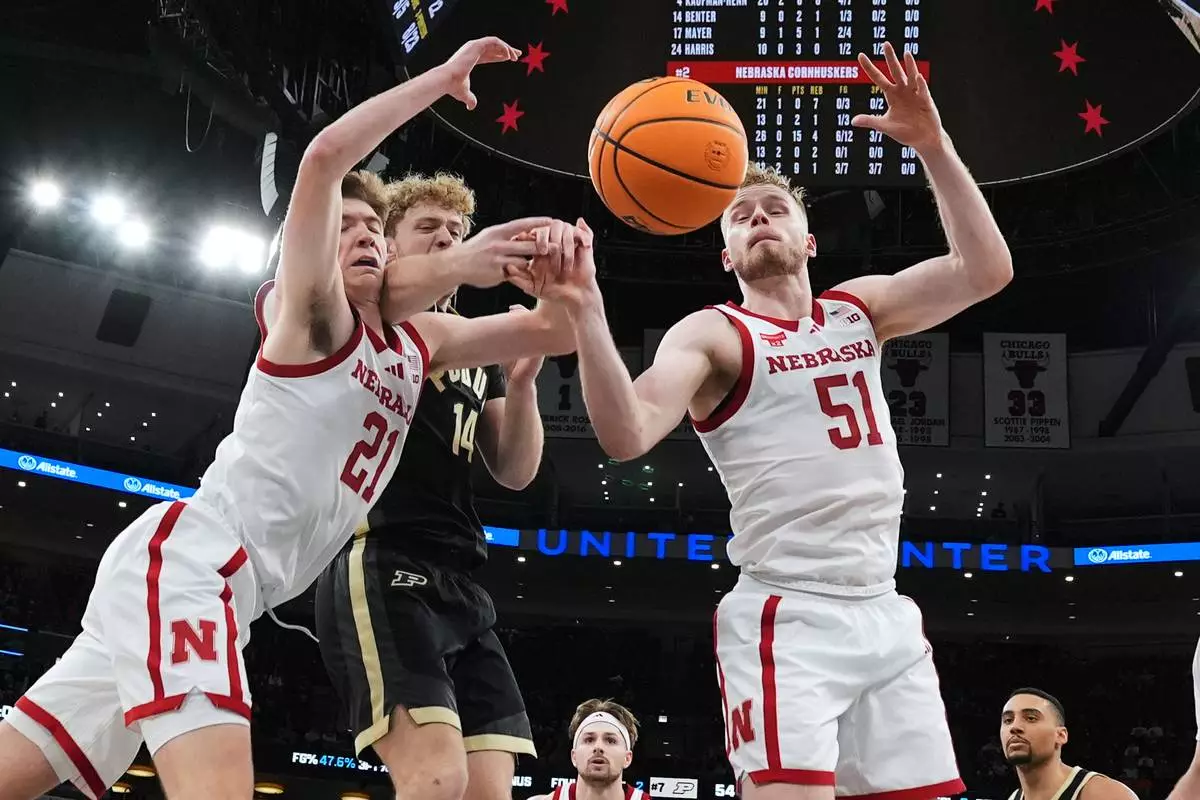
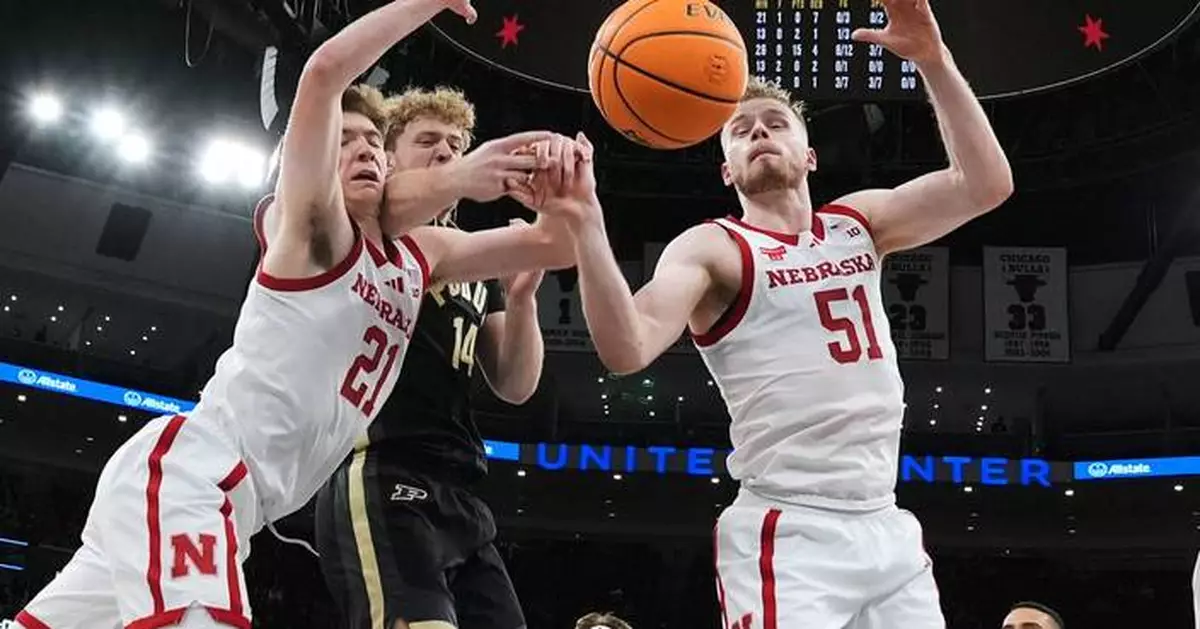
Purdue guard Jack Benter (14) battles for a rebound against Nebraska forwards Pryce Sandfort, left, and Rienk Mast (51) during the second half of an NCAA college basketball game in the quarterfinals of the Big 10 Conference tournament, Friday, March 13, 2026, in Chicago. (AP Photo/Nam Y. Huh)
Duke received the top overall seed for March Madness on Sunday, followed by Arizona, Michigan and Florida, each of whom would love a repeat of last season when all four No. 1s made it all the way to the Final Four.
The top line was the most predictable thing to come out of Selection Sunday, with Michigan’s drop of one spot to the overall No. 3 the result of the Wolverines' loss to Purdue moments before the brackets were revealed, according to tournament selection chair Keith Gill.
In the day’s biggest nail-biter, Miami (Ohio) made the field as a No. 11 seed, but just barely. The RedHawks, with a 31-1 record but the 339th-ranked strength of schedule, were one of the last teams in the field and they face a First Four game Wednesday against SMU in Dayton, Ohio, not terribly far from home.
The tournament starts Tuesday with other play-in games, including one pitting bubble teams and No. 11 seeds Texas and North Carolina State. The national champion will be crowned at the Final Four in Indianapolis on April 6.
Among those left out were San Diego State, Indiana, Oklahoma and Auburn.
The Tigers had 16 losses but the third-best strength of schedule. The snub drew predictable blowback from Bruce Pearl, their former coach and father of their current coach, who was working for CBS and said “they played the toughest schedule in the country and I don’t know if they were rewarded for it.”
Even with those snubs, the Southeastern Conference led the way by placing 10 teams in the field of 68, four short of its record from last year.
The Big Ten followed with nine, the ACC and Big 12 with eight apiece -- an unsurprising result in an era of massive conference expansion and NIL compensation drawing top players to the biggest spenders.
The Gators (26-7) are the defending champion, trying to repeat their back-to-back titles from 2006-07. Last season, Florida was part of an all-No. 1 Final Four -- the first time that had happened in 17 seasons.
Gill confusingly said Miami (Ohio) was not the last at-large team in the bracket, even though it was ranked in the 1-68 lineup behind bubble teams North Carolina State, Texas and SMU. Those three teams also rated above Miami in some of the key metrics.
The 31 wins must have meant something.
Gill said the committee looked hard at how injuries would impact teams.
No team suffered more, both on the bracket and the court, than North Carolina, which is a No. 6 seed after losing Caleb Wilson to a broken right thumb. JT Toppin’s season-ending knee injury was also a factor in Texas Tech’s No. 5 seeding.
Asked how the NCAA’s seeding principles played a role in moving teams around in the bracket, Gill pointed to the First Four meeting between NC State and Texas the committee would have liked to avoid because it is a rematch of a game they played in the Maui Invitational in November.
He said nothing about placing No. 2 seed Houston in the South, where it could play the regional final in its hometown — normally something the NCAA shies away from. The game could be against Florida in what would be a rematch of last year’s national championship game.
The committee weighed the Big Ten final in moving Michigan down one notch and moving Purdue from a 3 to a 2 seed, but didn’t seem to pay as much attention to the action in the Big East.
St. John’s beat UConn by 20 in that conference final but remained where most bracketologists had them, at No. 5, and with a cross-country trip this week to San Diego to play Northern Iowa. UConn stayed at No. 2 where it had been predicted all along.
AP March Madness bracket: https://apnews.com/hub/ncaa-mens-bracket and coverage: https://apnews.com/hub/march-madness
Kentucky guard Collin Chandler (5) falls onto Florida forward Alex Condon (21) during the second half of an NCAA college basketball game in the quarterfinal round of the Southeastern Conference tournament, Friday, March 13, 2026, in Nashville, Tenn. (AP Photo/George Walker IV)
Arizona's Jaden Bradley celebrates after making the game-winning shot at the buzzer to defeat Iowa State during an NCAA college basketball game in the semifinal round of the Big 12 Conference tournament Friday, March 13, 2026, in Kansas City, Mo. (AP Photo/Charlie Riedel)