Sarah Fillier spent her first two seasons with the New York Sirens accustomed to staring at empty blocks of seats across the bench during home games.
Due to poor turnouts, the PWHL team — for practical and visual purposes — limited ticket sales for seats in Sections 2-11 located behind the benches at the Prudential Center, home of the NHL New Jersey Devils.
All that changed for New York’s game against Ottawa on March 8, when the entire lower bowl was filled. Fans even populated sections in the upper level to help set a Sirens home attendance record of 8,264.
“Being able to look across and see fans cheer you on, getting involved in the game and reacting to in-game emotions and situations, it was so cool,” Fillier said of a turnout that saw a 6-2 win and eclipsed their previous best of 5,132.
“We’ve experienced a lot of that on the road, when the crowd is really against you. It was really nice to have them truly on our side this game,” she added. “And we obviously wanted to put on a show so we can hopefully get them back at future home games.”
The Sirens’ attendance spike reflects a surge in attention for women’s hockey, and for the PWHL in particular, in the weeks following Team USA’s 2-1 overtime win against Canada at the Winter Olympics.
The PWHL’s first three games out of the Olympic break were sellouts, including a league-record 17,335 turnout in Seattle. The league has already sold out upcoming games at Madison Square Garden and Boston’s TD Garden. And the post-Olympic attention led to the PWHL reaching a deal with Scripps Sports to broadcast its first game to a national U.S. audience.
“You always hope for the best. You have this belief that this could be something big,” executive VP of business operations Amy Scheer said. “Have we exceeded expectations? Sure. But I think inwardly we knew what was capable of happening here.”
One benefit was having a two-plus-year leadup to the Olympics, which allowed the league to establish a presence in six markets before adding expansion teams in Seattle and Vancouver this season. It also gave PWHL executives time to develop a plan on how to leverage the Games to market itself to fans and sponsors.
Scheer said the PWHL invited about 25 partners to join them in Milan, including coordinator hotels, tickets for events and dinners.
“We made sure every piece of our business was ready to capitalize on what could happen and was going to happen after the Olympics,” she said. “And now that work, and maybe the most important work, is continuing.”
The one-time broadcast deal with Scripps Sports was struck in Milan, and has the potential to turn into a long-time partnership. Sponsors were pitched on various programs and youth development projects the PWHL is preparing to launch.
And then there’s more expansion, with the PWHL planning to add as many as four markets for next season.
As for ticket sales, StubHub released figures on Friday that indicate searches for PWHL games have jumped by nearly 50% since the Olympics. Ticket purchases for the league’s four U.S.-based franchises have jumped by 42% over the same time last year.
The game-changer is having the PWHL in place. While women’s hockey always enjoyed a boost every four years, players never had an established league such as the PWHL to come home to until now.
“It’s incredible,” said Boston Fleet defender Megan Keller, who scored the clinching goal against Canada and went on to make a celebrated appearance on “Saturday Night Live” with team captain Hilary Knight. “I’m not totally shocked. But I would say, yeah, it does feel like I was a little bit surprised at how much attention we got from the Games."
The evidence is with the Sirens, a team that had difficulty finding a home in its first season before moving to New Jersey, and struggled generating attention in a crowded sports market. The team averaged a league-low 2,764 fans per game last season.
Fillier might have settled for silver in representing Canada, but is celebrating the benefits the entire league is enjoying coming out of Milan.
“I think it was just the perfect storm of an incredible final gold medal game, and just bringing fans right into the PWHL, and have that hockey kind of on demand for them to be a part of,” Fillier said. “It’s incredible. And it’s a testament to this league, too, and all the players who have been here from the start.”
AP women’s hockey: https://apnews.com/hub/womens-hockey

Minnesota Frost forward Taylor Heise, right, celebrate her goal with teammate Kendall Cooper during the third period of a PWHL hockey game, in Toronto, Sunday, March 8, 2026. (Nathan Denette/The Canadian Press via AP)

FILE -Fans get excited during the first period of a PWHL game between the New York Sirens and the Minnesota Frost, at Little Caesars Arena, in Detroit, Sunday, March 16, 2025. (David Guralnick/Detroit News via AP, File)

United States women's gold medal hockey players Megan Keller, center, Aerin Frankel, left, and Haley Winn, right, acknowledge the crowd before a ceremonial puck drop ahead of an NHL hockey game Wednesday, March 4, 2026, in Newark, N.J. (AP Photo/Adam Hunger)
BRUSSELS (AP) — The European Union is seeking more strategic clarity about the U.S. and Israel’s plans for Iran and when the conflict might end as the bloc weighs whether to send ships to help shore up security in the Persian Gulf.
“It is in our interest to keep the Strait of Hormuz open, and that’s why we are also discussing what we can do in this regard from the European side,” Kaja Kallas, the EU’s foreign policy chief, said Monday ahead of a meeting of the 27-nation bloc’s foreign ministers in Brussels.
U.S. President Donald Trump has asked allies — including France, China, Japan, South Korea and Britain — to help secure the strait for global shipping.
Kallas said the EU could expand its Operation Aspides naval mission to protect shipping in the Red Sea up into the Persian Gulf, or it could form a “coalition of the willing” with member nations contributing military capacity on an ad hoc basis.
The war in Iran, sparked on Feb. 28 airstrikes by Israel and the U.S., has driven up energy prices worldwide, with brent crude up more than 40%. But the conflict has also disrupted the wider global supply chain beyond oil, affecting everything from pharmaceuticals from India, semiconductors from Asia and oil-derived products like fertilizers that come from the Middle East.
Cargo ships are stuck in the Gulf or making a much longer detour around the southern tip of Africa. Planes carrying air cargo out of the Middle East are grounded. And the longer the war drags on, the more likely that there will be shortages and price increases on a wide range of goods.
France has said it is working with countries — President Emmanuel Macron mentioned partners in Europe, India and Asia — on a possible international mission to escort ships through the strait but has stressed it must be when “the circumstances permit,” when fighting has subsided.
French senior officials, speaking anonymously on ongoing talks, said The Netherlands, Italy, and Greece had shown interest and that Spain might be involved in some way.
Outside the EU, the U.K. may also be part of it if they have some capabilities available, the officials said. They mentioned the Red Sea-focused Operation Aspides as a possible model for a naval mission to the Persian Gulf.
German Foreign Minister Johann Wadephul said it will be important for the U.S. and Israel to define “when they consider the military aims of their deployment to have been reached.”
He said before meeting his EU colleagues in Brussels that “we need more clarity here” from the U.S. and Israel.
At the same time, Wadephul said the Iranian government poses a significant danger to the region, the freedom of shipping and the global economy, and “this danger definitely must not continue.” He said he would back sanctions against those responsible for blocking the Strait of Hormuz, without elaborating.
Once there’s clarity on the U.S.-Israeli aims, Wadephul said it will be time to enter a phase in which “a security architecture for this whole region” is defined. He said that will also entail speaking to Iran.
Luxembourg Foreign Minister Xavier Bettel said the EU remains uncommitted to any military action.
“The fact is, for the moment, the EU is not directly part of the situation. So we need to decide if we are going to be part or not. That’s an important decision," Bettel said.
Operation Aspides was formed to thwart attacks to shipping in the Red Sea by Somali pirates and Yemen’s Iran-backed Houthi rebels, who have yet to join the current fray. Saudi Aramco manages a pipeline network that bypasses the Strait of Hormuz to deliver oil to the Red Sea port city of Yanbu.
“If we want to have security in this region, then it would be easiest to actually already use the operation that we have in the region and maybe change a bit,” Kallas she said. “There is also talk of coalition of the willing in this regard, but we also need to see what could be the fastest to provide this opening for the Strait of Hormuz, but of course, as you can see, it’s not easy.”
The EU is anxious that a potential refugee crisis in Iran will develop if the war continues.
“Although for now, the conflict has not translated into immediate migratory flows toward the EU, what the future holds remains unclear and necessitates the full mobilization of every migration diplomacy tool we have at our disposal,” said European Commission President Ursula von der Leyen in a statement Sunday.
Estonian Foreign Minister Margus Tsahkna said that his country has been a staunch supporter of the U.S., but that it needs to “know as well what are the plans...in the region.”
He said U.S. allies in Europe want to understand Trump’s “strategic goals. What will be the plan?”
-
Associated Press writers Geir Moulson in Berlin and Sylive Corbet in Paris contributed to this report.
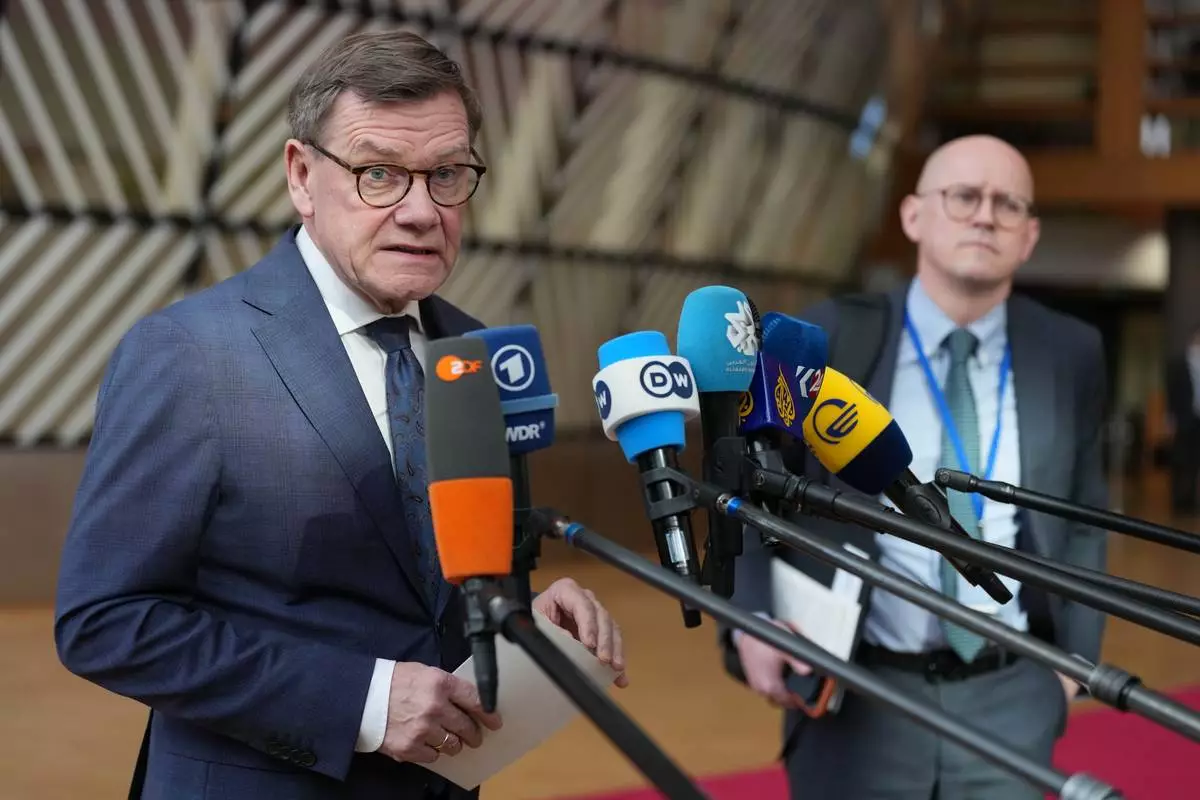
Germany's Foreign Minister Johann Wadephul speaks with the media as he arrives for a meeting of EU foreign ministers at the European Council building in Brussels, Monday, March 16, 2026. (AP Photo/Virginia Mayo)

European Union foreign policy chief Kaja Kallas speaks with the media as she arrives for a meeting of EU foreign ministers at the European Council building in Brussels, Monday, March 16, 2026. (AP Photo/Virginia Mayo)