China's first AI-powered interactive intelligent passenger clearance service system for seaports passed acceptance review and officially went into operation on Monday in Xiamen, east China's Fujian Province, which is expected to further facilitate the cross-Strait travel.
This system marks the first deep integration of AI technology into operations at a Chinese seaport. It enables real-time consistency verification of biometric data at stages of check-in, inspection, and boarding, as well as automatic filling of ship schedule information, thus establishing a new clearance model of intelligent declaration, intelligent verification, and information sharing.
At 10:00, the city's ferry terminal Wutong Wharf experienced a peak in passenger traffic, with ships departing from the dock every 30 minutes. Despite the rush, the border inspection ran to its full capacity to ensure efficient clearance and smooth boarding for passengers.
"I'm a frequent traveler between Kaohsiung and Xiamen for a long time, as I work in Xiamen. What I find the most convenient is that we don't need to carry any documents but to get through with just a face scan. For businesspeople like me, this system saves much time cost," said a Taiwan resident surnamed Hsieh.
At the passenger port, a large screen provides real-time data on passenger check-in progress, ticket validation, and boarding status, allowing duty officers to monitor the entire passenger flow for different ferries and time slots, enabling smarter on-site coordination and smoother transitions between each clearance process.
According to the Xiamen Gaoqi Border Inspection Station, the new system achieves seamless data exchange and information sharing among border inspection authorities, port operators, and shipping companies. By efficiently linking and automatically verifying passenger information at each stage, travelers can now move through the port without repeatedly swiping documents or tickets.
With the new system, inspection for a single ferry on the Xiamen-Kinmen route can be 40 percent more efficient. Even during peak travel times, the system supports simultaneous processing of multiple vessels, allowing passengers to pass through as soon as they arrive.
The "mini three links" refer to direct trade, mail and transport services between east Fujian Province and Kinmen and Matsu islands.
Over the past 25 years, the "mini three links" have evolved from irregular passenger ferries in the early days to 36 "bus-like" sailings every day with an abundant supply of tickets. It has become an important channel for personnel exchanges across the Taiwan Strait.
In 2025 alone, the "mini-three-links" route handled over 1.7 million passenger trips, including more than 1.3 million by Taiwan residents, the highest of any port on the Chinese mainland.
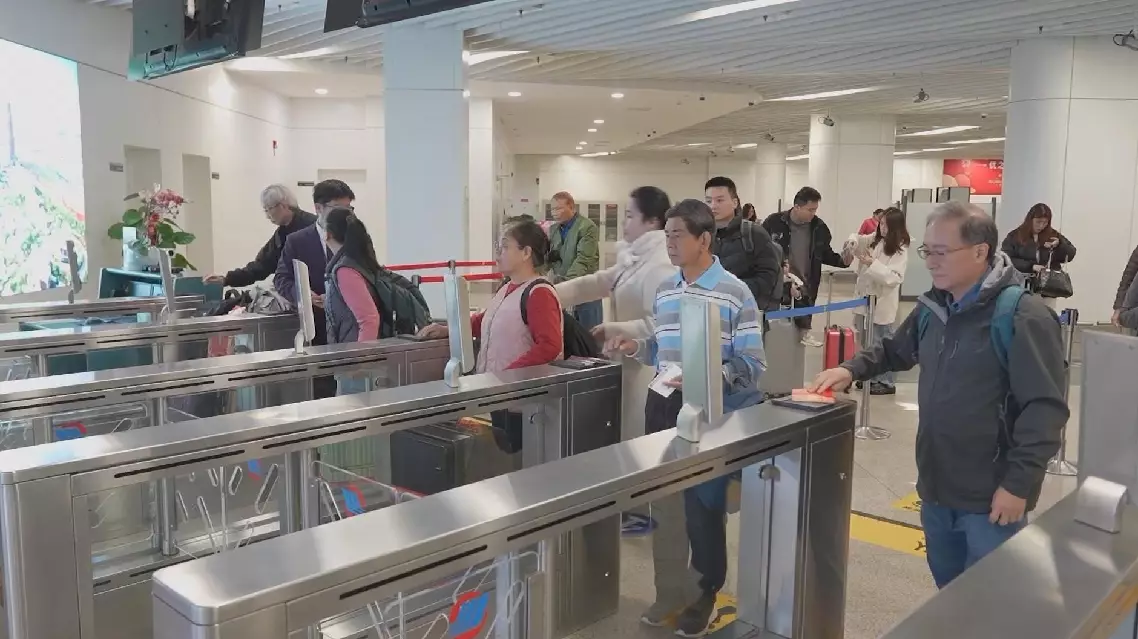
AI-powered intelligent customs clearance system launched in Xiamen