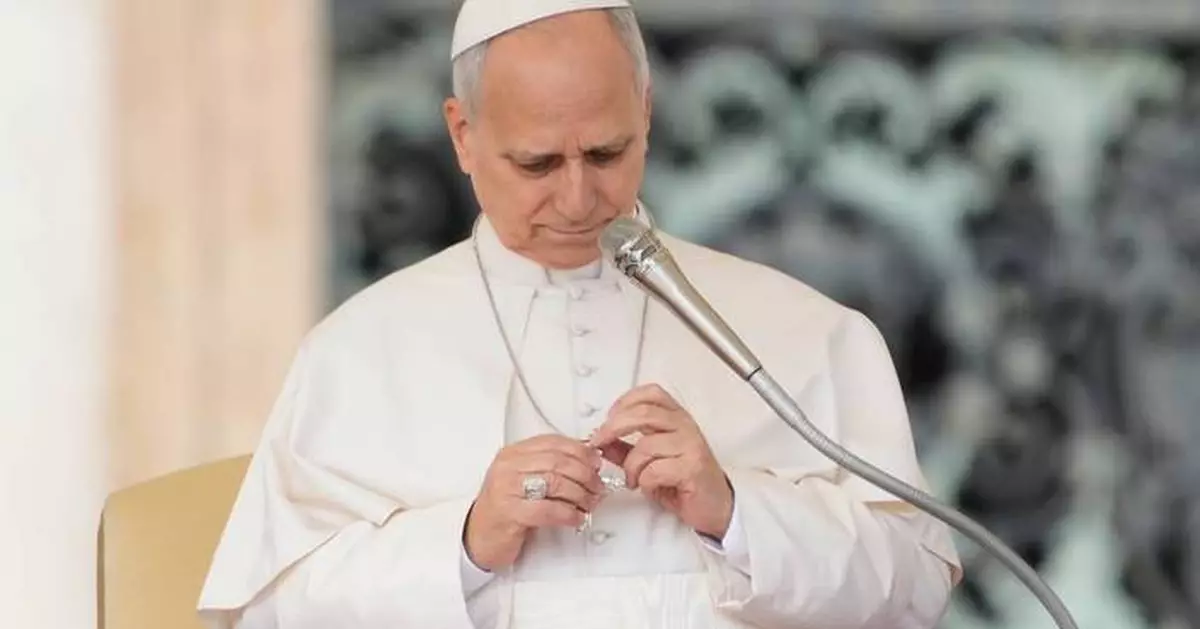
PHILADELPHIA (AP) — Pope Leo XIV will accept the Liberty Medal in Philadelphia on the eve of July 4 in a remote broadcast from Rome but won’t travel to the U.S. during its 250th birthday celebrations this year.
Leo, the first American pope, will instead spend the Fourth of July on the Sicilian island of Lampedusa, the arrival point for many desperate migrants trying to reach Europe from Africa.
He will be honored on Independence Mall on July 3 for “his lifelong work promoting religious liberty and freedom of conscience and expression around the world — ideals enshrined by America’s founders in the First Amendment,” the National Constitution Center said in a press release Monday.
The center awards the Liberty Medal each year to someone “of courage and conviction” who promotes liberty around the world. Past recipients include Ukrainian President Volodymyr Zelenskyy, Supreme Court Justice Ruth Bader Ginsburg and U.S. Rep. John Lewis, the late civil rights leader.
Leo, born Robert F. Prevost, was raised in Chicago and attended Villanova University near Philadelphia, graduating in 1977.
He has a busy year of travel planned, including a grand tour of Italy and trips to four African nations. The Vatican has confirmed he will not travel to the United States this year, despite an invitation from President Donald Trump.
Leo has followed in his predecessor’s footsteps in highlighting the plight of migrants around the world.
Pope Francis had made Lampedusa his first trip outside Rome after his 2013 election, when he celebrated Mass there on an altar made of shipwrecked migrant boats and denounced the “globalization of indifference”— a mantra that increased tensions with the first Trump administration.
Francis visited Philadelphia during a six-day trip across the U.S. in 2015.
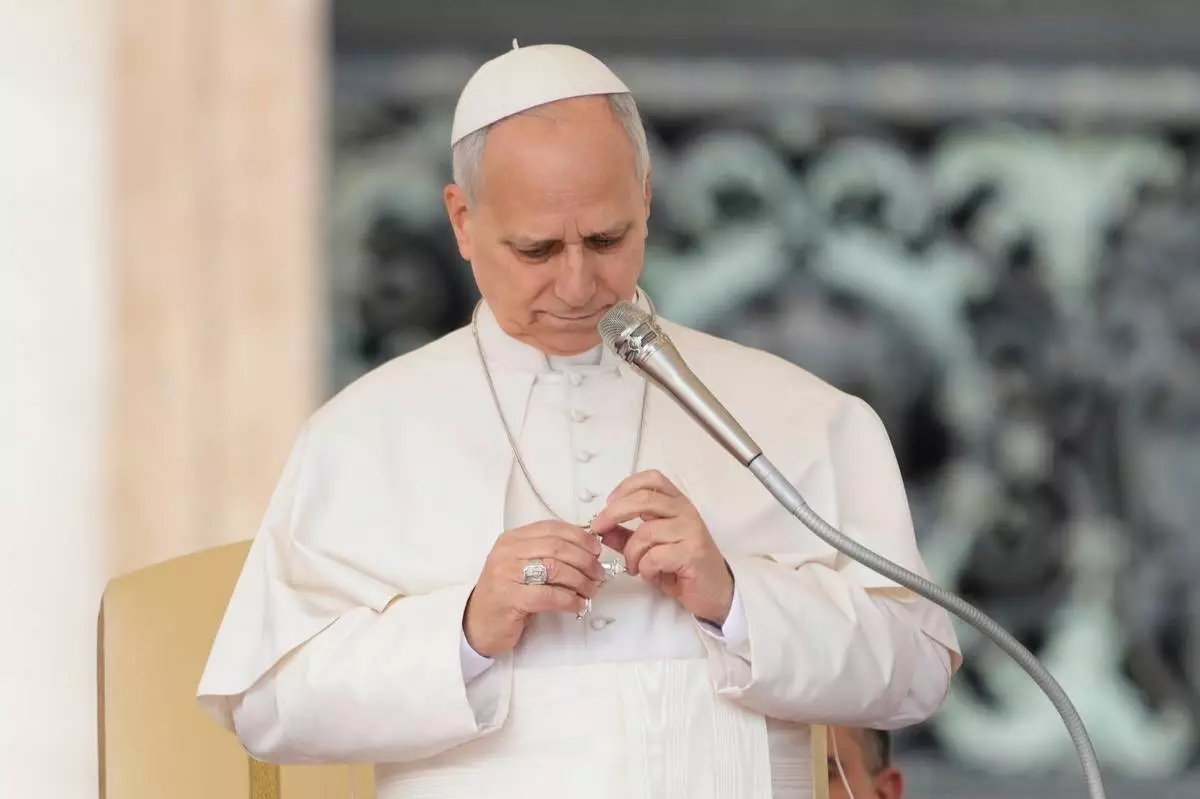
FILE - Pope Leo XIV holds his weekly general audience in St. Peter's Square at The Vatican, Wednesday, March 11, 2026. (AP Photo/Gregorio Borgia, File)
NEW YORK (AP) — Oil prices are down, and stocks are up Monday, though such moves have been quick to reverse since the war in Iran began.
The S&P 500 jumped 1% and was on track for its best day in five weeks. The Dow Jones Industrial Average was up 379 points, or 0.8%, as of 1:11 p.m. Eastern time, and the Nasdaq composite was 1.3% higher.
The driver for markets once again was the price of oil. A barrel of benchmark U.S. crude fell 3.4% to $95.36, easing some pressure off the economy after topping $102 earlier in the morning. Brent crude, the international standard, fell 0.9% to $102.20 per barrel after earlier getting as high as $106.50.
It's a reprieve, for now at least, after oil prices spiked from roughly $70 before the United States and Israel began their attacks on Iran. In response, Iran has nearly halted traffic through the narrow Strait of Hormuz, where a fifth of the world’s oil typically sails from the Persian Gulf to customers worldwide. That has oil producers cutting production because their crude has nowhere to go.
The worry in financial markets is that if the strait remains closed for a long time, it could keep enough oil off the market to drive inflation up to a debilitating level for the global economy.
President Donald Trump over the weekend demanded that other countries hurt by the closure of the Strait of Hormuz “take care of that passage” and said his country “will help - A LOT!”
European countries, meanwhile, want to know more about Trump’s plans for the war on Iran and when the conflict might end as they weighed his demand.
The U.S. stock market has a track record of bouncing back relatively quickly from military conflicts in the Middle East and elsewhere, as long as oil prices don’t stay too high for too long. Many professional investors are still expecting that to be the case again, which has helped keep U.S. stock prices near their record levels.
For all its dramatic swings, including several over the last two weeks that struck hour to hour, the S&P 500 is still only about 4% below its all-time high.
Escalations have been mounting quickly in the war, to be sure, but that could suggest “both sides are facing growing constraints that may prevent a long conflict,” according to Paul Christopher, head of global investment strategy at Wells Fargo Investment Institute.
On Wall Street, stocks of companies with big fuel bills helped lead the market thanks to falling oil prices. Norwegian Cruise Line Holdings steamed 4.6% higher, while United Airlines climbed 3.1% to trim their sharp losses for the year so far.
National Storage Affiliates leaped 29.4% after Public Storage said it would buy its 69 million rentable square feet in an all-stock deal valuing it at $10.5 billion. Public Storage fell 2.2%.
Dollar Tree rose 7.3% after reporting a stronger profit for the latest quarter than analysts expected, even as fewer shoppers visited its stores.
Nebius Group, a Dutch AI cloud company, saw its stock that trades in the United States leap 15.3% after announcing a five-year infrastructure contract with Meta Platforms that could be worth up to $27 billion. Shares in Meta rose 1.9%.
Nvidia, whose AI chips are powering much of the world's move into artificial-intelligence technology rose 2.5% and was the strongest single force lifting the S&P 500. Nvidia's CEO, Jensen Huang, is set to give a speech in the afternoon where he could announce new products.
In stock markets abroad, indexes rose in Europe, including a 0.5% return for Germany's DAX, following a mixed finish in Asia.
Stocks jumped 1.4% in Hong Kong but slipped 0.3% in Shanghai.
In the bond market, Treasury yields eased as falling oil prices took some pressure off inflation worries. A report showing a weakening of manufacturing activity in New York state also weighed on yields.
The yield on the 10-year Treasury fell to 4.24% from 4.28% late Friday.
Yields, though, are still higher than they were before the war, when the 10-year Treasury yield was at just 3.97%. Traders have pushed back their expectations for when the Federal Reserve could resume its cuts to interest rates because of the spike in oil prices caused by the war.
Such cuts would give the economy and job market a boost, and they're something Trump has angrily been calling for, but they would worsen inflation. Traders see virtually no chance the Fed will announce a cut to rates when its next meeting concludes on Wednesday, according to data from CME Group.
AP Business Writers Matt Ott and Elaine Kurtenbach contributed.
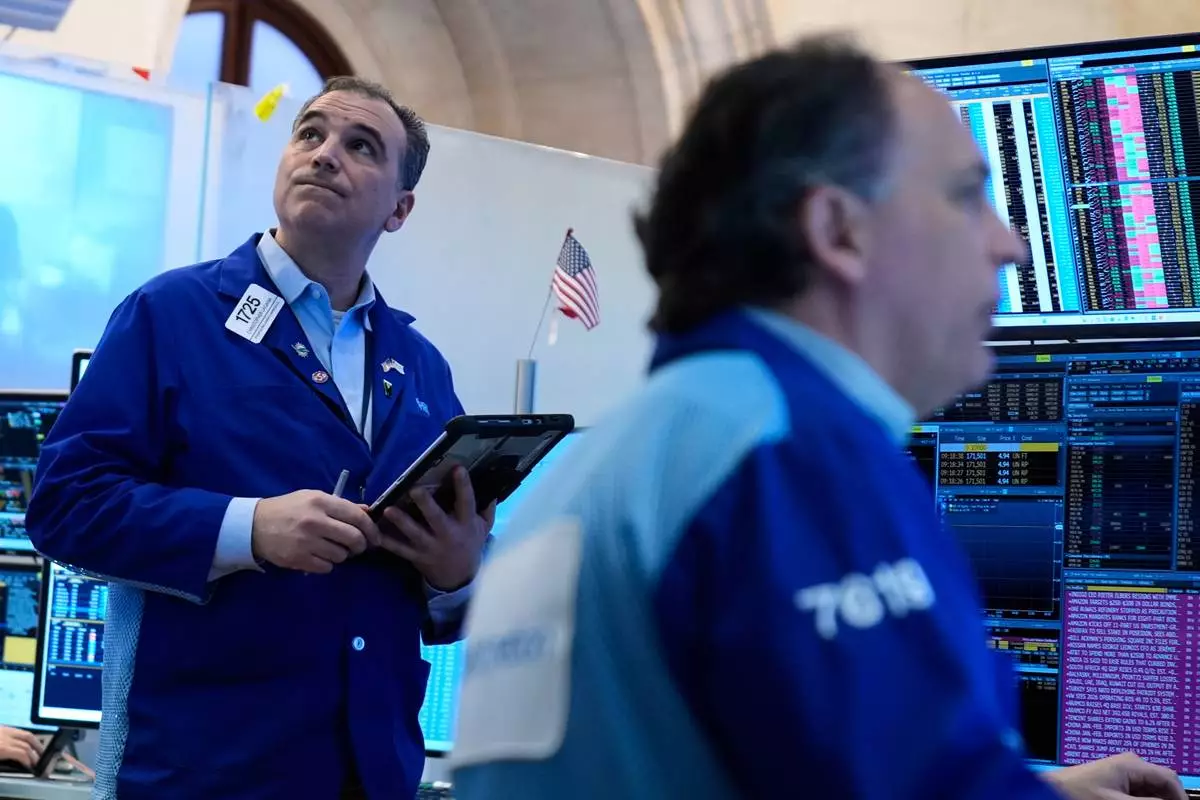
Christopher Lagana works on the floor at the New York Stock Exchange in New York, Tuesday, March 10, 2026. (AP Photo/Seth Wenig)
Screens display financial information on the floor at the New York Stock Exchange in New York, Tuesday, March 10, 2026. (AP Photo/Seth Wenig)
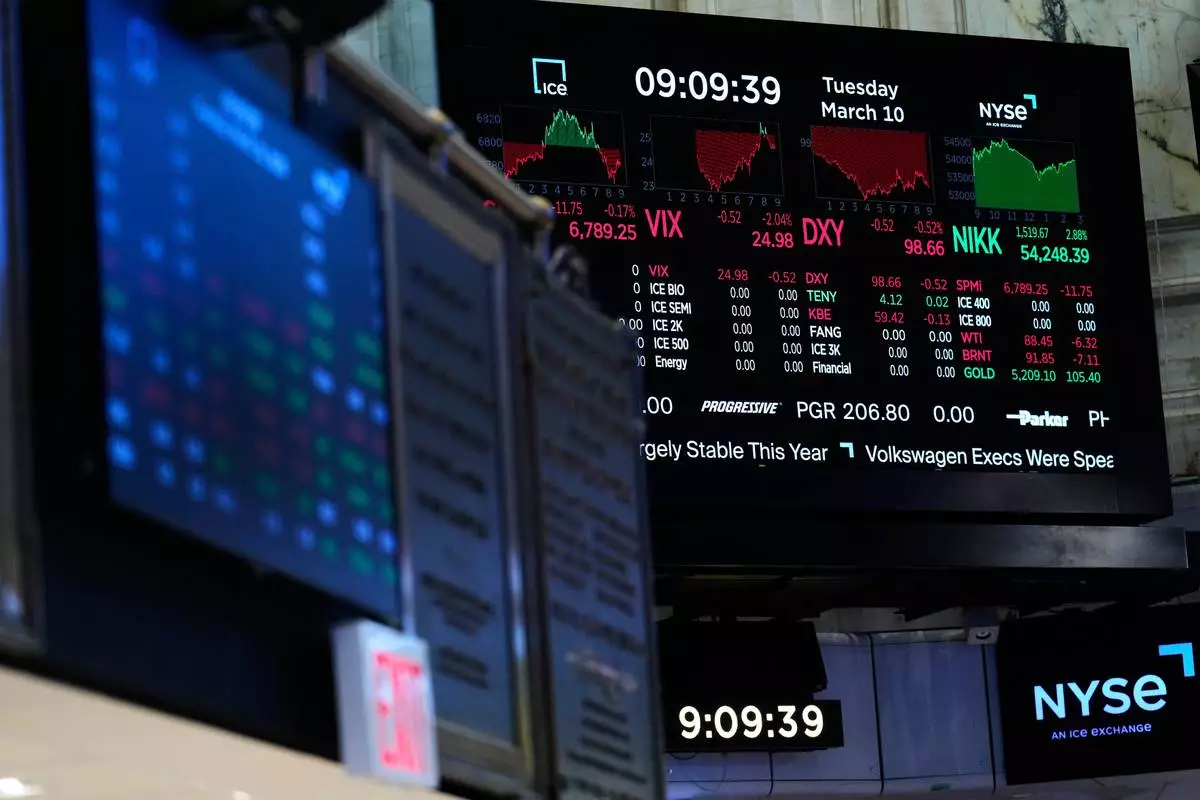
Screens display financial information on the floor at the New York Stock Exchange in New York, Tuesday, March 10, 2026. (AP Photo/Seth Wenig)
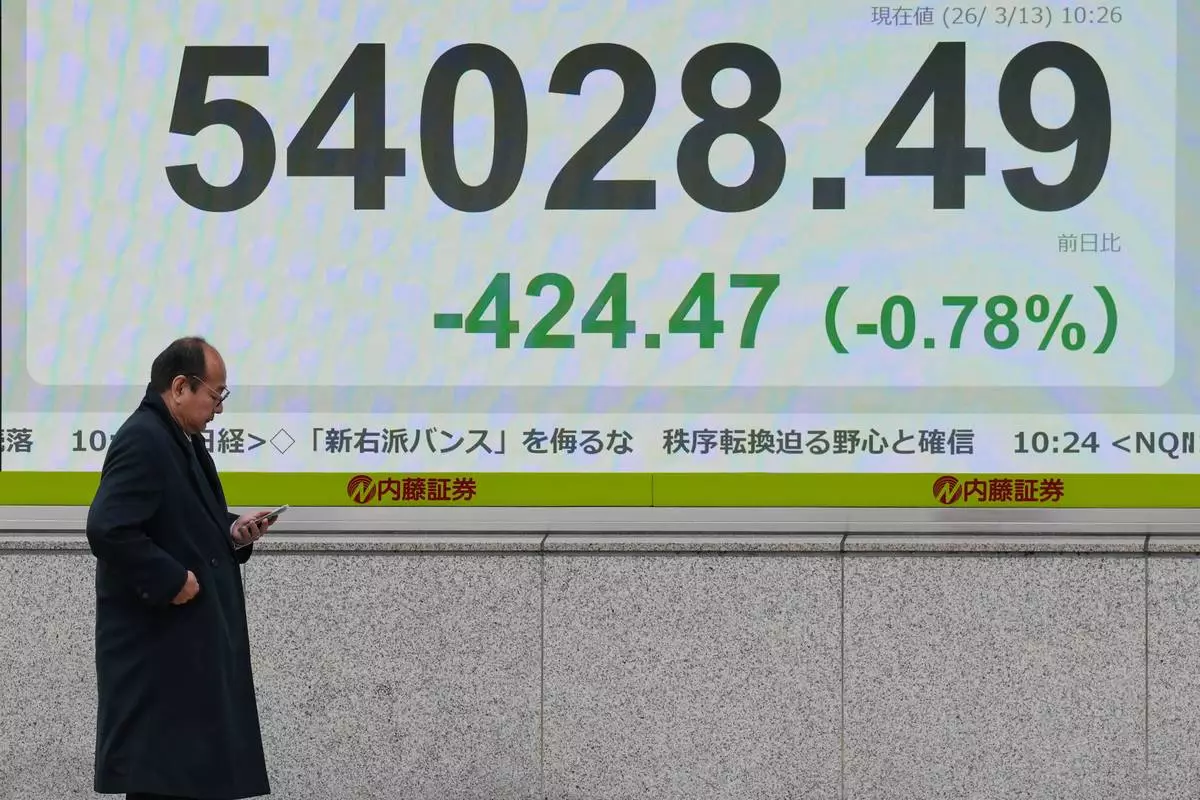
A person walks in front of an electronic stock board showing Japan's Nikkei index at a securities firm Friday, March 13, 2026, in Tokyo. (AP Photo/Eugene Hoshiko)
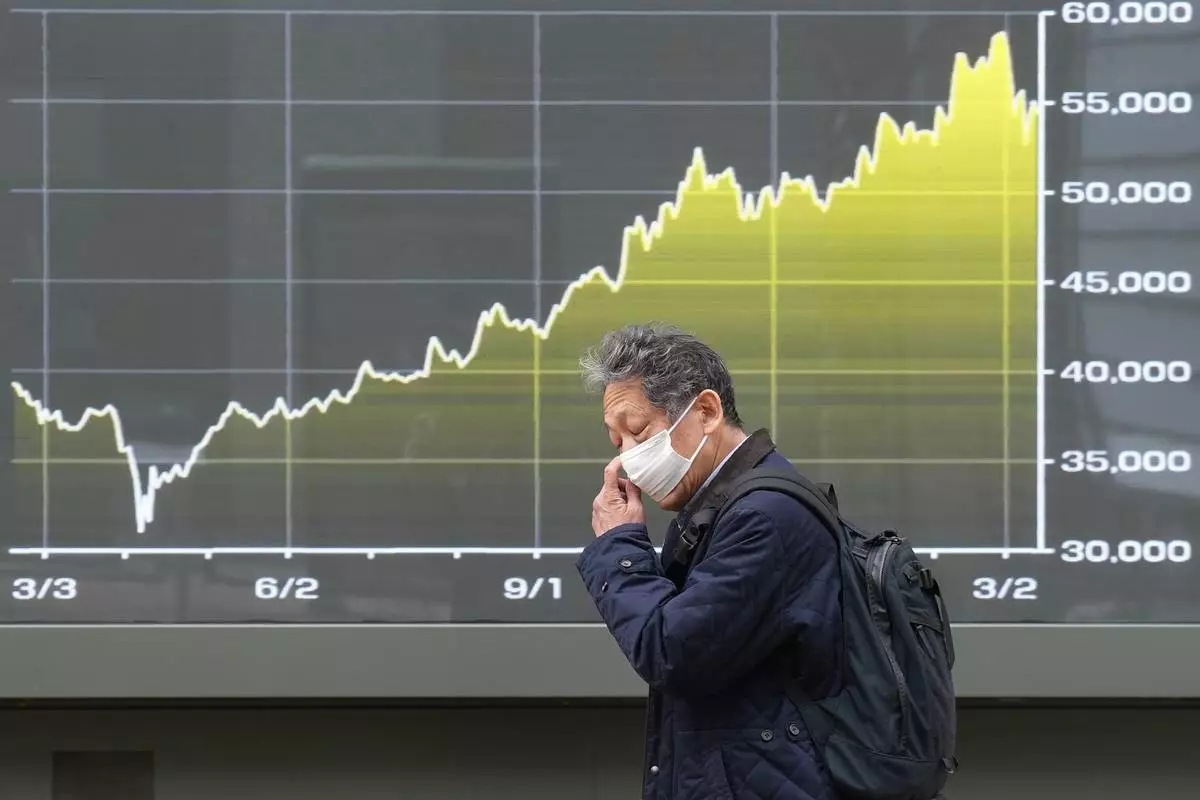
A person walks in front of an electronic stock board showing Japan's Nikkei index at a securities firm Friday, March 13, 2026, in Tokyo. (AP Photo/Eugene Hoshiko)
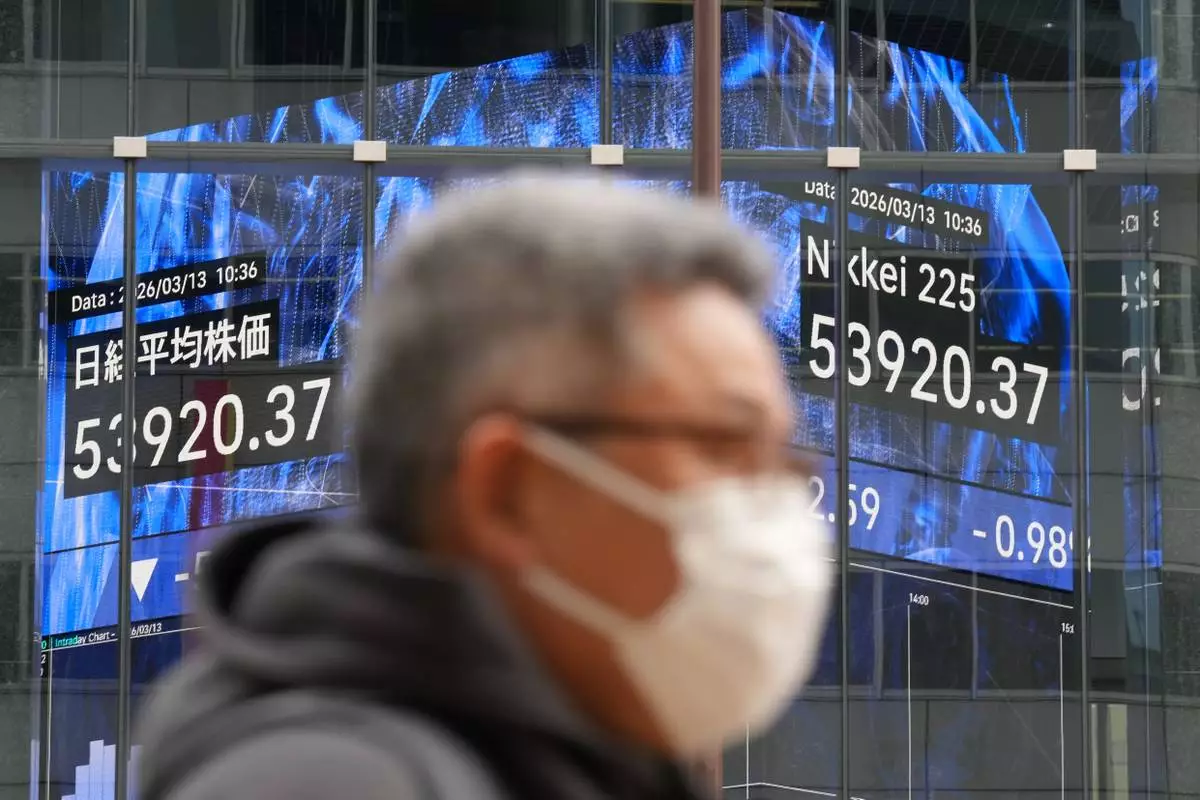
A person walks in front of an electronic stock board showing Japan's Nikkei index at a securities firm Friday, March 13, 2026, in Tokyo. (AP Photo/Eugene Hoshiko)
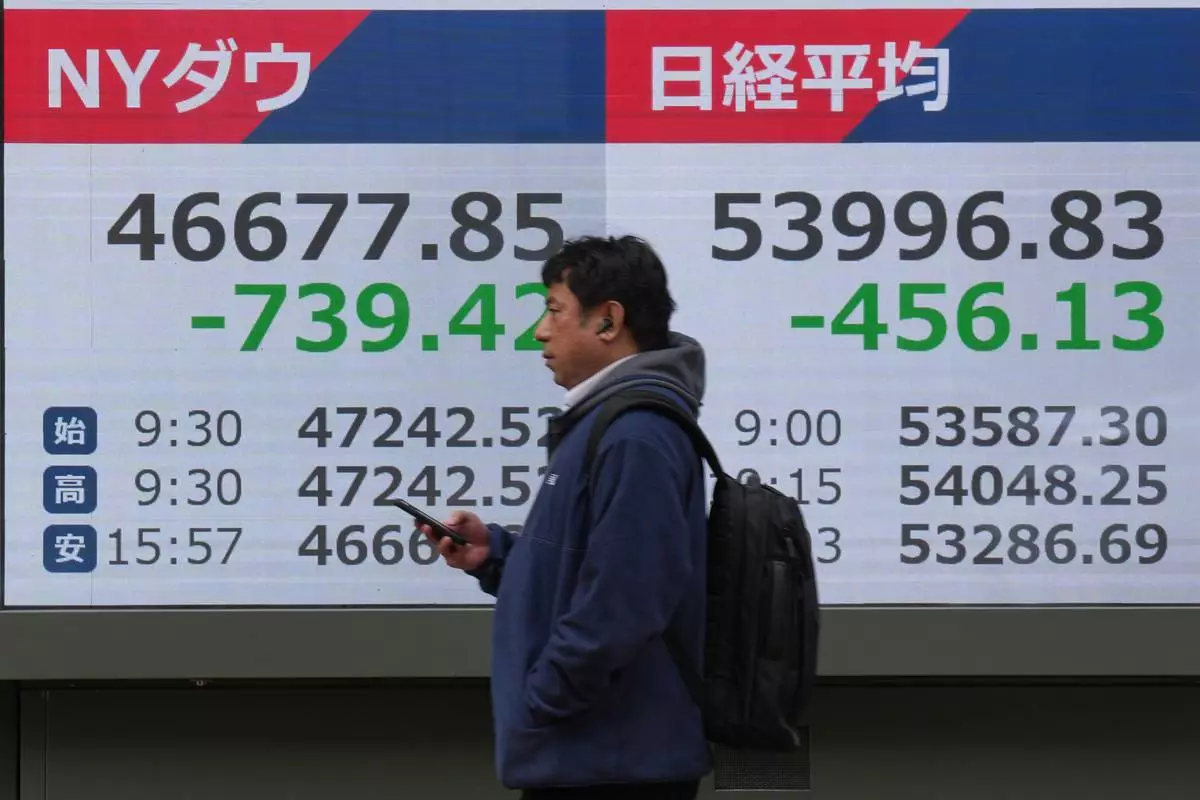
A person walks in front of an electronic stock board showing Japan's Nikkei index at a securities firm Friday, March 13, 2026, in Tokyo. (AP Photo/Eugene Hoshiko)