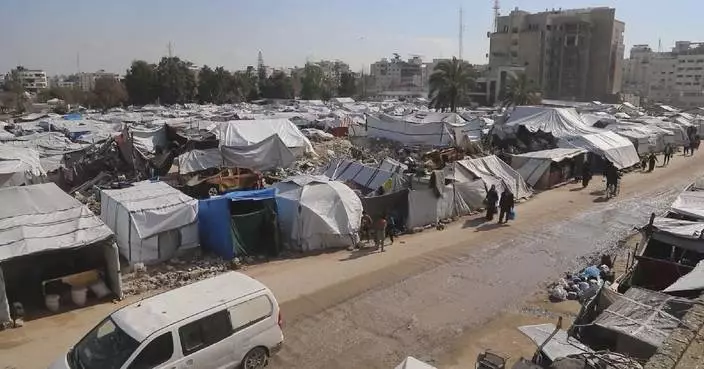
Medical supplies have rapidly dwindled in the Gaza Strip after Israel closed all crossings amid escalating tensions with Iran, leaving hospitals and patients struggling to obtain essential medicines.
Israel announced on Feb. 28 the closure of all crossings into the Gaza Strip, including the Rafah land crossing, until further notice, citing security concerns. The move halted the delivery of humanitarian aid into Gaza.
The disruption of supply routes has rapidly depleted medicine stocks across the enclave, with many commonly used drugs beginning to run out, placing mounting pressure on hospitals and patients.
Some widely used drugs have already run out at Al-Awda Hospital in central Gaza as the staff there are checking remaining supplies.
"This is your medicine, but now it's out of stock," a staff member at the hospital's pharmacy told a patient.
"This type of medicine isn't available at the hospital. I will try to find it elsewhere," said the patient.
The hospital said that more than 85 percent of medical consumables is now out of stock. Painkillers, antibiotics, surgical and anesthetic drugs, as well as diagnostic reagents, are all in severe shortage. Some commonly used medications for chronic diseases such as hypertension and diabetes have also become difficult to obtain.
"Every day the warehouse informs us that a certain medicine has run out, so we keep searching for alternatives. Patients are also looking everywhere for medicines, but often they still cannot find them," said the head of the medicine warehouse at Al-Awda Hospital.

Crossing closures leave hospitals in Gaza Strip facing shortage of essential medicines

Crossing closures leave hospitals in Gaza Strip facing shortage of essential medicines
Continued surges in global oil prices, a result of the ongoing U.S.-Israeli military strikes against Iran, will put severe pressure on Japan's heavily energy-import-dependent economy, a Japanese scholar warned.
The warning came as the Japanese government started a historic oil reserve release on Monday to ease the impact of volatile international oil prices. The release totaled around 80 million barrels, equal to roughly 45 days of Japan's domestic oil consumption, marking the largest-ever drawdown of the country's oil reserves.
Tomohiko Nakamura, a professor of the Faculty of Economics at Kobe International University, said that while the reserve release will have a limited effect in curbing oil price hikes, protracted geopolitical tensions in the Middle East will undermine the policy's impact given Japan's finite oil stockpiles.
"I believe the release of oil reserves will have a certain effect in curbing oil price hikes. However, if the tensions in the Middle East become protracted, that will pose a problem as Japan's oil reserves are not unlimited. We are facing a double whammy: on one hand, crude oil prices are rising, and on the other, the yen's depreciation is driving up import costs. The impact of soaring crude prices is being felt not just in Japan, but across the world. For example, the power sector, where a large share of electricity generation still relies on oil, will see higher generation costs, and as a result, nearly all industries will be affected. These unforeseen impacts may gradually become apparent over the next month," he said.
Beyond the immediate macroeconomic pressures, Nakamura expressed particular concern for Japan's small and medium-sized enterprises (SMEs), which form the backbone of the country's economic activity.
"The biggest impact is the sharp rise in raw material and fuel costs. While large corporations can reduce costs through bulk purchasing, SMEs find it difficult to achieve the same. As a result, the operating pressures on SMEs will grow increasingly severe, leading to a probable rise in the number of businesses exiting the market. The trend of declining SME numbers could accelerate further," he said.

Soaring oil prices put severe pressure on Japan's economy: Japanese scholar