BARCELONA, Spain--(BUSINESS WIRE)--Mar 18, 2026--
Ferrer has been recognised by Ethisphere, a global leader in defining and advancing standards of ethical business practices, as one of the World’s Most Ethical Companies® 2026. Ferrer is the only Spanish pharmaceutical company to receive this recognition in 2026. This year, only 138 organisations worldwide, from 17 countries and 40 different industries, have achieved this distinction. One of the most prestigious international rankings, it recognizes organisations that have the highest standards of business integrity and responsible corporate practices.
This press release features multimedia. View the full release here: https://www.businesswire.com/news/home/20260318851117/en/
By entering this ranking, the company, which holds ISO 37001 certification for anti-bribery and anti-corruption management systems and was recognised last year by Ethisphere with the U.S. Compliance Leader Verification™, further consolidates its commitment to corporate ethics. Ferrer continues embedding its ethical culture into its corporate decision-making and business activities.
“At Ferrer, ethics and responsibility are a critical part of our purpose to use business to fight for social justice. Being included among Ethisphere’s 138 most ethical companies in the world reinforces our conviction that generating real social change through our business activity is essential. Above all, this recognition reflects the daily commitment of everyone at Ferrer to build a company guided by integrity, respect and a genuine desire to contribute to a fairer and more sustainable society,” said Mario Rovirosa, CEO of Ferrer.
Meritxell Casas, Ferrer’s Chief Legal, IP & Compliance Officer, highlighted that “this recognition highlights an approach that defines Ferrer. Our ethics are reflected in how we go beyond regulatory compliance when making decisions and relating to others with rigour, coherence and integrity. We have a strong ethical framework across the company that guides our internal and external conduct and reinforces a way of doing business based on responsibility and transparency.”
Assessment process
To compile the World’s Most Ethical Companies® list, Ethisphere evaluates candidate companies using its Ethics Quotient® methodology, based on more than 240 documented proof points related to integrity practices. This analysis covers key pillars such as corporate governance, programme resources and structure, internal policies, and training and communication strategies. It also assesses risk management and audits, investigation processes and disciplinary measures, ethical culture, third-party risk management, and commitment to social and environmental impact.
These data are then analysed in depth by a broad panel of experts, who review and validate the information provided by each candidate company. This rigorous process establishes a benchmark that defines and aligns best practices in ethics and compliance across organisations worldwide and across all sectors.
About Ferrer
At Ferrer we use business to fight for social justice. We have long been a company that looks to do things differently; instead of maximizing shareholder returns, we reinvest around 50% of our profit in initiatives that give back to society. Back where it belongs. We go beyond compliance and are guided by the highest standards of sustainability, ethics and integrity. As such, we are the highest-rated B Corp pharma company in the world.
Founded in Barcelona in 1959, Ferrer offers transformative solutions for debilitating life-threatening diseases in more than one hundred countries. In line with our purpose, we have an increasing focus on pulmonary vascular and interstitial lung diseases and rare neurological diseases. Our 1,700-strong team is driven by the clear conviction the our business is not an end in itself, but a way to change lives.
We are Ferrer. Ferrer for good.
https://www.ferrer.com/es

Ferrer team members participating in an outdoor volunteer activity, reflecting the company’s ongoing commitment to ethical practices and positive social impact as recognized by Ethisphere’s as one of the World’s Most Ethical Companies® 2026.
Senegal isn't giving up its Africa Cup of Nations title without a legal fight, with the country's soccer federation saying it will appeal the “unfair, unprecedented, and unacceptable decision” to strip the team of its victory in a chaotic final against host Morocco.
The Confederation of African Football’s appeals board on Tuesday ruled Senegal forfeited the final in January by walking off the field and turned its 1-0 win in extra time into a 3-0 default win for Morocco.
The Senegalese Football Federation (FSF) said the decision “discredits African football,” and that it will appeal “as soon as possible” to the Court of Arbitration for Sport in Lausanne, Switzerland, a process that would typically take a year to deliver a verdict.
“The FSF reaffirms its unwavering commitment to the values of integrity and sporting justice and will keep the public informed of developments in this matter,” the federation said in a statement.
The Jan. 18 final descended into chaos when Senegal’s players left the field in stoppage time after having a late goal ruled out before Morocco was awarded a potentially game-deciding penalty. There were scuffles between rival players while furious Senegal fans tried to storm the field where they were battling with stewards, before Senegal coach Pape Thiaw led most of his players off. It was unclear if the game could continue.
But they returned after around 10 minutes and play resumed with Morocco star Brahim Díaz having his “Panenka”-style penalty saved by Édouard Mendy. Senegal’s Pape Gueye scored the only goal in extra time.
CAF in its decision referred to Articles 82 and 84 of its Africa Cup regulations. Article 82 says if a team “refuses to play or leaves the ground before the regular end of the match without the authorization of the referee” it loses the game and is eliminated from the competition. Article 84 awards the opposing team a 3-0 win.
However, Law 5 of the International Football Association Board (IFAB), which sets the rules for the game globally, gives “full authority” to referees to determine what happens in a match.
“The decisions of the referee regarding facts connected with play, including whether or not a goal is scored and the result of the match, are final. The decisions of the referee, and all other match officials, must always be respected,” according to Law 5.2.
CAF in January imposed fines of more than $1 million for both the Senegalese and Moroccan federations. It banned Thiaw for five Africa games for bringing the game into disrepute. But it did not interfere with the outcome of the game.
On Tuesday, it reduced Morocco player Ismaël Saibari’s three-game ban to one match and scrapped his $100,000 fine for unsporting behavior, while it also reduced fines that were imposed against the Moroccan federation for the conduct of its ball boys from $200,000 to $50,000. Another fine was also reduced.
The CAF decision was met with disbelief and dismay in Senegal.
“To take back a trophy two months after the final was played is just ridiculous,” Souleymane Ba, a university student, told The Associated Press in Senegal's capital Dakar. “The Senegalese players won medals, millions of francs (hundreds of thousands of dollars) in bonuses for winning the cup, and paraded the trophy through the country. And now CAF wants to take all that away? How do they even expect to do that?”
Pape Sarr, a shop owner, said while he is shocked by the ruling, he is confident the appeal to CAS will be successful.
“The referee did not forfeit the match after the players left, and validated the result, so that should be the end of the story,” Sarr said.
Taxi driver Abdoulaye Diouf had a similar view.
“The whole world saw that we won legitimately," Diouf said. "Senegal are the champions on the field. Morocco can be the champions in the courthouse if they want.”
Morocco’s embassy in Dakar called on Moroccans in Senegal to “demonstrate restraint, vigilance, and a sense of responsibility.”
“It is important to recall that, in all circumstances, it is only a match, the outcome of which should never justify any form of escalation or excessive remarks between brotherly peoples," the embassy said.
Streets in the capital were mostly calm, also because of Ramadan.
Associated Press reporter Mark Banchereau contributed from Dakar, Senegal.
AP soccer: https://apnews.com/hub/soccer
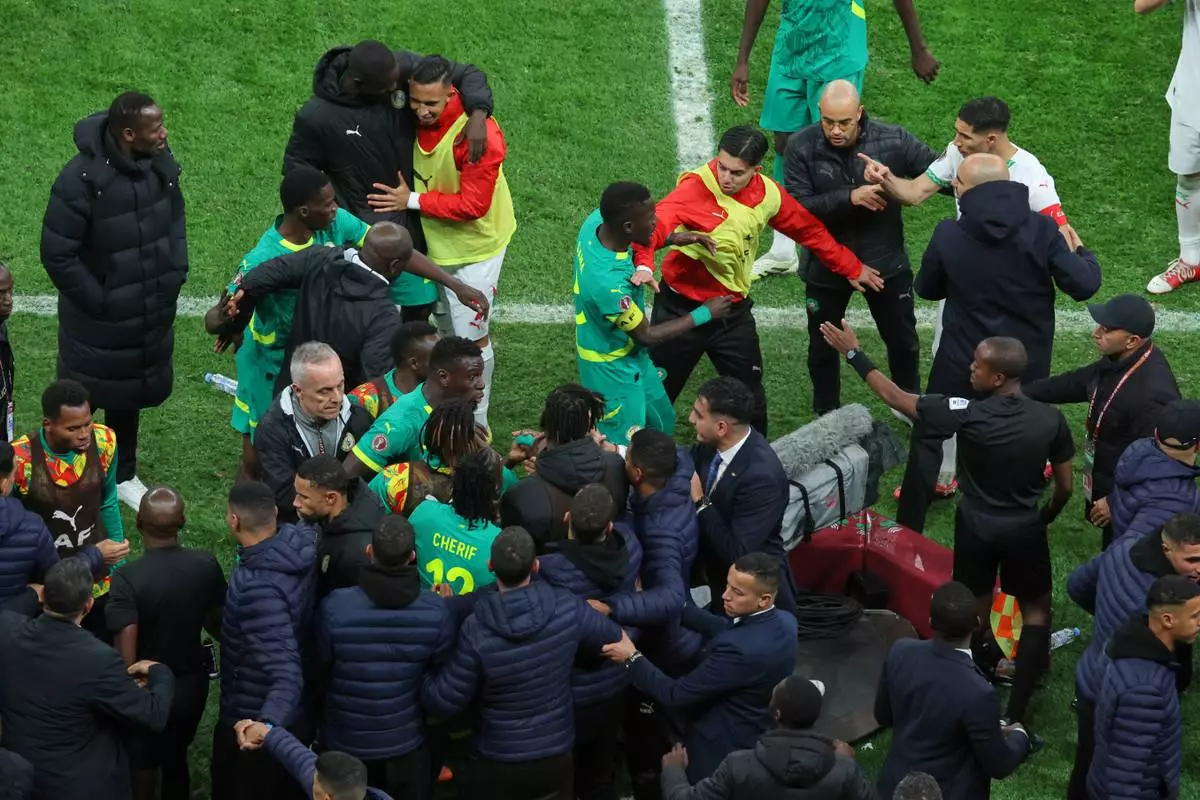
FILE - Players from both sides clash after a controversial penalty was awarded to Morocco late on during the Africa Cup of Nations final soccer match between Senegal and Morocco in Rabat, Morocco, Sunday, Jan. 18, 2026. (AP Photo/Youssef Loulidi, File)
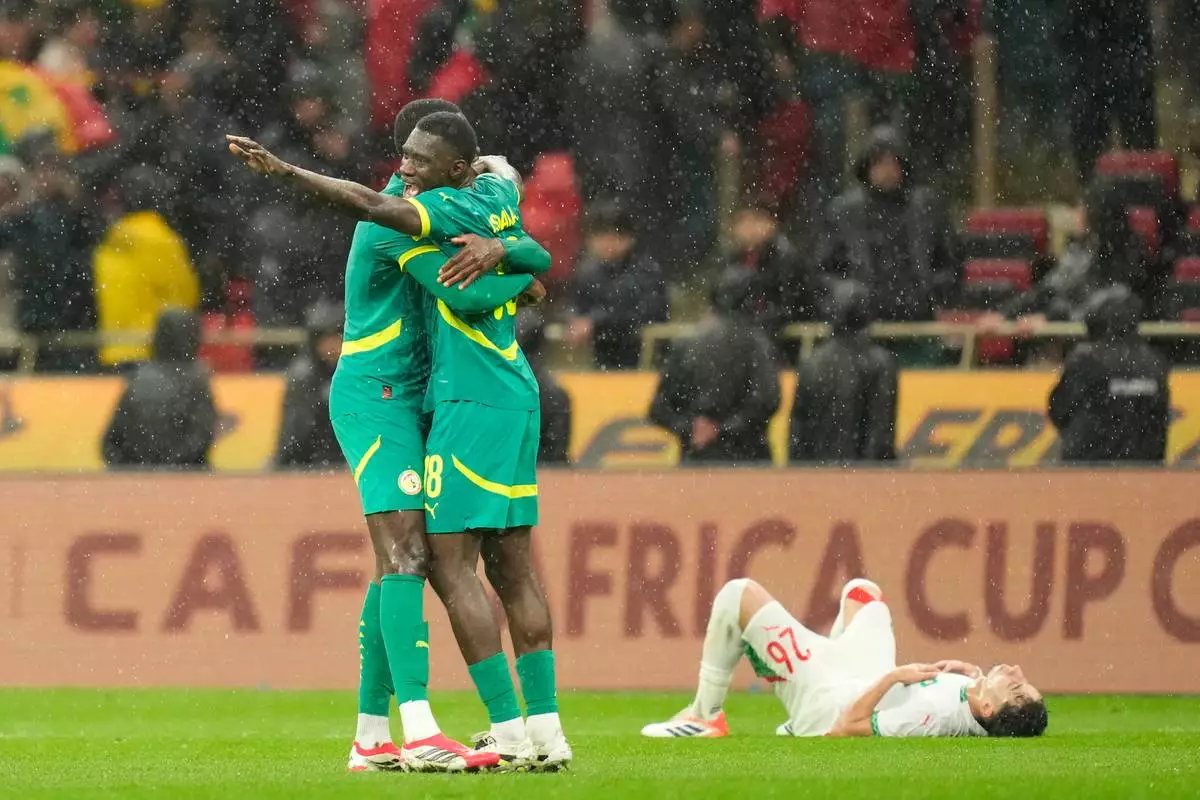
FILE - Sebegalese players celebrate after winning the Africa Cup of Nations final soccer match between Senegal and Morocco, in Rabat, Morocco, Sunday, Jan. 18, 2026. (AP Photo/Mosa'ab Elshamy, File)
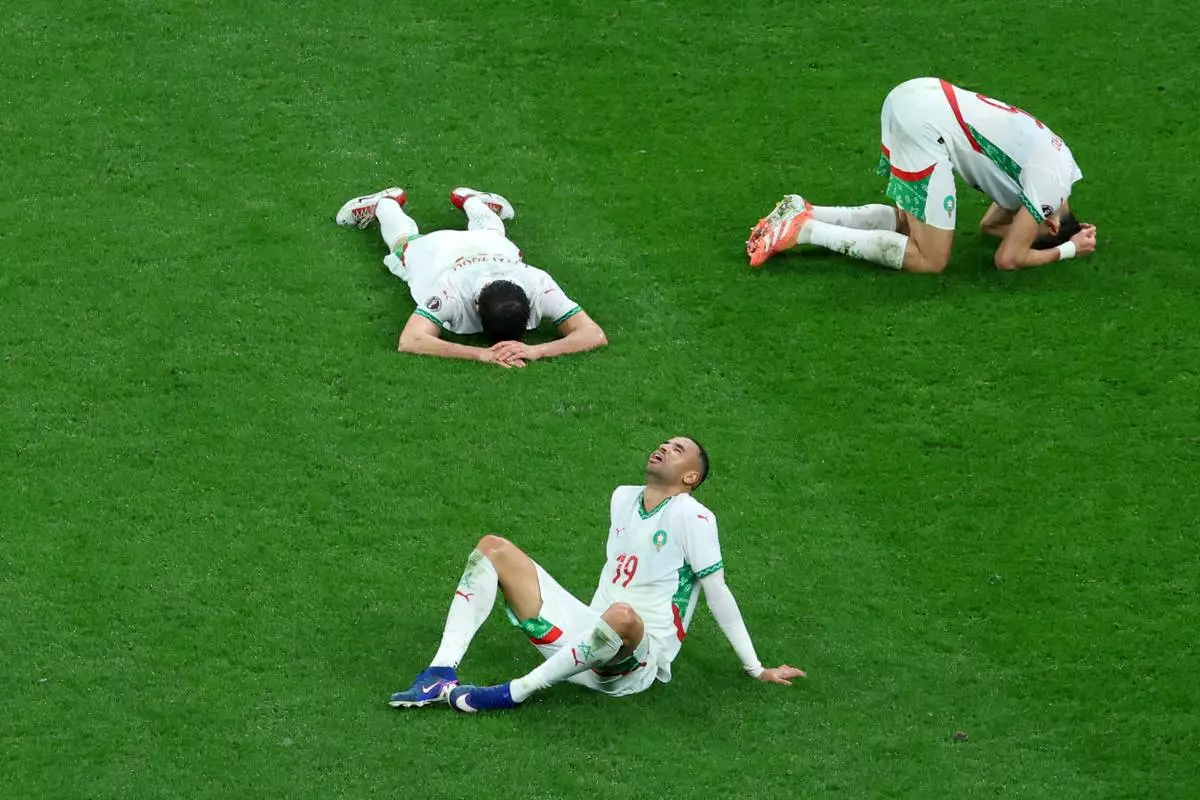
FILE - Morocco players react after losing the Africa Cup of Nations final soccer match between Senegal and Morocco in Rabat, Morocco, Sunday, Jan. 18, 2026. (AP Photo/Youssef Loulidi, File)
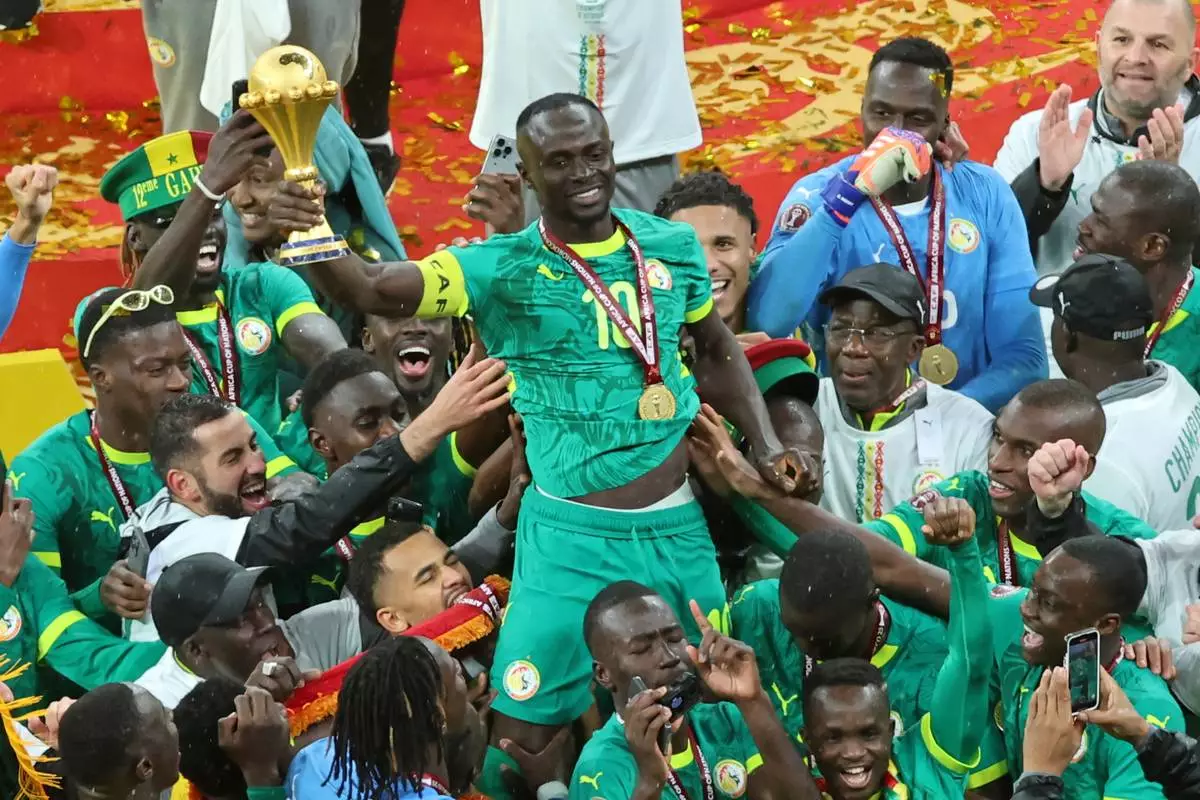
FILE - Senegal's Sadio Mane holds the trophy aloft as he celebrates with teammates after winning the Africa Cup of Nations final soccer match between Senegal and Morocco in Rabat, Morocco, Sunday, Jan. 18, 2026. (AP Photo/Youssef Loulidi, File)