AACHEN, Germany--(BUSINESS WIRE)--Mar 18, 2026--
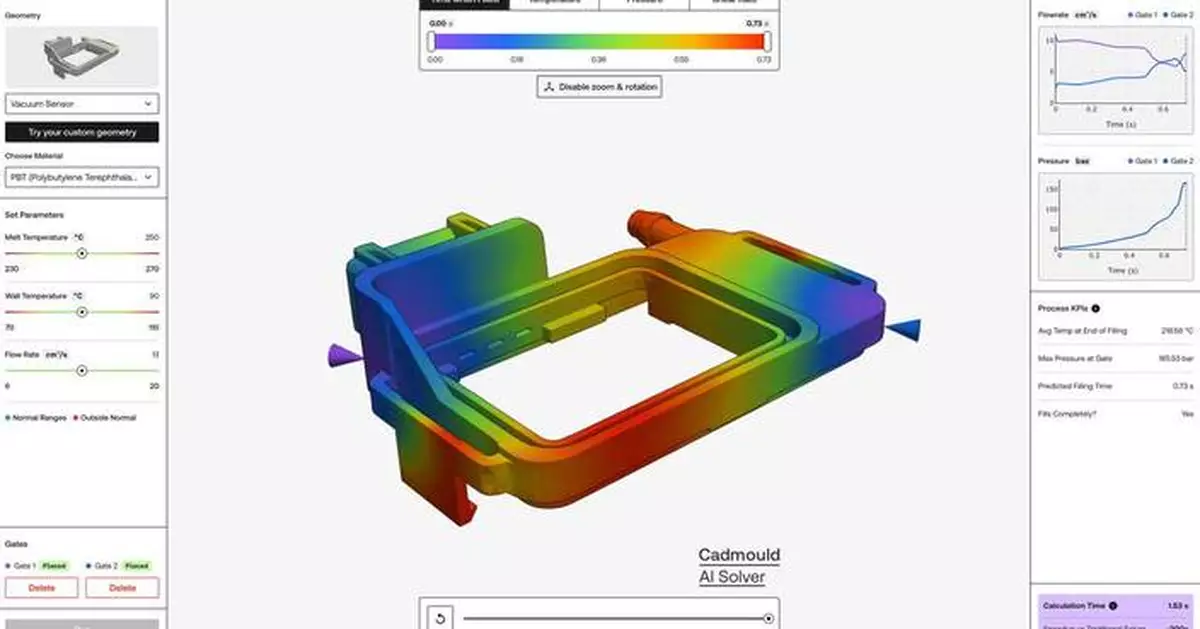
SIMCON today announced the launch of the Cadmould AI Solver, the world’s first Large Engineering Model for injection moulding. Co-developed with Emmi AI, the new transformer-based architecture delivers simulation results up to 1000 times faster than traditional numerical solvers.
This press release features multimedia. View the full release here: https://www.businesswire.com/news/home/20260318680159/en/
Historically, lengthy computation times have acted as a bottleneck, limiting the number of design variations engineers can practically explore during the development process. The Cadmould AI Solver shatters this barrier by providing engineers with instant feedback on filling pattern, pressure, and temperature in seconds. What once required hours per simulation now takes seconds, enabling engineers to explore orders of magnitude more design alternatives during early development.
Crucially, the new AI technology is designed to complement, not replace, traditional numerical solvers. In this new paradigm, engineers use the Cadmould AI Solver in the early stages to rapidly explore the solution space and narrow down the optimal process window. Once the ideal design is identified, the classical numerical solver within Cadmould Flex is used to perform the ultimate, highest-precision validation required for final manufacturing sign-off.
“For decades, the industry has accepted that high-fidelity simulation requires hours of computation,” said Bastiaan Oud, CEO at SIMCON. “By introducing the Cadmould AI Solver, we are giving engineers a high-speed compass to use during the iterative design phase, while Cadmould Flex remains the definitive map for final validation. Together, they create an end-to-end workflow that is both incredibly fast and reliable.”
Built on a transformer-based neural network architecture and trained on hundreds of terabytes of data, the AI Solver demonstrates true geometric generalization. It accurately predicts complex physical behaviours and filling patterns for new, unseen part topologies without requiring model retraining.
To mark the milestone, SIMCON has launched a free, interactive research preview accessible directly via web browser.
Simultaneously, the company is inviting interested practitioners to apply for its Partner Program. Designed for industrial enterprises, the program gives partners priority access to upcoming capabilities - such as shrinkage and warpage prediction - as they become available. Partners benchmark the AI Solver against their own geometries in close exchange with SIMCON's engineering team, and their feedback directly informs the product roadmap.
About SIMCON
SIMCON, founded in Germany, is a software company specializing in injection moulding simulation and optimization solutions. For more than 30 years, SIMCON has been supporting plastics injection moulding leaders globally. SIMCON works with thousands of customers from industries such as the automotive, aerospace, consumer electronics and medical sectors, to improve the cost, quality and speed of their plastics injection moulding projects.
About EMMI AI
Emmi AI is building the physics simulation layer for industrial engineering. Founded in 2024, the company develops universally applicable, AI-driven physics simulation Large Engineering Models for manufacturing in aerospace, energy, semiconductors, automotive, and chemicals. Emmi AI is bringing faster iteration into production engineering workflows across Fluid Dynamics, Multiphysics, and Solid State Mechanics.
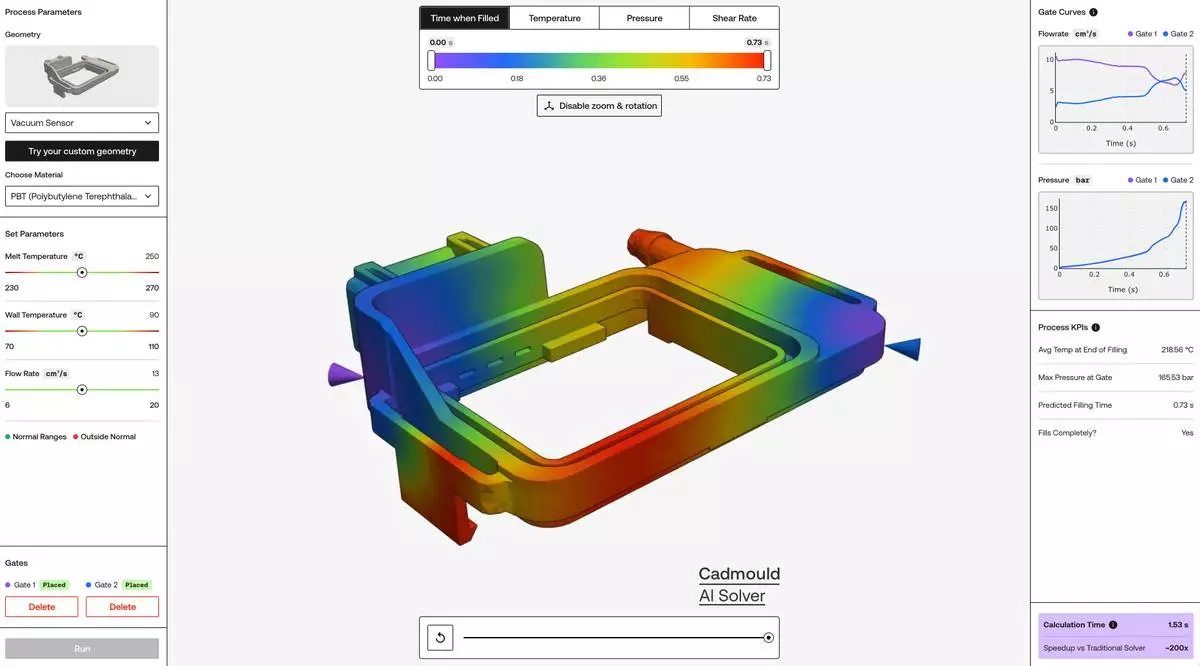
SIMCON’s new Cadmould AI Solver delivers injection molding simulation results in seconds. By removing lengthy computation times, the tool enables engineers to dynamically explore thousands of design and process variations in a single day.
NEW YORK (AP) — U.S. stocks are sinking Wednesday after another climb for oil prices raised worries about inflation, which may have been primed to worsen even before the war with Iran began.
The S&P 500 fell 0.6% and was on track for its first loss this week. The Dow Jones Industrial Average was down 380 points, or 0.8%, as of 12:55 p.m. Eastern time, and the Nasdaq composite was 0.6% lower.
Stocks fell under the pressure of a 4.7% climb for the price of a barrel of Brent crude, the international standard, to $108.27. Benchmark U.S. oil rose 1.5% to $97.61 per barrel.
Oil and natural gas prices have been spiking since the war began because of disruptions to the Persian Gulf's energy industry. Iran’s state television said Wednesday that the Islamic Republic would be attacking oil and gas infrastructure in Qatar, Saudi Arabia and the United Arab Emirates after an attack on facilities associated with its offshore South Pars natural gas field.
If the disruptions keep oil and gas prices high for long, they could send a debilitating wave of inflation crashing into the global economy.
A report released Wednesday morning showed that inflation pressures were already worsening before the war began. It said inflation at the U.S. wholesale level unexpectedly accelerated last month to 3.4%, and those cost increases could hit U.S. households if producers pass them all along.
Such numbers strengthened Wall Street’s consensus that the Federal Reserve will announce that it’s keeping interest rates steady this afternoon following its latest meeting, instead of resuming its cuts.
Cuts would give the job market and investment prices a boost, and President Donald Trump has been angrily calling for them. But lower interest rates would also worsen inflation.
More important for Wall Street is whether Fed officials will say they still think one cut to rates may be possible over the course of 2026. That’s what the median member said in December, the last time Fed officials published such expectations.
The Iran war has made it difficult for anyone to make economic forecasts. Gasoline prices are soaring and will push up inflation for at least the next month or two. The average price for a gallon of gasoline spiked again overnight, reaching $3.84. It was well under $3 last month.
Global oil flows remain largely constrained, ING Bank analysts Warren Patterson and Ewa Manthey wrote in a research note on Wednesday, even as hopes were growing that Iran might be allowing more vessels through the Strait of Hormuz, a key waterway for global oil and gas transport.
Roughly a fifth of the world’s crude oil passes through the strait, which has been largely closed as Iran blocks ships linked to the U.S., Israel and their allies.
On Wall Street, mixed profit reports helped keep the market in check.
Macy’s jumped 5.2% after reporting stronger profit and revenue for the latest quarter than analysts expected. The retailer behind Bloomingdale’s and Bluemercury is in the midst of a turnaround plan to drive growth under CEO Tony Spring.
But General Mills slipped 1% after the company behind the Pillsbury, Progresso and Wheaties brands reported a weaker profit for the latest quarter than analysts expected. CEO Jeff Harmening is investing in its brands in hopes of driving growth, and it’s sticking with its forecast for profit over the full fiscal year.
In the bond market, Treasury yields ticked higher following the higher-than-expected update on inflation at the wholesale level. The yield on the 10-year Treasury rose to 4.22% from 4.20% late Tuesday and from just 3.97% before the war with Iran started.
In stock markets abroad, indexes mostly fell in Europe following a stronger finish in Asia. They reacted to the rise in the price of crude, which accelerated as trading headed westward around the world.
Tokyo’s Nikkei 225 rallied 2.9% after the government reported exports in February were higher than expected. South Korea’s Kospi leaped 5%.
AP Business Writers Chan Ho-him and Matt Ott contributed.

Christopher Lagana works on the floor at the New York Stock Exchange in New York, Wednesday, March 18, 2026. (AP Photo/Seth Wenig)

Traders work on the floor at the New York Stock Exchange in New York, Tuesday, March 10, 2026. (AP Photo/Seth Wenig)

Philip Finale works on the floor at the New York Stock Exchange in New York, Tuesday, March 10, 2026. (AP Photo/Seth Wenig)

Traders work on the floor at the New York Stock Exchange in New York, Tuesday, March 10, 2026. (AP Photo/Seth Wenig)
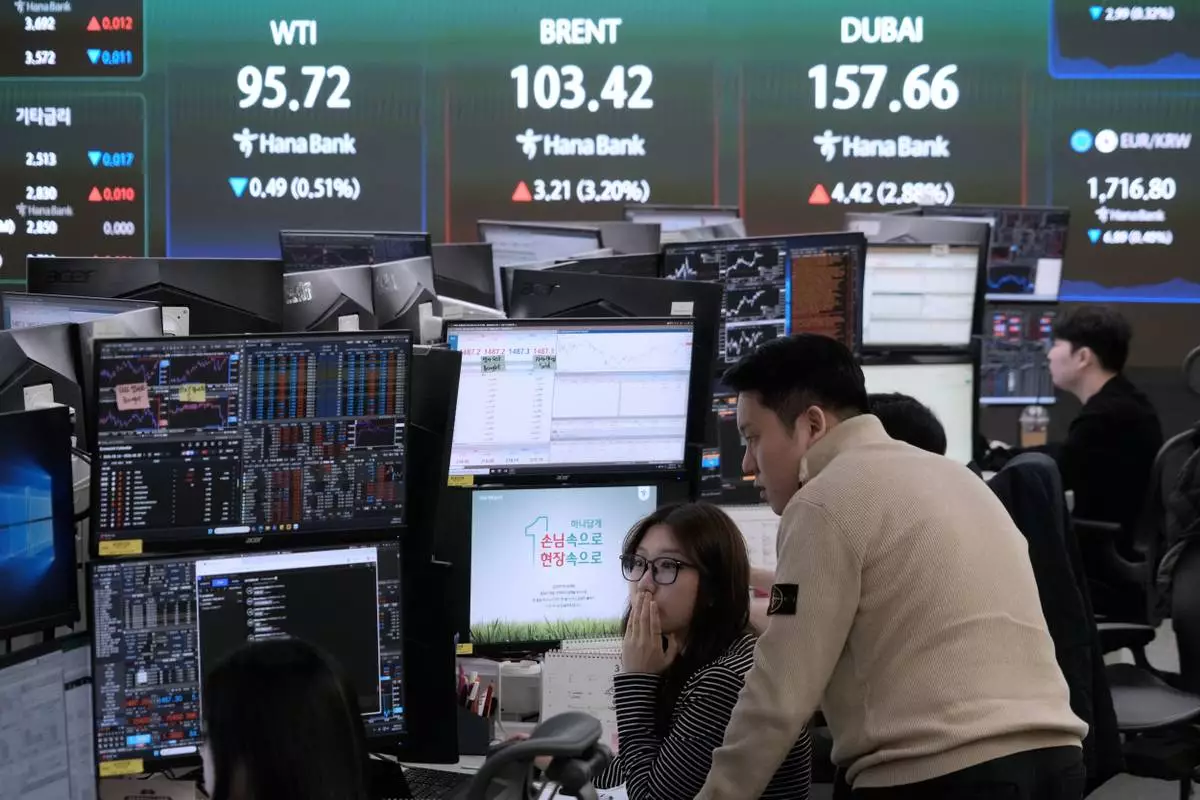
Currency traders watch monitors near a screen showing international oil prices at the foreign exchange dealing room of the Hana Bank headquarters in Seoul, South Korea, Wednesday, March 18, 2026. (AP Photo/Ahn Young-joon)

Currency traders watch monitors near a screen showing the Korea Composite Stock Price Index (KOSPI), left, at the foreign exchange dealing room of the Hana Bank headquarters in Seoul, South Korea, Wednesday, March 18, 2026. (AP Photo/Ahn Young-joon)

A currency trader passes by a screen showing international oil prices at the foreign exchange dealing room of the Hana Bank headquarters in Seoul, South Korea, Wednesday, March 18, 2026. (AP Photo/Ahn Young-joon)
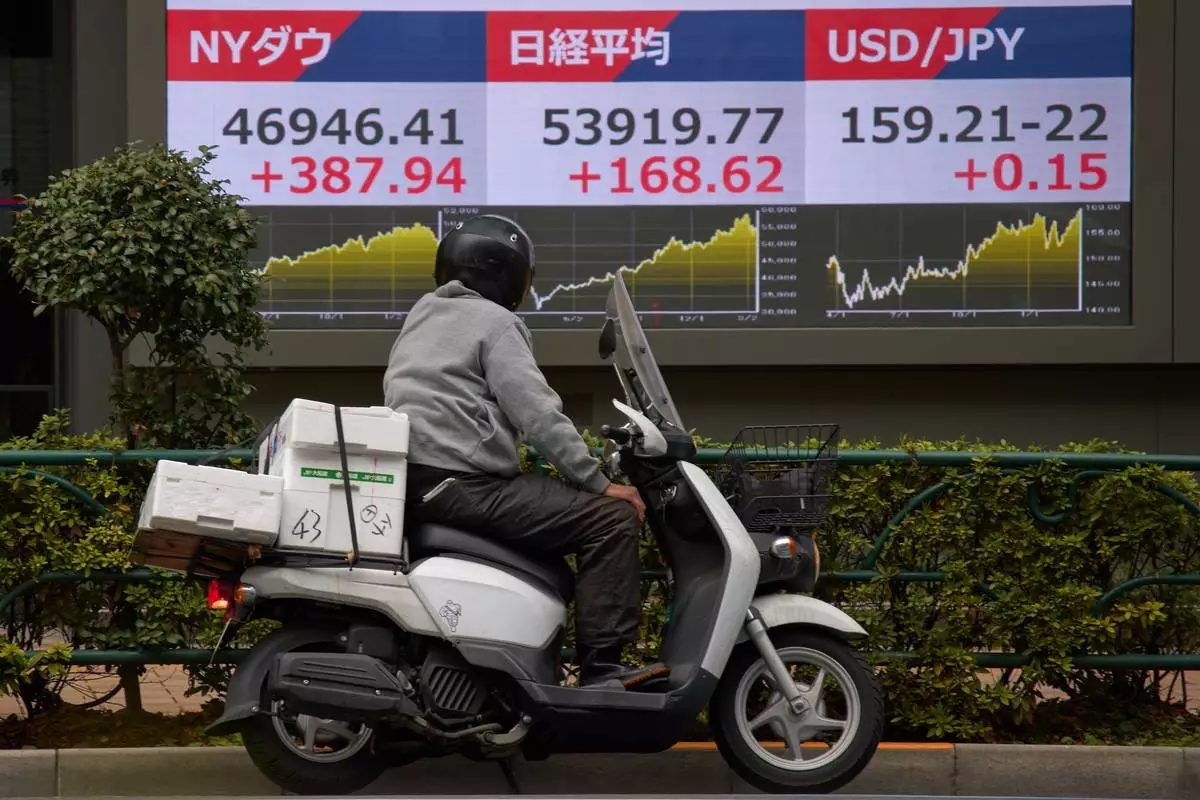
A person looks at a stock price monitor showing New York Dow and Nikkei indexes also US dollar Japanese yen exchange rate at a security company Tuesday, March 17, 2026, in Tokyo. (AP Photo/Eugene Hoshiko)
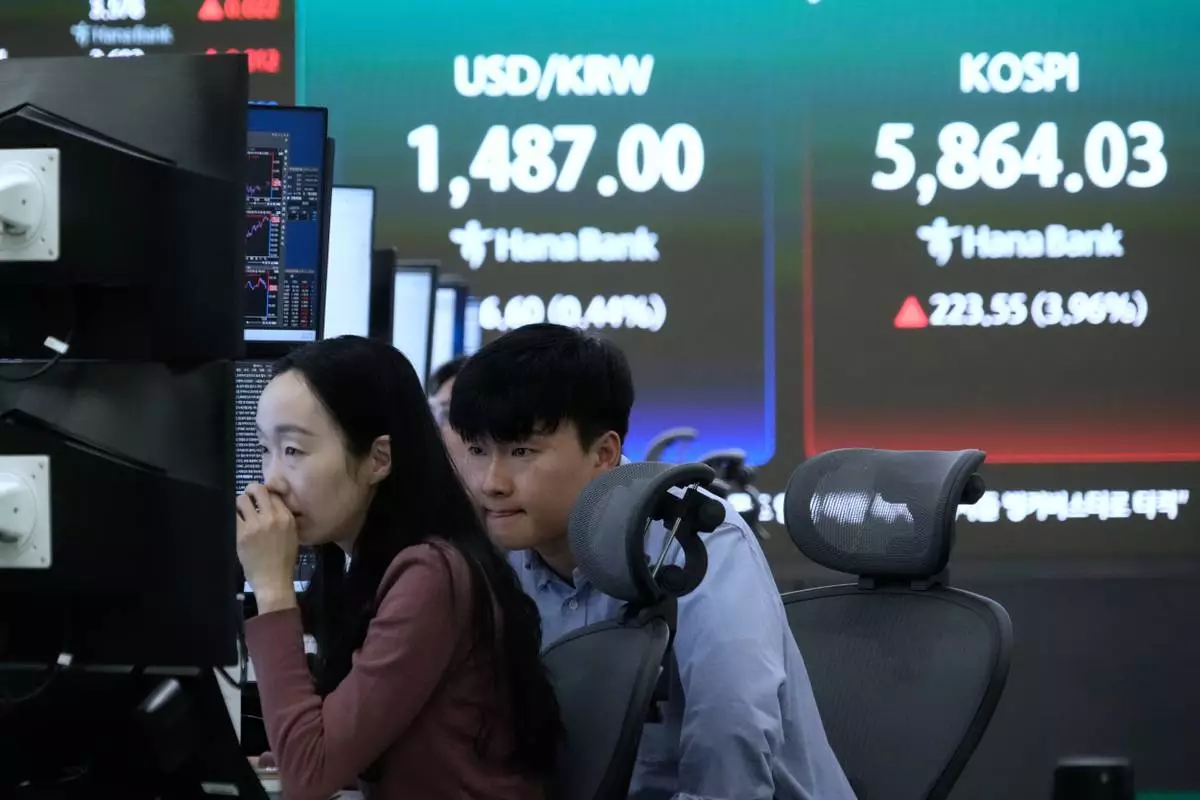
Currency traders watch monitors near a screen showing the Korea Composite Stock Price Index (KOSPI), top right, at the foreign exchange dealing room of the Hana Bank headquarters in Seoul, South Korea, Wednesday, March 18, 2026. (AP Photo/Ahn Young-joon)