Chilean biologists have rung alarm bells about the endangerment of the Patagonian ice dragon, a glacier-dwelling insect, which they say may offer critical insights into how climate change affects micro-ecosystems on the world’s shrinking ice fields.
The UN General Assembly declared 2025 the International Year of Glaciers' Preservation in December 2022, with March 21 designated as annual World Glacier Day starting from 2025. The aim is to underscore glaciers' crucial role in the climate system and global water resources, as well as the impacts of rapid glacier melting.
In South America's Patagonian Ice Field, the tiny Patagonian ice dragon is drawing attention as a "barometer" of glacier health.
The field stretches across Chile and Argentina, and the ice dragon is found only in these frigid environments, surviving at temperatures below minus one degree Celsius and feeding on microorganisms on the ice. Professor Maribet Gamboa from Catholic University of the Most Holy Conception (UCSC) in Chile leads the world's only research team dedicated to studying this rare species.
"This insect is extremely rare because it only lives in the glaciers of Patagonia. The glaciers are now melting and even disappearing, so it's becoming very difficult to find them. Glaciers are not static, and they are constantly changing. When temperatures rise significantly on certain days or in certain years, the glaciers disappear, and so does the habitat of the ice dragon. This reduces our chances of finding them," said Gamboa, professor of Biology at UCSC.
Since 2024, Chile's Institute of Ecology and Biodiversity (IEB) has partnered with Gamboa's team for a new round of research. Scientists believe the ice dragon produces a special "cold protein" that prevents its blood from clotting, acting like a natural anticoagulant. Research indicates that this adaptation allows the insect to survive in glacial meltwater as deep as 40 meters, making it a unique indicator of glacier ecosystem health.
"We have found that the Patagonian ice dragon is closely linked to the glaciers. This makes us believe they act like sentinels and can be used to monitor glacier changes," Gamboa said.
According to the biologist, the Patagonian ice dragon is the only known insect that lives exclusively in glaciers.
"There is very little we can do to protect the ice dragon. Climate change is already happening, and we are witnessing the glaciers gradually disappear. The only thing we can do is try to slow down the temperature changes caused by overall climate change," she said.
UNESCO and related agencies warn that, due to global warming, many of the world's glaciers could melt or disappear entirely by 2050. Glaciers are vital to the planet's ecosystem, serving as freshwater reservoirs, regulating sea levels, and supporting biodiversity.
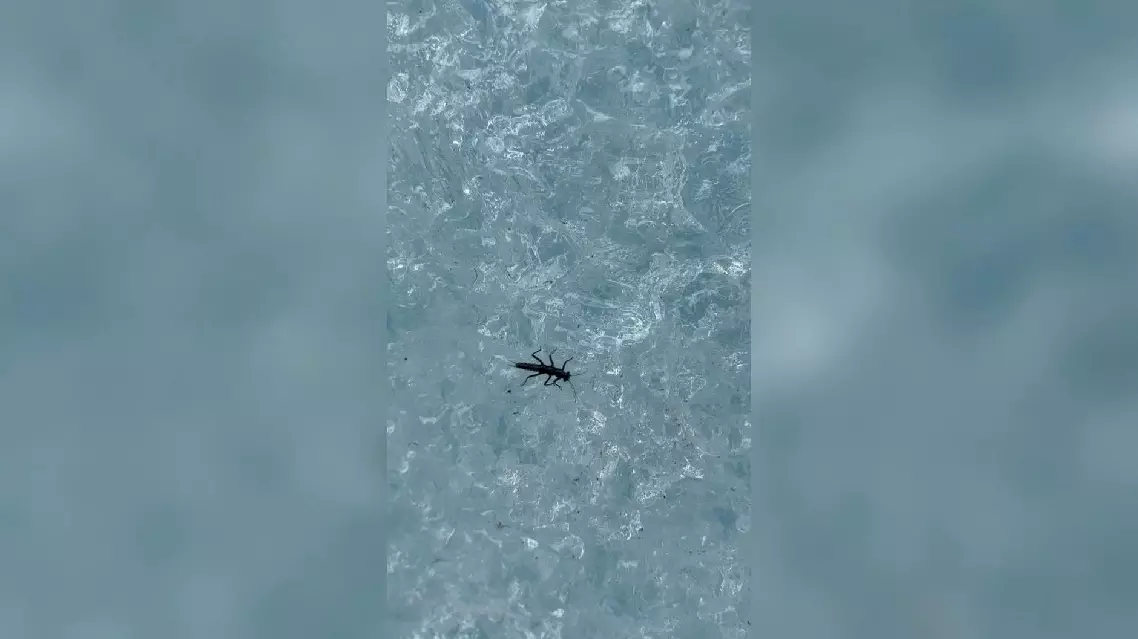
Melting glaciers put rare Patagonian glacier insect at risk

Cultural exchanges are playing a key role in strengthening relations between China and Russia, from joint art exhibitions to restaurants offering Chinese diners with authentic Russian cuisine all helping to grow neighborly bonds.
Ties between the two sides have been in the spotlight this week as Russian President Vladimir Putin wrapped up a two-day state visit to China on Wednesday, while this year also marks the 25th anniversary of the signing of the China-Russia Treaty of Good-Neighborliness and Friendly Cooperation.
At an art space in downtown Shanghai, paintings from a Russian artist based in Nantong City of east China's Jiangsu Province are on show.
An Yike, director of the ANYUE Space, said the exhibition has been a great success, providing Chinese art enthusiasts with the opportunity to appreciate the creative works of Russian artists.
"The theme of our exhibition is 'A Journey from West to East'. Paintings here reflect the artist's observation of the world, showcasing the landscapes and regional impressions he has encountered. And through such cultural exchange between China and the West, I believe that Western artists can learn from the more profound, restrained, and delicate techniques found in Chinese art. At the same time, as Chinese artists, we can embrace the expressive and emotional openness seen in Western art. The different painting techniques of China and the West can merge together. Take this exhibition as example, you can see the Russian painter, his art incorporates many elements of Chinese painting. His work feels deeply rooted in the Chinese tradition, yet it comes from the brush of a Russian artist. This is the beauty of cultural exchange, art becomes more diverse, carries richer inner emotion, and fosters cross-border communication," said An.
Meanwhile, the universal language of food is also bringing the two cultures closer together.
A home-style Russian restaurant in Shanghai is serving up a host of delicious dishes which are delighting diners. The establishment's owner said food has the power to break down barriers and create connections between people.
"I really like Shanghai. And I always have a passion for cooking. So I thought that I can maybe start doing something towards in that direction here in Shanghai. We have big flow of like not only Russian speaking community, but also like, French, Italians, a lot of people were interested, but also like maybe Russian speaking friends were bringing their foreign friends to our parties to introduce Russian food. And also a lot of Chinese people as well. We can introduce our culture through food, which is not just eating. It's about the environment, it's about the drinking habits, the party habits. So I think it's great cultural exchange," said Evgeniya Boyar, owner of the 'Borsh and Kompot' eatery.
Food, art plays part as cultural exchanges forge stronger bonds between China, Russia