3D printing is emerging as a new driving force in China's intelligent manufacturing, bringing about more efficient production and wider application scenarios.
This technology has broken the limits of traditional manufacturing, enabling greater freedom in producing irregularly shaped objects. It not only brings designers' ideas to life, but also makes it possible for ordinary people to realize their creative ideas.
"3D printing is especially suitable for small-scale production. For example, if a product only has a small demand of 1,000 or 2,000 units, that production volume does not justify the cost of developing a steel mold or an injection mold. In such cases, using 3D printing allows for higher cost efficiency. Moreover, molds made with this technology can be updated very quickly. During the research and development phase, multiple versions of molds can be produced to test performance and optimize parts design," said Zhou Chengxu, marketing manager of Bambu Lab, a leading Shenzhen-based manufacturer of high-performance desktop 3D printers.
From everyday items to large-scale projects, 3D printing is expanding into a wide range of scenarios, including smart homes, art installations and urban construction.
Unlike traditional manufacturing methods, this technology is driving industrial production toward a future that is more efficient, more sustainable and more creative.
"This workshop mainly prints sculptures, cultural and creative products, smart home devices, medical equipment, as well as medium- and high-temperature molds for the aerospace sector. This piece depicts an urban renewal project. Outdoors, it can last up to 30 years depending on different environmental conditions. The material is resistant to corrosion and low temperatures and is biodegradable and recyclable," said Yang Jingqiang, engineer of Kings 3D, a prominent industrial 3D printing solution provider in China.
With its unique advantage on precision, 3D printing technology provides a green alternative to large-scale assembly-line production, especially when it comes to cost efficiency and carbon emissions.
"3D printing is a kind of additive manufacturing, which generates almost no material waste. This helps reduce costs and improve efficiency. In addition, you can produce any quantity you need. Whether it's one unit, ten units, or even a hundred, every model has the same finish, appearance and quality -- they are completely consistent. From an environmental perspective, the materials we use are biodegradable," said Chen Bingyun, executive deputy general manager of Kings 3D.
Today, Shenzhen, a global hub for innovation in south China's Guangdong Province, produces more than 90 percent of the world's consumer-grade 3D printers, allowing everyone to bring their ideas to life.
Through digital and flexible production, it breaks the limitations of traditional manufacturing and is becoming a new driving force behind intelligent manufacturing in China.
Official data from the National Bureau of Statistics show China's 3D printing equipment output surged 52.5 percent in 2025.
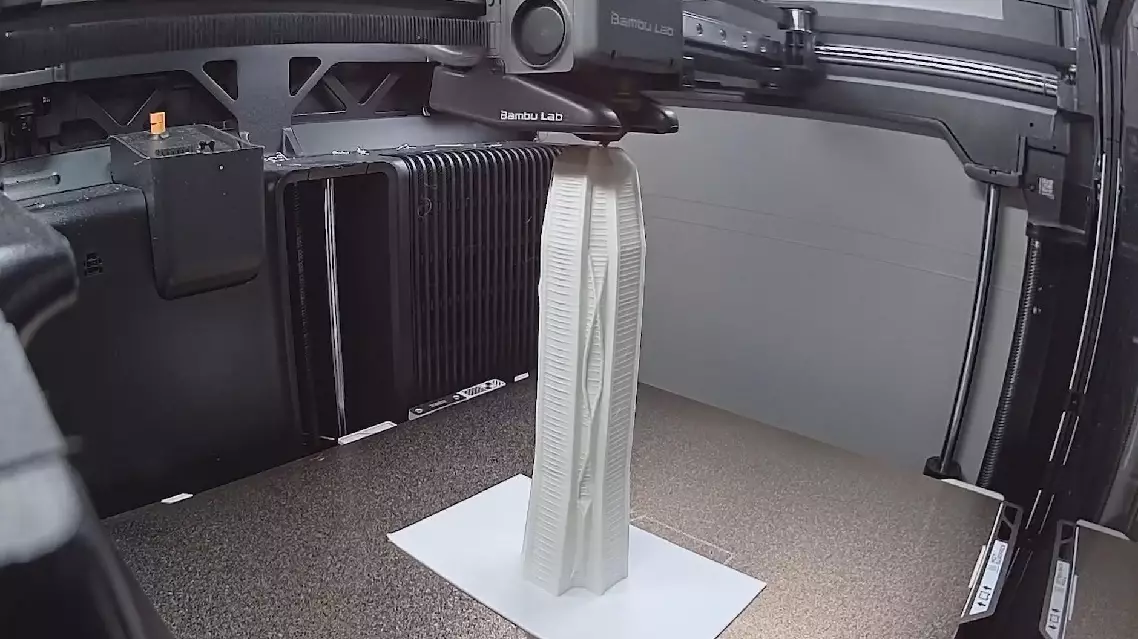
3D printing emerges as powerful engine driving China's intelligent manufacturing