China is ready to work with all parties to develop the Open Coalition on Compliance Carbon Market (OCCCM) into an open, inclusive, pragmatic and efficient platform for international cooperation on carbon markets, and contribute to global climate governance, a senior Chinese official has said.
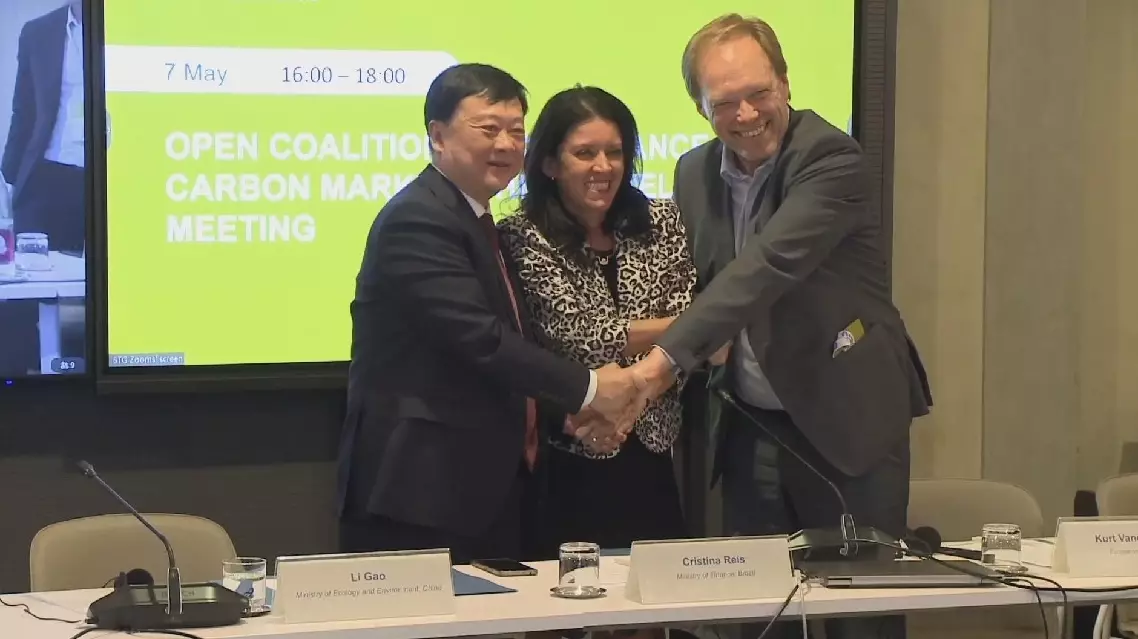
The remarks were made by Li Gao, vice minister of China's Ministry of Ecology and Environment, when he attended the first high-level meeting of the OCCCM held in Florence, Italy.
China is accelerating the construction of a more effective, dynamic, and internationally influential carbon market, and is willing to share its practices in green and low-carbon development and carbon market construction with the international community, Li said.
In addition to China, representatives from Brazil, the European Union (EU), Germany, New Zealand, Canada, Britain, Türkiye, France, and other countries and regions attended the meeting, exchanged views and discussed topics such as the OCCCM priority areas of cooperation and key tasks for the next stage.
Participants in the meeting highlighted that emissions trading systems are an important market-based instrument for advancing the green and low-carbon transition and addressing climate change. The coalition will follow principles of openness, inclusiveness and voluntariness, while strengthening policy dialogue, experience sharing and capacity building among members.
Cooperation will focus on areas such as monitoring, reporting and verification (MRV) systems, carbon accounting methodologies and high-integrity offset, aiming to improve the effectiveness of carbon market operations.
During the meeting, China, Brazil and the EU, as the coalition's founding members, signed the Terms of Reference for the OCCCM, setting out its objectives, scope of work, governance structure and decision-making framework.
Kurt Vandenberghe, director-general for climate action at the European Commission, said the joint launch of the coalition by China, Brazil, and the EU sends a clear signal of continued progress in global climate action and international cooperation.
"We're very confident and encouraged by this open coalition because we see the value of the EU-China cooperation on compliance markets, and we can extend this now to others as well. Because -- and that's very important -- we believe more and more countries are interested in carbon pricing as a cost-efficient way to decarbonize and modernize the economy," said Vandenberghe.
Cristina Reis, deputy secretary for sustainable economic development at Brazil's Ministry of Finance, said that the establishment of the OCCCM is an innovative initiative reflecting the shared willingness of both developing and developed countries to strengthen cooperation on carbon markets.
She added that Brazil is ready to deepen exchanges and cooperation with China and other partners to enable carbon pricing mechanisms to play a greater role in emissions reduction and green transition.
"I believe that China can contribute to the other countries, showing the challenges that the country has faced to implement the emissions trading system (ETS) and it's continued to be facing because it's becoming more and more complex. It is in largely its coverage. So, we can learn with China about that experience," said Reis.
China ready to help develop OCCCM into open, inclusive cooperation platform: official