ATLANTA (AP) — Allergy season can be miserable for tens of millions of Americans when trees, grass, and other pollens cause runny noses, itchy eyes, coughing and sneezing.
Where you live, what you’re allergic to and your lifestyle can make a big difference when it comes to the severity of your allergies. Experts say climate change is leading to longer and more intense allergy seasons, but also point out that treatments for seasonal allergies have become more effective over the last decade.
Here are some tips from experts to keep allergy symptoms at bay — maybe even enough to allow you to enjoy the outdoors.
The Asthma and Allergy Foundation of America issues an annual ranking of the most challenging cities to live in if you have allergies, based on over-the-counter medicine use, pollen counts and the number of available allergy specialists.
This year, the top five cities are: Boise, Idaho; San Diego; Tulsa, Oklahoma; Provo, Utah; and Rochester, New York.
Pollen is the powdery substance made by seed-producing plants and trees that is part of their reproductive process. Earlier in the spring, tree pollen is the main culprit. After that grasses pollinate, followed by weeds in the late summer and early fall.
Some of the most common tree pollens that cause allergies include birch, cedar, cottonwood, maple, elm, oak and walnut, according to the Asthma and Allergy Foundation of America. Grasses that cause symptoms include Bermuda, Johnson, rye and Kentucky bluegrass.
Pollen trackers can help you decide when to go outside. The American Academy of Allergy Asthma and Immunology tracks levels through a network of counting stations across the U.S. Counts are available at its website and via email.
The best and first step to controlling allergies is avoiding exposure. Keep the windows in your car and your home closed, even when it’s nice outside.
If you go outside, wearing long sleeves can keep pollen off your skin to help ward off allergic reactions, said Dr. James Baker, an allergist at the University of Michigan. It also provides some sun protection, he added.
When you get home, change your clothes and shower daily to ensure all the pollen is off of you — including your hair. If you can’t wash your hair every day, try covering it when you go outside with a hat or scarf. Don’t get in the bed with your outside clothes on, because the pollen will follow.
It's also useful to rinse your eyes and nose with saline to remove any pollen, experts said. And the same masks that got us through the pandemic can protect you from allergies — though they won’t help with eye symptoms.
Over-the-counter nasal sprays are among the most effective treatments for seasonal allergies, experts said.
But patients often use them incorrectly, irritating parts of the nose, said Dr. Kathleen May, an allergist at Augusta University in Georgia. She suggested angling the nozzle outward toward your ear rather than sticking it straight up your nose.
Over-the-counter allergy pills like Claritin, Allegra and Zyrtec are helpful, but may not be as effective as quickly since they're taken by mouth, experts said.
If your allergy symptoms are impacting your quality of life, like causing you to lose sleep or loose focus at work or school, it might be time to consider making an appointment with an allergist. There are medications that can train you immune system not to overreact to allergens.
Some remedies for allergy relief that have been circulating on social media or suggested by celebrities — like incorporating local honey into your diet to expose yourself to pollen — have been debunked.
Dr. Shyam Joshi, an allergist at Oregon Health and Science University, said that's because the flowers that bees pollinate typically don't contain the airborne pollen that causes allergy symptoms.
Winters are milder and growing seasons are longer as the climate is changing, meaning there’s more opportunity for pollen to stay in the air, resulting in longer and more severe allergy seasons.
Last year was one of the most intense allergy seasons on record, particularly in the Southeast U.S.
A version of this story was published April 19, 2025. The writer is no longer with The Associated Press.
The Associated Press Health and Science Department receives support from the Howard Hughes Medical Institute’s Science and Educational Media Group and the Robert Wood Johnson Foundation. The AP is solely responsible for all content.

FILE - Elena Ivanov, visiting from San Jose, Calif., walks across a field covered with blooming poppies near the Antelope Valley California Poppy Reserve in Lancaster, Calif., March 30, 2022. (AP Photo/Jae C. Hong, File)
WASHINGTON (AP) — The U.S. economy was supposed to start the year with a bang, fueled by an unusually large jump in tax refunds from President Donald Trump's tax cut legislation. Yet spiking gas prices are on track to eat up those refunds, leaving most Americans with little extra to spend.
“Next spring is projected to be the largest tax refund season of all time,” Trump said in a prime-time speech in December that was intended to address voters' concerns about the economy and stubbornly high prices.
But that was before the Iran war, which began Feb. 28. Oil and gas prices have soared since then, with the nationwide average price of gas reaching $3.94 Sunday, up more than a dollar from just a month earlier.
Gas prices are likely to remain elevated for some time, even if the war ends soon, because shipping and production have been disrupted and will take time to recover. Economists now expect slower growth this spring and for the year as a whole, as dollars that are spent on gas are less likely to be used for restaurant meals, new clothes, or entertainment.
Lower and middle-income households are likely to be hit particularly hard, because they receive lower refunds, while spending a greater proportion of their earnings on gas.
“The energy shock is to going to hit those who have the least cushion,” said Alex Jacquez, chief of policy at the left-leaning Groundwork Collaborative and a former economist in the Biden White House. "And it doesn't look like those tax refunds are going to be here to save them.”
Neale Mahoney, director of the Stanford Institute for Economic Policy Research, calculates that gas prices could peak in May at $4.36 a gallon, based on oil price forecasts by Goldman Sachs, followed by slow declines for the rest of the year. The notion that gas prices decline much more slowly than they rise is so ingrained among economists that they refer to it as the “rocket and feathers” phenomenon.
In that scenario, the average household would pay $740 more in gas this year, nearly equal to the $748 increase in refunds that the Tax Foundation has estimated the average household will receive.
Through March 6, refunds have risen by much less than that, according to IRS data: They have averaged $3,676, up $352 from $3,324 in 2025. Still, average refunds could rise as more complex returns are filed.
Other estimates show similar impacts. Economists at Oxford Economics, a consulting firm, estimate that if gas prices average $3.70 a gallon all year, it will cost consumers about $70 billion — more than the $60 billion in increased tax refunds.
The gas price spike comes with many consumers already in a precarious position, particularly compared to 2022, when gas prices also soared because of Russia's invasion of Ukraine. At that time, many households still had fattened bank accounts from pandemic-era stimulus payments and companies were hiring rapidly and sharply lifting pay to attract workers.
Now, hiring is nearly at a standstill and Americans' saving rate has steadily fallen in the past few years as many households borrow more to sustain their spending.
“When you start looking across the perspective from a consumer side, you’re seeing people who have maxed out their credit cards, are using ‘buy now, pay later’ to purchase their groceries,” said Julie Margetta Morgan, president of The Century Foundation, a think tank. “They're making it work for now, but that can fall apart quite quickly.”
The impact will likely worsen the “K-shaped” narrativ e around the U.S. economy, analysts said, in which higher income households have fared better than lower-income households. The bottom 10% of earners spend nearly 4% of their incomes on gasoline, Pantheon Macroeconomics estimates, while the top 10% spend just 1.5%.
For now, most analysts still expect the U.S. economy to expand this year, even if more slowly, given the gas price shock. Higher gas prices will likely worsen inflation in the short run, but over time weaker spending will also slow growth.
American consumers and businesses have repeatedly shaken off shocks since the pandemic — soaring inflation, rising interest rates, tariffs — and continued to spend, defying concerns that the economy would tip into recession. Many economists note that the proportion of their incomes that Americans spend on gas and other energy has fallen significantly compared with a decade ago.
Data from the Bank of America Institute, released Friday, showed that spending on gas on the bank's credit and debit cards shot 14.4% higher in the week ended March 14 compared with a year ago. Before the war, such spending was running 5% below the previous year, a benefit to consumers.
Spending on discretionary items — restaurant meals, electronics, and travel — is still growing, the institute said, evidence of consumer resilience. But there is little sign it is accelerating, as many economists had hoped.
“The longer these gasoline prices persist, the more that will gradually sap consumer discretionary spending,” said David Tinsley, senior economist at the institute.
Other analysts expect growth will slow because of the war. Bernard Yaros and Michael Pearce, economists at Oxford Economics, forecast that the U.S. economy will grow just 1.9% this year, down from an earlier estimate of 2.5%.
“We had anticipated a lift in spending from a bumper tax refund season,” they wrote, “but the rise in gasoline prices, if sustained, would more than offset that boost.”
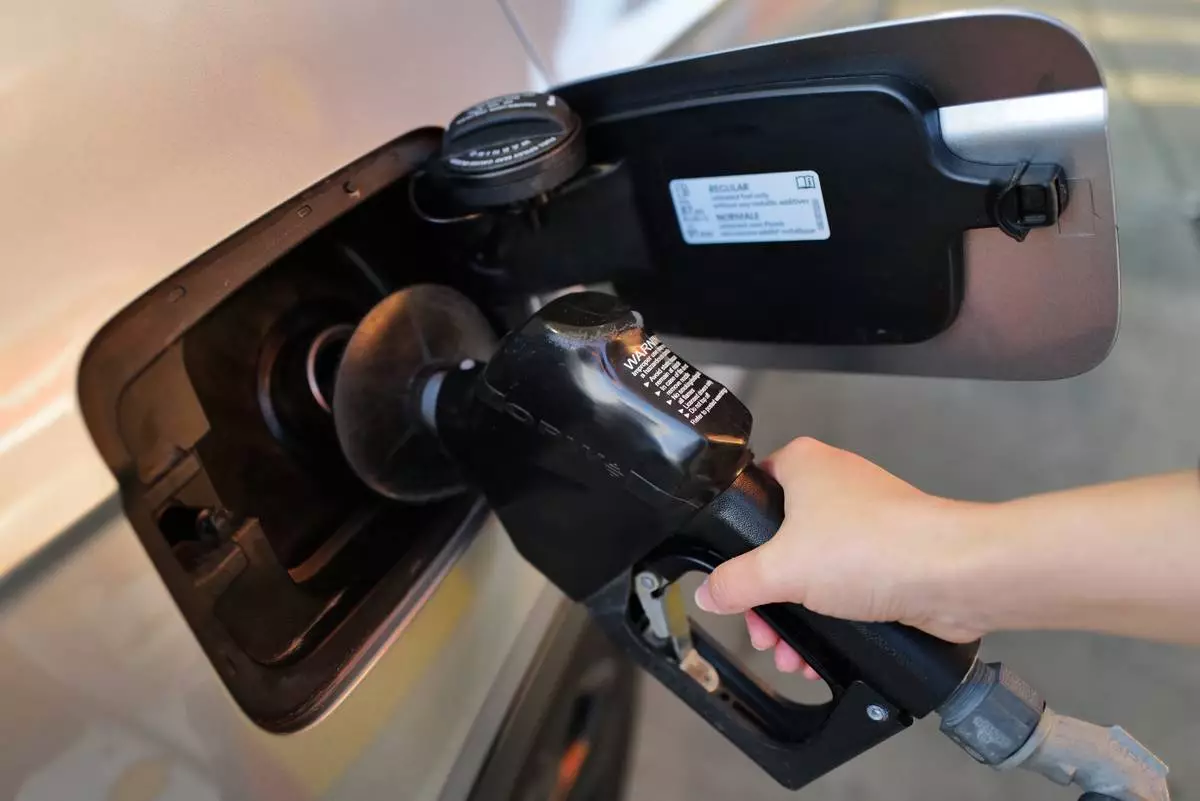
A person fills up her vehicle's gas tank at a gas station in Buffalo Grove, Ill., Thursday, March 19, 2026. (AP Photo/Nam Y. Huh)