Skip to Content Facebook Feature Image

Skyrocketing fuel prices affect Nigerian small and medium-sized enterprises

China

China

China

Skyrocketing fuel prices affect Nigerian small and medium-sized enterprises

2026-03-23 15:47 Last Updated At:16:37

The small and medium-sized enterprises (SMEs) in Nigeria find it hard to deal with the increasing costs resulting from the skyrocketing fuel prices pushed up by the ongoing U.S.-Israeli military operations against Iran.

In Nigeria, SMEs face major challenges like limited access to finance and infrastructure, the burden that comes with the increased cost of fuel has become a pendant of albatross on these business operators.

Oil prices continued to climb on March 20. The West Texas Intermediate for April delivery went up 2.18 U.S. dollars, or 2.27 percent, to settle at 98.32 dollars a barrel on the New York Mercantile Exchange. Brent crude for May delivery added 3.54 dollars, or 3.26 percent up, to settle at 112.19 dollars a barrel on the London ICE Futures Exchange.

Officials from Saudi Arabia's oil industry said if the war persists until the end of April, international oil prices could exceed 180 U.S. dollars per barrel.

"Increase of the fuel [price] has affected our production, everything--that we had to like increase the prices of our stuff, which in one way affects the customers, too. So, it has really, really affected us," said Oluwanifemi Fiyinfoluwa Obanure, a fashion designer in Abuja, the national capital of Nigeria.

Obanure did her research and chose a location with steady power supply so as to avoid paying extra costs on fuel to power generator. It was unknown to her that her business could be determined by a war in a foreign land.

"I heard that it was because of the war in Iran. So, I was so depressed. I had to come online to voice out. I made a post and the post went viral. An anonymous man came to my rescue. So, that was how I was able to get a solar for my business. If not for the solar, by now, I would have packed up. I would have packed up," said Obanure.

Abdulwasiu Ontoye, a welder in Abuja, said he has been struggling to deal with the increasing costs as customers are reluctant to pay more.

"The work we are doing now, if we tell the customer this is the amount of the work, they will say, 'No.' They will still pay the previous amount they were paying. We don't change our price, but now the materials we're buying, the price changed," said Ontoye.

Skyrocketing fuel prices affect Nigerian small and medium-sized enterprises

Skyrocketing fuel prices affect Nigerian small and medium-sized enterprises
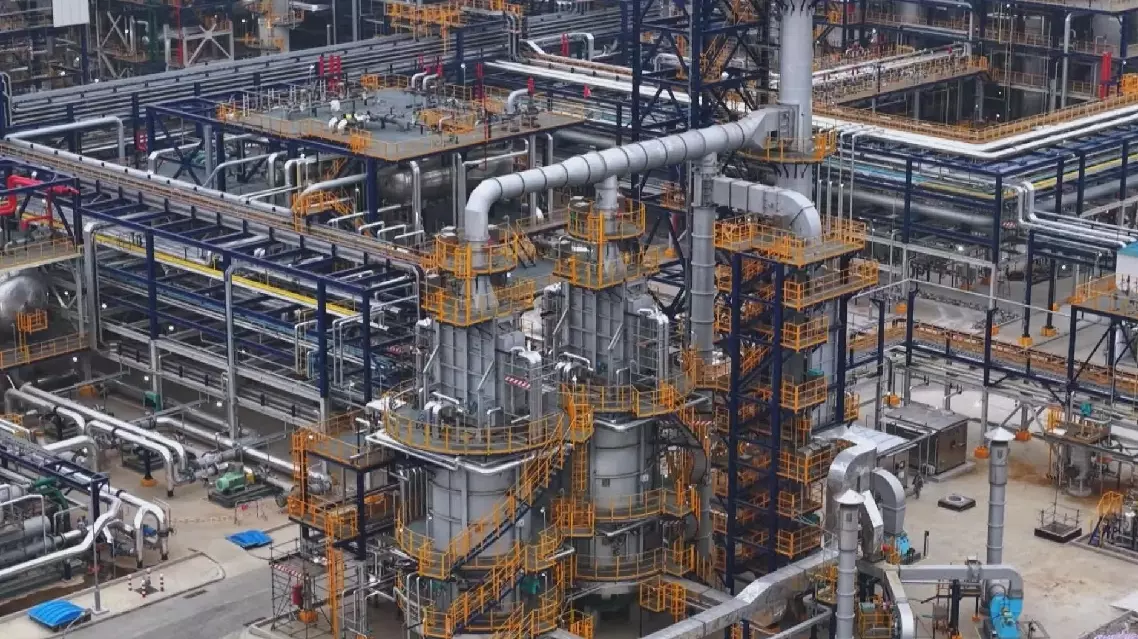
China's first full-chain domestic solution-process polyolefin elastomers (POE) industrial device has entered trial operation in north China's Tianjin Municipality, according to China Petrochemical Corporation (Sinopec), world's largest oil refiner and China's top aviation fuel producer, on Sunday. Sinopec said that the facility will help reduce China's reliance on imported materials and significantly ease the import dependence of strategic emerging industries such as photovoltaics on this key material.

Often referred to as "industrial gold", POE is a high-performance material that combines the processability of plastic with the high elasticity of rubber. It is an essential component in the manufacturing of photovoltaic (PV) modules, lightweight automotive parts and high-end packaging. "POE is known as 'industrial gold.' Our device adopts the solution-process POE technology and metallocene catalyst independently developed by us. At the same time, we adopted a domestic automatic control system, ensuring that all equipment in the production chain were made in China," said Wang Xiaowei, director of the Research Institute of Sinopec Tianjin Branch.

Driven by the photovoltaic and new energy vehicle industries, China's POE consumption increased from 640,000 tons in 2021 to 1.11 million tons in 2025, with an average compound annual growth rate of 14.7 percent, making it the world's largest POE consumer market.

Due to high technical barriers, China has long relied on imports for POE, with import dependency reaching 76 percent in 2025.

"After the plant goes into operation, our products can be used in strategic emerging industries, enabling the light transmittance of photovoltaic encapsulation films to reach 93.5 percent or higher. At the same time, they contribute to automotive lightweighting. After application, the products can reduce weight by more than 15 percent compared with traditional materials. Additionally, they can be used in lithium battery separator coatings and charging pile cable insulation layers, allowing us to better meet safety standards," said Wang.

China energy giant reports breakthrough in PV, EV material production

China energy giant reports breakthrough in PV, EV material production

Recommended Articles