LJUBLJANA, Slovenia (AP) — Slovenia 's president on Monday urged the country's political parties to start talks on forming a new government as soon as possible after a parliamentary election on the weekend in the European Union country ended with no clear winner and the main players practically tied.
Prime Minister Robert Golob's liberal Freedom Movement won 29 seats in the 90-member assembly while the opposition right-wing Slovenian Democratic Party, or SDS, won 28, according to preliminary results of 99.85% of votes counted by the state election authorities.
The outcome means that no party has a clear majority of 46 seats and that a future government will depend on smaller parties that emerged as kingmakers following the vote. It was not immediately clear what shape potential future alliances might take.
“I urge them to sit down at the negotiating table as soon as possible,” President Natasa Pirc Musar said on X. She congratulated the pro-EU ruling Freedom Movement party, which had a lead of less than 1%, describing it as “the relative winner" of the election.
Sunday's vote was seen as a key test of whether the EU member nation stays on its liberal course or sways toward the right. The undecided outcome also reflects deep divisions among Slovenia’s 1.7 million eligible voters.
Golob’s government has been a strong liberal voice in the 27-nation EU. SDS leader Janez Jansa is a populist-style politician and a close ally of nationalist Hungarian Prime Minister Viktor Orbán. His return to power would be a boost to Europe’s right-wing blocs.
Golob on Sunday evening thanked the voters on the relative victory, saying that “we have remained the leading party.” He predicted “tough weeks ahead” when he will meet with parliamentary parties to try to find common ground.
Jansa, an admirer of U.S. President Donald Trump, said his party would not want to form a weak coalition government. He said a “balance of political powers ... based on what we see now, will not provide much stability."
The vote was held after a heated campaign that featured allegations of foreign interference and corruption, further whipping already heightened political tensions between the two opposed blocs.
Pensioner Rajko Campa, from the capital Ljubljana, said he was surprised by the election results and that he supported Jansa's conservatives, arguing that it is healthy to change those in power every few years.
Slovenia routinely has switched between the right and left-leaning blocks since it broke away from the former Yugoslavia in 1991. The Alpine nation of 2 million people became a member of NATO and the EU in 2004.

People casts her vote at a polling station for parliamentary elections in Arnace, Slovenia, on Sunday, March 22, 2026. (AP Photo/Denes Erdos)

Prime Minister of Slovenia Robert Golob casts his vote at a polling station for parliamentary elections in Ljubljana, Slovenia, on Sunday, March 22, 2026. (AP Photo/Denes Erdos)
President Donald Trump extended his deadline for Iran to reopen the Strait of Hormuz, saying the U.S. will hold off on striking power plant strikes for five days.
Trump made the announcement on his Truth Social site hours ahead of a deadline. Trump said the U.S. and Iran have had “very good and productive conversations” that could yield “a complete and total resolution” in the war. Talks will continue “throughout the week,” Trump said.
Iran had earlier threatened to strike regional power plants and float mines in the Persian Gulf if Trump went ahead with his threat to bomb Iranian energy stations or ordered a land invasion.
The death toll from the war has risen to more than 1,500 people in Iran, more than 1,000 people in Lebanon, 15 in Israel and 13 U.S. military members, as well as a number of civilians on land and sea in the Gulf region. Millions of people in Lebanon and Iran have been displaced.
Here is the latest:
Iranian state television offered Tehran’s first reaction to U.S. President Donald Trump’s decision to extend a deadline for reopening the Strait of Hormuz by five days.
The deadline should have been around 0000 GMT Tuesday. Instead, Trump on Monday said he extended it by five days.
Reacting to the news, Iranian state television said in a graphic on screen: “U.S. president backs down following Iran’s firm warning.”
Oman’s top diplomat says his country, which has long mediated between the U.S. and Iran, was working to secure safe transit through the Strait of Hormuz. He did not elaborate.
Foreign Minister Bad Albusaidi also wrote in a social media post that Iran is not to be blamed for the war.
“Whatever your view of Iran, this war is not of their making. This is already causing widespread economic problems,” he wrote.
China’s Middle East envoy pinned the blame squarely on the U.S. and Israel for a war he said has dealt a heavy blow to the global economy and shipping lanes.
“We all know who started this war,” Zhai Jun told reporters in Beijing after a recent trip to Saudi Arabia, the UAE, Bahrain, Kuwait and Egypt.
Asked about the biggest obstacle to a ceasefire, he quoted a Chinese saying. “To untie a belt, the person who tied it is needed,” he said, repeating his government’s call for the U.S. and Israel to halt their military actions immediately and return to negotiations.
Zhai said the ongoing fighting made his delegation’s trip an unusual one, including witnessing missile interceptions above them. “We heard explosions and sirens for the first time in a real war, he said.
Trump added that the suspension of his threat to attack Iranian power plants was “subject to the success of the ongoing meetings and discussions.”
Trump’s announcement came as the United Arab Emirates reported its air defenses were attempting to intercept new incoming Iranian fire Monday afternoon.
Prior to Trump’s announcement, Iranian Foreign Minister Abbas Araghchi acknowledged talking by phone with his Turkish counterpart, Hakan Fidan. Turkey has been an intermediary before in negotiations between Tehran and Washington.
Trump made the announcement on his Truth Social website Monday, just hours ahead of a deadline later in the day.
Writing in all capital letters, he said the U.S. and Iran have had “very good and productive conversations” that could yield “a complete and total resolution” in the war. Talks will continue “throughout the week,” Trump said.
Speaking in Parliament, Prime Minister Narendra Modi on Monday compared the challenges caused by the war to those faced during the COVID-19 pandemic and said India needs to be equally prepared this time.
Modi said the country’s power plants have adequate coal reserves and that all power supply systems are being closely monitored as summer approaches and demand rises. He said India’s fertilizer stocks remain sufficient.
“This war is not in the interest of humanity. India is encouraging all sides to end war peacefully,” Modi said.
Associated Press journalists heard explosions across multiple points in Iran’s capital, Tehran, on Monday afternoon. It wasn’t immediately clear what was hit.
Bahrain's Defense Ministry said the projectiles were fired in the last 24 hours.
The Kremlin said Monday that any U.S. strikes on Iran’s Russia-built nuclear power plant could trigger “irreparable” consequences.
Asked about President Donald Trump’s warning to “obliterate” Iran’s power plants if it doesn’t fully open the Strait of Hormuz, Kremlin spokesman Dmitry Peskov told reporters that the “catastrophically tense” situation in the region could only be settled by political and diplomatic means.
Peskov warned that any strikes on nuclear facilities would be “extremely dangerous and fraught with possibly irreparable consequences,” adding that Russia has “conveyed relevant signals” to the U.S.
Ofer “Poshko” Moskovitz was killed on Sunday in Misgav Am, a northern community on the border with Lebanon.
The army said Monday that following an examination it determined that Moskovitz was hit by Israeli artillery fire due to “operational errors,” including directing the fire “at an incorrect angle” and not following protocol.
“As a result, five artillery shells were fired at the Misgav Am ridge instead of toward the enemy target,” the army said in a statement. It expressed regret over the incident, which it described as “very severe.”
“The deliberate destruction of infrastructure in Lebanon represents a blatant Israeli policy of collective punishment,” the Egyptian Foreign Ministry said in a Monday statement.
It criticized Israel’s “systemic and deliberate” strikes, including on bridges on the Litani River in south Lebanon.
The wife of Prime Minister Benjamin Netanyahu flew to Washington early Monday morning to take part in a meeting of first spouses from dozens of countries organized by first lady Melania Trump.
According to the prime minister’s office, Netanyahu will be in the states for two or three days and is expected to return to Israel immediately afterward. The White House said the meeting of first spouses will focus on supporting children through the “safe and innovative use of technology.”
The strike on the bridge Monday in the southern village of Qaaqaaiyet al-Jisr cut a main link between the southern city of Nabatiyeh and al-Hujair valley region farther south.
The state-run National News Agency gave no further details about the latest strike on a bridge on the Litani river to be destroyed in recent days.
On Sunday, Israel struck the Qasmiyeh bridge near the southern port city of Tyre.
Lebanese President Joseph Aoun called Israel’s new targeting of bridges in the south “a prelude to a ground invasion.”
Iran’s Defense Council issued the statement as concern in Tehran grows about the potential arrival of U.S. Marines to the region.
“Any attempt by the enemy to target Iran’s coasts or islands will, naturally and in accordance with established military practice, lead to the mining of all access routes ... in the Persian Gulf and along the coasts,” the council said.
The U.S. has been trying to reopen the Strait of Hormuz, the narrow mouth of the Persian Gulf, to energy shipments. The Marines could come ashore to seize either islands or territory in Iran to support that mission. Israel also has suggested a ground operation could take part in the war.
Jamal Abdi, head of the National Iranian American Council, described President Donald Trump’s threat to strike Iran’s energy facilities as a “collective punishment.”
“Threatening to bomb Iran’s power plants is a threat to millions of civilians,” he said. “This is not a ‘targeted’ strike. This is collective punishment.”
A senior United Nations official said the war in the Middle East has “far reaching” impact on millions of people particularly in developing countries in Asia and Africa.
In a Monday statement, Jorge Moreira da Silva, executive director of the U.N. Office for Project Services, detailed the ripple effects of the war, now in its fourth week, including “exponential price hikes in oil, fuel and gas.”
“Our world is the most violent it has been since the Second World War,” he said.
He warned that the number of hungry people is likely to increase by tens of millions over the course of the year, as the widening war threatens remittance flows.
The war also displaced 3.2 million people in Iran and 1 million in Lebanon, he said.
He called for diplomacy to end the conflict, saying: “There is no military solution.”
As Trump’s 48-hour deadline to bomb power-generation sites in Iran over the opening of the Strait of Hormuz approaches, there are several electrical sites that could be targets in the Islamic Republic.
Some 80% of all power generated in Iran is created at plants powered by natural gas.
Those plants have continued working, even after Israel last week bombed Iran’s South Pars offshore natural gas field in the Persian Gulf.
Among the top natural gas plants are Damavand Power Plant, Shahid Salimi Neka Power Plant and Shahid Rajaee Power Plant – all around Iran’s capital, Tehran.
Knocking those plants offline could affect businesses and homes in Tehran, as well as halt gas stations and other crucial sites.
— By Jon Gambrell
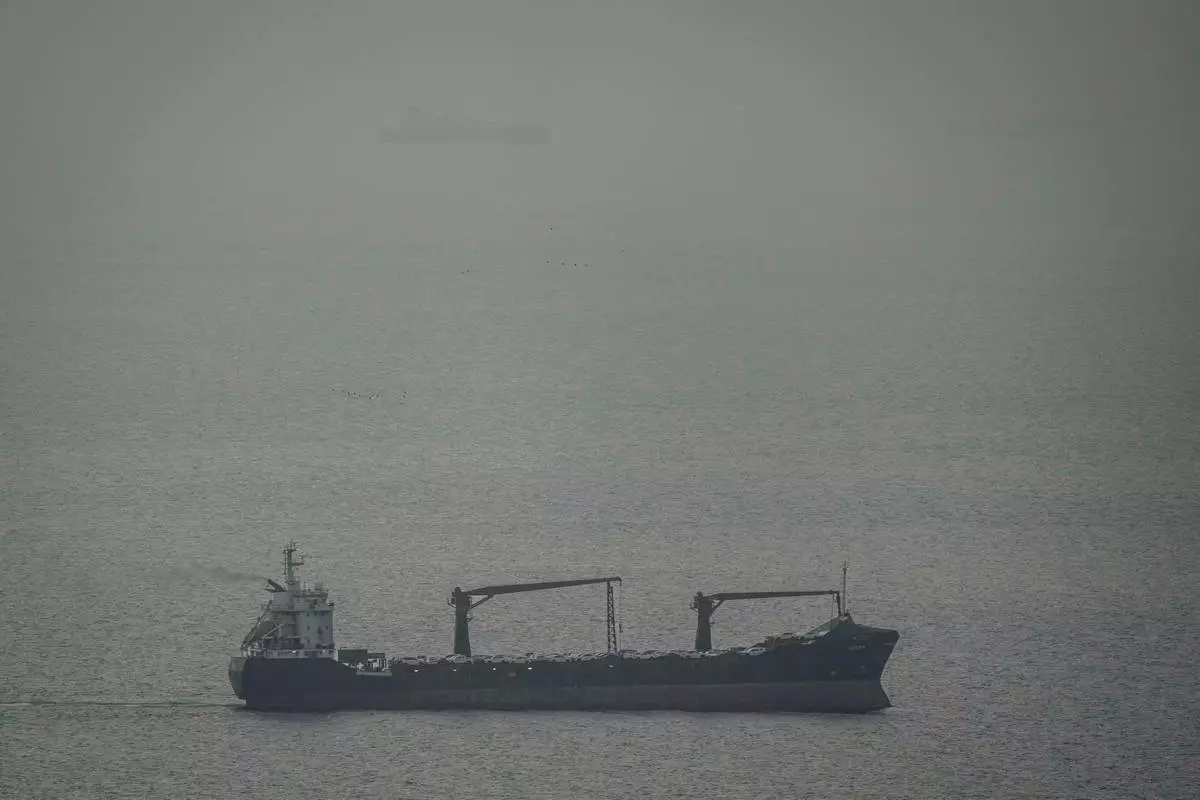
A cargo ship carrying vehicles sails through the Arabian Gulf toward the Strait of Hormuz in the United Arab Emirates, Sunday, March 22, 2026. (AP Photo)
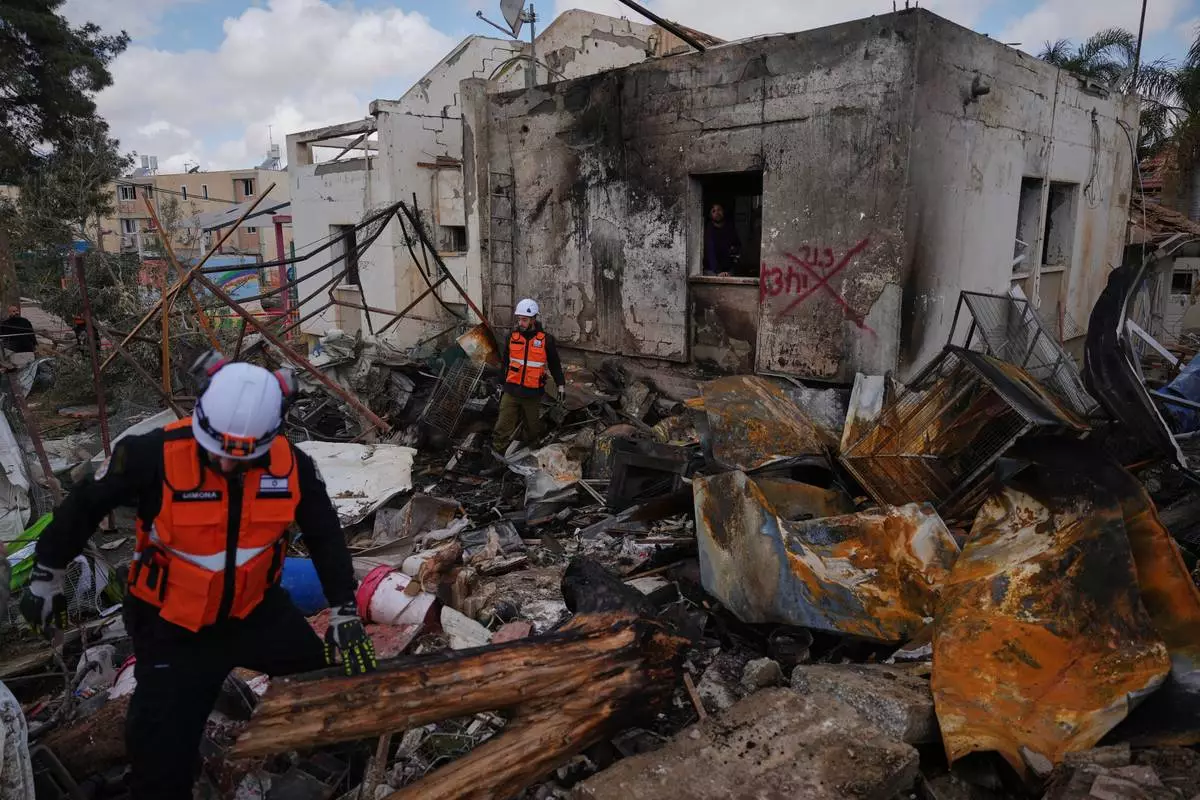
Israeli security forces survey the site that was struck by an Iranian missile in Dimona, southern Israel, Sunday, March 22, 2026. (AP Photo/Ariel Schalit)
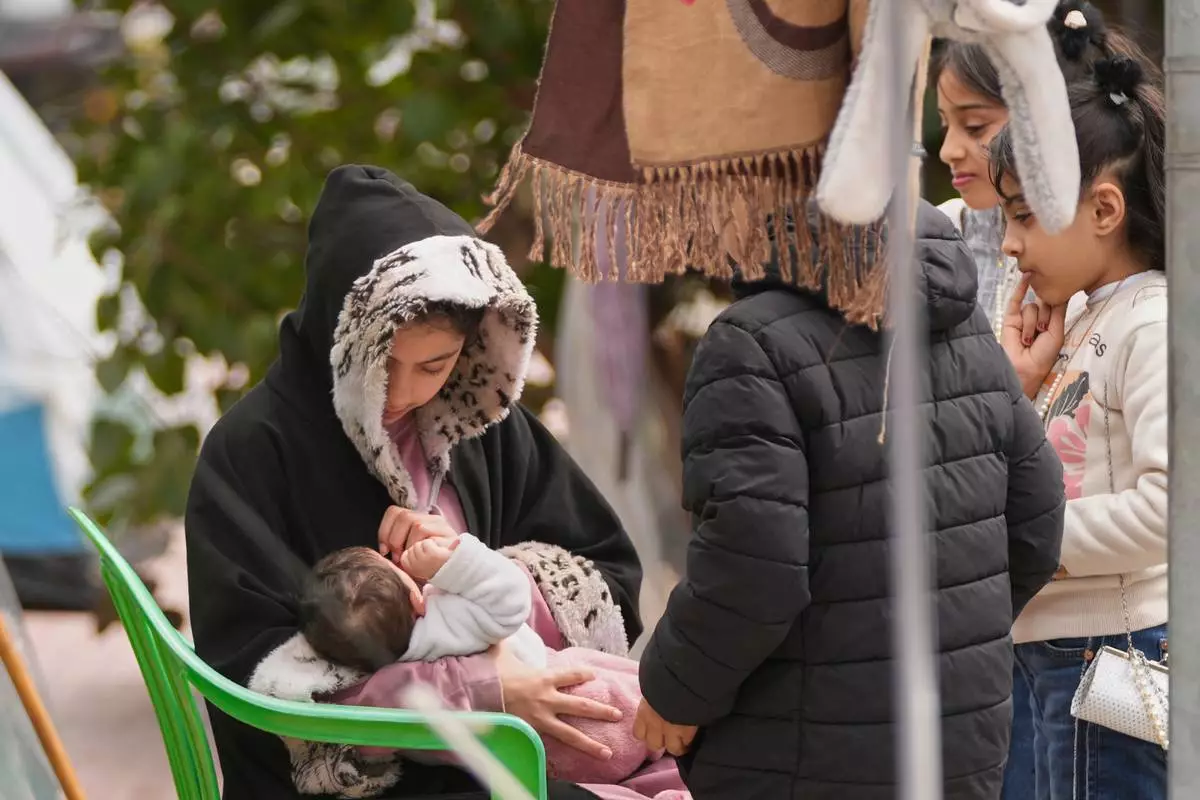
A displaced girl feeds a baby as other children stand at tents sheltering people who fled Israeli airstrikes in Dahiyeh, in Beirut's southern suburbs, along the wall of the Pine Residence, the official residence of the French ambassador, in Lebanon. (AP Photo/Hassan Ammar)
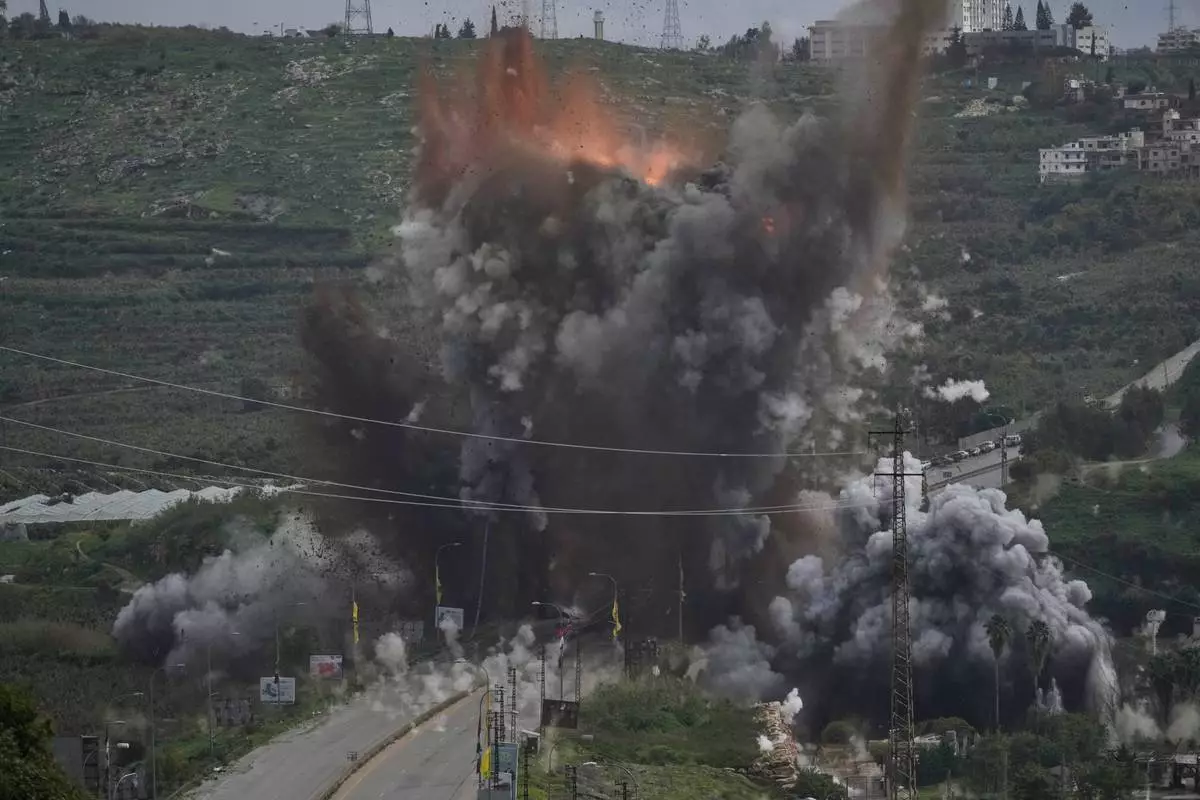
Smoke and flames rise from an Israeli airstrike that hit the Qasmiyeh Bridge near the coastal city of Tyre, Lebanon, Sunday, March 22, 2026. (AP Photo/Mohammad Zaatari)