Skip to Content Facebook Feature Image

Chinese shares plunge amid growing tensions in Middle East

China

China

China

Chinese shares plunge amid growing tensions in Middle East

2026-03-23 23:22 Last Updated At:03-24 02:27

China’s major stock indices plunged more than three percent on Monday as investors around the globe became increasingly anxious about the possible impacts from ongoing U.S.-Israeli military operations against Iran, said a market analyst.

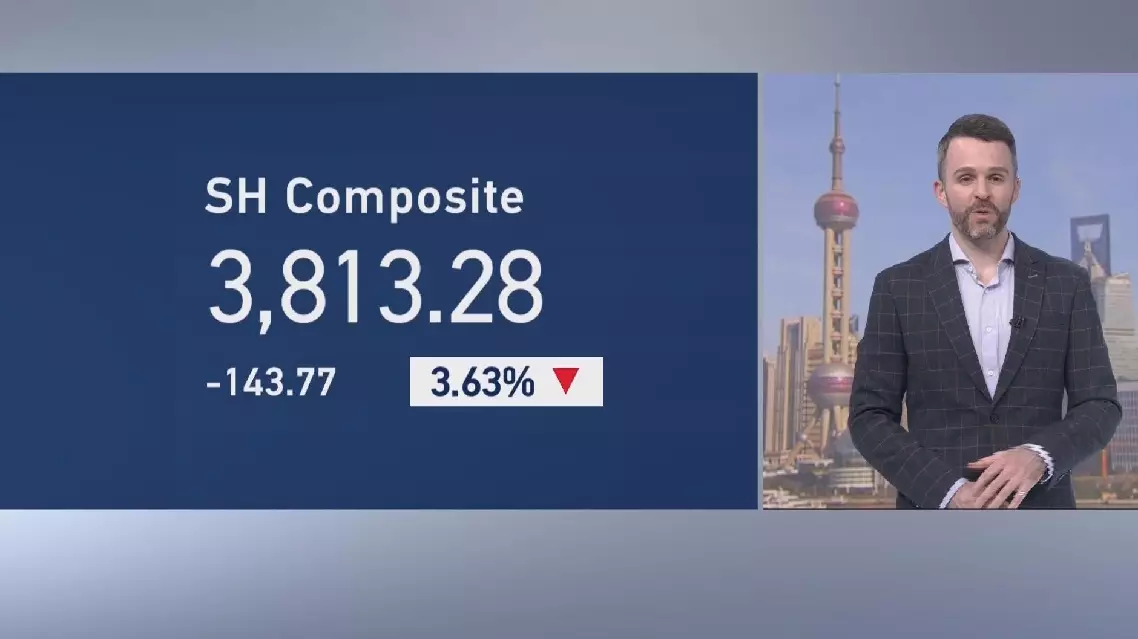
The benchmark Shanghai Composite Index was down 3.63 percent to 3,813.28 points.

The Shenzhen Component Index closed 3.76 percent lower at 13,345.51 points.

The ChiNext Index, tracking China's Nasdaq-style board of growth stocks, lost 3.49 percent to close at 3,235.22 points.

Timothy Pope, a market analyst for China Global Television Network (CGTN), said there are concerns that rising oil prices may drive up inflation around the world and impact the global demand for Chinese exports.

"Today the Chinese mainland markets looked like they were preparing for an oil shock. The Shanghai Composite Index shed 3.6 percent. The Shenzhen Component Index was down 3.75 percent. And this follows on from last week, which was the worst for the Chinese equities since November. The increase in tensions in the war with Iran, which have seen a U.S. ultimatum and more threats from the Iranian side as well, have added extra anxiety to an already jittery global marketplace. We talked last week of concerns that war-driven inflation could impact the Chinese economy, and we could be looking at lower demand for Chinese exports if there's significant fallout from rising global oil prices," said Pope.

He said Monday's sell-off was very broad.

"Investors backed out of pretty much everything from tech to consumer stocks. Energy stocks were about the only sector doing OK, although they too were broadly negative by the close of the trade. There were some gains for oil exploration stocks, coal producers and new energy providers. But that was nothing like enough to offset the heavy losses that we saw elsewhere. Agriculture stocks took a beating as well. They are expected to see costs rise as a result of the bottleneck for oil getting out of the Middle East. Also, fertilizer too. We've learned that the Middle East is a major fertilizer production hub," said Pope.
Chinese shares plunge amid growing tensions in Middle East


Chinese shares plunge amid growing tensions in Middle East

The Hong Kong and Tokyo stock markets plunged on Monday as investors are becoming increasingly worried about the prolonged conflict in the Middle East, which could potentially change the outlook for inflation and interest rates, according to a market analyst.

Hong Kong's stock market ended lower Monday with the benchmark Hang Seng Index down 3.54 percent to close at 24,382.47 points.

The Hang Seng China Enterprises Index fell 3.11 percent to end at 8,307.82 points, while the Hang Seng Tech Index fell 3.28 percent to end at 4,712.48 points.

Timothy Pope, a market analyst for China Global Television Network (CGTN), said stocks in gold producers and jewelry retailers dropped significantly, as precious metal prices tumbled.

"The Hang Seng was also down about 3.5 percent. Only 2 stocks gained on that index -- one the oil producer CNOOC and the other Geely Automobile. Gold producers and jewelry retailers were also down. The spot gold price fell to its lowest level this year today. Last week, actually, was the worst for gold in 43 years. It's down about 10 percent. So, that's the worst loss it has had since 1983 when the Volcker Fed rate hikes really crushed spot gold. And today marked the 9th session in a row of declines for the precious metal -- silver and platinum prices are also down. This turnaround for gold is essentially down to the fact that the war has completely flipped the inflation and interest rate outlook for many developed economies. A few weeks ago, we were looking at a market which expected rate cuts this year in the U.S., UK and Europe. Now rate hikes are back on the agenda and gold is a lot less appealing because it's not a yielding asset," said Pope.

Tokyo stocks ended sharply lower on Monday, with the benchmark Nikkei stock index falling to its lowest level since Jan 8.

The 225-issue Nikkei Stock Average ended down 1,857.04 points, or 3.48 percent, from Thursday at 51,515.49, after briefly losing over 2,600 points.

"The Nikkei 225 slid 3.5 percent, that was a very popular fall today, being down about 5 percent earlier on in the session. It's worth noting as well how the war has also completely flipped the outlook for the Nikkei. Before, the projections were broadly for a fairly steady path towards 60,000 points for the index. Now, we are looking at the very realistic prospect that it will slip below 50,000 points quite soon. Japan also gets about 90 percent of its oil from the Middle East, which obviously makes the country very exposed to the current conflict. Today we saw all the heavyweight stocks like Advantest plunging and 95 percent of Japanese prime equities actually traded lower this session," said Pope.

Hong Kong, Tokyo stock markets plunge on Monday as Middle East conflict continues

Hong Kong, Tokyo stock markets plunge on Monday as Middle East conflict continues

Recommended Articles