Skip to Content Facebook Feature Image

High cost-performance key advantage of China's AI models

China

China

China

High cost-performance key advantage of China's AI models

2026-03-23 20:35 Last Updated At:03-24 00:37

The large artificial intelligence (AI) models developed by Chinese technology firms with high cost-performance have been attracting more and more users both at home and abroad.

Data from a top global AI platform, OpenRouter, showed that API calls, or user visits, to Chinese large models began surpassing U.S. levels in February, highlighting China's rising influence in the global AI ecosystem.

Chinese models occupy three of the top five spots globally by usage -- MiniMax's M2.5, Moonshot's Kimi K2.5 and DeepSeek's V3.2 -- mainly driven by their high cost-performance, according to the platform.

"For instance, it would take me five to 10 minutes to create such an e-commerce website. It's high in efficiency and cost performance. Because the model scale is small, its cost is not that high, about three to five yuan, which is much cheaper," said Liang Li, product manager of MiniMax, a company for multi-modal models and AI-native products.

MiniMax's M2.5 has topped the global call volume chart for five consecutive weeks.

"Compared with us, overseas models of the same capability level are more than 10 times the price of ours. Seeing the similar capabilities while at much lower price, users will naturally choose us. [We hope] more people enjoy artificial intelligence while it doesn't impose a higher burden on them in terms of cost," said Yan Yijun, vice president of the MiniMax.

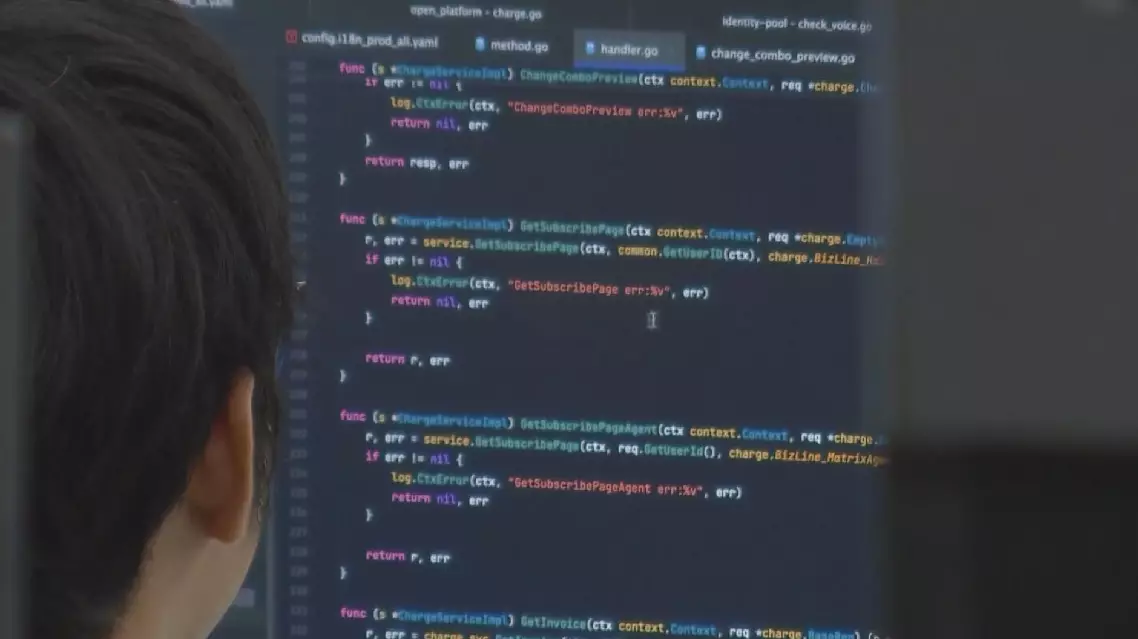
The first key factor of the high cost-performance is technological innovation. In simple terms, it means completing the same task with fewer tokens, units of data processed by AI models.

Another key factor is the energy advantage. Stable energy supply and low electricity prices contributed a more competitive cost for China's AI industry.

"In China, we have a lot of quantity of energy at low prices. This was really a strategic long-term planning that was done before that today supports the AI industries and is able to keep prices affordable for electricity, but also for AI as well," said Giacomo Ficari, head of international business for Kimi, an AI chatbot, at Moonshot AI, an AI company based in Beijing.

"Seeing from the evolution of the computing power market, there are basically two models. One is the single card with the price of about 10 yuan an hour; the other is charged according to token. When calculated based on millions of tokens, it is much cheaper. The domestic products are at 0.2 yuan per million tokens," said Sun Tao, president of Worki, a cloud service provider.
High cost-performance key advantage of China's AI models
High cost-performance key advantage of China's AI models

Global business leaders gathering in Beijing for the China Development Forum 2026 said that they remain optimistic about China's role as a key driver of growth and are committed to deepening their presence in the Chinese market.

Themed "China in its 15th Five-Year Plan period: advancing high-quality development and creating new opportunities together", the two-day forum, which kicked off on Sunday, highlighted China as a key engine of global development as the country begins its 15th Five-Year Plan (2026-2030).

Patrick Pouyanne, chairman and CEO of TotalEnergies, a French energy giant, acknowledged the growing barriers in global energy cooperation, but stressed that both China and Europe share a common path toward green energy.

"We have observed more barriers, in fact, we see a lot of, I would say, non-cooperative attitude, I am still convinced, in particular, in the field of energy. But in fact, both China and Europe have exactly the same strategy, which is going to more green energy, which is a way to combine security with supply and China is leading the way," he said.

Philippe Delorme, president and CEO of KONE Corporation, a global leader in the elevator and escalator industry, said that Finnish Prime Minister Petteri Orpo's visit to China from January 25 to 28 has reinforced trust, mirroring the strong relationships KONE has built with its Chinese partners.

"Prime Minister Orpo went to China to reinforce the trust that has been built over time, which is actually very parallel to the trust that KONE has been building with the China-based ecosystem and its customers," he said.

Judy Marks, CEO and president of American elevator maker Otis emphasized the company's strong commitment to China, highlighting the access and enthusiasm she experiences on every visit.

"Well, every time I come to China, my agenda is packed, and I want it that way. I want to see our colleagues, I want to see our business partners, I want to see government officials. And guess what, in China, every time we have that access. It's always an exciting time in China. We're investing and we're here to stay," she said.

Rogier Janssens, president of Merck China, talked about his professional journey of returning to China, drawn by the country's rapid pace of development and the opportunities he sees unfolding.

"I am not new to China. I'm also not new to Merck. I ran the healthcare business for Merck between '17 and '22 out of Beijing. It's interesting. Actually, at some point in time, I was thinking about after 35 years of working in the pharmaceutical industry, I thought maybe I needed to slow down a little bit and take it easy. Maybe I'd take a job at the headquarters or something like that. But in reality, I thought no. There needs to be a bit more excitement and I'm super excited about what I'm seeing and hearing. I mean the speed of China, the way things are development so rapidly here," he said.

Since its inception in 2000, the China Development Forum has become one of the country's major platforms for dialog among Chinese government officials, global business leaders, international organizations, and scholars.

Global business leaders express confidence in China's market

Global business leaders express confidence in China's market

Recommended Articles