Skip to Content Facebook Feature Image

Record-smashing heat continues: 'Basically the entire US is going to be hot'

News

Record-smashing heat continues: 'Basically the entire US is going to be hot'
News

News

Record-smashing heat continues: 'Basically the entire US is going to be hot'

2026-03-24 10:35 Last Updated At:12:51

After smashing March heat records in 14 states and the U.S. as a whole, the gigantic heat dome that's baked the Southwest is creeping eastward and may end up being one of the most expansive heat waves in American history, meteorologists and weather historians said.

And it's not going away for awhile, maybe not till the middle of the next week as April starts, said meteorologist Gregg Gallina of the National Weather Service's Weather Prediction Center.

“Basically the entire U.S. is going to be hot,” Gallina said Monday. “The area of record temperatures is extremely large. That's the thing that's really bizarre.”

This heat dome — in which high pressure is acting like a pot lid trapping hot air over a region — will leave Flagstaff, Arizona, with 11 or 12 straight days of temperatures higher than the city's previous March record, said meteorologist Jeff Masters of Yale Climate Connections.

Gallina said the dome's eastward movement will mean temperatures in the 90s Fahrenheit (mid-30s Celsius) by Wednesday over the southern and central plains. From one-quarter to one-third of the 48 continental states will be flirting with records for March, Gallina said.

The physical area of this heat wave likely dwarfs two other historic heat waves — one in 2012 in the Upper Midwest and Northeast and another in 2021 in the Pacific Northwest — according to weather historian Chris Burt, author of the book “Extreme Weather.” It may not be as large as the Dust Bowl heat waves of 1936, but that was a series of heat waves over two months during summer, not a single big event like now, Burt said.

Both the Dust Bowl and the 2021 heat wave were more intense, with higher temperatures that hurt people more because they fell in June and July, Gallina said.

Another saving grace for people in this heat wave is that it's not as humid as it would be if the temperatures rose in the summer, Gallina said.

On Friday, four places in Arizona and California hit 112 degrees (44.4 degrees Celsius), according to the Weather Service. Not only did that smash the record for the hottest March day in the continental United States by 4 degrees (2 degrees Celsius), but it was only 1 degree shy of the hottest day recorded in the Lower 48 in April.

Climatologist and weather historian Maximiliano Herrera, who tracks global weather records, compiled a list of 14 states that have notched their hottest March day on record since this heat dome started: California, Arizona, Nevada, Kansas, New Mexico, Nebraska, Utah, South Dakota, Missouri, Iowa, Colorado, Wyoming, Minnesota and Idaho.

“In Mexico, even May records were trashed with March records broken by as much as 14 (degrees Fahrenheit), far more than July 1936, March 1907 or June 2021,” Herrera wrote in an email.

The National Center for Environmental Information registered at least 479 weather stations breaking records for March from Wednesday through Saturday, based on its network of stations. Herrera, who analyzed a broader set of data, said the true number is likely higher. Another 1,472 daily records — which are easier to break — were shattered at the same time, the center said.

What's happening is the jet stream — which moves weather systems from west to east — is pretty much stuck as far westward as the storms dousing Hawaii, where people are seeing torrential rains and flooding, Masters and Gallina said.

On Friday, a group of international climate scientists called World Weather Attribution determined that the record heat was "virtually impossible'' and 800 times more likely because of climate change from the burning of coal, oil and natural gas. The result of those activities added at least 4.7 degrees (2.6 degrees Celsius) to the heat, said report co-author Clair Barnes, an Imperial College of London scientist with the group.

The heat dome will move on by late next week, Masters said: “We just have to give it time.”

The Associated Press’ climate and environmental coverage receives financial support from multiple private foundations. AP is solely responsible for all content. Find AP’s standards for working with philanthropies, a list of supporters and funded coverage areas at AP.org.

A jogger runs past as a man sunbathes at Crissy Field in San Francisco, Tuesday, March 17, 2026. (AP Photo/Godofredo A. Vásquez)
A jogger runs past as a man sunbathes at Crissy Field in San Francisco, Tuesday, March 17, 2026. (AP Photo/Godofredo A. Vásquez)

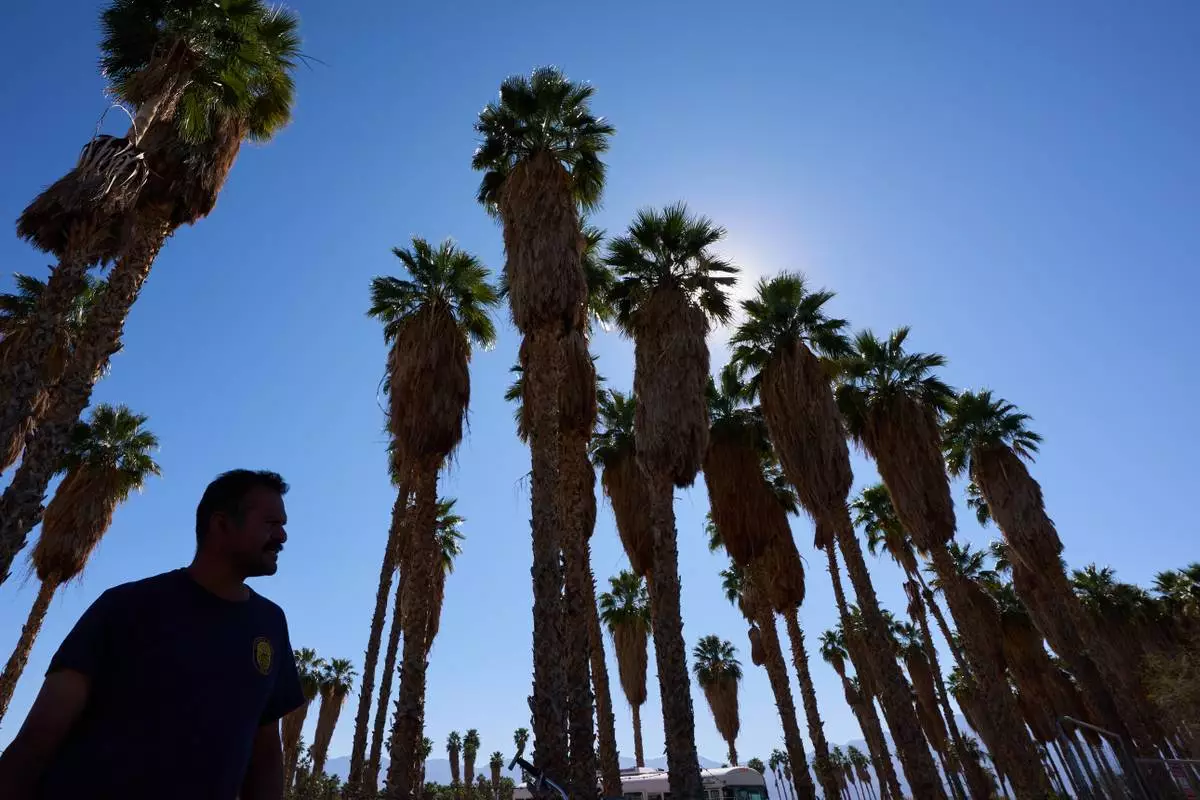
Rubin Pantaleon stays in the shade while waiting for work washing car windshields as a record-breaking winter heat wave continues across the Southwest, Thursday, March 19, 2026, in Thermal, Calif. (AP Photo/Gregory Bull)
Rubin Pantaleon stays in the shade while waiting for work washing car windshields as a record-breaking winter heat wave continues across the Southwest, Thursday, March 19, 2026, in Thermal, Calif. (AP Photo/Gregory Bull)

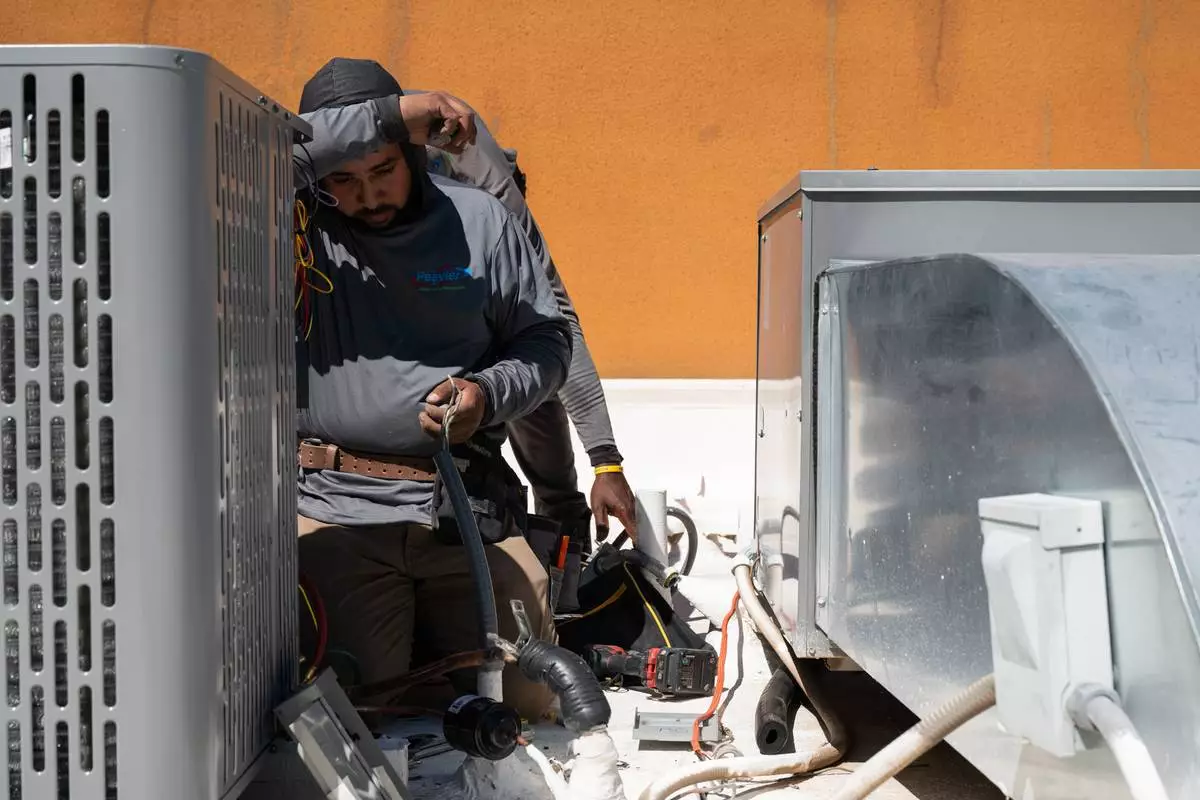
Brian Hermosillo wipes sweat from his brow while installing a new air conditioning unit during record-breaking heat Thursday, March 19, 2026, in Tempe, Ariz. (AP Photo/Caitlin O'Hara)
Brian Hermosillo wipes sweat from his brow while installing a new air conditioning unit during record-breaking heat Thursday, March 19, 2026, in Tempe, Ariz. (AP Photo/Caitlin O'Hara)

MELBOURNE, Australia (AP) — The European Union and Australia on Tuesday agreed on the final text of a free trade agreement, some two years after negotiations broke down over Australian demands for more red meat market access and complaints about Australian products labeled with traditionally European names such as prosecco.

The breakthrough comes as both the EU and Australia seek to diversify their trading networks and reduce their economic reliance on China and exposure to uncertain U.S. tariffs.

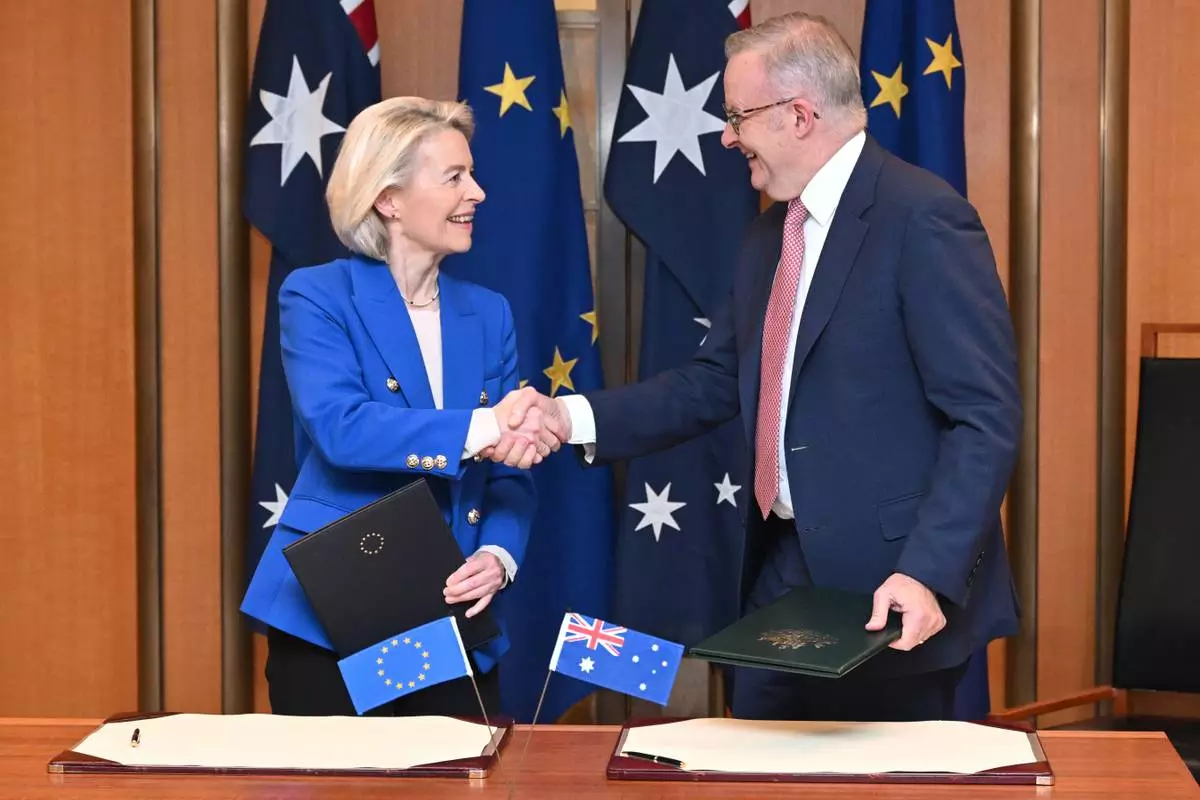
European Commission President Ursula von der Leyen and Australian Prime Minister Anthony Albanese signed the agreement at the Australian Parliament House after protracted negotiations that began in 2018. The leaders said the pact demonstrated that both sides benefitted from rules-based trade.

“Today we are telling an important story to a world that is deeply changing. A world where great powers are using tariffs as a leverage and supply chains as vulnerabilities to be exploited," von der Leyen told reporters.

"In our story, open rules based trade delivers positive some outcomes. Trust matters more than transactions,” she added.

Albanese said the context in which the agreement was reached was an important factor in allowing negotiations that collapsed in October 2023 to restart.

“This is both the European Union and Australia asserting that we believe in free and fair trade, that we understand that trade advances the prosperity of both trading entities who are involved, that it is in our interest to get this done,” Albanese said.

The leaders also announced a new defense partnership that will bring closer military cooperation and the start of negotiations toward Australia becoming an associate of the research and innovation funding program Horizon Europe.

Albanese said the defense partnership would provide a framework for the EU and Australia to cooperate on global challenges, marking as areas of collaboration defense industries, maritime security, cyber security, countering terrorism and combating hybrid threats such as disinformation.

“It shows our shared commitment to global peace and security, including reaffirming our steadfast support for Ukraine in the face of Russia’s illegal full-scale invasion,” Albanese said.

Albanese said the pact also removed tariffs on key Australian exports including wine, seafood and horticulture.

The EU will open two tariff rate quotas of a total of 30,600 metric tons (33,731 U.S. tons) for Australian red meat, with 55% of that duty free.

Under the trade deal, Australian producers of prosecco, traditionally a sparkling wine from northern Italy, will be banned from using the name on exports 10 years after the pact takes effect.

A start date for the pact has not been announced.

The pact will also help the EU secure supplies of critical raw materials including lithium and tungsten.

Hazel Moir, an economist from the Australian National University’s Center for European Studies, said that both the Europeans and Australians were keen to reach a deal in response to U.S. President Donald Trump's push to impose global tariffs.

“What’s changed is all of Trump’s behavior on tariffs. So everyone got nervous and they wanted to do other things,” Moir said.

Moir said it was too soon predict the impact on bilateral trade, as the agreement's full text has not yet been released.

An EU free trade deal with four South American countries will begin on May 1 after more than a quarter-century of negotiations and new global economic uncertainty.

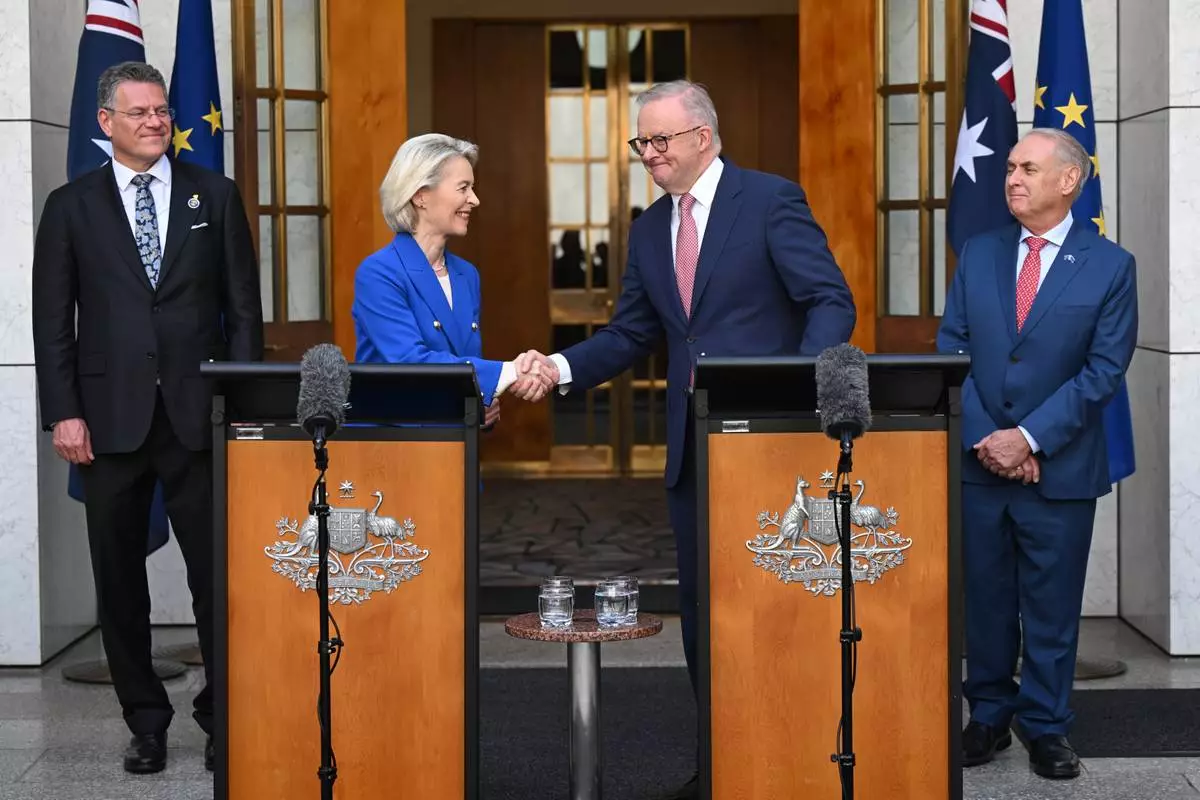
European Commission President Ursula von der Leyen, center left, and Australian Prime Minister Anthony Albanese shake hands after an agreedment on the final text of a free trade agreement at Parliament House in Canberra, Tuesday, March 24, 2026, as EU Commissioner for Trade and Economic Security Maros Sefcovic, left, and Australian Minister for Trade, Don Farrell, right, look on. (Lukas Coch/AAP Image via AP)

European Commission President Ursula von der Leyen, center left, and Australian Prime Minister Anthony Albanese shake hands after an agreedment on the final text of a free trade agreement at Parliament House in Canberra, Tuesday, March 24, 2026, as EU Commissioner for Trade and Economic Security Maros Sefcovic, left, and Australian Minister for Trade, Don Farrell, right, look on. (Lukas Coch/AAP Image via AP)

European Commission President Ursula von der Leyen, left, and Australian Prime Minister Anthony Albanese shake hands after signing a joint statement during a ceremony at Parliament House in Canberra, Tuesday, March 24, 2026. (Lukas Coch/AAP Image via AP)

European Commission President Ursula von der Leyen, left, and Australian Prime Minister Anthony Albanese shake hands after signing a joint statement during a ceremony at Parliament House in Canberra, Tuesday, March 24, 2026. (Lukas Coch/AAP Image via AP)

Recommended Articles