MARLBOROUGH, Mass.--(BUSINESS WIRE)--Mar 24, 2026--
ExaGrid®, the leader in Tiered Backup Storage, today announced that CRN UK—a brand of The Channel Company—has selected Andy Walsky, VP of EMEA & APAC Sales, for inclusion on the prestigious 2026 CRN ® Channel Leaders EMEA list. This annual recognition celebrates IT vendor and distribution executives who are shaping channel strategy and driving innovation and partnership across the industry.
This press release features multimedia. View the full release here: https://www.businesswire.com/news/home/20260324173870/en/
ExaGrid works with resellers and distributors worldwide. The ExaGrid channel programs are designed to be easy for partners, with support from the ExaGrid sales team and without milestone commitments. ExaGrid is known for having a Tiered Backup Storage system that “just works,” is not oversold or undersized, and provides its customers with the best customer support in the industry with an assigned level 2 technical support engineer, ensuring that partners’ customers are well taken care of. ExaGrid provides its reseller partners with a registration program to protect accounts and margins, and SPIF incentives.
“I am honored to be named to this list again in 2026, and grateful to CRN UK for its continued coverage of the EMEA region,” said Andy Walsky. “Working with channel partners is the key to success for any company and must be treated with the highest priority. My channel philosophy is to treat the channel as you would want to be treated yourself, always be fair and keep your word. Developing trust with channel partners is critical. I have deep respect for the work our channel partners do every day.”
The annual CRN Channel Leaders EMEA list spotlights the most influential leaders across the IT channel, celebrating those who champion collaboration, drive innovation and empower their partners and customers to achieve shared success.
“As my team and I reviewed this year’s Channel Leaders EMEA entries, one thing came through loud and clear: a deep, long-standing respect for the channel community. We want to thank these Channel Leaders for being so open about both their strategies, and what drives them as people. Across EMEA’s diverse markets and many years of change, we're proud to recognise their ongoing commitment and the role they continue to play in strengthening the channel,” said Nima Sherpa Green, EMEA Editorial Director, CRN, The Channel Company.
CRN’s 2026 Channel Leaders EMEA list will be featured on channelweb.co.uk.
About ExaGrid
ExaGrid provides Tiered Backup Storage with a unique disk-cache Landing Zone, long-term retention repository, scale-out architecture, and comprehensive security features, including AI-Powered Retention Time-Lock to recover from a ransomware attack. ExaGrid’s Landing Zone provides for the fastest backups, restores, and instant VM recoveries. The Repository Tier offers the lowest cost for long-term retention. ExaGrid’s scale-out architecture includes full appliances and ensures a fixed-length backup window as data grows, eliminating expensive forklift upgrades and planned product obsolescence. ExaGrid offers the only two-tiered backup storage approach with a non-network-facing tier (tiered air gap), delayed deletes, and immutable objects to recover from ransomware attacks.
ExaGrid has physical sales and pre-sales systems engineers in the following countries: Argentina, Australia, Austria, Benelux, Brazil, Canada, Chile, CIS, Colombia, Czech Republic, France, Germany, Hong Kong, India, Israel, Italy, Japan, Mexico, Nordics, Poland, Portugal, Qatar, Saudi Arabia, Singapore, South Africa, South Korea, Spain, Switzerland, Turkey, United Arab Emirates, United Kingdom, United States, and other regions.
Visit us at exagrid.com or connect with us on LinkedIn. See what our customers have to say about their own ExaGrid experiences and learn why they now spend significantly less time on backup storage in our customer success stories. ExaGrid is proud of our +81 NPS score!
ExaGrid is a registered trademark of ExaGrid Systems, Inc. All other trademarks are the property of their respective holders.
About The Channel Company
The Channel Company (TCC) is the global leader in channel growth for the world’s top technology brands. We accelerate success across strategic channels for tech vendors, solution providers, and end users with premier media brands, integrated marketing and event services, strategic consulting, and exclusive market and audience insights. TCC is a portfolio company of investment funds managed by EagleTree Capital, a New York City-based private equity firm. For more information, visit thechannelco.com.
Follow The Channel Company:LinkedIn, X, and Facebook
© 2026 The Channel Company, Inc. CRN is a registered trademark of The Channel Company, Inc. All rights reserved.

Andy Walsky of ExaGrid Honored as A 2026 CRN EMEA Channel Leader
GENEVA (AP) — Scientists in Geneva took some antiprotons out for a spin — a very delicate one — in a truck, in a never-tried-before test drive that has been deemed a success.
If this so-called antimatter came into contact with actual matter, even for a fraction of an instant, it would have been annihilated in a quick flash of energy. So experts at the European Organization for Nuclear Research, known as CERN, over the course of four hours Tuesday, brought about 100 antiprotons on the road.
The antiprotons were suspended in a vacuum inside a specially designed box and held in place by supercooled magnets.
After easing them from the lab and onto the truck, the scientists transported the antimatter on a half-hour drive to test how — if at all — the infinitesimal particles could be transported by road without seeping out. The antiprotons were then taken back to the lab in Tuesday's final stage.
CERN spokeswoman Sophie Tesauri called the experiment successful. It was not immediately clear how many antiprotons had survived the entire journey, but roughly 91 of 100 were still there after the truck's trip.
The hard part: Manipulating antimatter, like antiprotons, can be tricky business. As scientists understand the universe today, for every type particle that exists, there is a corresponding antiparticle, exactly matching the particle but with an opposite charge.
If those opposites come into contact, they “annihilate” each other, setting off lots of energy, depending on the masses involved. Any bumps in the road on the test journey that aren't compensated for by the specially-designed box could spoil the whole exercise.
Tuesday’s practice is a first step toward making good on hopes, one day, to deliver CERN antiprotons to researchers at Heinrich Heine University in Düsseldorf, Germany, which is about eight hours away in normal driving conditions.
The antiprotons were encased in a 1,000-kilogram (2,200 pounds) box called a “transportable antiproton trap.” It was compact enough to fit through ordinary laboratory doors and fit on a truck. It used superconducting magnets cooled to -269 degrees Celsius (-452 Fahrenheit) that allowed the antiprotons to be remain suspended in a vacuum — not touching the inner walls, which are made of ... matter.
The mass in Tuesday's test — slightly less than that of about 100 hydrogen atoms — is so little, experts say, that the worst possible outcome was the loss of the antiprotons. Even if they did touch matter, any release of energy would be unnoticeable, only an oscilloscope, which picks up electrical signals, was be able to detect it.
The trap, says Tesauri, “is supposed to contain these antiprotons no matter what: if the truck stops, if it starts again, if it has to slam on the brakes — all that.” Work remains: The trap can contain the antiprotons on its own for only about four hours, and the drive to Düsseldorf is twice that.
The Geneva-based center is best known for its Large Hadron Collider, a network of magnets that accelerates particles through a 27-kilometer (17-mile) underground tunnel and slams them together at velocities approaching the speed of light. Scientists then study the results of those collisions.
But the sprawling, buzzing complex of scientific experiment is more than just about smashing atoms together: the World Wide Web, for example, was invented here by Britain’s Tim Berners-Lee in 1989.
Heinrich Heine University is seen as a better place to study antiprotons in-depth, because CERN — with all its other activities — generates a lot of magnetic interference that can skew the study of antimatter.
But to get them there, those antiprotons will have to avoid touching anything on the way.
The center's Antiproton Decelerator, where a proton beam gets fired into a block of metal, causes collisions that generate secondary particles, including lots of antiprotons. It’s billed as a unique machine that produces low-energy antiprotons for the study of antimatter.
CERN’s “Antimatter Factory,” lab officials say, is the only place in the world where scientists can store and study antiprotons.
The center has been experimenting with antimatter for years, and has made breakthroughs on measurement, storage and interaction of antimatter. Two years ago, the team transported a “cloud” of about 70 protons — not antiprotons — across CERN's campus.
It was a similar drill this time, except that with antiprotons, a much better vacuum chamber is needed, according to Christian Smorra, head of a team behind the apparatus designed to store and transport antimatter.
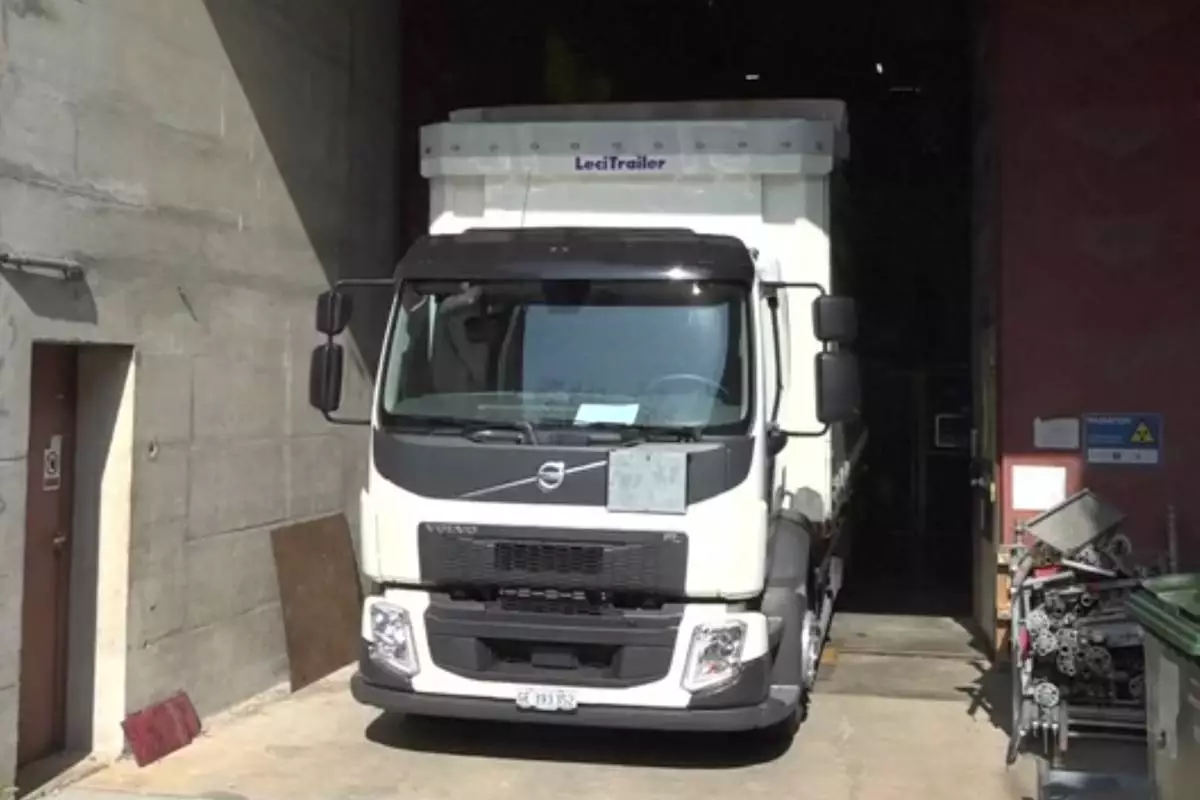
This image, taken from video, shows a truck transporting antiprotons in a first-ever test drive to study antimatter at the European Organization for Nuclear Research, CERN, in Meyrin, near Geneva, Switzerland, March 24, 2026. (AP Photo/Jamey Keaten)
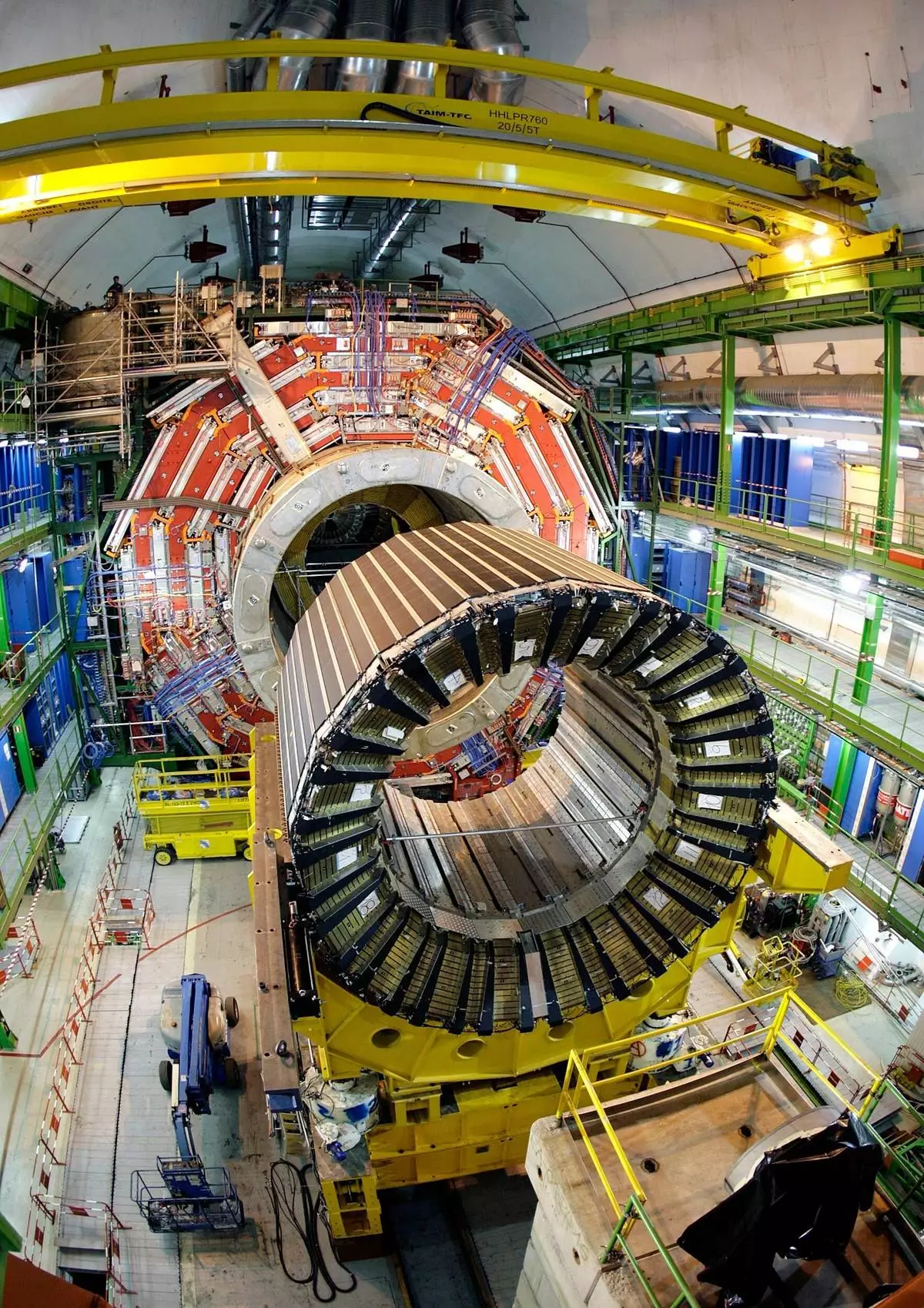
FILE - The magnet core of the world's largest superconducting solenoid magnet (CMS, Compact Muon Solenoid) at the European Organization for Nuclear Research (CERN)'s Large Hadron Collider (LHC) particle accelerator, in Geneva, Switzerland, March 22, 2007. (AP Photo/Keystone, Martial Trezzini, File)
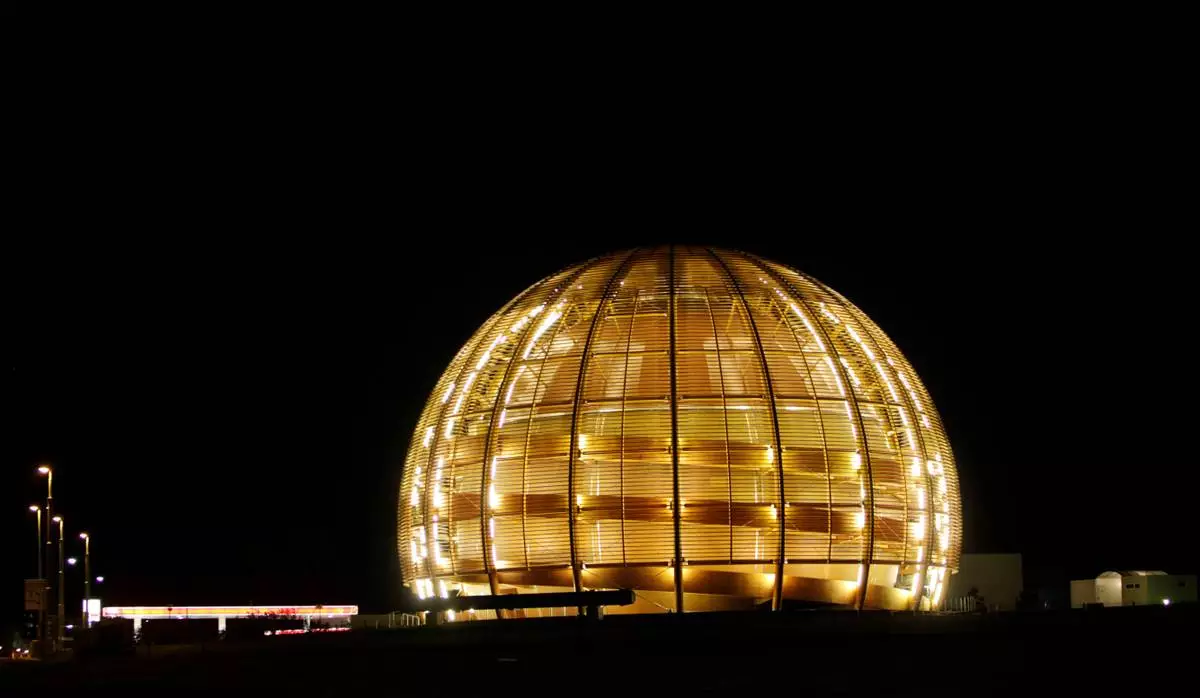
FILE - The globe of the European Organization for Nuclear Research, CERN, is illuminated outside Geneva, Switzerland, March 30, 2010. (AP Photo/Anja Niedringhaus, File)
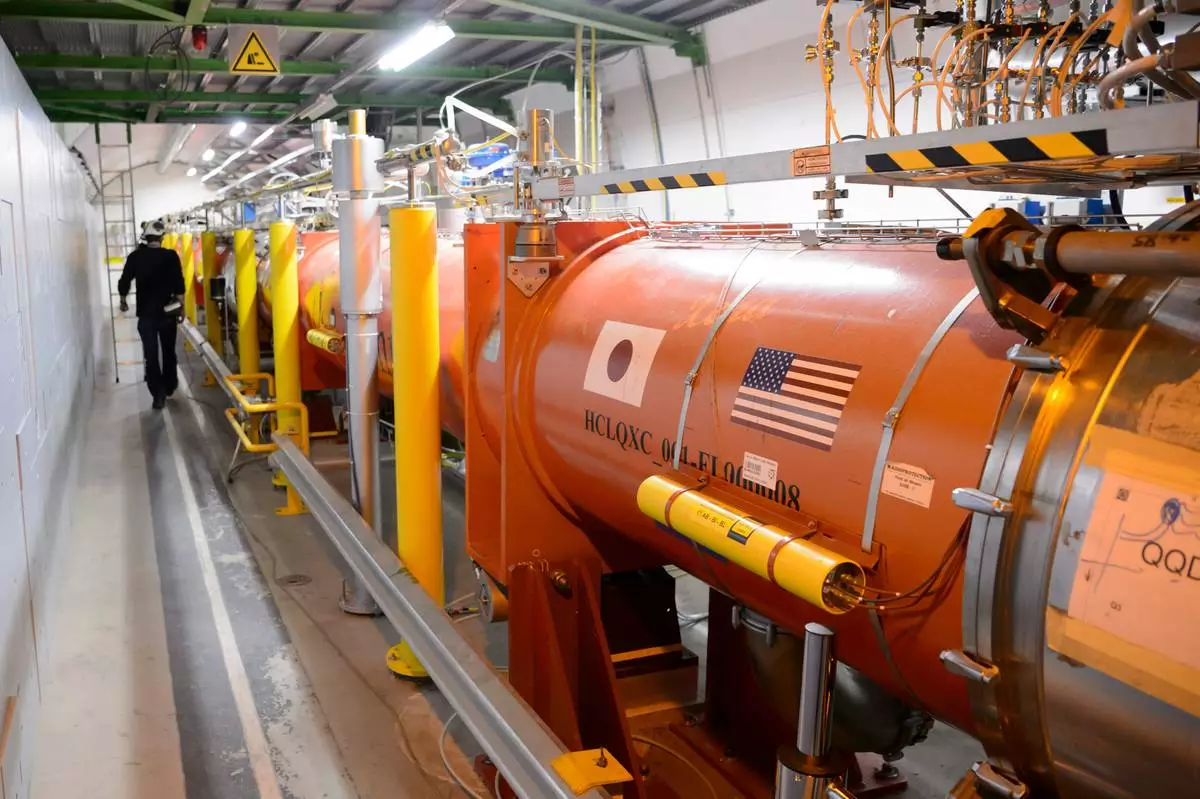
FILE - A technician works in the LHC (Large Hadron Collider) tunnel of the European Organization for Nuclear Research, CERN, during a press visit in Meyrin, near Geneva, Switzerland, Feb. 16, 2016. (Laurent Gillieron/Keystone via AP, File)
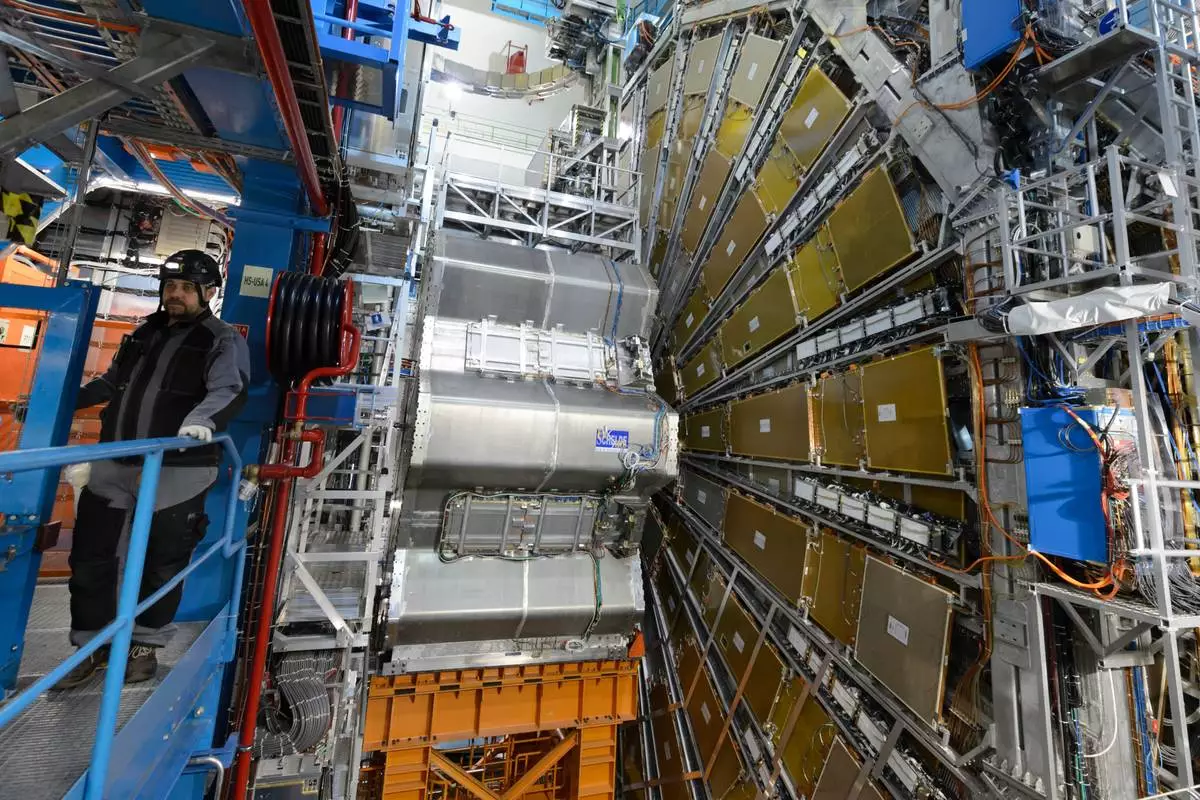
FILE - A technician works in the LHC (Large Hadron Collider) tunnel of the European Organization for Nuclear Research, CERN, during a press visit in Meyrin, near Geneva, Switzerland, Feb. 16, 2016. (Laurent Gillieron/Keystone via AP, File)