Fashion works powered by digital and intelligent technologies such as artificial intelligence (AI) come into the spotlight at the ongoing China Fashion Week in Beijing, demonstrating the appeal of the country's new generation of designers.
The spring session of the 2026 China Fashion Week began in Beijing on Friday last week, shining a spotlight on the fusion of traditional Chinese culture and modern fashion.
With the help of AI, the works integrating Chinese elements and oriental aesthetics have been precisely de-constructed and digitally reconstructed, showcasing the modern appeal of traditional Chinese craftsmanship to global audiences.
"By leveraging AI and digital technology to design textile patterns, we combine classic Chinese elements, including stand collar and knot button, with the western style like suit, waistcoat, and short jacket. Paired with fabrics of varying textures, the design highlights style and grace of traditional clothing," said He Rong, a Chinese fashion designer.
At the Art Museum of the Central Academy of Fine Arts in Beijing, 100 young designers from 59 universities and design institutes nationwide presented their latest fashion works.
Ranging from fully 3D-printed garment fabric to ready-to-wear collection, and from cutting-edge techniques such as laser cutting and digital modeling to creative design, the exhibition showcased the original creativity and culture succession carried by the next generation of design talent.
"Whether it is 3D printing or other digital and intelligent technologies, they fundamentally serve to apply traditional culture to contemporary lifestyles. They may help us bridge the gap between technology and life," said Xie Mengdi, teacher at the School of Design of the Central Academy of Fine Arts.
Centuries-old intangible cultural heritage techniques, reimagined by young designers, have been brought to the runway to offer audiences a renewed expression of oriental aesthetics.
"It's not simply about borrowing past techniques and traditions of intangible cultural heritage, but rather about using new technologies, such as AI, to continuously refine and improve the ability of contemporary Chinese youth to look back at the past and look forward to the future," said Zou You, vice president of the Beijing Institute of Fashion Technology.
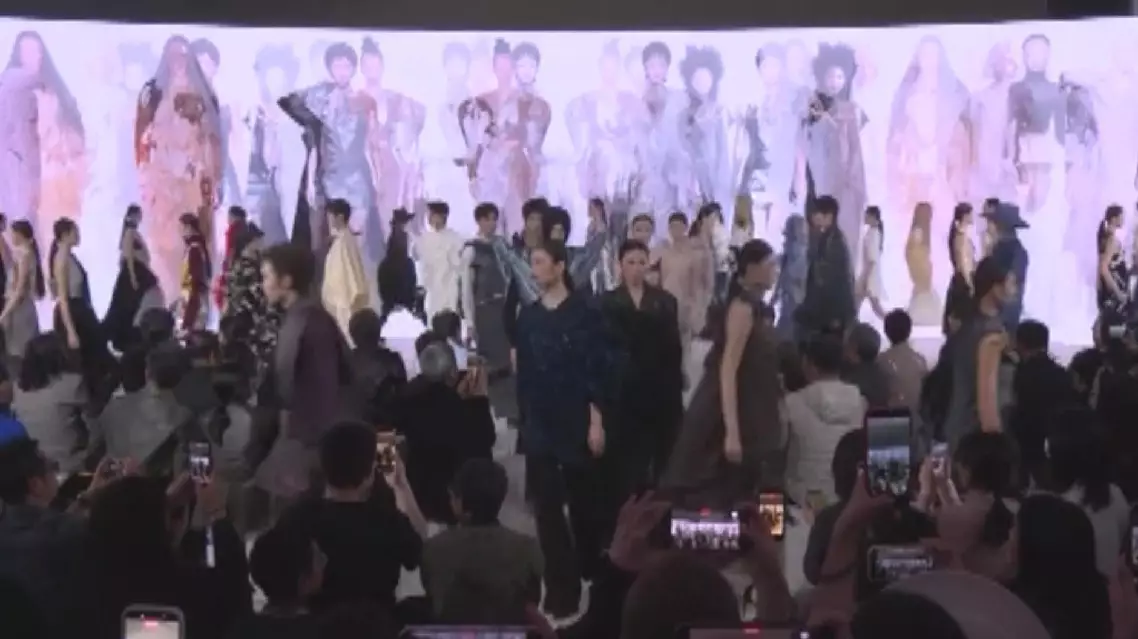
Digital, intelligent technologies take center stage at China Fashion Week in Beijing
Nantong, a city in east China known as the nation's bedding hub, is turning to AI to help local manufacturers tackle the longstanding inventory challenges affecting both domestic and overseas sales.
With a population of 7.7 million, Nantong supplies 60 percent of the world's bedding sets.
Unlike clothing, bedding lacks complex tailoring, making patterns the primary driver of consumer preference. That is allowing some manufacturers to gain a competitive edge by deploying AI design tools.
One of the factories using the technology produces some 20,000 bedding sets a month. Operators use a platform that generates new patterns and renders images in seconds, with a single computer capable of producing thousands of designs daily.
Demand for these services has given rise to a tech firm ecosystem in Nantong, as startups begin specializing in providing AI services to local manufacturers.
One young team has served some 1,300 home textile firms and has generated over 3 million creative designs.
"In the past, one design draft cost between 2,000 and 4,000 yuan. Now AI helps to save costs. For companies, they can use the money saved from product design to improve product quality," said Yuan Zehua, CEO of Sansyn AI.
AI can also assist in quality control. For one local factory with a staff of just 40 employees and machines running around the clock, full-system AI monitoring is vital for identifying problems. As soon as an issue emerges, an on-screen prompt appears, providing operators with ample warning.
The city also has numerous inventory stores selling bedding sets that have remained unsold for extended periods. Most eventually sell as waste fabric, priced by weight.
With AI assistance, many factories now release numerous new styles for market testing before proceeding with mass production. This approach helps manufacturers gauge consumer demand early, reducing the risk of excess inventory.
"We can test different products to provide more choices for customers. Then AI, along with our quick response to the supply chain, could help solve our inventory problems," said Shi Si, general manager of Briney Textile.
However, the technology is not without limitations. AI-generated designs can raise intellectual property (IP) concerns, and even reshape workforce allocation in the textile industry, a sector that has long provided significant employment.
The industry is developing solutions. To address IP issues, AI platforms are building databases to trace design origins and identify the earliest creation.
Meanwhile, century-old textile companies are seeking workers with new skill sets, shifting hiring priorities as automation changes traditional roles.
"Repetitive work is replaced by robots. So we want college graduates to ensure the safe and stable operation of the equipment while ensuring the product quality," said Li Lanyu, director of Innovation Management at Dasheng Group.

China's bedding set hub Nantong harnesses AI to tackle inventory problems