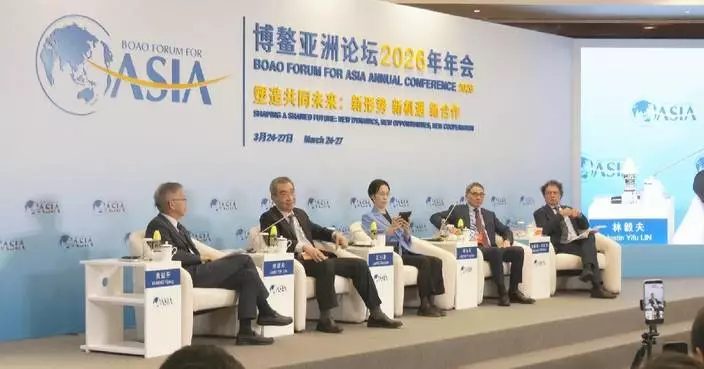
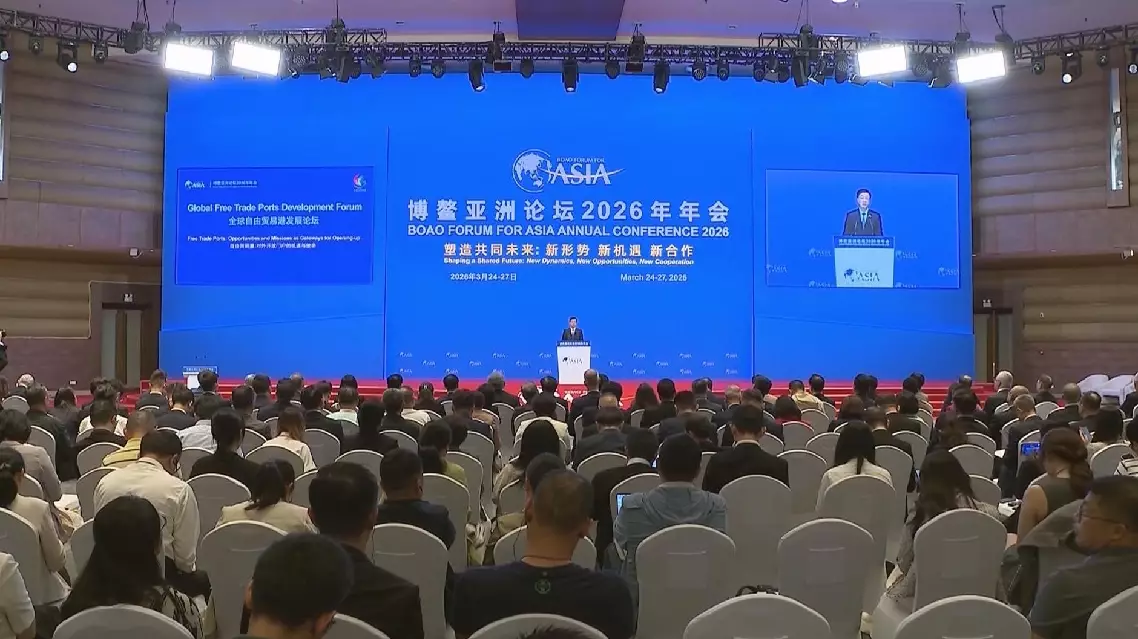
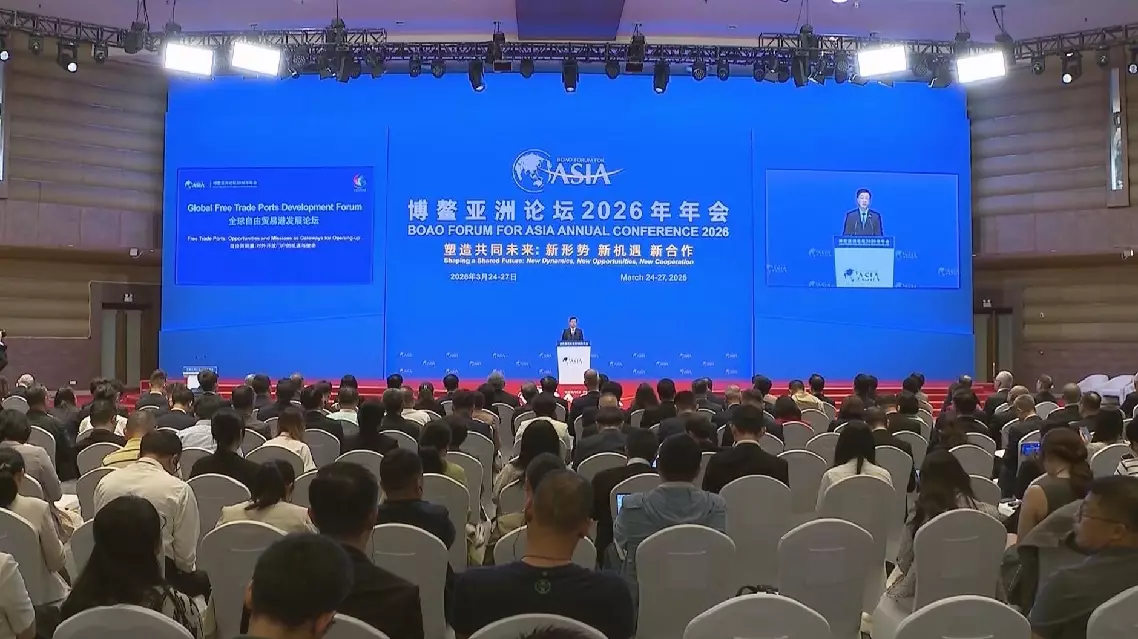
The Global Free Trade Ports Development Forum was held on Tuesday afternoon, focusing on new opportunities for Hainan's opening-up following the implementation of special customs operations.
The forum is one of Hainan's key thematic events under the plenary of the Boao Forum for Asia Annual Conference 2026.
Co-hosted by the Boao Forum for Asia Secretariat and the Hainan Provincial People's Government, this was the first time the forum was held since Hainan's special customs operations began, allowing freer entry of overseas goods and expanding zero-tariff coverage.
Held under the theme "Free Trade Ports: Opportunities and Missions as Gateways for Opening-Up", it attracted participants from more than 20 countries and regions, including representatives from over 10 overseas free trade zones and ports.
Attendees included government officials, representatives from international organizations, leading experts and scholars, and executives from multinational companies.
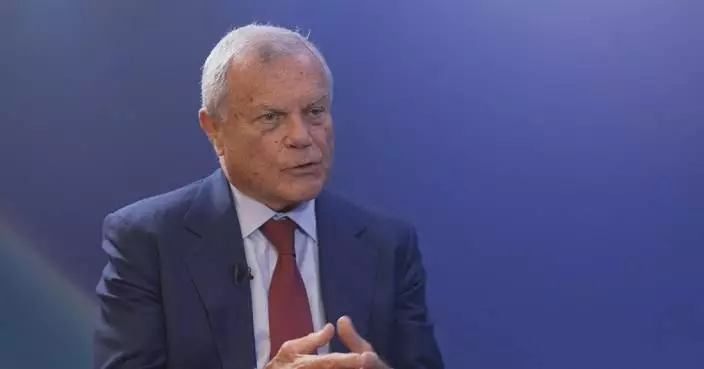
George Yong-Boon Yeo, former Foreign Minister of Singapore, offered his own bold proposal that he said could facilitate the Hainan Free Trade Port's future development.
"Hainan should be able to develop its own free trade agreements, let us say, with Singapore in services and this will encourage movement between Singapore and Hainan, a little extended to other ASEAN countries as well. I think if we have the right conditions, business people will look for the opportunities," said the former official.
Against the backdrop of shifting global geopolitical dynamics and a push toward higher-standard opening-up, the forum focused on three key areas: the role and function of free trade ports as gateways for opening-up; the strategies and pathways to better fulfill this role amid a changing global landscape; and economic and trade cooperation, along with functional connectivity, among free trade ports.
"What's happening also with your port infrastructures and all the efforts that your regional government has been doing in the last year - so it was quite evident to us that in this decision to open ourselves to other places in the world, Hainan could be a nice opportunity to us. And this is why we are back," said Jaume Duch Guillot, regional minister for the European Union and External Action in Spain's Generalitat de Catalunya.
"I think it's so important that we do trade with each other that we integrate each other in each community, in society and economy. That's why I need to come here in order to get contacts, to bring my businesses to China, but also definitely to help Chinese businesses integrating themselves in the European part," said Holger Bingmann, Deputy Secretary General of the International Chamber of Commerce.
Hainan Province last year introduced an action plan to promote high-quality development of air logistics in the region, aiming to accelerate opening-up, expand global cargo networks, and enhance the Hainan Free Trade Port's role as an international air cargo hub.
The plan supports Hainan in developing "two bases" (one for Chinese enterprises expanding globally and another for foreign firms entering China), and "two hubs" (an international shipping hub for the New Western Land-Sea Corridor and a regional aviation gateway to the Pacific and Indian Oceans).
Cai Qiang, Secretary-General of the Hainan Provincial People's Government, said that the Hainan Free Trade Port will continue to play a key role in this regard.
"Hainan, in the current environment, as a landmark initiative to promote an open world economy and demonstrate China's commitment to further opening-up, will play a key role in the 'two hubs and two bases', and continue to push for high-standard opening-up," said Cai.
With the forum serving as a bridge and openness as a driving force, the Hainan Free Trade Port is aiming to accelerate its integration with the global economy.
Global forum on free trade ports explores new opportunities for Hainan's special customs
Global forum on free trade ports explores new opportunities for Hainan's special customs