A robotic data training center in Beijing is training humanoid robots with a wide range of tasks, helping to tackle authentic data shortage, a major hurdle to the large-scale deployment of such robots.
Inside the humanoid robot data training center, the striking synchronization between humans and robots is eye-catching. Cleaning dishes is no longer a chore for robots. Picking fruit, brewing coffee, and folding clothes have become routine. Their versatility owes much to the human trainers working behind the scenes.
Chen Shudong is one of the human mentors for robots. Each day, he and his colleagues train robots on a wide range of tasks to collect movement data. He explained why real-world data is so crucial.
"Once deployed in real environments, robots often struggle with friction, changing light, or background noise. Simulation data alone is not enough to train high-quality models. To bring robots into daily life, we need real-world data to drive the industry forward," he said.
According to Chen, multimodal real-world data -- covering sight, sound, touch, and motion control -- acts as the essential fuel for training AI models, which serve as the robot's brain. AI firms and large-model developers rely on this data to train their own systems. Using exoskeleton equipment, a data collector can gather around 200 data samples per day. But the work is far from repetitive. Chen gave the example of folding towels, a seemingly simple task that presents unexpected challenges.
"A towel is a soft object. Every time you fold a corner, its shape changes completely. During data collection, we have to account for different towel types, colors, and sizes. That means collecting data from various operating scenarios. We also deliberately collect difficult cases -- moments when the robot is likely to make mistakes -- so the model can learn to correct itself," he said.
A skilled data collector must understand how to break down movements and give clear instructions so robots can execute them successfully. Patience and focus are essential.
"Collectors need to ensure the robot's movements are as smooth and natural as a human's, without pauses or stiffness. When people handle objects, they do so in a fluid, continuous way. The robot must learn to replicate that kind of flexible motion," he said.
As humanoid robots move toward mass production, the demand for data keeps growing. In just one year since its opening, Chen's training center has collected tens of thousands of hours of real-machine data. He expects AI companies' data needs to become increasingly varied.
"At first, everyone focused on training a high-quality general-purpose AI model. Later, AI companies need to collect specialized data to address specific weaknesses in their models. When these models are deployed in real-world settings, failures may occur in certain scenarios. Then we need additional data collection to solve those problems," he said.
Currently, more than one million robotics-related companies are operating in China, including over 26,000 newly registered in 2025 alone. The rapid rise of AI and robotics is poised to reshape China's economy, explains Sa Rina, professor from Beihang University.
"Intelligent robots require high-quality sensors, reducers, and high-performance chips. This means China is likely to see an industrial upgrade that blends software and hardware. I believe this will become a new growth engine. With its vast real-world data and complete industrial chain, China is well placed to help shape robot standards and application scenarios. This could allow the country to move from a follower to a leader in this field," she said.
Thanks to the tireless work of Chinese scientists and engineers, robots are steadily becoming part of daily life. Human-robot collaboration is no longer science fiction, it is on the verge of becoming a reality.
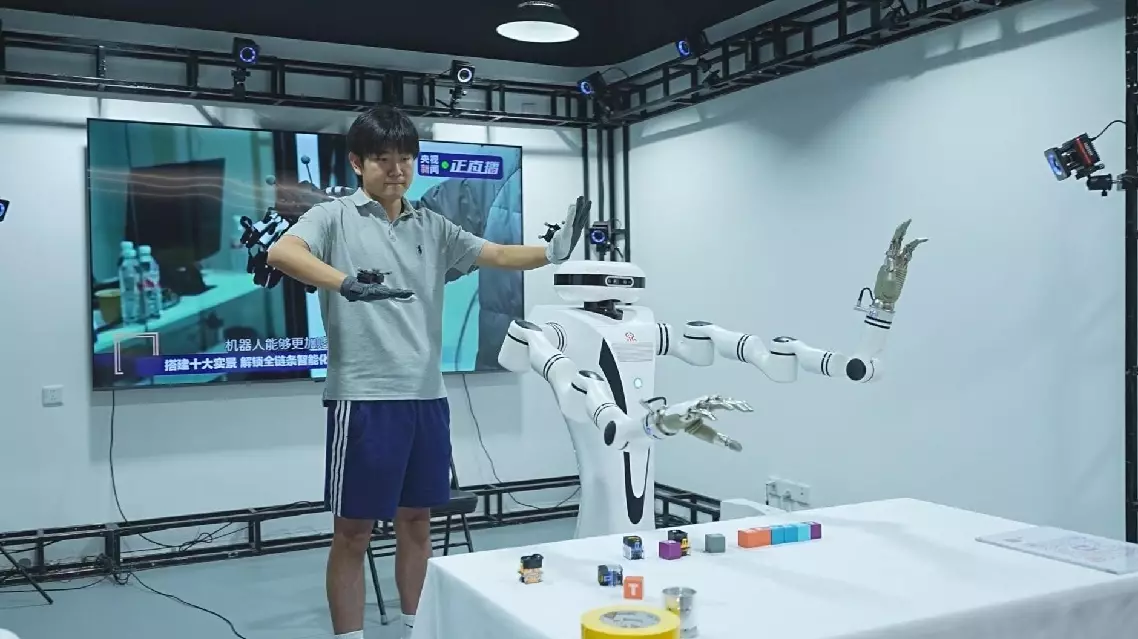
Real world data powers large scale deployment of humanoid robots