As temperatures rise across northeast China's Heilongjiang Province, marigolds are bursting into bloom, bringing bright pops of color and spring vitality to the colder northeast China region where a lingering winter landscape has remained dominant so far in the spring season.
In Hailin City, time-lapse footage captured the cold-hardy flowers emerging among shrubs on hillsides. Standing just five to 15 centimeters tall, the plants slowly unfurled their golden-yellow petals amid patches of remaining snow and dried leaves.
It is one of the earliest blooming herbaceous plants in the colder regions of northeast China, and is often called "the first flower to herald spring in the northeast." The flowering period of marigolds lasts from mid-to-late March through early April.
"In springtime in the north, especially in Harbin, there are very few flowers in bloom right now. You usually only see flowers in greenhouses. It's still quite cold this season, yet the marigold has already emerged. It has that same kind of resilience as plum blossoms," said Di Keying, a student at the Northeast Forestry University.

Marigold flowers add spring vitality to colder northeast China region
Mutually beneficial and win-win results have formed a very important experience for economic growth in Asia, said Justin Lin Yifu, former senior vice president and chief economist of the World Bank, on the sidelines of the Boao Forum for Asia (BFA) Annual Conference 2026 running from Tuesday to Friday in south China's Hainan Province.
Asia remains the world's primary growth engine, with its economy forecast to expand by 4.5 percent in 2026, according to a report released by the BFA on Tuesday.
Asia's share of the global GDP is projected to continue its upward trajectory, rising from 49.2 percent in 2025 to 49.7 percent in 2026 on a purchasing power parity basis, according to the report titled "Asian Economic Outlook and Integration Progress Annual Report 2026."
"Asia has become a main engine for global economic growth, which involves a lot of experience. Facing challenges of the world, Asian countries can provide Asian solutions that are based on our experience," said Lin, also dean of the Institute of New Structural Economics under the Peking University.
The foundations of Asian trade integration have continued to strengthen, the report noted, citing data that intra-regional trade dependence edged up from 56.3 percent in 2023 to 57.2 percent in 2024, as major economies across the region increasingly orient their trade ties toward one another.
"Leveraging respective comparative advantages within the framework of RCEP (Regional Comprehensive Economic Partnership), and using respective growths to create development opportunities for other countries, such mutually beneficial and win-win results form a very important experience for the Asian economy," Lin said.
On the tech front, the report said, the global epicenter of artificial intelligence (AI) development is progressively shifting from Europe and the United States toward Asia.
"Capitalizing on their substantial digital populations, diverse application ecosystems, and coherent policy frameworks, Asian economies are rapidly evolving from AI followers into frontrunners," it said.
Lin said China has various comparative advantages in developing industries of the future represented by AI.
"China has a huge domestic market and rich application scenarios for AI, and as for hardwares required for AI growth, China has the world's most complete manufacturing categories to offer those. That's a great strength," he said.
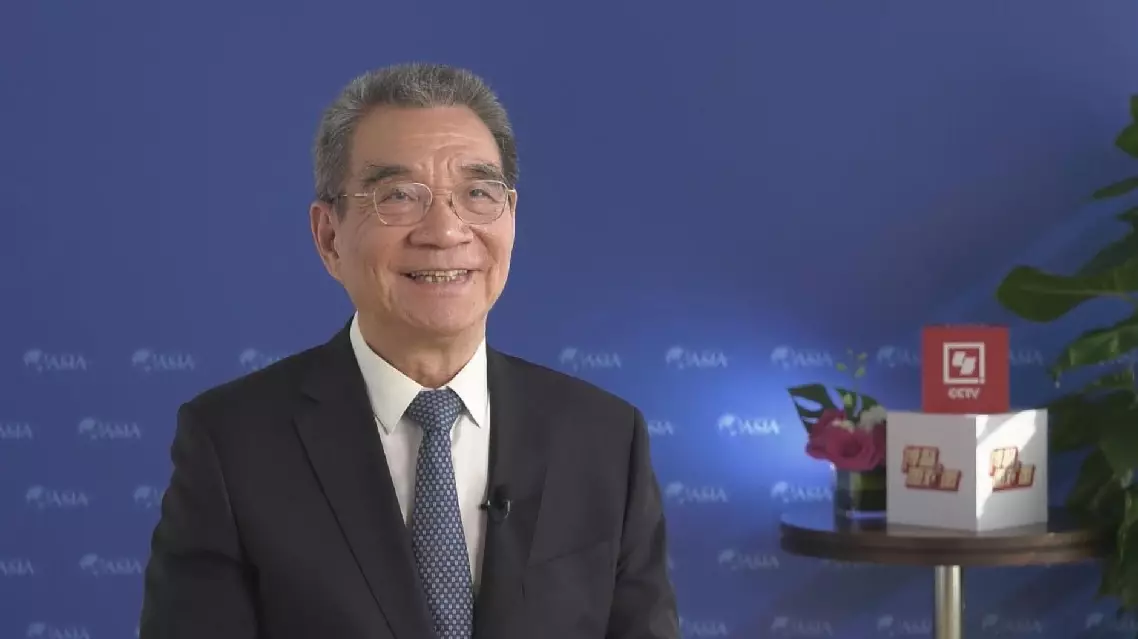
Mutually beneficial, win-win results important experience for Asia's economic growth: expert