Infrared camera has captured video footage of wild golden jackals in the shrubland area of Zhaosu County, northwest China's Xinjiang Uygur Autonomous Region, marking an extension of the species' known distribution range within China.
Previously, golden jackals were confirmed only in the southern part of the Xizang Autonomous Region in southwest China.
The footage was obtained by a research team from the Xinjiang Academy of Forestry Sciences, which deployed infrared cameras in the shrubland last September to monitor local wildlife.
The images provide clear views of golden jackals, whose physical traits distinguish them from other medium to large canids found in Xinjiang, such as wolves and dholes.
The golden jackal is larger than a red fox yet slightly smaller than a wolf. It features a narrower and longer muzzle, a lower tail-to-body length ratio, and long, pointed ears that set it apart from the dhole, which has semicircular ears.
Following the announcement of the discovery, the wildlife protection department in Zhaosu County has stepped up monitoring and patrols around the golden jackals' activity areas to safeguard their habitat and foraging environment.

Wild golden jackals caught on camera in Xinjiang
Thai exporters are leveraging this year's China International Import Expo (CIIE) to seek new opportunities in China as innovation and shifting consumer demand reshape how Thailand's traditional agricultural products are grown, produced and brought to market.
For generations, families in Thailand have made a living from coconut palms, harvesting the fruit by hand and shipping it far beyond the orchards where it is grown.
Natthasak Manusrungsri's family has been exporting aromatic coconuts for more than two decades. But growing demand from China has transformed the scale of their business, driving production, expanding exports and inspiring new ways to bring this familiar fruit to consumers.
"Almost every factory that packs fresh coconuts depends on China as its main market, almost entirely. After Thailand received permission to export coconuts to China, volumes kept rising, driven by trends and by customers becoming more knowledgeable and health-conscious," said Natthasak Manusrungsri, managing director of K-Fresh Co.
But as demand grows, so does the pressure to innovate. Generations of agricultural knowledge are meeting a new generation of ideas.
For Thai producers, China offers enormous opportunities, but competition is intensifying. As consumer preferences change, exporters are shifting their focus beyond simply increasing sales to developing innovative products that offer greater convenience and bring more value to an increasingly competitive industry.
That transformation begins long before the coconuts leave the trees. Across a network of plantations, precision agriculture is helping farmers monitor growing conditions, identify problem areas, and improve yields, while maintaining the quality of Thailand's renowned coconuts.
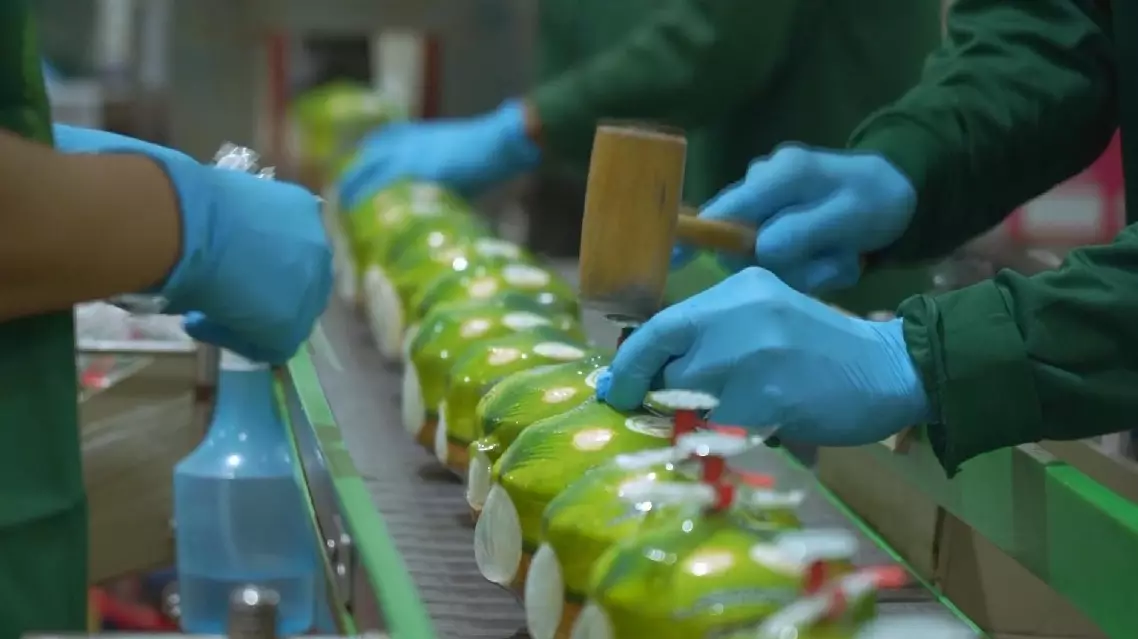
Inside the factory, innovation takes a different form. Even the simple act of opening a coconut has been redesigned. A patented mechanism allows consumers to open it with a push.
"Innovation matters for both the farm and production, so we can deliver the highest quality to our customers. So, we practice precision agriculture. And in the factory, we focus on innovation to make it easier for consumers to open and enjoy, bringing quality products to consumers around the world and in China," said Manusrungsri.
For the farmers who tend these palms, the rhythm of life remains much as it has for generations. But beyond the orchards, almost everything else is changing.
And at CIIE 2026, Thailand's humble coconut is showing how an age-old harvest can find new value in a world of changing tastes and possibilities.
Thai coconut exporter taps CIIE to promote industry innovation