International Atomic Energy Agency (IAEA) Director General Rafael Mariano Grossi hailed China's efforts in nuclear energy development, nuclear-related medical fields and engineering talent cultivation.
In a recent exclusive interview with the China Global Television Network (CGTN) in Beijing, Grossi spoke highly of China's efforts in nuclear energy development as the country has joined the global declaration for triple nuclear energy by 2050.
China, Brazil, Italy and Belgium signed up to the goal of at least tripling global nuclear energy capacity by 2050, bringing the number of signatory countries to 38, according to the Nuclear Energy Summit 2026 held in Paris this month.
"Facts speak louder than words. And when we look at the pace of the growth of the nuclear program here in China, we see already the fleet, which is the second largest fleet of operational reactors in the world. We see already that adding the reactors in construction and more and more that are planned, you could even become the first fleet in the world with different companies, also with the capacity to operate, design and operate all the existing technologies. China is, in this sense, is very eclectic," he said.
The IAEA chief said China shows good momentum in developing nuclear energy.
"China is very competitive, because of the pace of construction. It used to be the case in the West before, but they lost a little bit. They're trying to catch up now. But in China, since you have one reactor after the other, these add an element of enormous efficiency. Because the supply chain is there. The supply chain is constantly working. This is one of the salient characteristics here in China and in these new technologies, like small modular reactors, which are so important," Grossi said.
He also praised IAEA's cooperation with China in fields like treating cancer in least developed countries as well as cultivating engineering talents in the industry.
"The IAEA launched a few years ago, a program which is called Rays of Hope, the rays of radiotherapy and the hope of curing the cancer. The cancer figures worldwide continue to be concerned. So, we have this partnership now here that has a very well developed and advanced human health sector so that we can integrate them as what I call an anchor center. This is what we are going to be doing here, having this capacity to help countries in the region and also in Africa. So, this is one very important focus here. There have been many," Grossi said.
"But the other, of course, has to do with the engineering, of course, which is very important. Here has been at the forefront of a number of technological design engineering capacities for the nuclear program, and for many other things here in China. Nuclear does not come out as mushrooms from the earth after storm. You have to have dedicated groups, working, deploying, and having these projects which are quite complex in a good way," he said.

IAEA chief hails China's role in developing nuclear energy, application

IAEA chief hails China's role in developing nuclear energy, application
With the Pinglu Canal set to open within the year, the new river-sea shipping corridor is poised to reshape the logistic landscape for the Guangxi Zhuang Autonomous Region and southwest China while spurring industrial and infrastructural upgrades, as its economic ripple effects have already spread beyond the region.
The Pinglu Canal, currently under construction in south China's Guangxi, stretches more than 134 kilometers, aiming to link the Xijiang River, a major waterway in southwest China, with ports in the Beibu Gulf.
Regarded as the shortest and most economical and convenient waterway route from Guangxi and southwest China to the region of the Association of Southeast Asian Nations (ASEAN), the project is already beginning to generate growing economic spillover effects.
In Pingtang Village, located at the canal's starting point, local residents are seeking to leverage the area's geographic advantage by building a cultural and tourism brand as the "first village of the canal," hoping to give the local economy a fresh start.
Moreover, the canal's benefits are extending to more regions and industries.
At the Xijiang Heavy Industry shipbuilding base, about 110 kilometers from the canal's starting point, the construction of a 5,000-ton river-sea direct shipping demonstration vessel for the Pinglu Canal has completed several key procedures.
The new generation of ships, designed to support the canal's core transport capacity, features greener and smarter technologies.
"The ship is equipped with an LNG clean-energy power system as well as seven functional modules including an intelligent engine room, reducing carbon dioxide emissions by 23 percent and sulfur compounds by 99 percent. The Pinglu Canal will not only change the shipping routes, but also drive the transformation and upgrading of our shipbuilding industry. This is an unprecedented opportunity," said Wei Mingliu, assistant general manager of the shipbuilder.
Meanwhile, Qinzhou Port, located at the canal's sea outlet, has completed renovations of multiple berths to meet demands for large-tonnage, multi-cargo and high-efficiency multimodal transport which is soon to emerge after the canal opens.
In addition, nearby ports are also accelerating upgrades of port infrastructure and cargo distribution systems.
"After the Pinglu Canal opens, it will rewrite the history of inland shipping in Guangxi and southwest China that relies on 'detours through Guangdong to reach the sea', reshape the regional cargo transport pattern, and greatly expand the service radius of the Beibu Gulf Port, enabling its leap from a port to a 'transportation hub' in overall capacity," said Yu Shuoxian, an engineer from Qinzhou automated container terminal.
In fact, the canal's influence has already extended beyond Guangxi.
In a petrochemical industrial park less than three kilometers from Qinzhou Port, a new plant is being built by a new energy company from southwest China's Sichuan Province. It is expected to add 300,000 tons of annual capacity upon completion next year.
According to a senior executive, the company is attracted by the logistics cost advantage brought by the Pinglu Canal.
"Qinzhou Port is the nearest seaport outlet port to the Sichuan-Chongqing region. Our raw materials mainly come from the Sichuan-Chongqing region, but our products are primarily sold to Europe. After the Pinglu Canal opens, both raw materials and products can be transported by waterway. Just in terms of raw material transportation costs, it is expected to drop directly by 10 percent to 20 percent, which directly enhances our market competitiveness," said Xia Diqiang, CFO of the company.
In addition to Sichuan, companies from Yunnan, Chongqing, Guizhou and other southwestern regions within the canal's reach are accelerating their entry into the canal's prime shipping route.
Bulk cargo shipped via the Pinglu Canal directly to the Beibu Gulf and onward to global routes is expected to significantly reduce logistics costs.
At the same time, industrial coordination is also taking shape. Port-adjacent, water-oriented industries including AI, next-generation information technology, modern green chemical engineering, and nonferrous metals are being planned along the canal route.
Authorities in Guangxi said they are strengthening industrial cooperation with eastern coastal regions and provinces along the New International Land-Sea Trade Corridor, a key logistics network connecting China's western regions to global markets, promoting integration of cross-border industrial and supply chains, and fully leveraging the Pinglu Canal's comprehensive benefits as a backbone project of the corridor.
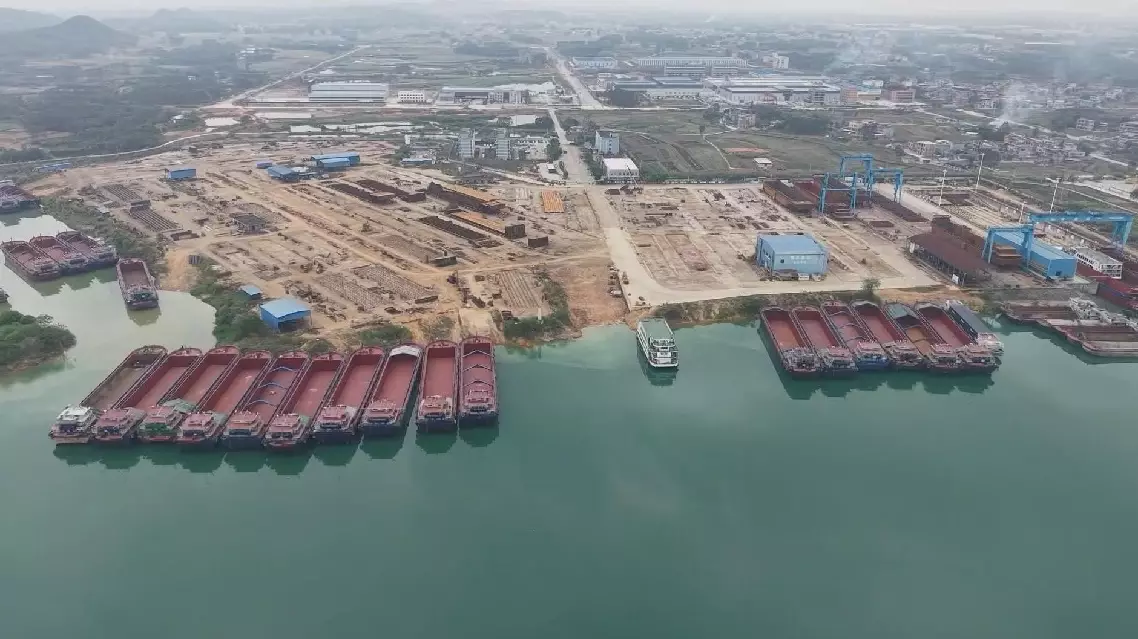
Ports, shipbuilders, industries race to seize opportunities from Pinglu Canal construction