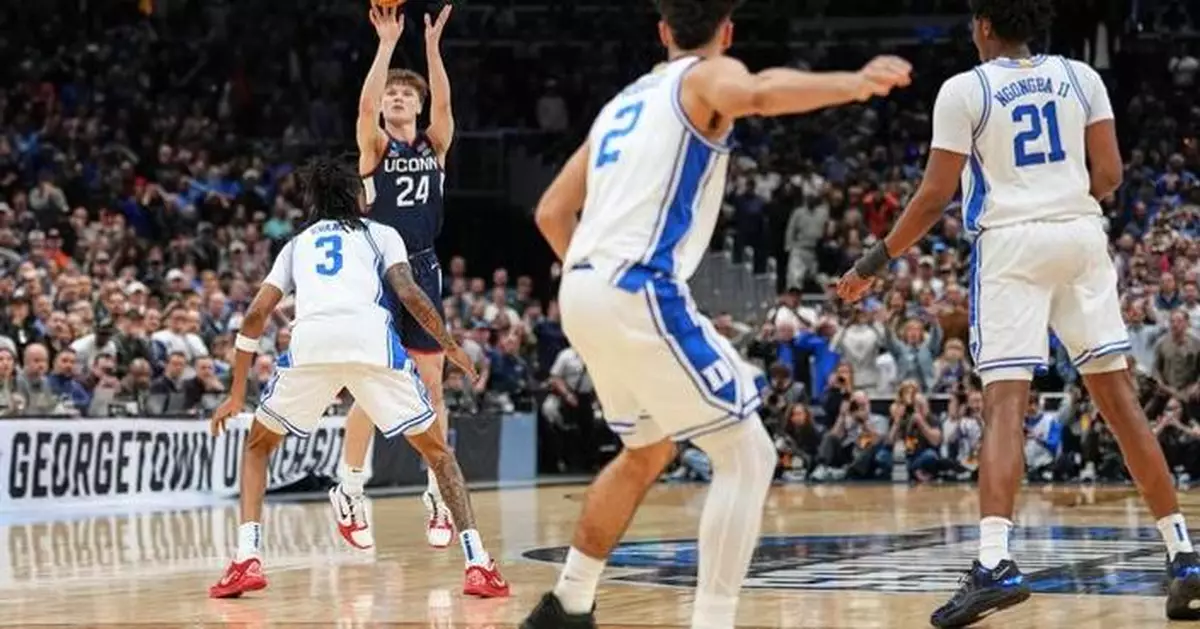
WASHINGTON (AP) — A couple of days ago, Braylon Mullins was a UConn freshman whose name carried weight mostly among the true diehards — college basketball junkies and Indiana high school hoops enthusiasts.
Now he's a part of NCAA Tournament lore. That's what can happen at this time of year.
“One of the most brilliant shooters you’ll ever see shoot a basketball made an incredible, legendary March shot,” Huskies coach Dan Hurley said.
Mullins' 35-footer with 0.4 seconds remaining lifted UConn over Duke 73-72 in the Elite Eight on Sunday, and now that the dust has settled, it's time to evaluate just how legendary — as Hurley put it — this shot was.
The bar for last-second game winners is actually higher in the women's tournament, where North Carolina's Charlotte Smith once made a 3-pointer at the buzzer to win the national title game by one in 1994. And who can forget Notre Dame's Arike Ogunbowale winning both the semifinaland final in 2018 with tiebreaking jumpers?
On the men's side, it's a little more complicated. There are several factors to consider when determining the best of the best.
Last-second shot means last-second shot. Michael Jordan's game winner for North Carolina in the 1982 title game was memorable because of who shot it, but it also left plenty of time for a very ill-fated Georgetown possession at the other end.
Still, Mullins' 3 doesn't lose any luster because there were 0.4 seconds left when it went in. It wasn't literally at the buzzer, but that's close enough.
Sports Reference helpfully compiled a database of game-winning buzzer-beaters from NCAA Tournament history. The site requires a shot to be in the last 2.0 seconds to make the list — with some leeway for the era before the clock stopped after made baskets at the end. Only game winners are included. Tying the score and forcing overtime, with apologies to Kentucky's Otega Oweh, isn't quite in the same category.
Mullins also gets bonus points because if his shot misses, UConn loses. As incredible as Kris Jenkins' 3-pointer at the buzzer was when it won Villanova a championship in 2016, the game was tied at the time, so the worst-case scenario for his team was overtime.
Buzzer-beaters are a big part of what makes March Madness special, but as much as the first couple of rounds create the tournament's charm, it's the second weekend and beyond when the national championship starts to feel within reach. So last-second shots take on added importance.
According to the Sports Reference list, prior to Mullins there were just 16 instances in the men's tournament — in the Sweet 16 or later — in which a team was trailing before winning with a last-second shot:
— Jack Shelton's shot for Oklahoma State to beat Wyoming in the 1949 quarterfinals.
— Pembrook Burrows' tip-in for Jacksonville against Iowa in the 1970 round of 16.
— Richard Washington's shot for UCLA to beat Louisville in the 1975 national semifinal.
— Danny Ainge going coast-to-coast for BYU against Notre Dame in the 1981 round of 16.
— Mike Jones' shot from the perimeter to lift Wichita State over Kansas in the 1981 round of 16.
— Kevin Gamble's jumper for Iowa to beat Oklahoma in the 1987 round of 16.
— Keith Smart's baseline jumper for Indiana to beat Syracuse in the 1987 title game. This shot went through the hoop with around 4 seconds left, but a timeout didn't stop the clock until there was 1 second remaining.
— Anderson Hunt's 3-pointer that gave UNLV a one-point win over Arizona in the 1989 round of 16.
— Tate George's turnaround at the buzzer for UConn against Clemson in the 1990 round of 16. (Bookmark this one for now.)
— Christian Laettner's shot at the buzzer for Duke that beat UConn in the 1990 regional final.
— Laettner again, at the buzzer to beat Kentucky in the 1992 regional final.
— Cameron Dollar's shot for UCLA against Iowa State in the 1997 round of 16.
— Richard Hamilton's fadeaway at the buzzer — after multiple offensive rebounds — that gave UConn a win over Washington in the 1998 round of 16.
— Chris Chiozza's running 3-pointer at the buzzer for Florida that beat Wisconsin in the 2017 round of 16.
— Kyle Guy making three consecutive free throws for Virginia with 0.6 seconds left to beat Auburn in the 2019 national semifinal.
— Lamont Butler's jumper at the buzzer for San Diego State to beat Florida Atlantic in the 2023 national semifinal.
You can see there aren't many 3-pointers on that list — but there are two other UConn players in George and Hamilton. Now Mullins joins them, and his shot came a round later.
Mullins' shot wasn't quite as far as the midcourt heaves by U.S. Reed of Arkansas (1981 second round vs. Louisville) and Paul Jesperson of Northern Iowa (2016 first round against Texas). The more apt comparison, in terms of distance, is with Jalen Suggs' buzzer-beating bank shot for Gonzaga against UCLA in the 2021 semifinal, although that game was tied before the winning play.
It's also worth considering the difficulty of the entire sequence. George's shot in 1990 required UConn to go the length of the court in 1 second, an impressive throw-catch-shoot sequence in which almost everything had to go perfectly. Baseball draft pick Scott Burrell made the long pass for the Huskies. Duke had 2.1 seconds to set up Laettner in '92, with Grant Hill throwing the ball down the court to him.
The reason Laettner's shot in 1992 stood the test of time is because it was the defining moment of a second straight NCAA title run for Duke. And obviously, the game winners by Jenkins and Smart decided national championships on the spot. If UConn doesn't win it all this year, maybe Mullins' 3 falls back to a slightly lower tier, but if the Huskies do prevail in Indianapolis, it'll be their third national title in four years. That's something not even Duke has done before.
And it's only possible because of Mullins' Miracle.
AP March Madness bracket: https://apnews.com/hub/ncaa-mens-bracket and coverage: https://apnews.com/hub/march-madness
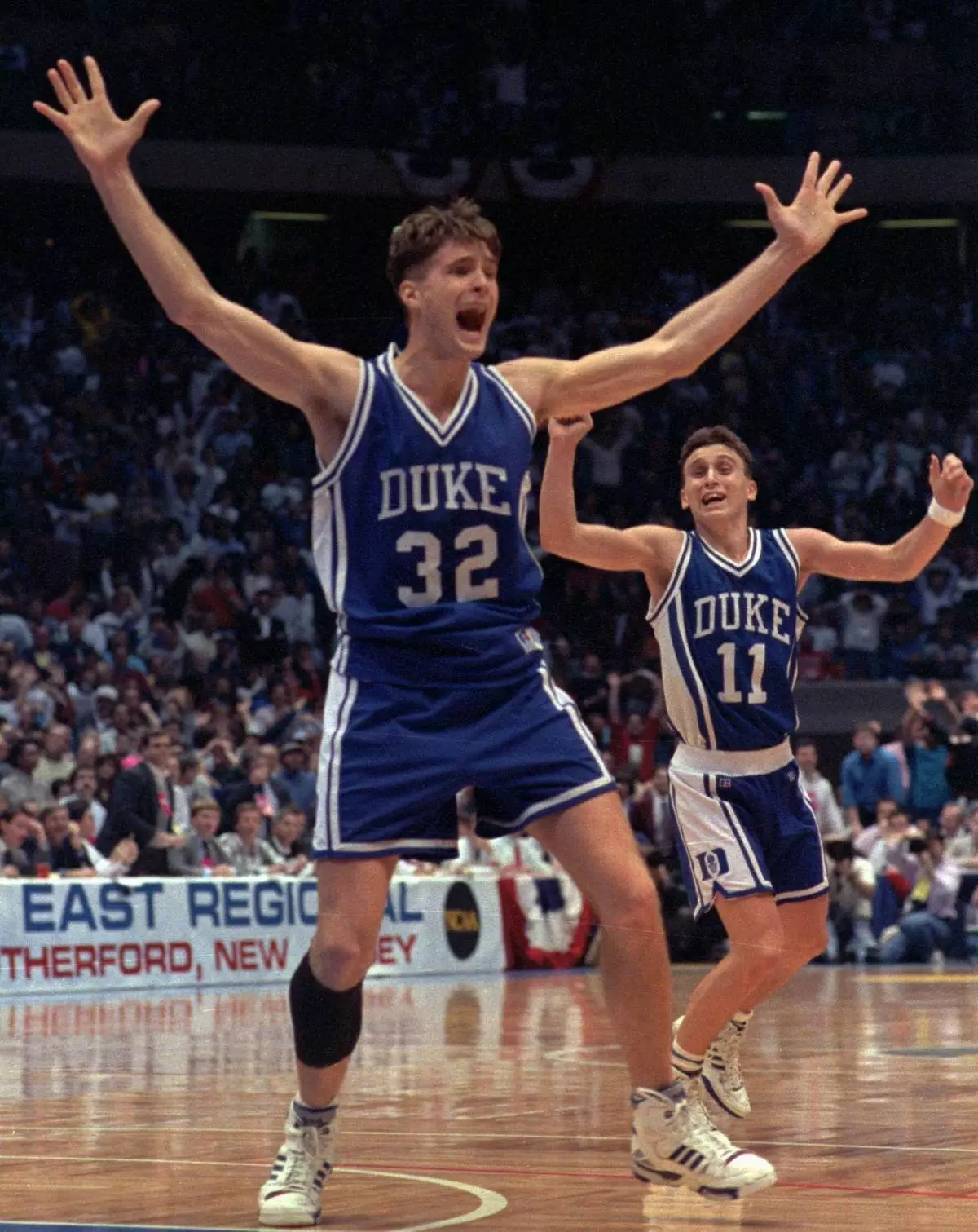
FILE - Duke's Christian Laettner, center, celebrates his game-winning shot against Connecticut in the NCAA East Regional Final at East Rutherford, N.J., on March 24, 1990. In the background is teammate Bobby Hurley. (AP Photo/Susan Ragan, File)
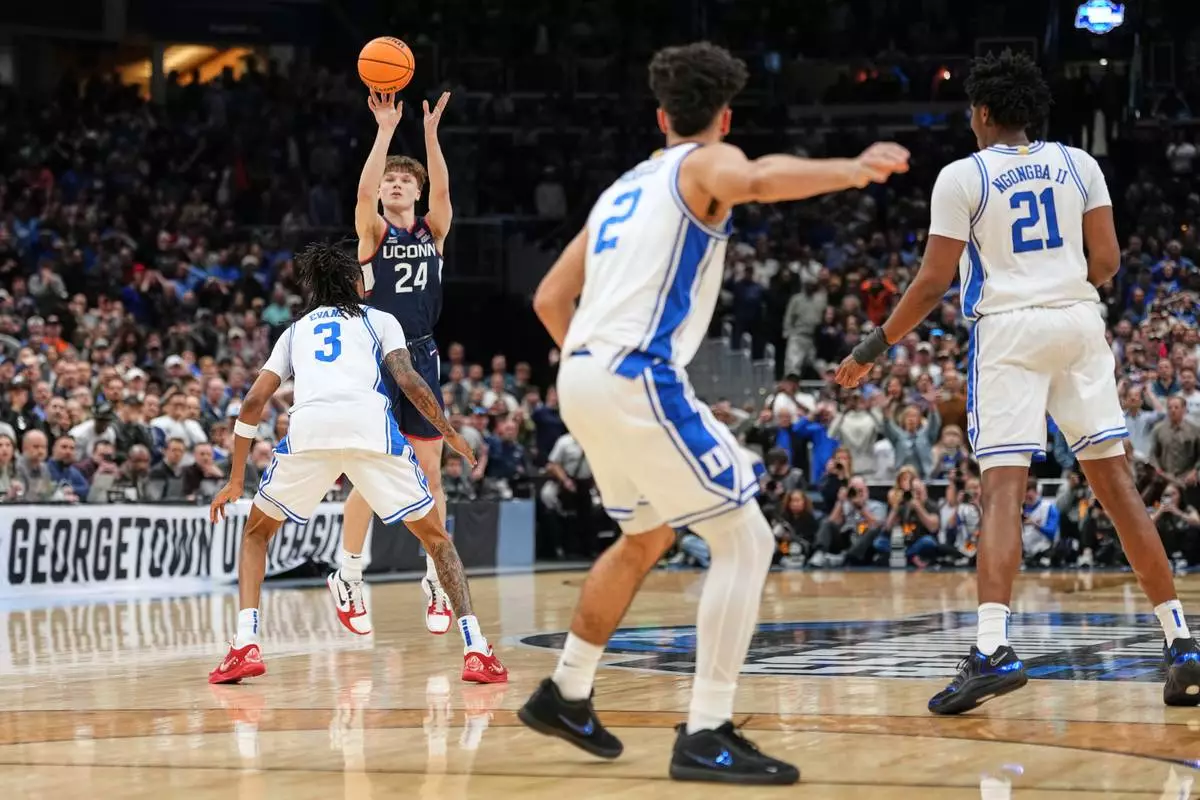
UConn guard Braylon Mullins (24) scores the winning basket during the second half against Duke in the Elite Eight of the NCAA college basketball tournament, Sunday, March 29, 2026, in Washington. (AP Photo/Abbie Parr)