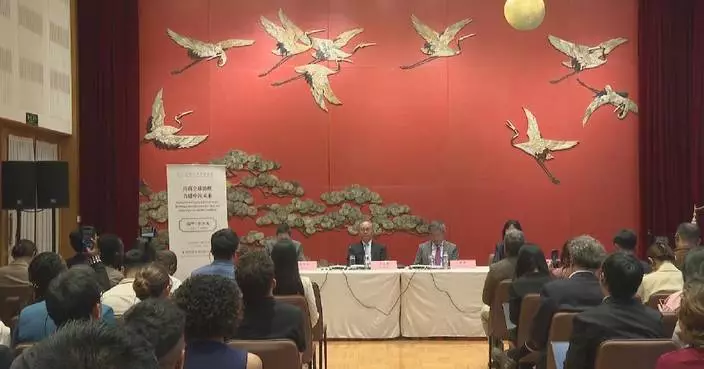
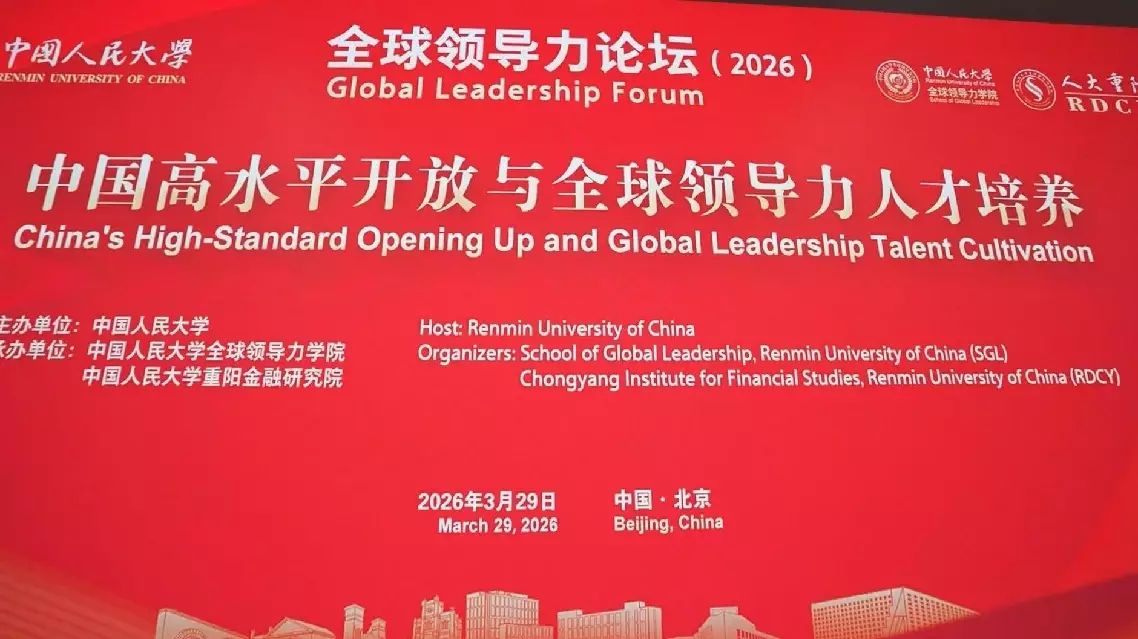
China's advances in new quality productive forces and technological innovation fuel high-quality growth at home and bring stability and momentum to the global economy, according to researchers attending the 2026 Global Leadership Forum Sunday in Beijing.
China's expanding global openness has created numerous opportunities for overseas investors, said Xu Tianqi, deputy director of the Country Studies Department at Renmin University of China's Chongyang Institute for National Studies.
"You don't need to worry about the supply chain in China. You can buy everything, right? The manufacturing, the services. As long as you ask your supplier to provide you, they will immediately send you the messages and send you the products that you want. So I think it's safe in these scenarios. Also that's very good for Chinese business environment, but it's not saying China is safe for investment to earn money. You need to compete in China to earn your money," Xu said.
He said China is likely to maintain the leadership in high-end manufacturing and secure its important position in the global supply chain.
"Firstly, we want to maintain our leadership in the high-technology manufacturing, high-end manufacturing. If you look at those 'dark light factories' in China, that's automatic, also those robotic factories in China, you can see this kind of scenario. That's the first part. We don't want all manufacturing, like labor manufacturing, we don't need all of them, but we need to maintain our leadership in the high-end manufacturing. That's very important. The second one is that we want to be the innovation center. That's also mentioned in the newest five-year-plan. So together it creates the new position for China in the global supply chain," Xu said.
Technological advancement empowers Chinese firms to evolve from supply chain participants to ecosystem creators, competing via innovation and exporting standards, said Li Jiaying, associate researcher of Chongyang Institute for Financial Studies at Renmin University of China.
"The breakthrough of technology will enable Chinese enterprises to transform from the participants in the global supply chains to the ecosystem builders. It involves a shift from the cost competition to technological innovation competition, and the increase in the product added value, changing the position on the smile curve and transition into the high-end segments like the research and development, design and high-end services. Meanwhile, it will also allow our Chinese enterprises to export rules, to formulate standards and also provide integrated solutions," said Li.
China's advance in technological innovation creates opportunities for overseas investors: researchers
A growing number of motorists in Iraq are turning to liquefied petroleum gas (LPG) as a cost-effective and readily accessible alternative to gasoline, a shift driven by mounting concerns over fuel prices, supply reliability and declining fuel quality, with implications that extend beyond household savings to Iraq's broader energy sector.
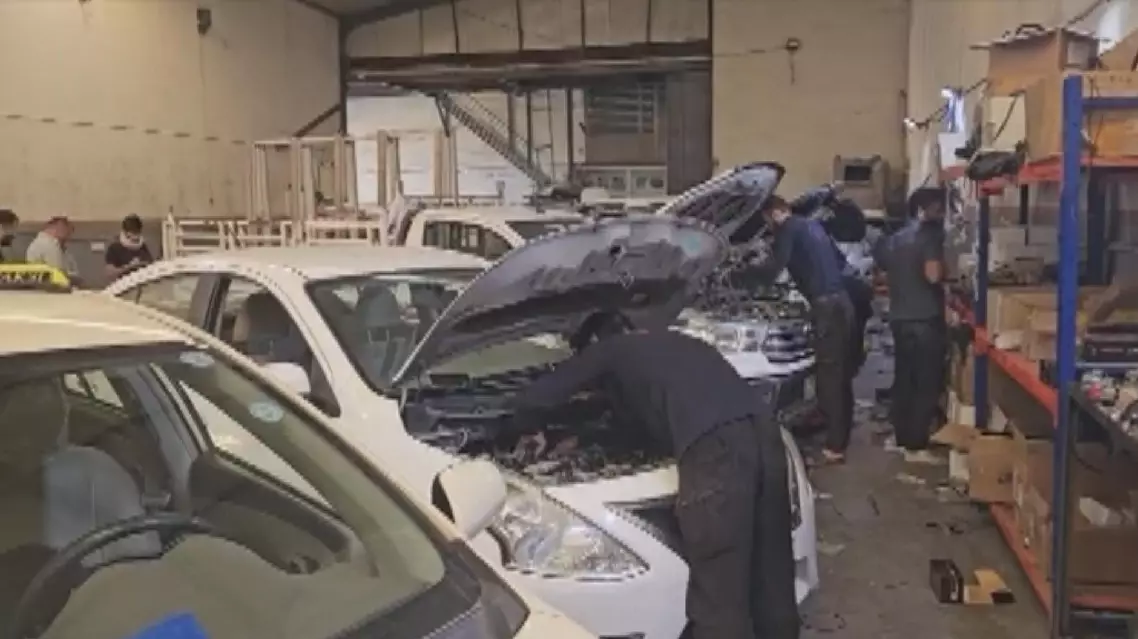
An auto workshop in Erbil, capital of Iraq's Kurdistan region, is one of many helping Iraqi motorists switch from gasoline to LPG. By installing an additional fuel system, drivers can reduce their reliance on gasoline while keeping the option to use it. For many drivers, the main motivation for adding the LPG system is economical.
"The difference is going to be very significant. Instead of spending 350,000 dinars (around 230 U.S. dollars) per month on gasoline, I'll now spend around 60,000 dinars on gas. Overall, this is going to make a very big difference in my running costs," said Haider Baha-Adin, an Iraqi driver.
But it's not just about saving money. For many motorists, switching to LPG also means avoiding long waits at gasoline stations.
"Just to get gasoline, I sometimes have to wait in line for three hours before I reach the station. With gas, that isn't the case. There are no such queues, so I can fill up very easily," said Baha-Adin.
The growing demand for LPG is also keeping mechanics busy. At the workshop in Erbil, technicians install LPG systems in around 5 to 10 vehicles a day. Installation costs vary depending on the vehicle and the type of system, ranging from several hundred to more than 800 U.S. dollars.
But cost and convenience aren't the only factors behind the shift. Workshop owner Saif Saad says concerns over declining gasoline quality are also pushing drivers toward LPG.
"The gasoline is not good, its octane rating has been declining, and its quality is poor. People are worried about their cars. GDI (gasoline direct injection) vehicles, GDI engines, and regular engines experience knocking and delayed combustion in the chamber," said Saif Saad, owner of the World Gas Systems workshop.
However, the growing demand is also creating challenges. Saad say his workshop is facing difficulties securing the equipment needed for LPG installations, especially with the current instability in the region which has disrupted supply chains.
Beyond the savings for motorists, the growing demand for alternative fuels could also have wider economic implications, creating new opportunities for investment in Iraq's energy sector.
"The Kurdistan Regional Government has a plan to invest in gas along with the oil because we used to invest in oil only, but nowadays the government is looking for alternatives, because that's a new, emerging trend and an emerging business for the government to help with the budget at the same time, to help the citizen. The government is trying to focus on LPG and electric vehicles," said Nabaz Nawzad, dean of the College of Administration and Economy at Lebanese French University in Erbil.
Iraqi motorists turn to LPG amid fuel price hikes, quality concerns