Monaco was unstoppable in Ligue 1 before the international break and now a Champions League spot is within reach.
The Principality side has swept its last six matches and is on a nine-match unbeaten run ahead of Sunday's reception of third-placed Marseille. Victory would see Monaco move level on points with its southern rival in the French standings.
This is quite the turnaround for Sébastien Pocognoli's players, who trailed Marseille by 14 points at the end of January.
Pocognoli guided Union Saint-Gilloise to the Belgian league title last season and intially struggled to adapt on the Riviera. His attacking approach, intense pressing and astute substitutions are, however, finally paying off.
Add to that Folarin Balogun's excellent recent form — seven goals in his last seven matches in all competitions — and sixth-placed Monaco is a strong contender for a top-three Champions League spot. The fourth-placed team goes through qualifying.
“Several teams are ahead of us, so we are in pursuit, applying pressure from our underdog position,” Pocognoli said. “This is a consequence of the difficult spell we endured from November through to January. We aim to claw our way up a few more spots in the standings before the season concludes."
It's a close fight at the top of the standings between defending champion Paris Saint-Germain and second-placed Lens. With seven rounds left, PSG has a one-point lead with one match in hand.
PSG hosts Toulouse on Friday and Lens facing a tricky trip to its northern neighbor Lille on Saturday. Lens was infuriated by a decision last week from the French league to postpone its April 11 game with PSG and questioned sporting equity. The league took the decision to allow PSG better preparation for its Champions League quarterfinal against Liverpool.
Maghnes Akliouche scored and was decisive for Monaco before the international break. He built on the momentum during France's short tour in the United States. The creative midfielder played 10 minutes during France's 2-1 win against Brazil and started in the 3-1 defeat of Colombia. Akliouche also impressed with his tactical decisions and an assist to Marcus Thuram.
The international break dealt a terrible blow to Strasbourg's ambitions. The Alsatian club lost Argentina forward Joaquín Panichelli, who tore his right ACL during training with his national team. The injury ruled him out to the end of the season. Panichelli has emerged as a new star in Ligue 1 after joining from Spanish side Deportivo Alaves. He is the league top scorer this season with 16 goals.
The highest Ligue 1 wages were published by sports daily L'Equipe on Thursday. Unsurprisingly, PSG remained at the top with an average gross salary of 650,000 euros ($749,000) per player. PSG's payroll remained stable with an increase of 3,000 euros per player compared to the previous season.
According to L'Equipe, Ballon d’Or winner Ousmane Dembélé was the highest-paid player in Ligue 1, reportedly earning 1.5 million euros gross per month.
Runner-up to PSG, Marseille paid an average gross monthly salary of 300,000 euros, which was 50,000 more than last season. Monaco completed the podium with 140,000 euros. Lens ranked only 10th with an average of 80,000 euros per player.
AP soccer: https://apnews.com/hub/soccer

PSG's Pedro Fernandez, center, celebrates after scoring his side's third goal during the French League One soccer match between Nice and Paris Saint-Germain in Nice, France, Saturday, March 21, 2026. (AP Photo/Philippe Magoni)
WASHINGTON (AP) — President Donald Trump used his first major address since launching his war in Iran to assure Americans that all of his military objectives will be completed "shortly” and urge an increasingly skeptical electorate to give him a little bit more time.
Trump in his Wednesday evening speech dialed back the bluster that's dominated his rhetoric in recent days as world markets convulse and a badly battered Iran is still landing some effective blows on Gulf neighbors' infrastructure and U.S. bases.
But the Republican president's promise to “finish the job” hardly built confidence with a jittery market as oil prices surged and Asian stocks fell as he vowed that the U.S. will continue to hit Iran very hard.
He offered no detail about the state of negotiations with Iran that could bring about a promised endgame that he insists could come in a matter of weeks. There was also no overt lashing out at NATO allies for failing to fall in line and help him reopen the critical Strait of Hormuz waterway — something White House officials had said would be a prominent part of his roughly 20-minute address.
The U.S. will continue to hit Iran hard for the next two or three weeks, he said, without saying how much longer the war would last. But he offered a plea to Americans to show a little patience.
“We are in this military operation, so powerful, so brilliant, against one of the most powerful countries for 32 days, and the country has been eviscerated and essentially is really no longer a threat,” Trump said. “This is a true investment in your children and your grandchildren’s future. The whole world is watching, and they can’t believe the power, strength and brilliance.”
But Trump finds himself not only negotiating with an enemy that refuses to throw in the towel but also dealing with an American tolerance for a conflict that's being stretched.
Most Americans believe recent U.S. military action against Iran has gone too far, and many are worried about affording gasoline, according to an AP-NORC poll conducted in mid-March, a couple of weeks after the war started. While Trump is deploying more warships and troops to the Middle East, about 59% of Americans say U.S. military action in Iran has been excessive.
Meanwhile, 45% are “extremely” or “very” concerned about being able to afford gas in the next few months, up from 30% in an AP-NORC poll conducted shortly after Trump won reelection with promises that he would improve the economy and lower the cost of living.
Americans, Trump noted, have certainly shown patience during times of war.
“American involvement in World War I,” he said, “lasted one year, seven months and five days. World War II lasted for three years, eight months and 25 days. The Korean War lasted for three years, one month and two days. The Vietnam War lasted for 19 years, five months and 29 days. Iraq went on for eight years, eight months and 28 days.”
Hours before his address, Trump seemed to reflect on the domestic pressure he’s feeling to wrap up the war.
Speaking at a private lunch at the White House to mark Easter, Trump argued that the U.S. could “very easily” use this moment to take Iran’s oil. It is "unfortunate," he lamented, that there did not seem to be patience among the American people for such an effort.
“They want to see it end,” he said. He added, “People in the country sort of say, ‘Just win. You’re winning so big. Just win. Come home.’ And I’m OK with that, too.”
Sen. Chris Murphy, D-Conn., said Trump's speech was “grounded in a reality that only exists in Donald Trump’s mind.”
The president, Democrats fumed, offered no plan for how he would go about reopening Hormuz, the critical waterway for oil tankers that a battered Iran has effectively choked off even though Trump claims it's been defeated.
For allies worried about a global economy that's been rattled by rising oil prices, Trump suggested they “buy oil from the United States of America” and “build up some delayed courage” and help the U.S. secure the strait. Trump made no attempt to answer his European critics who say he entered his war of choice against Iran without consulting global allies but is now expecting the world to help him fix the unintended damage that it has caused.
“We are losing this war," Murphy added. "We cannot destroy all their missiles or drones, nor their nuclear program. Iran projects more power in the region than they did before the war, especially if they now permanently control the Strait of Hormuz. We are spending billions we don’t have and losing American lives in a war that is destabilizing the world and making us look feckless.”
Trump offered cautious optimism that those now in power in Iran after more than a month of U.S. and Israeli strikes are “less radical and much more reasonable" with much of the pre-war Islamic Republic’s hierarchy taken out. He didn’t explicitly mention a Monday deadline he has set for Iran to open the strait or face attacks from U.S. forces on its energy infrastructure, though he made clear that he remains open to targeting the heartbeat of Tehran’s economy.
“If there is no deal, we are going to hit each and every one of their electric generating plants very hard and probably simultaneously,” Trump said. “We have not hit their oil, even though that’s the easiest target of all, because it would not give them even a small chance of survival or rebuilding. But we could hit it, and it would be gone.”
Trump also notably did not signal that he's making any preparation for a ground invasion by American troops.
He seemed to steer away from the possibility of sending ground troops to secure Iran’s nearly 1,000 pounds (450 kilograms) of highly enriched uranium, saying it “would take months” for Iran to get to it as it’s buried under the rubble created by last year’s American bombing campaign of Iran’s nuclear sites.
Trump has offered shifting reasons for launching the war, but he has been consistent in articulating that a primary objective in joining Israel in the military action is ensuring that Iran will “never have a nuclear weapon.”
But over the course of the conflict, he has been more circumspect about how far he’s willing to go to follow through on his pledge to destroy Iran’s weapons program once and for all, including seizing or destroying the near-bomb-grade nuclear material that Iran possesses.
“We have it under intense satellite surveillance and control,” Trump said in his prime-time speech. “If we see them make a move, even a move for it, we’ll hit them with missiles very hard again. We have all the cards. They have none.”
Associated Press writers Collin Binkley, Michelle L. Price and Konstantin Toropin contributed to this report.
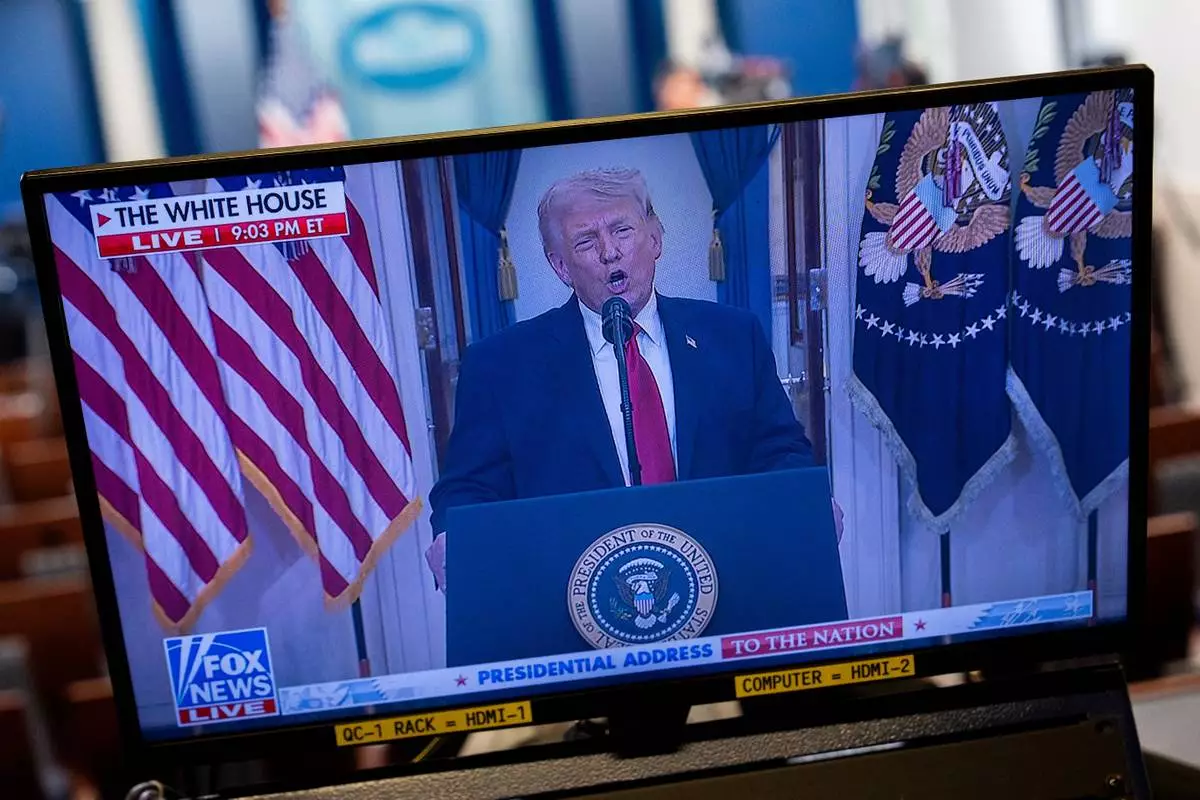
President Donald Trump is seen speaking about the Iran war on a television screen in the James Brady Press Briefing Room of the White House, Wednesday, April 1, 2026, in Washington. (AP Photo/Julia Demaree Nikhinson)
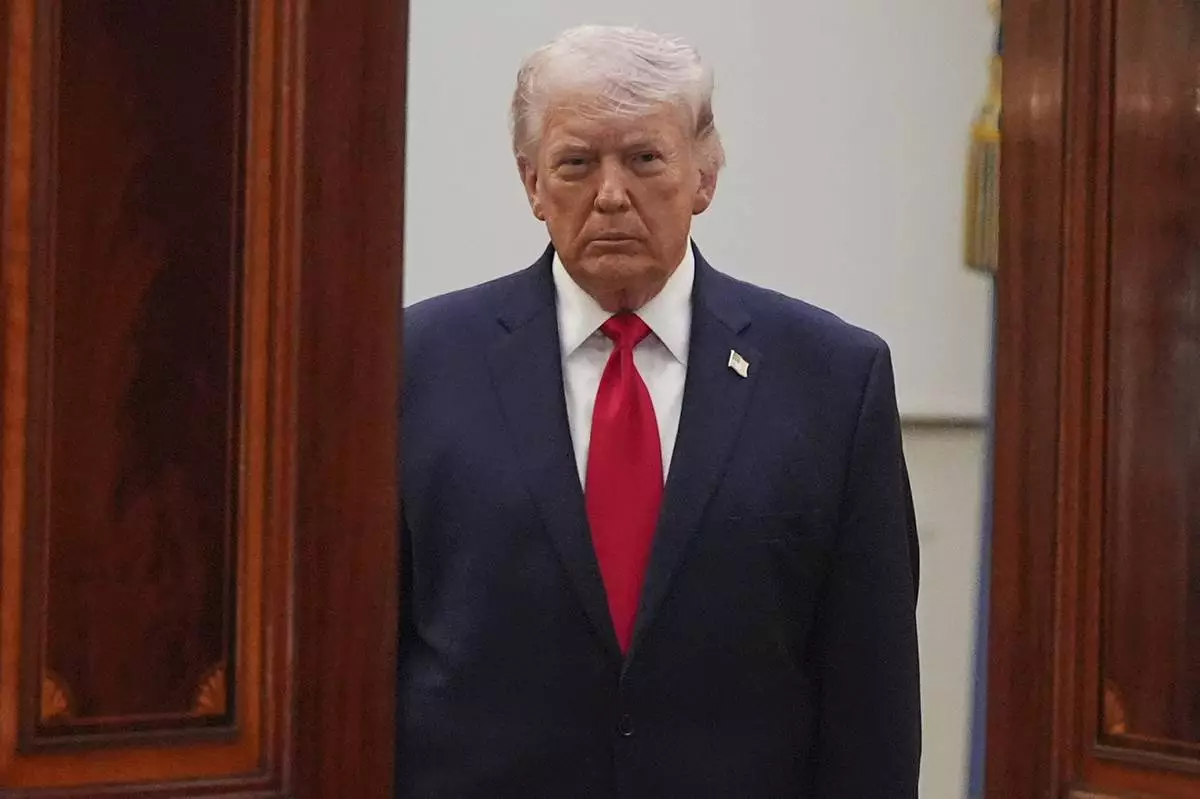
President Donald Trump arrives from the Blue Room to speak about the Iran war from the Cross Hall of the White House on Wednesday, April 1, 2026, in Washington. (AP Photo/Alex Brandon, Pool)
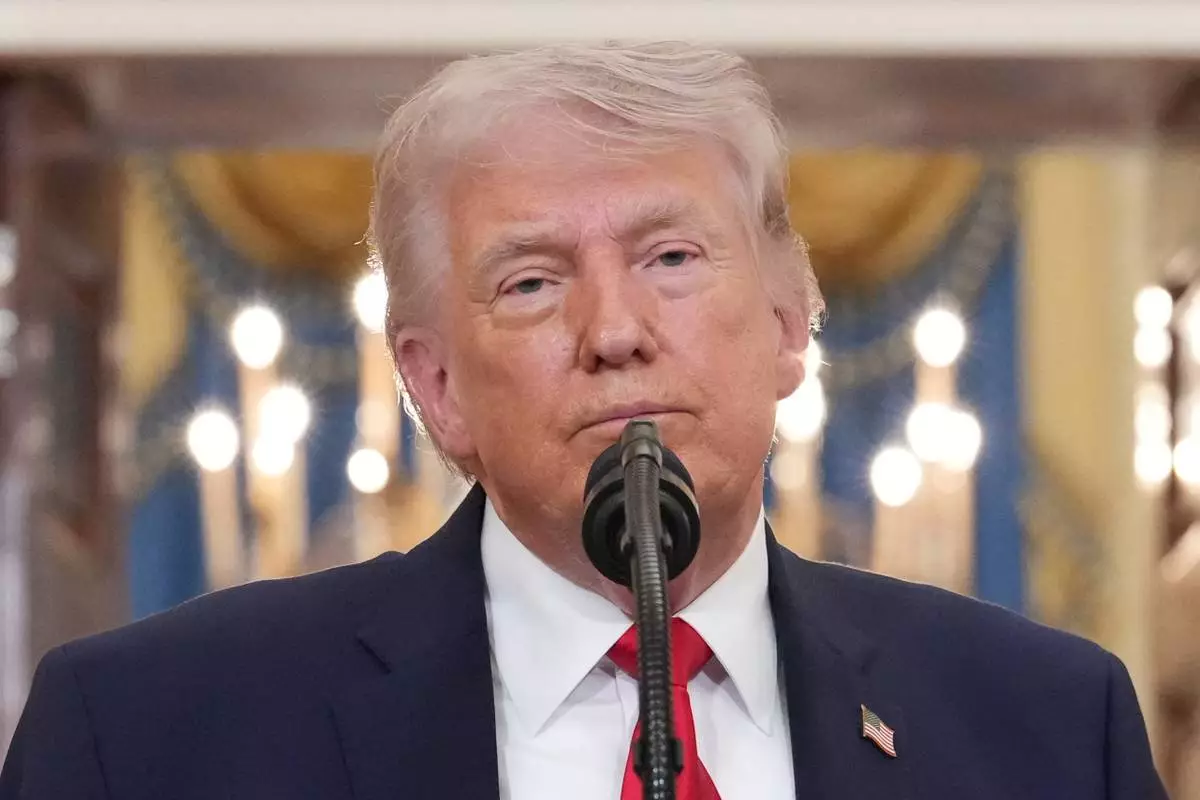
President Donald Trump speaks about the Iran war from the Cross Hall of the White House on Wednesday, April 1, 2026, in Washington. (AP Photo/Alex Brandon, Pool)