HUNTSVILLE, Ala.--(BUSINESS WIRE)--Apr 2, 2026--
Adtran today extended its edge routing portfolio with new Terabit-class edge routers, featuring 400Gbit/s interfaces. These new devices give operators a practical, cost-effective way to scale capacity at the network edge without adding space, power or operational burden. Supported by a unified software foundation that simplifies deployment and operations across the portfolio, the solutions provide a consistent, future-ready environment for edge growth. With 100Gbit/s interfaces now widely deployed across fiber access, aggregation and mobile backhaul, operators need higher-capacity edge options that reduce cost, complexity and inventory sprawl. Unlike traditional monolithic platforms, Adtran’s new Terabit-scale edge solution with 400Gbit/s interfaces combines compact, energy-efficient, cabinet-ready designs with optional optical integration for even greater levels of scale and signal amplification.
This press release features multimedia. View the full release here: https://www.businesswire.com/news/home/20260402884499/en/
“Operators are being asked to deliver more bandwidth and support faster deployment timelines, all while managing rising operational complexity and keeping costs under tight control,” said Christoph Glingener, CTO of Adtran. “What we see across the industry is a growing mismatch between real-world edge requirements and the oversized platforms traditionally used to meet them. Operators are being forced to juggle too many boxes, too many port types and too much inventory. Our Terabit edge routers let them scale intelligently, by simplifying deployments, stripping out unnecessary hardware and reducing dependence on proprietary architectures, while maintaining consistent operations as the network grows. The result is a cleaner, more streamlined edge that delivers capacity where it’s needed at significantly lower expense.”
Adtran’s new high-capacity edge routers built on the FSP 150 and SDX 8000 product series support high-density aggregation from 10Gbit/s to 400Gbit/s in compact form factors designed for edge and regional aggregation. The SDX 8230 is purpose-built for temperature-hardened cabinet installations, while the FSP 150-XG490 targets higher-density environments, giving operators flexible options for bringing 400Gbit/s aggregation closer to access networks and mobile backhaul sites without relying on oversized core routers. With the right balance of port density, performance and price, the platforms make 400Gbit/s aggregation practical at the edge, without paying core-router economics for edge use cases. The platforms are powered by Adtran’s network operating system, enabling automation, simplified provisioning and consistent operations as the portfolio evolves.
Adtran’s Terabit-scale edge routers integrate directly with Adtran’s FSP 3000 IP OLS and ZR/ZR+ coherent optics to extend 400Gbit/s packet-based edge transport beyond native reach in supported configurations. This combined approach simplifies network design, reduces the need for standalone transponders and keeps edge architectures streamlined as capacity grows. Unified control and automation across edge routing and optical transport are delivered through Adtran’s automation and orchestration tools, enabling advanced routing services at the edge, such as MPLS, segment routing, EVPN and IPVPN within a disaggregated architecture.
“For teams planning their next phase of edge and aggregation upgrades, deploying our new high-capacity edge solutions is as much about practicality as performance,” commented Andy Ruble, GM of access and aggregation at Adtran. “By bringing together compact 400Gbit/s aggregation, integrated optics and unified management, we make it possible to roll out high-capacity routing in tight cabinet and central-office environments while stripping out surplus equipment, cutting footprint sprawl and avoiding increased operational overhead. It’s a more efficient way to build the edge, one that scales smoothly over time, lowers day-to-day operational effort and supports long-term growth, giving operators the confidence to expand on their own terms with a clearer, more sustainable architecture.”
Further information on Adtran’s Terabit-class edge routers can be found in this video.
About Adtran
ADTRAN Holdings, Inc. (NASDAQ: ADTN and FSE: QH9) is the parent company of Adtran, Inc., a leading global provider of open, disaggregated networking and communications solutions that enable voice, data, video and internet communications across any network infrastructure. From the cloud edge to the subscriber edge, Adtran empowers communications service providers around the world to manage and scale services that connect people, places and things. Adtran solutions are used by service providers, private enterprises, government organizations and millions of individual users worldwide. ADTRAN Holdings, Inc. is also the majority shareholder of Adtran Networks SE, formerly ADVA Optical Networking SE. Find more at Adtran, LinkedIn and X.
Published by
ADTRAN Holdings, Inc.
www.adtran.com

Adtran’s new Terabit routing solution helps operators intelligently scale edge networks to meet soaring data demands.
LONDON (AP) — U.S. President Donald Trump and his Defense Secretary Pete Hegseth have been damning of the U.K.'s naval capabilities. Their jibes may have stung in a country with a long and proud maritime history, but they do carry some substance.
The U.K. has been at the forefront of Trump’s ire since the onset of the Iran war on Feb. 28, when British Prime Minister Keir Starmer refused to grant the U.S. military access to British bases.
Though that decision has been partly reversed with the decision to permit the U.S. to use the bases, including that of Diego Garcia in the Indian Ocean, for so-called defensive purposes, Trump is adamant he was let down. He has repeatedly lashed out at Starmer and branded the Royal Navy’s two aircraft carriers as “toys.”
“You don’t even have a navy,” he told Britain's Daily Telegraph in comments published Wednesday. "You’re too old and had aircraft carriers that didn’t work.”
Hegseth, meanwhile, said sarcastically that the “big, bad Royal Navy” should get involved in making the Strait of Hormuz safe for commercial shipping.
For numerous reasons, the Royal Navy is not as big and bad as it used it to be when Britannia ruled the waves. But it's not as feeble as Trump and Hegseth imply and is largely similar with the French navy, which it is often compared with.
“On the negative side, there is a grain of truth, with the Royal Navy being smaller than it has been in hundreds of years,” said professor Kevin Rowlands, editor of the Royal United Services Institute Journal. “On the positive side, the Royal Navy would say that it’s entering its first period of growth since World War II, with more ships set to be built than in decades.”
It’s not that long ago that Britain could muster a task force of 127 ships, including two aircraft carriers, to sail to the south Atlantic after Argentina’s invasion of the Falkland Islands. That 1982 campaign, which then-U.S. President Ronald Reagan was lukewarm about, marked the final hurrah of Britain’s naval pedigree.
Nothing on that scale, or even remotely, could be accomplished now. Since World War II, Britain’s combat-ready fleet has declined substantially, much of it linked to changing military and technological advances and the end of empire. But not all.
The number of vessels in the Royal Navy fleet, including aircraft carriers, destroyers frigates and submarines has fallen from 166 in 1975 to 66 in 2025, according to The Associated Press' analysis of figures from the Ministry of Defense and the House of Commons Library.
Though the Royal Navy has two aircraft carriers at its command, there was a seven-year period in the 2010s when it had none. And the number of destroyers has halved to six while the frigate fleet has been slashed from 60 to just 11.
The Royal Navy faced criticism for the time it took to send the HMS Dragon destroyer to the Middle East after the war with Iran broke out. Though naval officials worked night and day to get it shipshape for a different mission than the one it was readying for, to many it symbolized the extent to which Britain’s military has been gutted since the fall of the Berlin Wall in 1989.
For much of the Cold War, Britain was spending between 4% and 8% of its annual national income on its military. After the Cold War, that proportion steadily dropped to a low of 1.9% of GDP in 2018, fuel to Trump's fire.
Like other countries, Britain, largely under the Labour governments of Tony Blair and Gordon Brown, sought to use the so-called “peace dividend” following the collapse of the Soviet Union to divert money earmarked for defense to other priorities, such as health and education.
And the austerity measures imposed by the Conservative-led government in the wake of the global financial crisis of 2008-9 prevented any pickup in defense spending despite the clear signs of a resurgent Russia, especially after its annexation of Crimea and parts of eastern Ukraine.
In the wake of Russia's full-blown invasion of Ukraine in 2022, and with another Middle East war underway, there's a growing understanding across the political divide that the cuts have gone too far.
Following the Ukraine invasion, the Conservatives started to turn the military spending tide around. Since the Labour Party returned to power in 2024, Starmer is seeking to ramp up British defense spending, partly at the cost of cutting the country's long-vaunted aid spending.
Starmer has promised to raise U.K. defense spending to 2.5% of gross domestic product by 2027, and the updated goal is now for it to rise to 3.5% of GDP by 2035, as part of a NATO agreement pushed by Trump. That, in plain terms, will mean tens of billions pounds more being spent — a lot more kit for the armed forces.
The pressure is on for the government to speed that schedule up. But with the public finances further imperilled by the economic consequences of the Iran war, it's not clear where any additional money will come.
The jibes will likely keep coming even though the critiques are unfair and far from the truth, said RUSI's Rowlands, who was a captain in the Royal Navy.
“We are dealing with an administration that doesn’t do nuance," he said.
This story has been corrected to show there were 166 vessels in 1975, not 466.

An artillery piece from the 1982 Falklands War between Argentina and Britain lies on Mount Longdon on the Falkland Islands, also known as Islas Malvinas, Monday, March 16, 2026. (AP Photo/Ricardo Mazalan)
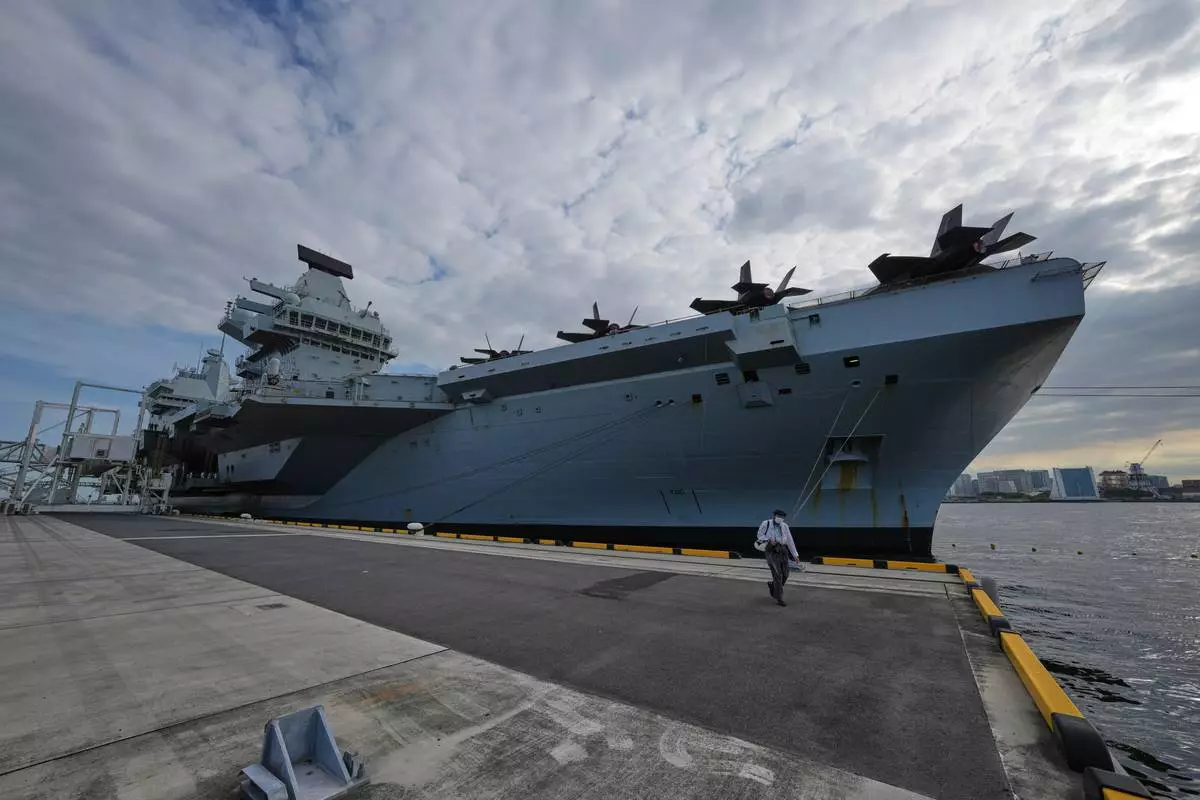
FILE - The Royal Navy aircraft carrier HMS Prince of Wales is pictured before its port call in Tokyo, Thursday, Aug. 28, 2025. (AP Photo/Eugene Hoshiko, File)

FILE - Britain's Prime Minister Keir Starmer speaks to Royal Marines onboard the HMS ST Albans in Oslo, during his visit to Norway on Friday, May 9, 2025.(AP Photo/Alastair Grant, Pool, File)

FILE - Indonesian soldiers stand guard as Royal Navy offshore patrol vessel HMS Spey is docked at Tanjung Priok Port during a port visit in Jakarta, Indonesia, Wednesday, Jan. 15, 2025. (AP Photo/Tatan Syuflana, File)

FILE - Crews walk near the Royal Navy aircraft carrier HMS Prince of Wales before its port call in Tokyo Thursday, Aug. 28, 2025. (AP Photo/Eugene Hoshiko, File)