Before picking Todd Blanche to help lead and now run the Justice Department, President Donald Trump was his client.
Blanche, whom Trump elevated Thursday from deputy attorney general to acting U.S. attorney general, rose to prominence representing the president in criminal cases that consumed the four years between his first and second terms.
Blanche, a former federal prosecutor and law firm partner, led Trump's criminal defense team, representing the Republican in matters including his New York hush money case, which ended in his conviction on 34 felony counts, and a pair of federal cases brought by special counsel Jack Smith, both of which have been abandoned.
In a social media post, Trump called Blanche “a very talented and respected Legal Mind.”
As deputy attorney general, Blanche was the Justice Department’s second-in-command.
Working under Attorney General Pam Bondi, he managed the department’s day-to-day operations and became one of its most vocal defenders and visible public faces. He oversaw the release of government files on Jeffrey Epstein and appeared frequently on TV news programs.
Here's a look at Blanche's career and his rise to running the Justice Department:
Blanche, 51, attended Brooklyn Law School at night while working as a paralegal at the U.S. attorney’s office in Manhattan, and graduated cum laude. Originally from the Denver suburbs, he completed his undergraduate studies at American University in Washington, D.C.
Blanche served as a law clerk for federal judges Denny Chin and Joseph Bianco, both now members of the 2nd U.S. Circuit Court of Appeals, and was a federal prosecutor for eight years in the same U.S. attorney’s office where he had started as a paralegal.
He spent two years as co-chief of the office’s violent crimes unit, overseeing about two dozen prosecutors and cases involving killings, kidnappings, and other violent crimes.
Blanche left the U.S. attorney's office in 2014, taking a job in the Manhattan office of the law firm WilmerHale. In September 2017, he moved to Cadwalader, Wickersham & Taft LLP, where he was a partner in the White Collar Defense and Investigations practice.
In a prelude to his work defending Trump, Blanche represented the president's former campaign chairman, Paul Manafort, and in 2019 succeeded in getting a mortgage fraud case against him dismissed in the same New York court where Trump was convicted.
Blanche argued that the case, brought by the Manhattan district attorney’s office that later prosecuted Trump, was too similar to one that landed Manafort in federal prison and therefore amounted to double jeopardy.
Blanche left Cadwalader in 2023, telling colleagues he was resigning to represent Trump. He joined the president's defense team just prior to his arraignment in the hush money case.
In an email announcing his departure, he wrote: “I have been asked to represent Trump in the recently charged DA case, and after much thought/consideration, I have decided it is the best thing for me to do and an opportunity I should not pass up.”
Despite his conviction, Trump came away from the hush money case impressed with Blanche’s tenacity, his willingness to spar with witnesses and judges, and the poise he showed in speaking in front of TV cameras.
Trump rewarded Blanche and another of his defense lawyers, Emil Bove, with prominent roles in his new administration's Justice Department, and last summer nominated Bove to be a judge on the 3rd U.S. Circuit Court of Appeals.
In addition to the hush money matter, Blanche represented Trump in the two cases brought by the special counsel, his 2020 election interference case in Washington and the Florida case accusing the former president of hoarding classified documents at his Mar-a-Lago estate.
In both cases, Trump's Blanche-led defense team successfully mounted a legal strategy focused heavily on delaying the cases until after the 2024 presidential election. When Trump won, Smith moved to abandon the cases, acknowledging a longstanding Justice Department policy that says sitting presidents cannot be indicted or prosecuted while in office.
Ten days before Trump returned to office, Blanche sat alongside him at his Mar-a-Lago estate in Florida, appearing by video together as a Manhattan judge sentenced the president-elect to no punishment in the hush-money case.
“The majority of the American people also agree that this case should not have been brought,” Blanche told the judge, citing the election results as a verdict of its own.
“The American voters got a chance to see and decide for themselves whether this was the kind of case that should’ve been brought," Blanche said. "And they decided.”

FILE - President Donald Trump, stands with then-defense attorney Todd Blanche, May 14, 2024, in New York. (AP Photo/Craig Ruttle, Pool, file)

FILE - Deputy Attorney General Todd Blanche meets with reporters in Washington, Jan. 30, 2026. (AP Photo/J. Scott Applewhite, file)

FILE - Attorney General Pam Bondi speaks with reporters during a news conference at the Department of Justice, Nov. 19, 2025, in Washington, as Deputy Attorney General Todd Blanche, listens. (AP Photo/Mark Schiefelbein, file)
CAPE CANAVERAL, Fla. (AP) — NASA’s Artemis II astronauts fired their engines and blazed toward the moon Thursday night, breaking free of the chains that have trapped humanity in shallow laps around Earth in the decades since Apollo.
The so-called translunar ignition came 25 hours after liftoff, putting the three Americans and a Canadian on course for a lunar fly-around early next week. Their Orion capsule bolted out of orbit around Earth right on cue and chased after the moon to nearly 250,000 miles (400,000 kilometers) away.
It was the first such engine firing for a space crew since Apollo 17 set out on that era’s final moonshot on Dec. 7, 1972. NASA reported that preliminary reports indicate it went well.
NASA had the Artemis II crew stick close to home for a day to test their capsule’s life-support systems before clearing them for lunar departure.
Now committed to the moon, the Artemis II test flight is the opening act for NASA’s grand plans for a moon base and sustained lunar living.
Commander Reid Wiseman, pilot Victor Glover, Christina Koch and Jeremy Hansen will dash past the moon then hang a U-turn and zip straight home without stopping on land. In the process, they will become the farthest humans have ever traveled from Earth, breaking the Apollo 13 distance record set in 1970. They also may become the fastest during their reentry at flight’s end on April 10.
Glover, Koch and Hansen already have made history as the first Black, the first woman and the first non-U.S. citizen to launch to the moon. Apollo’s 24 lunar travelers were all white men.
To set the mood for the day’s main event, Mission Control woke up the crew with John Legend’s “Green Light” featuring Andre 3000 and a medley of NASA teams cheering them.
“We are ready to go,” pilot Victor Glover said.
Mission Control gave the final go-ahead minutes before the critical engine firing, telling the astronauts that they were embarking on “humanity’s lunar homecoming arc” to bring them back to Earth. Koch replied: “With this burn to the moon, we do not leave Earth. We choose it.”
The next major milestone will be Monday’s lunar flyby.
Orion will zoom 4,000 miles (6,400 kilometers) beyond the moon before turning back, providing unprecedented and illuminated views of the lunar far side, at least for human eyes. The cosmos will even treat the Artemis II astronauts to a total solar eclipse as the moon temporarily blocks the sun from their perspective.
While awaiting their orbital departure earlier Thursday, the astronauts savored the views of Earth from tens of thousands of miles high. Koch told Mission Control that they can make out the entire coastlines of continents and even the South Pole, her old stomping ground.
“It is just absolutely phenomenal,” radioed Koch, who spent a year at an Antarctic research station before joining NASA.
NASA is counting on the test flight to kickstart the entire Artemis program and lead to a moon landing by two astronauts in 2028. Orion’s toilet may need some design tweaks before that happens.
The so-called lunar loo malfunctioned as soon as the Artemis crew reached orbit Wednesday evening. Mission Control guided astronaut Koch through some plumbing tricks and she finally got it going, but not before having to resort to using contingency urine storage bags.
Controllers also managed to bump up the cabin temperature. It was so cold earlier in the flight that the astronauts had to dig into their suitcases for long-sleeved clothes.
The contingency urine bags came in handy later in the day. Mission Control ordered the crew to fill a bunch of the empty bags with water from the capsule’s dispenser. A valve issue arose with the dispenser following liftoff, and NASA wanted plenty of drinking water on hand for the crew in case the problem worsened. The astronauts used straws and syringes to fill the pouches with more than 2 gallons (7 liters) worth before pivoting to the moon.
The Associated Press Health and Science Department receives support from the Howard Hughes Medical Institute’s Department of Science Education and the Robert Wood Johnson Foundation. The AP is solely responsible for all content.

In this photo provided by NASA, a view of the Earth from NASA's Orion spacecraft as it orbits above the planet during the Artemis II test flight, on Thursday, April 2, 2026. (NASA via AP)
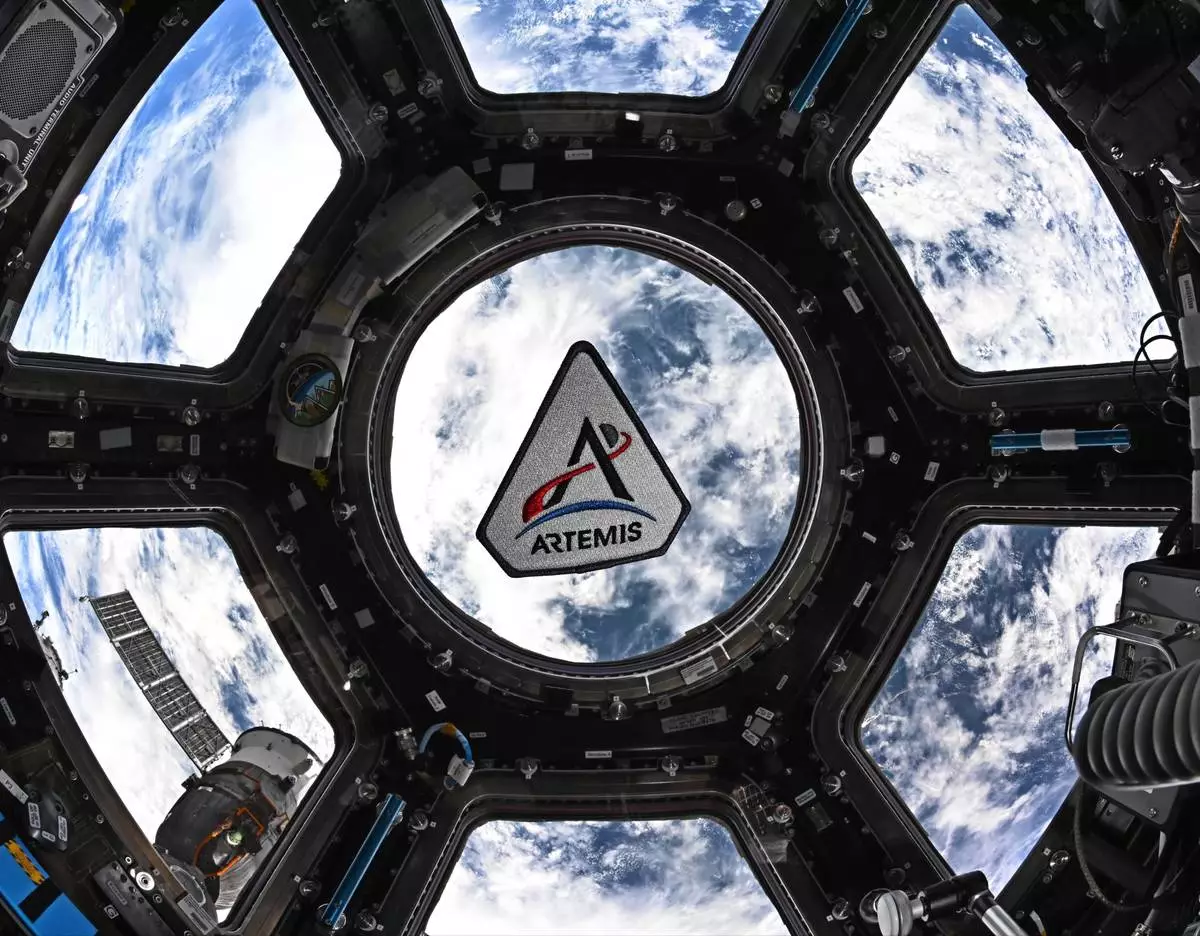
In this photo provided by NASA, an Artemis program patch floating in the International Space Station's cupola, on March 30, 2026. (Jessica Meir/NASA via AP)

Spectators view NASA's Artemis II moon rocket launch from the A. Max Brewer Bridge, Wednesday, April 1, 2026, in Titusville, Fla. (AP Photo/Phelan M. Ebenhack)
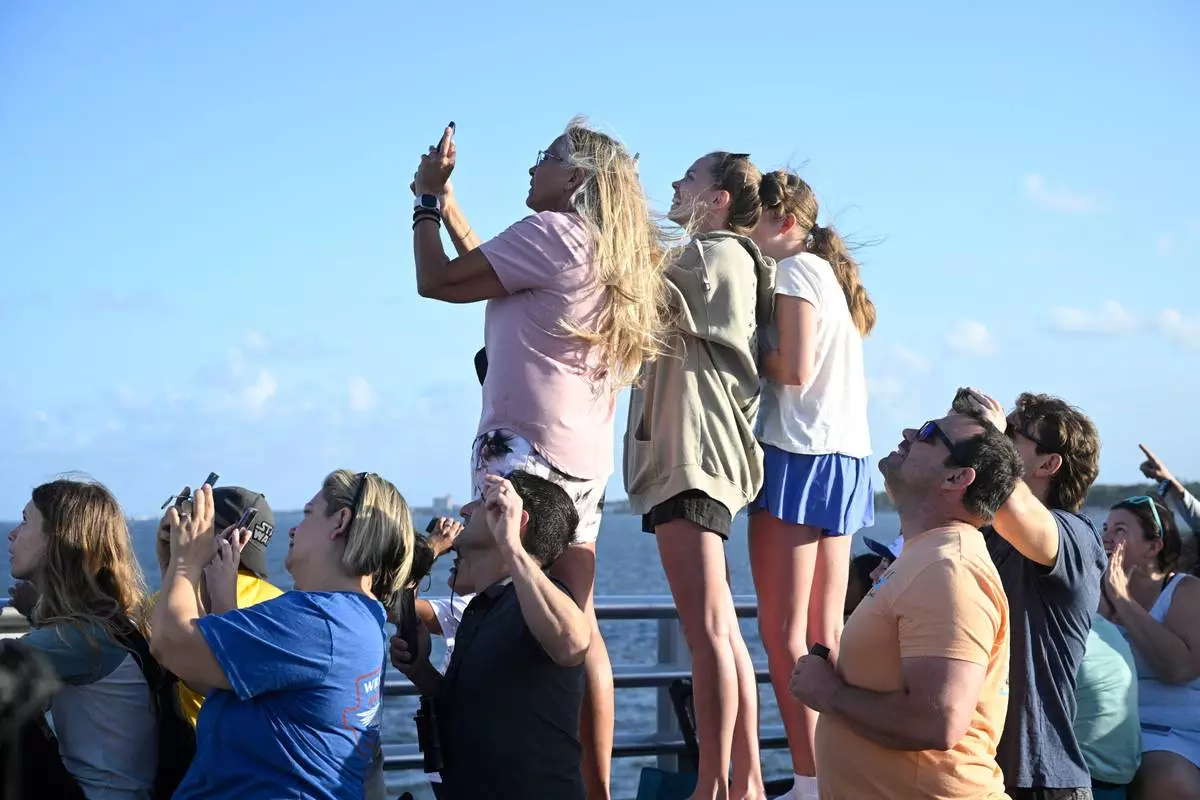
Spectators view NASA's Artemis II moon rocket launch from the A. Max Brewer Bridge, Wednesday, April 1, 2026, in Titusville, Fla. (AP Photo/Phelan M. Ebenhack)

NASA's Artemis II moon rocket lifts off from the Kennedy Space Center's Launch Pad 39-B Wednesday, April 1, 2026, in Cape Canaveral, Fla. (AP Photo/Chris O'Meara)

NASA's Artemis II moon rocket lifts off from the Kennedy Space Center's Launch Pad 39-B Wednesday, April 1, 2026, in Cape Canaveral, Fla. (AP Photo/Chris O'Meara)
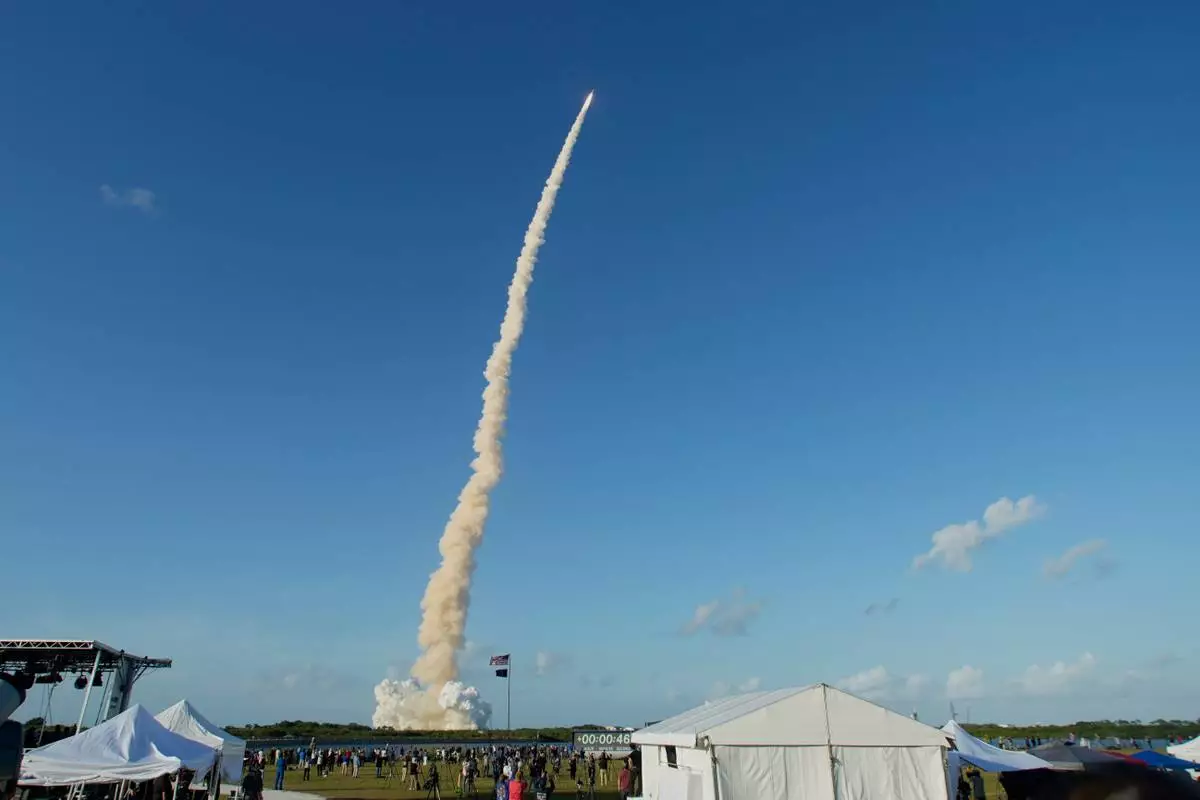
NASA's Artemis II moon rocket lifts off from the Kennedy Space Center's Launch Pad 39-B Wednesday, April 1, 2026, in Cape Canaveral, Fla. (AP Photo/John Raoux)