Fuse bead crafting, a hobby that uses tiny plastic beads to make pixel‑style designs, is catching on among young consumers in China, fueling a billion‑yuan industry and driving rapid growth in brick‑and‑mortar bead shops.
The craft involves arranging millimeter-sized plastic fuse beads onto a pegboard using tweezers, following a preset pattern. Once completed, the design is fused with heat from an iron, forming a thin, pixel-style piece that can be used as a decoration or made into a pendant or keychain.
Many enthusiasts said the tiny size of the beads and the subtle differences in color require considerable patience to complete a piece.
"Your hands need to be steady, and you also need to be sensitive to colors, as many of them can be easily confused," said a consumer surnamed Ms. Yang.
Fuse bead crafting has also emerged as a new social activity among young people, with couples, friends and families creating pieces together while chatting. Groups of gaming and anime fans also gather for the activity, driving strong foot traffic at offline stores.
"We consume about one ton of black beads a week. We have already opened 16 stores, with another three to five in preparation," said Zheng Wei, a shop owner in Hefei, the provincial capital of east China's Anhui Province.
As the trend continues, demand for related products has also surged, driving the development of a billion-yuan industry chain across upstream and downstream segments.
In Jinyi new district of Jinhua City, east China's Zhejiang Province, around 10 manufacturers are clustered together. They package more than 50 tonnes of beads, about 2.5 billion pieces, each day for shipment worldwide.
"Orders have been booming since last September. Production simply cannot keep up. We are constantly adding new production lines. Orders have surged explosively, rising roughly 20 to 30 times," said Zheng Mingquan, general manager of Yiwu Mingchuang Toys Co., Ltd.
Strong demand for raw materials has also boosted rapid growth in sales of related products such as specialized irons, heat-resistant tape, tweezers and storage boxes.
"It is no longer enough for products to simply function as in the past -- consumers now expect them to be more sophisticated and safer. Compact irons with adjustable temperature settings like this are suitable for beads of different sizes. Sales of this product have increased by more than 50 percent compared with last year," said Wu Yanping, a vendor at the Yiwu International Trade Market in Jinhua.
From workshops in Anhui to factories in Zhejiang, fuse bead crafting has grown from a niche pastime into a billion‑yuan industry chain, reflecting the rising appetite for hands‑on, social hobbies among China's youth.
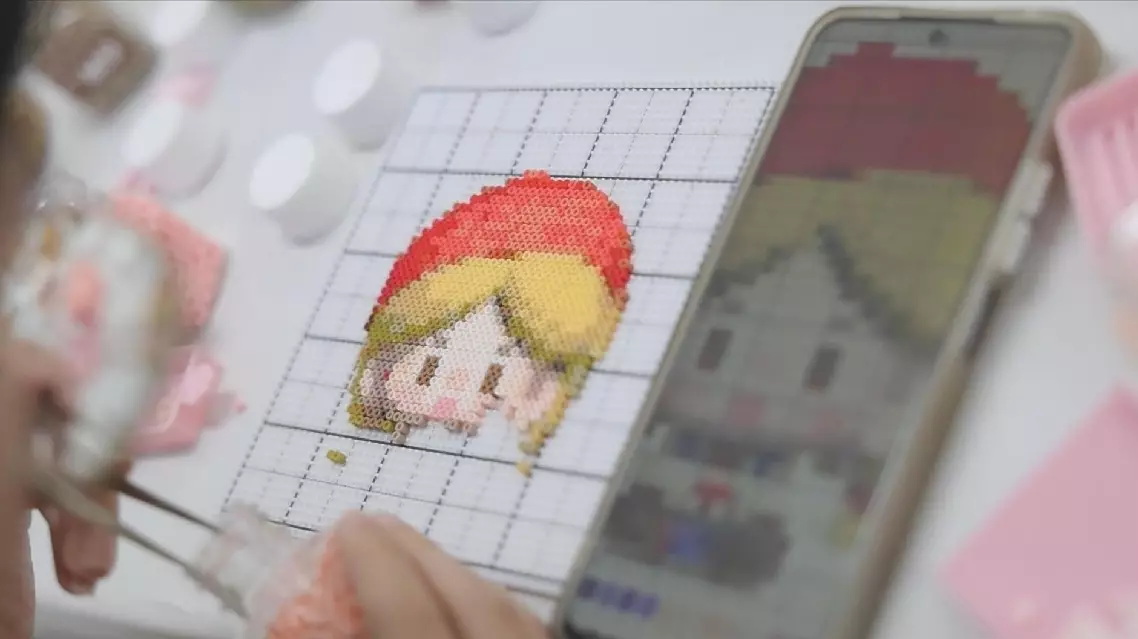
Pixel-style bead art fuels billion-yuan industry in China