China's humanoid robot industry is marching from technological innovations toward widespread commercial applications. The key to realizing the progress lies in the improvement of robots' "brain" -- the sophistication of their algorithms.
With a model of Vision-Language-Action (VLA), which is a single end-to-end architecture to achieve precise control from visual perception to its sophisticated joints, humanoid robots can perform highly complex, long-sequence tasks like making a bed.
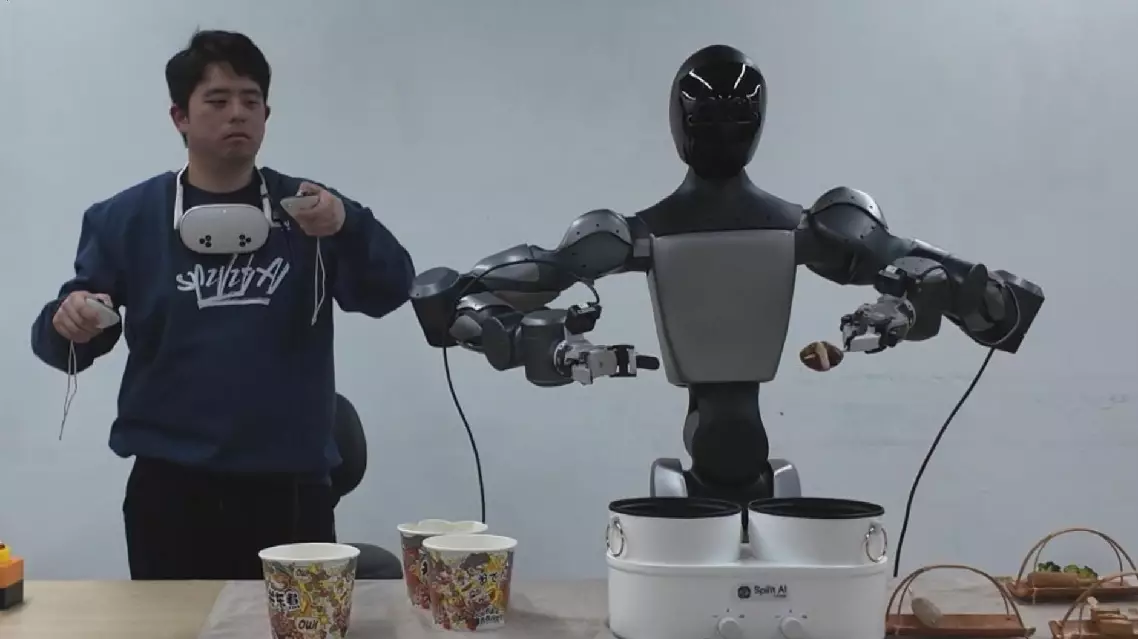
In Beijing, startup Spirit AI is training its robots to learn by imitation.
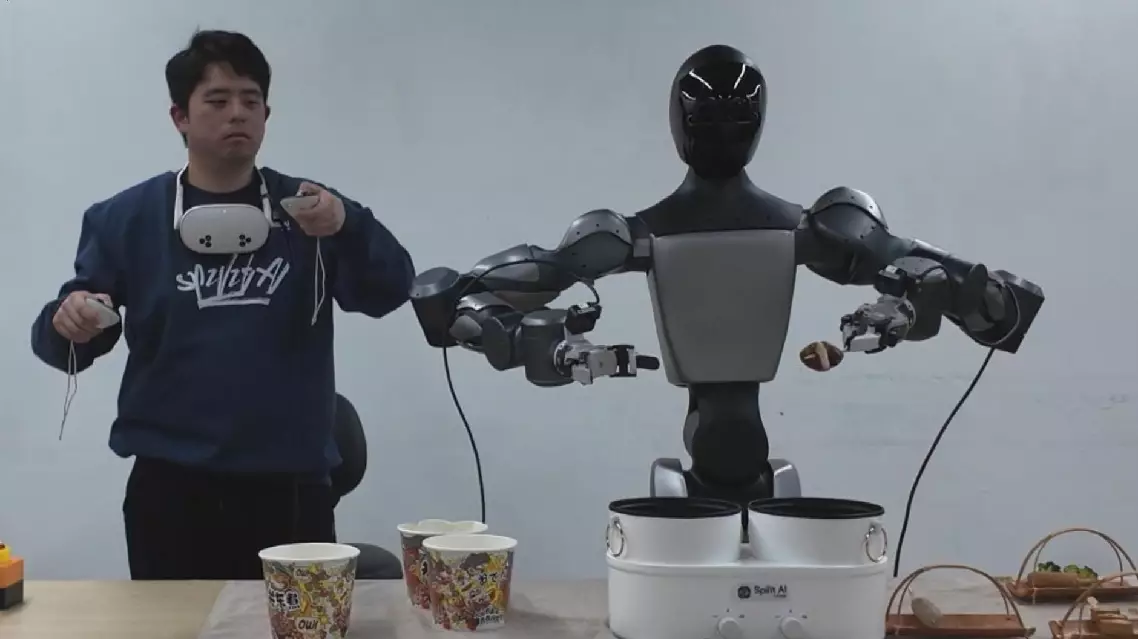
In a scenario of preparation for hot pot ingredients, for example, robots can be trained to exactly put food materials into bowls or other containers as a human being by following the moves of the staff member in a set of wearable devices.
In Shenzhen City, south China's Guangdong Province, robots enter households together with cleaning ladies to provide cleaning services. Their main training task is to assist the cleaner in organizing sundries and collecting garbage in the living room and the dining room.
"It can tidy up some used items such as bottles, jars and tissues, and throw them into our trash cans. Through doing housework, robots can train themselves. Such practice will optimize their models and make their algorithms more powerful. Eventually, they will perform tasks better and better," said Hu Bowen, an engineer with the X Square Robot, a Shenzhen-based AI startup.
For robots responsible for sorting commodities at supermarkets, they need to be familiar with the placement of items, input product information, and constantly train their grasping skills.
"In fact, we first have a pre-trained model, for which we only need half an hour to collect about 20 pieces of data for some goods. We hope it can draw inferences by analogy. For instance, for a category like potato chips, I might not consider its pattern, but generalize it to all types of potato chips. This is the generalization capability we have achieved through data-driven approaches from the large model end," said Pan Guoping, person in charge of algorithm with the Zerith Robotics.
"In terms of general artificial intelligence, it might take us five to 10 years to equip a robot with multi-dimensional performance capabilities like us humans. However, the vigorous development now allows for more breakthroughs in commercial application scenarios, and closed-loop application in such scenarios. We predict that in the next one to two years, there will be some pioneering application cases," said Yang Wei, brand manager with the Zerith Robotics.
China's humanoid robot poised for further commercialization
China's humanoid robot poised for further commercialization