Egypt's Ministry of Electricity and Renewable Energy announced late Saturday price hikes for commercial and residential electricity consumption effective this April, citing the global energy crisis triggered by the U.S.-Israeli conflict with Iran.
In a statement, the ministry said that the current "acute and unprecedented global crisis" across all energy resources, caused by the ongoing war in the Gulf region, has necessitated price increases for certain commercial and residential consumption tiers starting this month.
According to the statement, commercial consumption prices across various brackets will rise by an average of approximately 20 percent.
For residential consumption, prices for tiers consuming 2,000 kWh per month and above have been raised by an average of 16 percent, while rates for all tiers below the 2,000 kWh threshold will remain unchanged.
The ministry added that around 40 percent of subscribers fall within the lowest residential consumption categories, and most of them are exempt from the price increases.
Austerity measures announced by the government in late March included activating remote work systems, slowing the implementation of fuel-intensive mega-projects, and cutting fuel allocations for all government vehicles by 30 percent.
Additional measures included cutting business hours for shops, restaurants, cafes and malls as well as reducing street lighting and billboard illumination by one-third.

Egypt raises electricity prices amid global energy crisis

Egypt raises electricity prices amid global energy crisis
China's top diplomat Wang Yi on Tuesday emphasized the importance of upholding international rules, saying that the conflict between the United States and Iran, which has lasted for over a hundred days, has severely impacted the regional and international situation.
Wang, a member of the Political Bureau of the Communist Party of China Central Committee and director of the Office of the Central Commission for Foreign Affairs, made the remarks during the 16th Meeting of BRICS National Security Advisors and High Representatives on National Security held in New Delhi, India.
He said that the recent signing of the first phase of the U.S.-Iran Memorandum of Understanding, along with the conflict, has made many things clear to us.
The first is the importance of upholding international rules, Wang said at Tuesday's conference.
"The settlement of any international and regional hotspot issues should be based on abiding by international rules. The law of the jungle may succeed for a while, but it is not sustainable," he said.
The second is the importance of respecting national sovereignty, Wang said, adding that territorial integrity shall not be violated and a country's internal affairs shall not be interfered with. This is the most basic bottom line of international justice, he noted.
The third point is the importance of establishing a new vision of security, Wang said.
"Countries are increasingly becoming a community with a shared future. The practice of seeking absolute security of oneself at the expense of others will only backfire," he said.
The Chinese top diplomat said that the fourth is to understand the significance of new forms of war. Unconventional warfare, such as information warfare and cyber warfare, has become more visible in recent conflicts. Facing interwoven traditional and non-traditional security threats, it is the right time for BRICS countries to enhance dialogue and cooperation on security affairs.
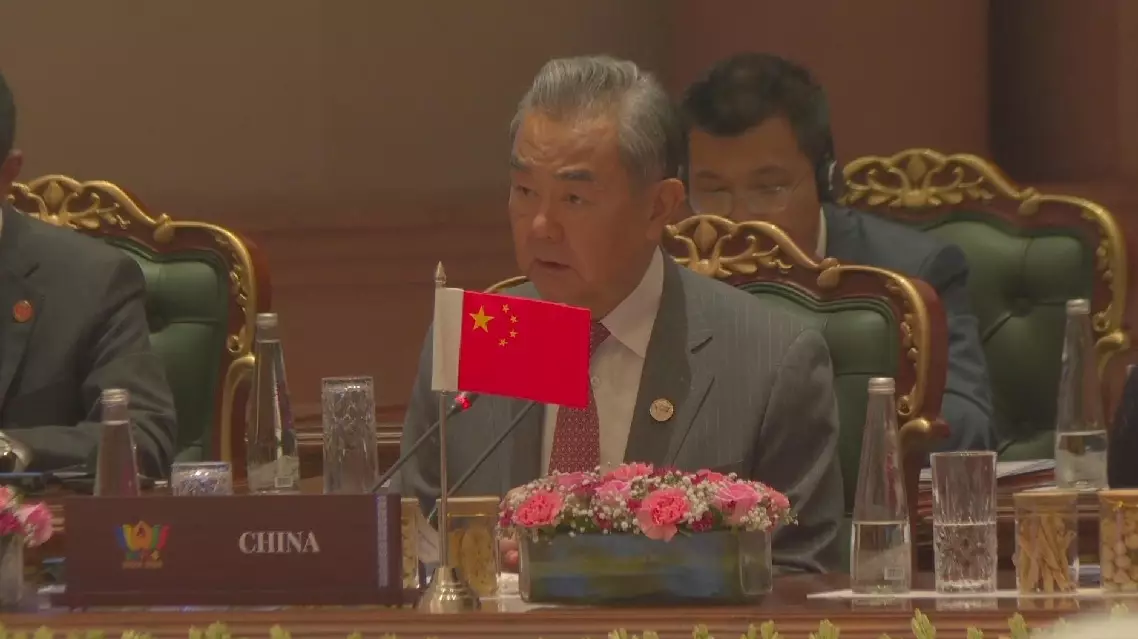
China's top diplomat stresses int'l rules at BRICS meeting