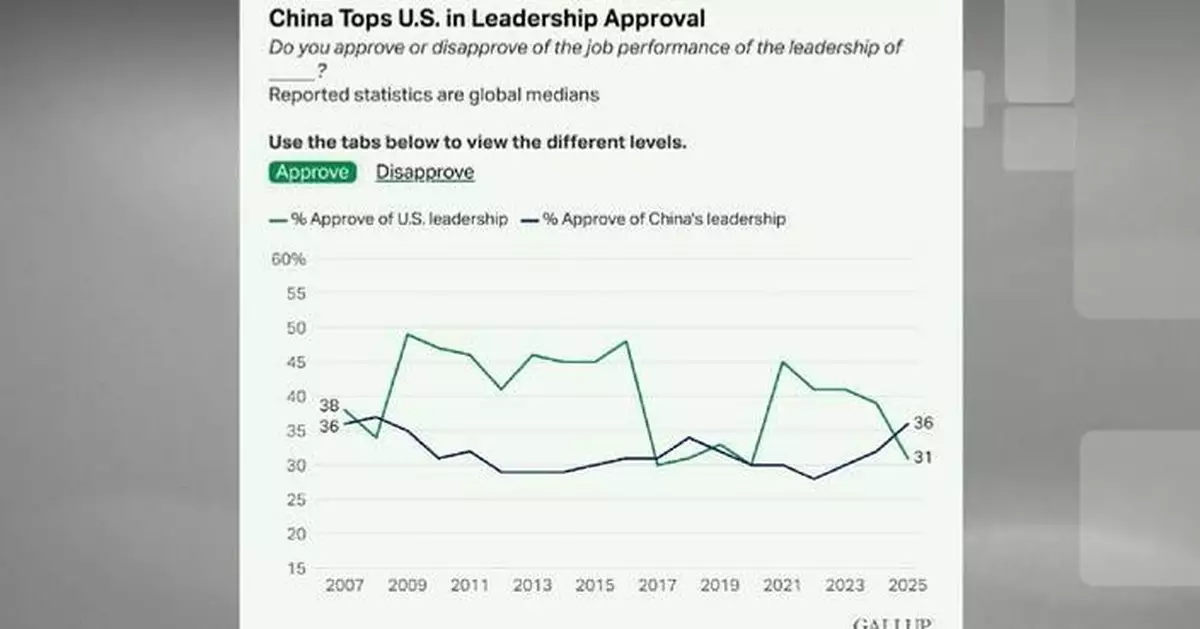
A poll conducted by Gallup found that China has surpassed the United States in global approval ratings in 2025, with a median of 36 percent approving of China's leadership, compared with 31 percent approval for the leadership in the United States.
Gallup's report, published Friday, said China's five-percentage-point advantage over the United States is the widest in China's favor in nearly 20 years.
The recent shift reflects a decline in U.S. ratings alongside an increase for China. Median approval of U.S. leadership fell from 39 percent in 2024 to 31 percent in 2025, returning to earlier lows, while China's approval rose from 32 percent to 36 percent, according to the report.
The latest results are based on Gallup surveys conducted in 2025 in more than 130 countries, with around 1,000 respondents in each country. They do not account for recent U.S. foreign policy moves since the beginning of 2026, including its attack on Iran and its withdrawal from 66 international organizations.
Approval of U.S. leadership has declined across many U.S. allied nations, including many NATO partners, and sunk the most in Germany, dipping 39 percentage points.
Einar Tangen, a senior fellow at the Center for International Government Innovation, believes the shift in global public opinion shows that China is on the right track with its approach to global governance and cooperation.
"There are two very different ideas: a zero-sum game where hegemony, as the rule of the United States, is on top of everything, versus China, which believes its Belt and Road Initiative, and that in order to have a common future for mankind, you have to share development, you have to encourage it elsewhere. This is also the key to peace," Tangen told China Global Television Network (CGTN) on Sunday.
"It's emblematic of the four initiatives that China has put out about development, security, civilization and global governance. So this is why when you take a positive view of the world, you say what can be done and how we can all work together," he said.
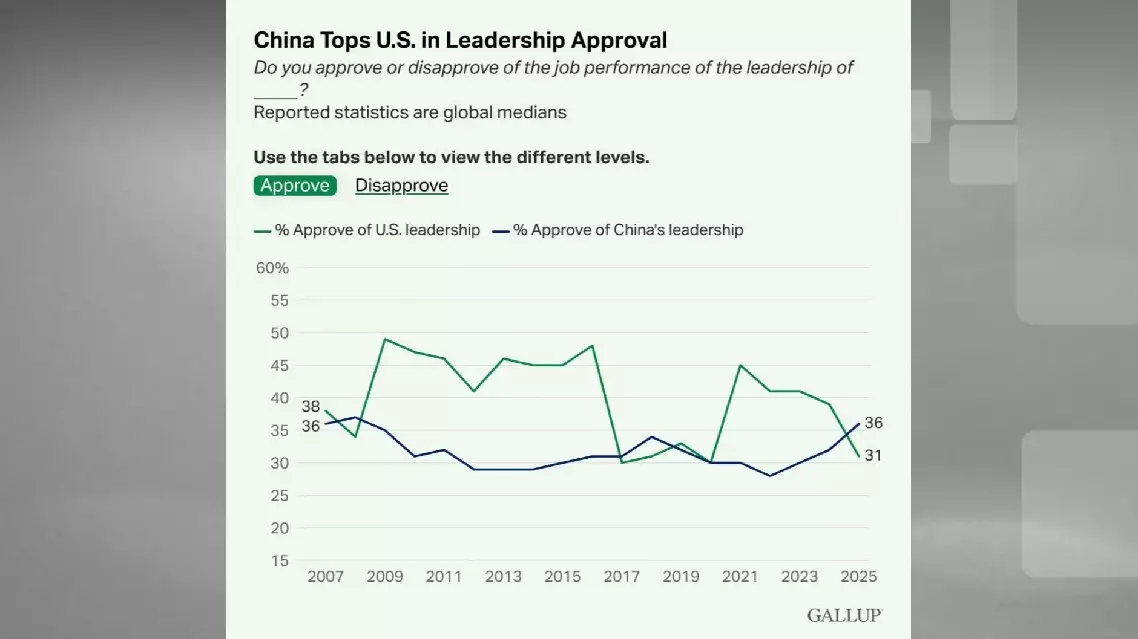
China surpasses US in global survey on leadership approval
China's Minister of Commerce Wang Wentao outlined the key priorities of the 32nd Asia-Pacific Economic Cooperation (APEC) Ministers Responsible for Trade Meeting, which opened on Friday in Suzhou, East China's Jiangsu province.
In an interview with CGTN ahead of the two-day meeting, Wang said free trade, digital cooperation and green economy are high on the agenda of the meeting.
"The key areas include advancing regional economic integration and the Free Trade Area of the Asia-Pacific, supporting the World Trade Organization (WTO) in strengthening digital cooperation and developing green economy. At present, the international situation is marked by intertwined turbulence and chaos, with intensified geopolitical instability. The rise of unilateralism and protectionism poses serious challenges to the international economic and trade order, disrupting global and Asia-Pacific development. Against this backdrop, all parties have higher expectations for this trade ministers' meeting, hoping that it can build consensus and deliver outcomes," Wang said.
This year marks China's third time hosting the APEC meetings and the 35th anniversary of its membership.
By 2025, China had become the largest trading partner of 13 APEC economies. Trade between China and APEC economies reached 3.7 trillion U.S. dollars, accounting for 57.8 percent of China's total foreign trade.
China has signed 24 free trade agreements or economic and trade arrangements with 31 countries and regions, including 15 APEC economies. In recent years, China has also completed upgrades of free trade agreements with APEC economies such as Singapore and Peru.
The minister said that China has always been a firm supporter and an important contributor to APEC.
"We have actively shared our vast market and development opportunities with all parties. China's door to the world will only open wider and wider. Facing the common challenges, China will continue to fulfill its responsibilities as a major country, further deepen reform, expand high-standard opening-up, and continue to provide new opportunities for the Asia-Pacific region and the world with its new achievements in Chinese modernization," the minister said.
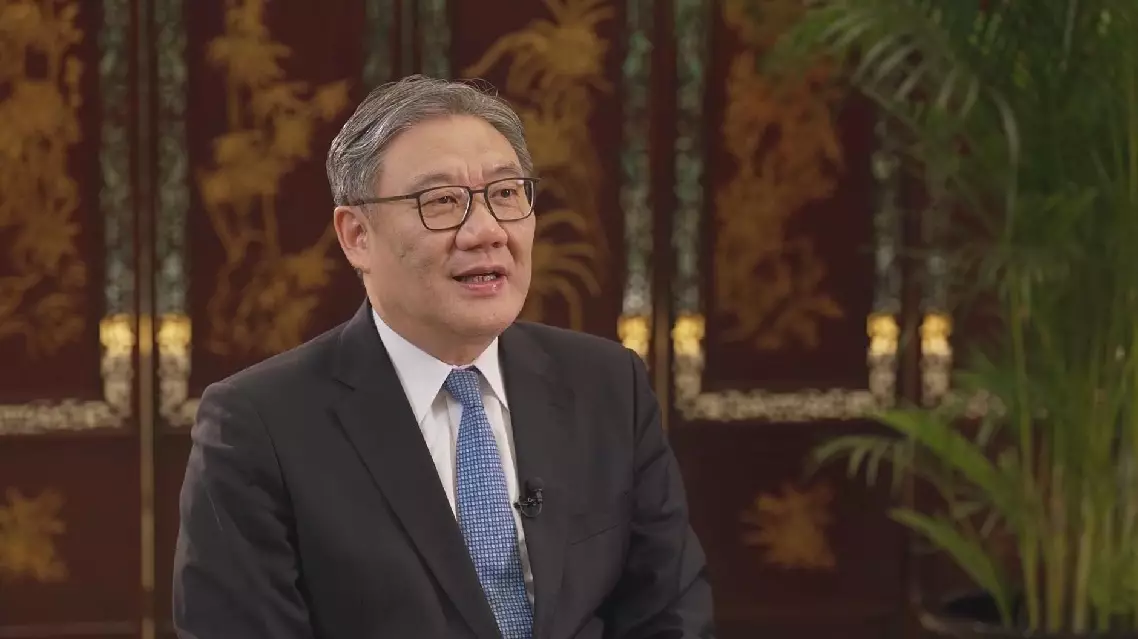
China's Commerce Minister outlines priorities for 32nd APEC trade ministers' meeting