WASHINGTON (AP) — Wisconsin voters will choose a new state Supreme Court justice in a Tuesday election that will either maintain or expand the court’s liberal majority. Meanwhile, the city of Waukesha will hold its first open-seat mayoral race in 20 years.
The contests are among the notable highlights of Wisconsin’s spring election, where races for judicial, municipal, educational and other traditionally nonpartisan offices will be decided beyond the din of the more explicitly partisan November elections.
In the race for the high court, state Appeals Court judges Chris Taylor and Maria Lazar are running to replace retiring Justice Rebecca Bradley from the court’s conservative bloc. Taylor is a former Democratic state representative who has endorsements from the court’s four sitting liberal justices. Lazar served as assistant state attorney general under former Republican Gov. Scott Walker. She is endorsed by conservative Justice Annette Ziegler, who announced in March she will not seek a third term in 2027.
This year’s contest has not generated the same level of attention as recent Wisconsin Supreme Court races, since the ideological balance of the bench is not at stake. But the winner will be a part of a panel that could be at the center of a political firestorm if there are any disputes related to either the 2028 presidential election or the next round of congressional redistricting in the early 2030s. Justices are elected to 10-year terms.
Liberals are looking for their fourth consecutive state Supreme Court victory. Liberal justices gained a 4-3 majority on the court in 2023 for the first time in 15 years after Justice Janet Protasiewicz won a seat previously held by a conservative. In 2025, Justice Susan Crawford joined the court and preserved the liberal majority after a campaign where Elon Musk and groups associated with him spent millions in support of a conservative candidate.
In any statewide election in Wisconsin, Democrats tend to win by large margins in the populous counties of Milwaukee and Dane (home to Madison), while Republicans win by wide margins in the smaller, more rural counties that stretch across most of the state. Republican candidates also tend to rely on strong showings in the “WOW” counties — Waukesha, Ozaukee and Washington in suburban Milwaukee — which help counter Democratic advantages in urban areas. Victory is determined by how big those margins are in the respective party strongholds, as well as which side can win over the more competitive swing areas.
In the 2024 presidential election, then-Vice President Kamala Harris won Milwaukee County with 68% of the vote and Dane County with 75%, while narrowly losing statewide. In comparison, Protasiewicz and Crawford in their successful state Supreme Court races received 73% and 75% of the vote in Milwaukee County and 82% of the vote in Dane County. They both won statewide with double-digit margins of victory.
Protasiewicz and Crawford each also won more than 10 swing counties that voted for Trump in 2024, most notably in Brown County, home to Green Bay, which Trump carried in all three of his White House campaigns.
In the race for Waukesha mayor, Common Council President Alicia Halvensleben and state Rep. Scott Allen are running to replace Mayor Shawn Reilly, who is not seeking a fourth term. Allen has been one of the most conservative Republicans in the Legislature since his election in 2014. Halvensleben is the preferred candidate of the Waukesha County Democratic Party.
Reilly is an independent who left the Republican Party after the Jan. 6, 2021, insurrection at the U.S. Capitol. He has endorsed Halvensleben.
The Associated Press does not make projections and will declare a winner only when it’s determined there is no scenario that would allow a trailing candidate to close the gap. If a race has not been called, the AP will continue to cover any newsworthy developments, such as candidate concessions or declarations of victory. In doing so, the AP will make clear that it has not yet declared a winner and explain why.
Recounts are not automatic in Wisconsin, but a trailing candidate may request one if the winning vote margin is less than a percentage point. The AP may declare a winner in a race that is eligible for a recount if it can determine the lead is too large for a recount or legal challenge to change the outcome.
Here are some of the key facts about the election and data points the AP Decision Team will monitor as the votes are tallied:
Polls close at 8 p.m. local time, which is 9 p.m. ET.
The AP will provide vote results and declare winners in the races for state Supreme Court and Waukesha mayor.
Any registered voter in Wisconsin may participate in the spring election.
As of April 1, there were about 3.6 million active registered voters in Wisconsin out of about 4.5 million eligible voting-age adults. Voters in the state do not register by party.
Nearly 2.4 million votes were cast in the 2025 spring election for state Supreme Court, which was about 62% of registered voters. About 29% of voters cast their ballots before election day.
As of Friday, nearly 281,000 ballots had already been cast.
In the 2025 spring election, the AP first reported results in the race for state Supreme Court at 9:09 p.m. ET, or nine minutes after polls closed. The last vote update of the night was at 2:12 a.m. ET with about 99% of total votes counted. The race was called at 10:16 p.m. ET.
In previous Wisconsin elections, counties varied in terms of when and how they released results from early and absentee voting. In the 2024 general election, roughly a third of the counties released all or most of their early and absentee voting results in the first vote update, while the rest released them throughout the night along with results from in-person Election Day voting.
As of Tuesday, there will be 210 days until the 2026 midterm elections.
Follow the AP’s coverage of the 2026 election at https://apnews.com/projects/elections-2026/.
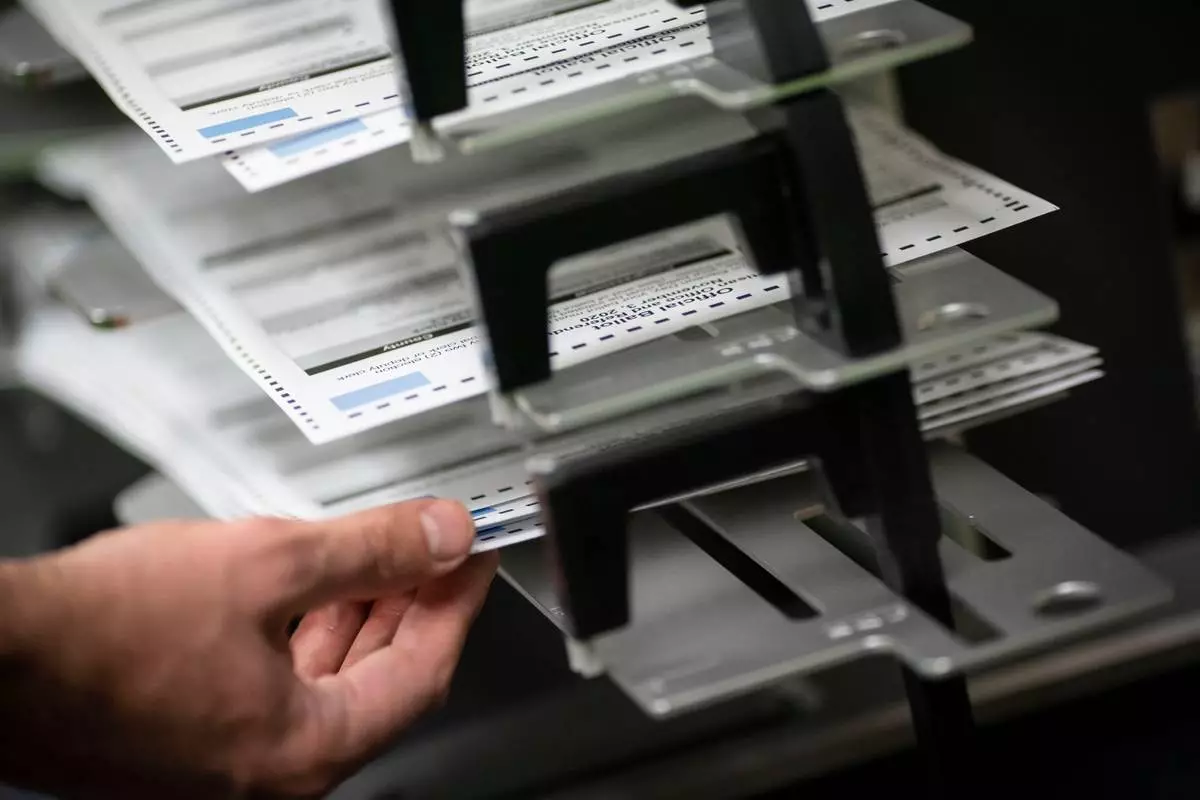
FILE - Poll workers sort ballots at the Kenosha Municipal Building on Election Day, Nov. 3, 2020, in Kenosha, Wis. (AP Photo/Wong Maye-E, File)
SIDON, Lebanon (AP) — Two years ago, Dr. Mohammed Ziara watched Israel ravage Gaza's health care system, shelling hospitals, striking ambulances and forcing patients to evacuate.
Now Ziara — along with many other medical workers, human rights groups and civilians — warns that the same scenario is unfolding in Lebanon.
Israel is pushing deep into the southern part of the country in its campaign against the Iran-backed group Hezbollah, a powerful militant force and political party that long has exercised de facto control over much of Lebanon’s Shiite community.
To describe its strategy in this war, the Israeli military has invoked the devastation it wrought in Gaza after the Hamas-led Oct. 7, 2023, attacks. At one point last month, Israeli warplanes even dropped leaflets over Beirut warning that after “great success in Gaza, a new reality is coming to Lebanon, too.”
“I've lived this before,” Ziara, a surgeon from Gaza City who specializes in burns, told The Associated Press on Thursday at the government hospital in the Lebanese port city of Sidon.
"I cannot go back to Gaza now,” Ziara said. “But I can be here, in Lebanon.”
As it did with Hamas in Gaza, Israel accuses Hezbollah of hiding in and operating from civilian areas, and using hospitals and ambulances for military purposes. Israel has increasingly targeted Lebanese first responders and medical centers, forcing several hospitals to evacuate.
“I was besieged in a hospital,” Ziara said of his time at Gaza’s Shifa Hospital, where he worked before evacuating to Egypt with his family. He then joined the U.K.-based nonprofit Interburns, which sent him to Lebanon in 2024 to respond to the outbreak of the previous Israel-Hezbollah war. “I feel what these people feel.”
Since the war between Israel and Hezbollah reignited on March 2, Israeli airstrikes have killed at least 56 health professionals as of Monday, according to the Lebanese Health Ministry.
Israel has carried out more than 150 attacks against emergency medical workers and ambulances, and forced the closure of six hospitals and 49 health clinics through attacks or threats, the ministry reported. In the latest attack that killed two paramedics and seriously wounded a third early Monday, the ministry accused Israel of deliberately targeting a gathering of first responders on duty.
Ziara and his team from Interburns, which trains medics around the world in burn care, have set up the Lebanese public health system's first specialized burn unit — a critical resource in this crisis-stricken country where the war has killed 1,461 people and wounded 4,430, according to the ministry. Israel claims to have killed hundreds of Hezbollah operatives in the latest bombardment and ground invasion.
The Israeli military argues that Hezbollah’s use of medical facilities makes them legitimate military targets under international law. It does not offer evidence to support its claims.
Hezbollah denies conducting militant activities within civilian sites. Although the group's presence in residential areas is well-documented, there has been no independent verification of its use of hospitals for military purposes.
Based in the first city just north of Israel’s evacuation zone that covers nearly all southern Lebanon, Sidon Government Hospital takes more wounded people every day.
Kamal Fakih, 27, hates when people ask him what happened on March 17.
It’s not that it pains him to recall the Israeli airstrike. It’s that he doesn’t remember anything at all. He regained consciousness a day later at the hospital in Sidon, his body burned and cut by shrapnel.
Once stabilized, Fakih tried to connect with the paramedic who pulled him and his friend Hassan from the burning rubble, hoping to hear his account and thank him for saving their lives. But by the time Fakih got his contact, Muhammad Tafili was already dead, killed with a fellow paramedic in an Israeli airstrike on ambulances in the southeastern village of Kfar Tebnit on March 28, according to Lebanon’s Health Ministry.
That same day, Israeli attacks killed seven other medics across four additional villages, the World Health Organization said. Among the dead was a medic targeted while responding to an Israeli airstrike that killed three journalists working for pro-Hezbollah TV channels. Footage of the incident shows two strikes in quick succession — the first hitting journalists in their car, the second crashing into paramedics as they rushed to the rescue.
Israel's military accused the two medics, and two of the three journalists killed, of being Hezbollah operatives. Its claim alarmed watchdogs that witnessed similar justifications for killing more than 260 journalists and 1,700 health workers in Gaza, according to figures from the United Nations humanitarian agency.
Although Lebanese medical workers and journalists were killed during the 2024 war with Hezbollah, “this time is different,” said Ramzi Kaiss, the Lebanon researcher at Human Rights Watch.
He pointed to a startling promise by Israeli Defense Minister Israel Katz last week that Israel would flatten all the houses in southern Lebanon to protect its border towns from Hezbollah rockets “in accordance with the model used in Rafah and Beit Hanoun in Gaza” — two cities that Israel almost entirely razed in its offensive against Hamas.
“There’s a new kind of brazenness in declaring an intent to commit unlawful attacks,” Kaiss said. “It appears impunity has emboldened the Israeli military.”
Sweeping Israeli evacuation orders in recent weeks have sent over 1 million Lebanese flocking north. As the south came under heavy bombardment, clinics shuttered or suspended operations. Nabih Berri Hospital was swamped by an influx of casualties. To make room, it evacuated dozens of patients.
Such transfers involve coordination with the Lebanese army, Health Ministry and U.N. peacekeeping force — a game of telephone, doctors say, that creates potentially life-threatening delays. Admitting patients isn’t easy either; the Sidon burn unit must discharge a patient to free up a bed.
But the referrals keep coming, straining a health system already crippled by economic collapse.
“The health system is on its knees,” Ziara said, as the hospital was plunged into darkness until backup generators kicked in 10 minutes later, a result of Lebanon’s long-running electricity crisis. “Now front-line hospitals are lacking staff and supplies. They're overwhelmed.”
Lebanese civilians say that Israeli bombs often come without warning and hit indiscriminately, feeding a growing feeling that Palestinians in Gaza know well — that nowhere is safe.
Mohammad Qubaisi, 53, said his neighborhood of Zuqaq al-Blat in central Beirut had not received Israeli evacuation guidance before March 18, when Israeli munitions slammed into his seventh-floor apartment.
Carrying his wife from the smoldering ruins, he shouted for his sons. His eldest, Adam, called to him. But he couldn’t hear Jad.
Qubaisi ran back into the skin-searing steam to search for his 15-year-old. When he woke up at the hospital hours later, his face raw with second-degree burns, he knew his son was gone.
The Israeli military said it was targeting Hezbollah. Qubaisi pushed back.
“These are civilian buildings, not military targets. They hit us and we still don’t know why,” he said from the Sidon hospital. “We were sleeping safely in our home, and look what happened to us.”
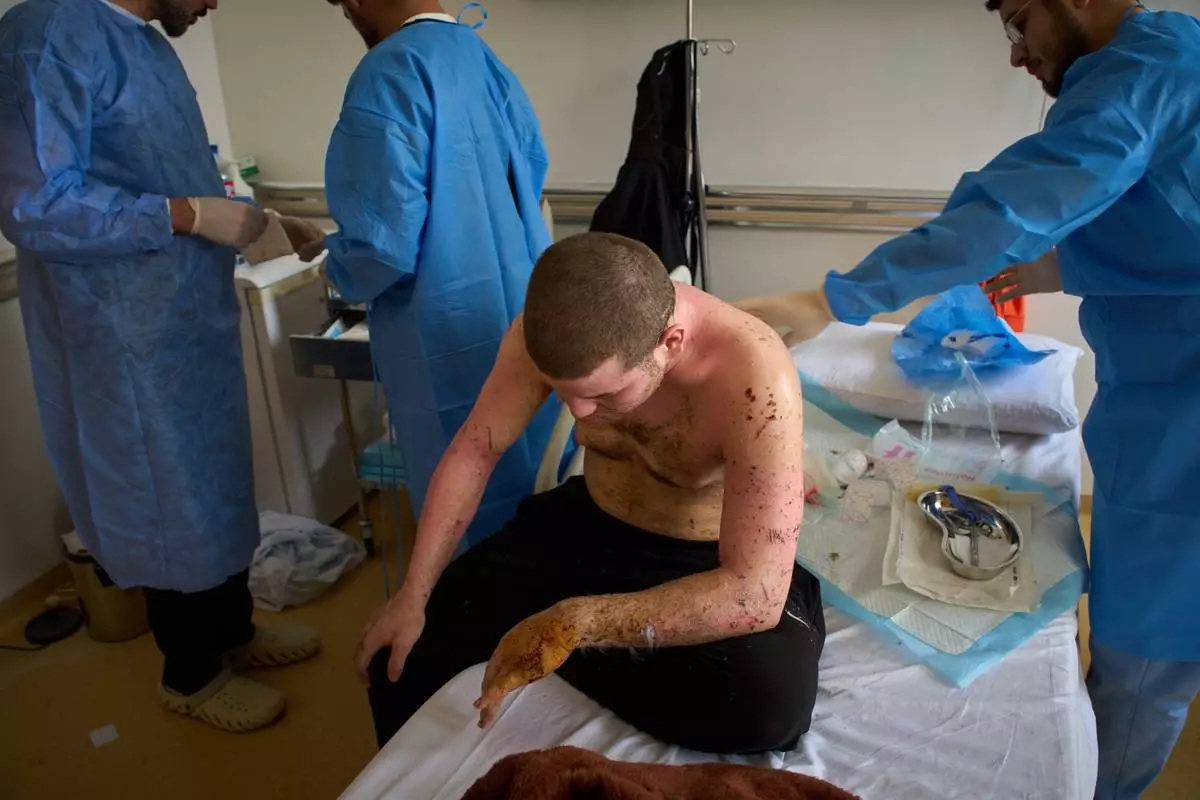
A man with burn wounds from an Israeli airstrike on southern Lebanon undergoes surgery by Dr. Mohammed Ziara and his team, at the Sidon Government Hospital in Sidon, Lebanon, Thursday, April 2, 2026. (AP Photo/Emilio Morenatti)
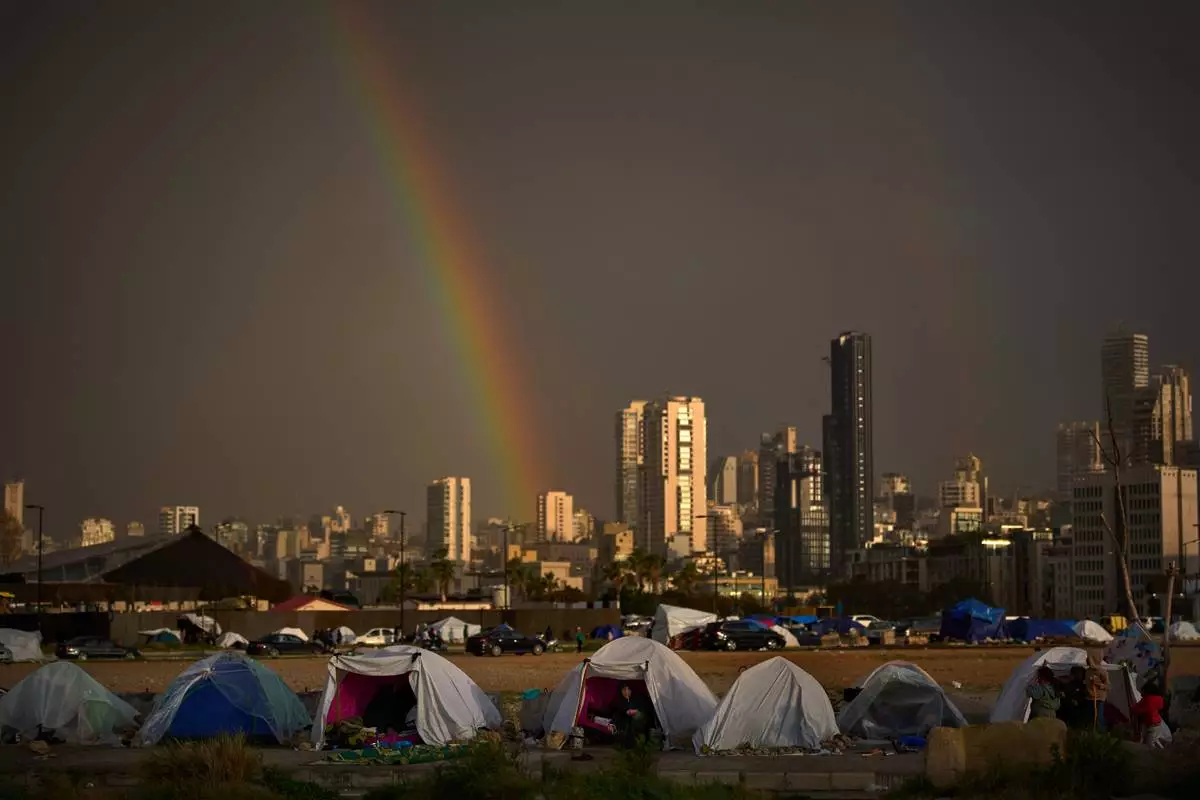
Displaced people who fled Israeli strikes in southern Lebanon sit inside tents used as shelters as a rainbow breaks through the rain in Beirut, Lebanon, Sunday, March 29, 2026. (AP Photo/Emilio Morenatti)
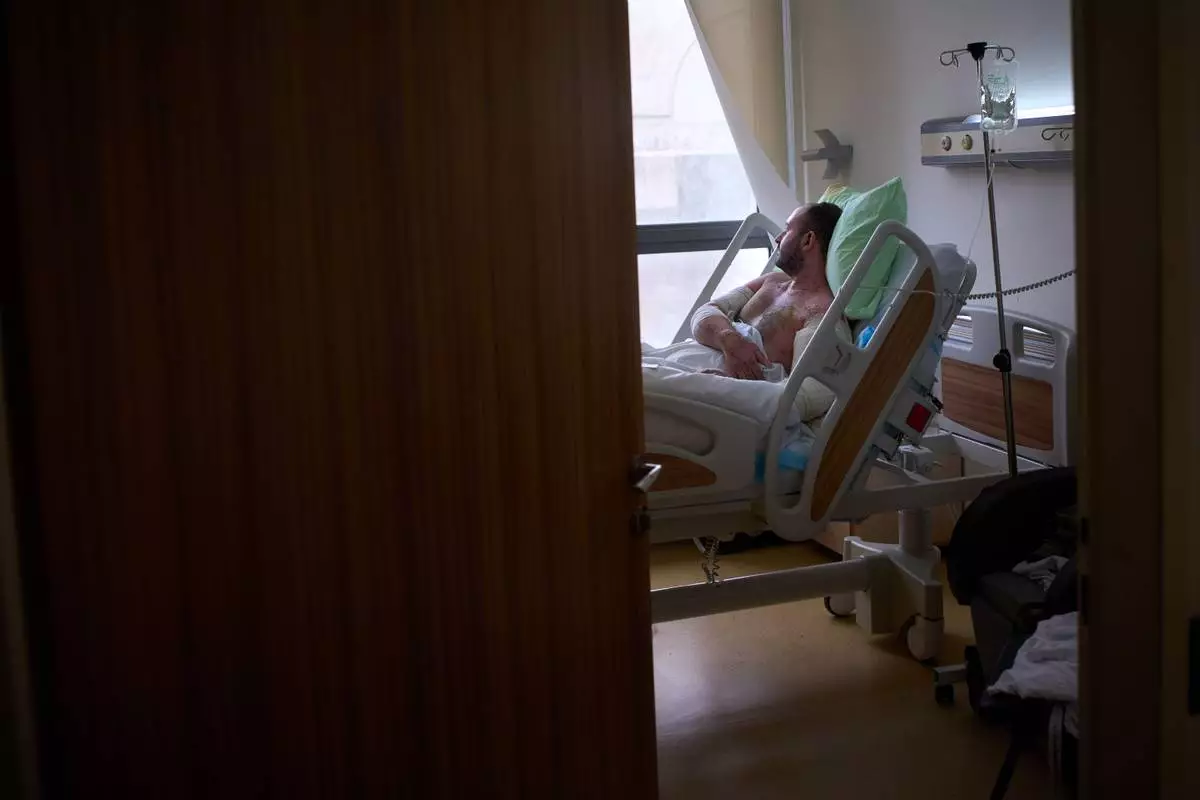
A man with burn wounds from an Israeli airstrike on southern Lebanon lying in bed at the Sidon Government Hospital in Sidon, Lebanon, Thursday, April 2, 2026. (AP Photo/Emilio Morenatti)
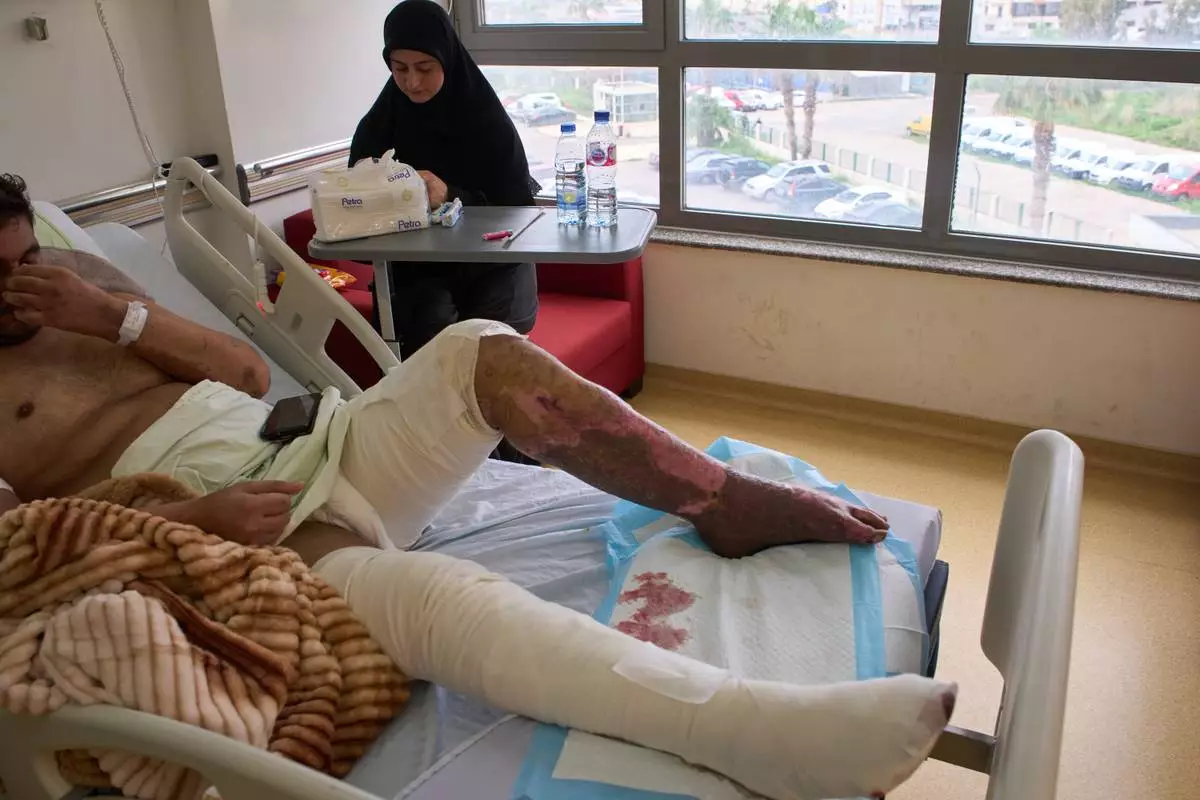
A man with burn wounds from an Israeli airstrike on southern Lebanon lying in bed at the Sidon Government Hospital in Sidon, Lebanon, Thursday, April 2, 2026. (AP Photo/Emilio Morenatti)
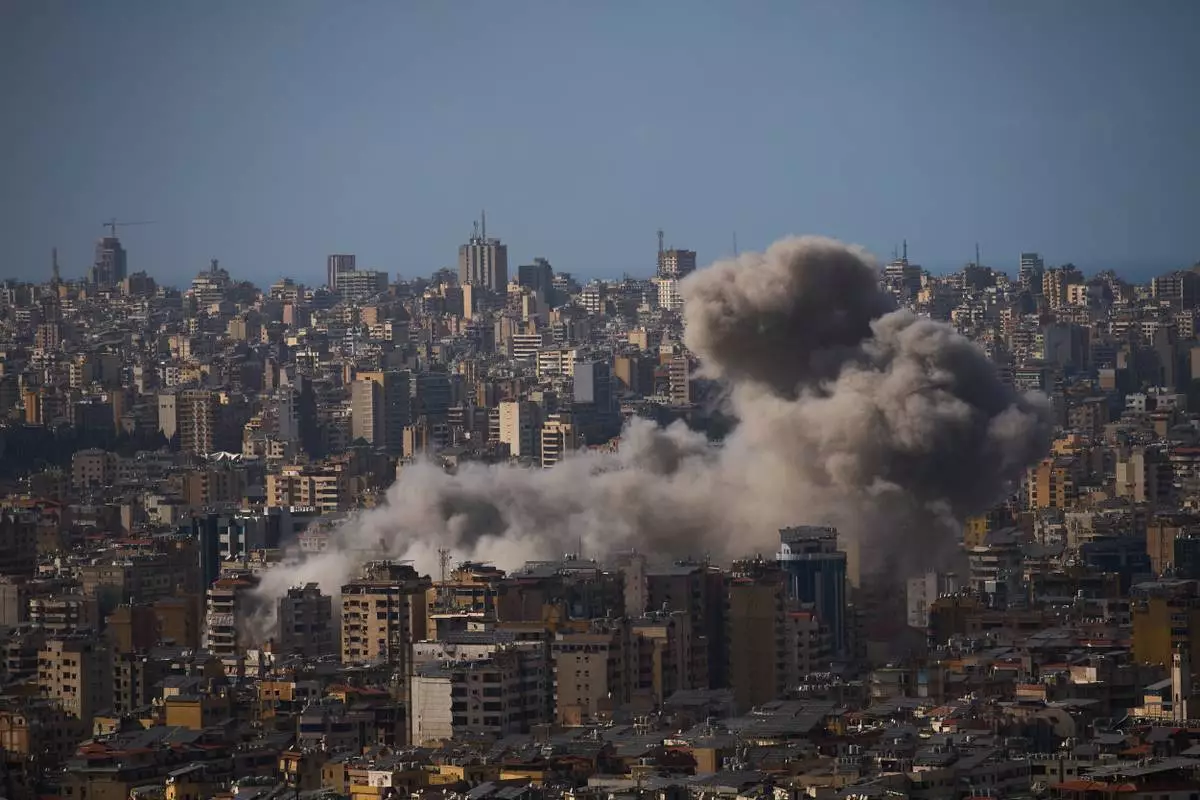
Smoke rises from Israeli airstrikes in Dahiyeh, a southern suburb of Beirut, Lebanon, Sunday, April 5, 2026. (AP Photo/Emilio Morenatti)
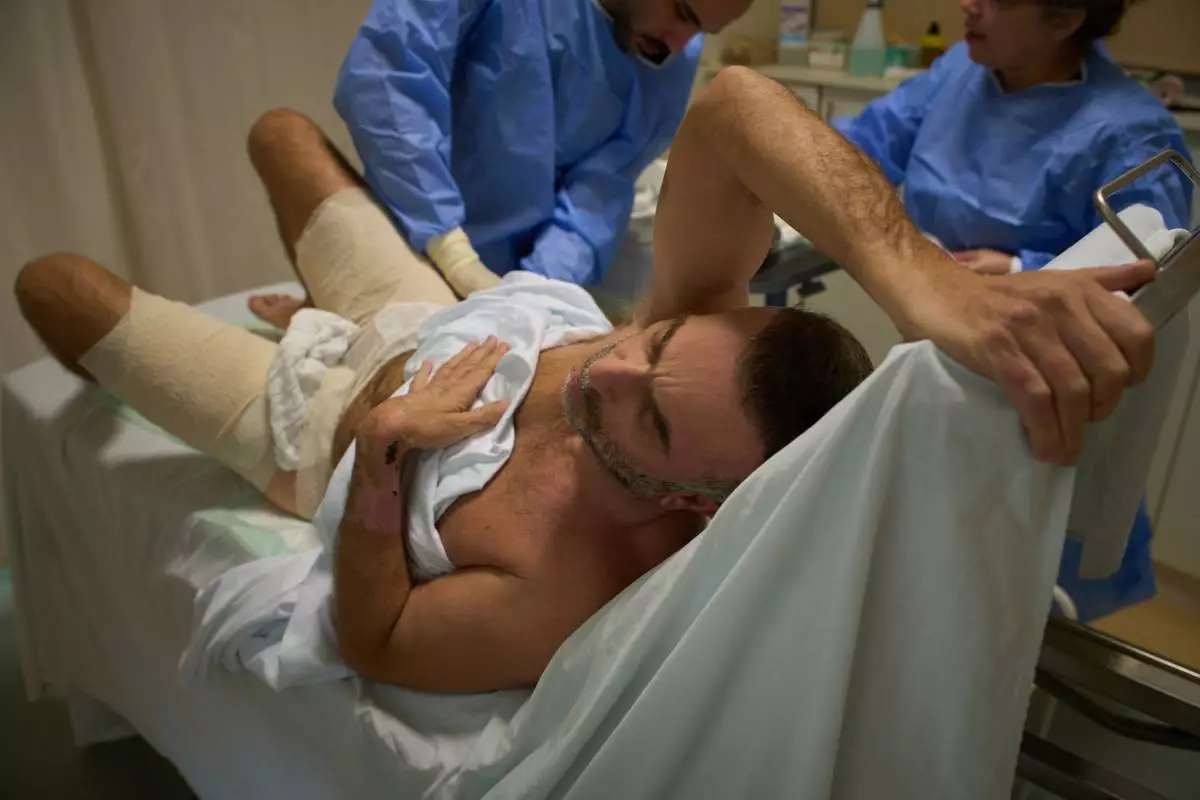
Mohammad Qubaisi, 53, with burn wounds from an Israeli airstrike on southern Lebanon, undergoes surgery by Dr. Mohammed Ziara, left, and his team, at the Sidon Government Hospital, in Sidon, Lebanon, Thursday, April 2, 2026. (AP Photo/Emilio Morenatti)