China has seen a peak in return trips on Monday, the final day of the three-day Qingming Festival holiday, as millions hit the roads, rails and waterways, particularly in populous regions.
Falling on April 5 this year, the Qingming Festival, or Tomb-Sweeping Day, is a traditional Chinese festival for people to pay tribute to the dead and worship their ancestors. The holiday also provides a short break for people as they engage in travel and leisure.
This year's Qingming Festival holiday coincides with the spring break at some schools. Travel demand for family visits, tomb sweeping, spring outings, and sightseeing has remained strong throughout the break.
According to the latest real-time data from the Ministry of Transport, the country's expressway network is expected to handle approximately 59 million vehicles on Monday, with traffic flows concentrated heavily on routes leading into major urban centers.
Return traffic is showing a clear regional concentration. The Guangdong-Hong Kong-Macao Greater Bay Area and the Yangtze River Delta region are experiencing the heaviest road congestion, particularly at key traffic junctions such as sections entering or exiting major cities, sections near scenic spots, and river-crossing routes. Short-term congestion and slowdowns are expected at these critical nodes.
The peak travel window runs from 15:00 to 19:00 on Monday, with the heaviest inbound flows directed toward major hub cities.
Return flows in the Greater Bay Area are characterized by movement from surrounding cities toward core urban centers, with vehicles converging from Zhoushan, Zhuhai and Dongguan, as well as suburban tourist spots, into Guangzhou, Shenzhen and Foshan.
In the Beijing-Tianjin-Hebei region, return flows to the capital is expected to surge from the afternoon into the evening, as travelers return from neighboring cities such as Tangshan and Baoding, as well as surrounding holiday destinations.
On the waterways, Shanghai's Huangpu River core sightseeing area is expected to see 3,410 ferry and cruise trips during the holiday period, carrying an estimated 300,000 passengers. To ensure safe and smooth travel, the maritime department has designated specialized navigation routes and implemented scientific scheduling measures to enhance operational safety for sightseeing vessels.
On the country's railways, the holiday travel rush is also hitting its peak. China State Railway Group, the country's railway operator, said it expects to handle 20.8 million passenger trips on Monday. Beijing South Railway Station, Shanghai Hongqiao Railway Station, and Guangzhou South Railway Station are among the busiest hubs.
According to ticketing data from 12306, the nation’s train ticket booking platform, the most popular departure and destination cities include Beijing, Guangzhou, Chengdu, Shanghai, Hangzhou, Wuhan, Nanjing and Xi'an.
Throughout the Qingming Festival holiday period, railway authorities have been operating a peak-service schedule, fully utilizing both high-speed and conventional rail capacity, with an average of more than 13,000 passenger trains running daily.
As the holiday coincides with spring breaks, a higher-than-usual proportion of travelers are children and the elderly. In response, railway operators across multiple cities have rolled out enhanced services, including passenger-friendly amenities and regionally inspired dining options.
Railway authorities have also deployed intelligent technologies to ensure safe and efficient operations. Xi'an has introduced intelligent inspection robots for high-speed trains to check key components, shortening the inspection time for a single train unit to 45 minutes, which marks a 50-percent improvement in efficiency.
The northwestern province of Shaanxi has seen particularly heavy railway passenger volumes during the holiday. Xi'an North Railway Station, a key transportation hub, handled an average of 210,000 passenger trips per day during the holiday, mostly tomb-sweeping trips, short-distance spring outings, and family visits to nearby cities.
On Saturday, the first day of the three-day holiday, the station handled 315,000 passenger trips, setting a new single-day record. The station expects to handle about 230,000 passenger trips on Monday, a nearly 10-percent increase compared to the final day of last year's Qingming Festival holiday.
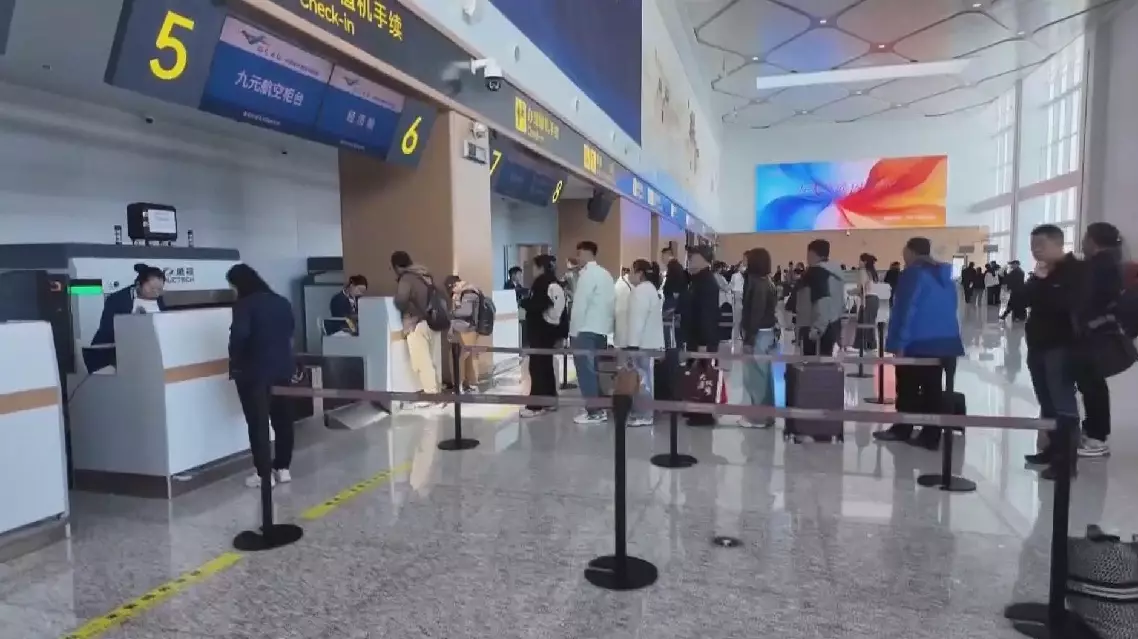
The newly opened Terminal 2 of Jiayuguan Jiuquan Airport, a key transportation node along the Hexi Corridor in northwest China's Gansu Province, recorded its first passenger surge since entering service on March 31.
The airport has handled more than 17,000 passenger trips since Terminal 2 was put into use, representing a roughly 21 percent year-on-year increase, according to airport authorities. Popular destinations of routes from this airport include Lanzhou, Xi'an and Beijing.
The new terminal, which has a total floor area of 14,000 square meters, marks a significant upgrade in facilities. The number of boarding bridges has increased from three to eight, while check-in counters have also expanded from three to eight, greatly reducing passenger waiting times.
China's holiday travel peaks as millions return on final day of Qingming break