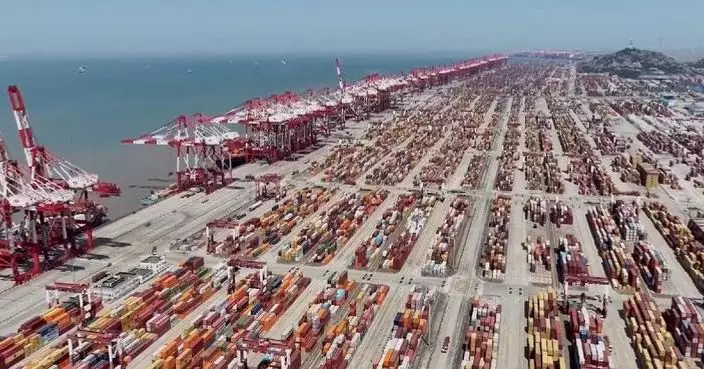
The growth of winter wheat and rice planting is progressing smoothly across China, thanks to the large-scale application of new equipment and techniques and government financial support.
According to the Ministry of Agriculture and Rural Affairs, winter wheat in China's major wheat-producing areas, including the Huang-Huai-Hai region and the northwestern regions, has reached the jointing and booting stages at roughly the same pace as in normal years.
As the current phase is critical to the final yield, local farmers have adopted innovative approaches to ensure abundant nutrients for the plants, such as intelligent sprinklers and smart fertilization and irrigation systems, which enable them to fertilize remotely and accurately.
East China's Shandong Province plans to install smart fertigation systems in 200,000 hectares of fields this year.
"It takes only 300 cubic meters of water for one hectare of land. This not only saves 70 percent of water, but also allows us to fertilize in a targeted manner for plants in different growth stages," said Qu Yankui, manager of the Quzhuang Village Land Shareholding Specialized Cooperative in Wucheng County of Shandong.
In Jinchang City, northwest China's Gansu Province, the local government has established a green channel for spring farming loans this year, through which the Postal Savings Bank of China has provided 420 million yuan (about 61 million U.S. dollars) of loans for more than 1,500 rural households, enabling them to rent or buy new agricultural machinery in advance.
Meanwhile, rice farming is also at the same pace as last year, with over 80 percent of early-season rice breeding and 20 percent of the plantations completed.
In Anyi County, east China's Jiangxi Province, farmers are using drones to broadcast early-season rice seeds.
With support from the BeiDou Navigation Satellite System, which automatically generates drone trajectories, they can achieve centimeter-level accuracy in efficient seeding.
"Using drones to sow the seeds, we can skip many steps such as the breeding, management, and planting of seedlings. This way saves over 20 percent of seeds compared to our traditional manual seeding," said Zhang Kun, executive director of a local cooperative specializing in agricultural machinery services.
In Qiyang City, central China's Hunan Province, rice transplanting and simultaneous side-deep fertilization integrated machines have been promoted for large-scale use this year.
Equipped with a soil depth-sensing system, this machine can measure soil softness and hardness in real time and automatically adjust depth with an error of less than 1 centimeter. It's particularly suitable for the uneven paddy fields with complex mud layers in the south.
By combining national, provincial, and municipal subsidies, farmers enjoy an over 40 percent reduction in costs when buying this machine. So far, local sales have exceeded 200.
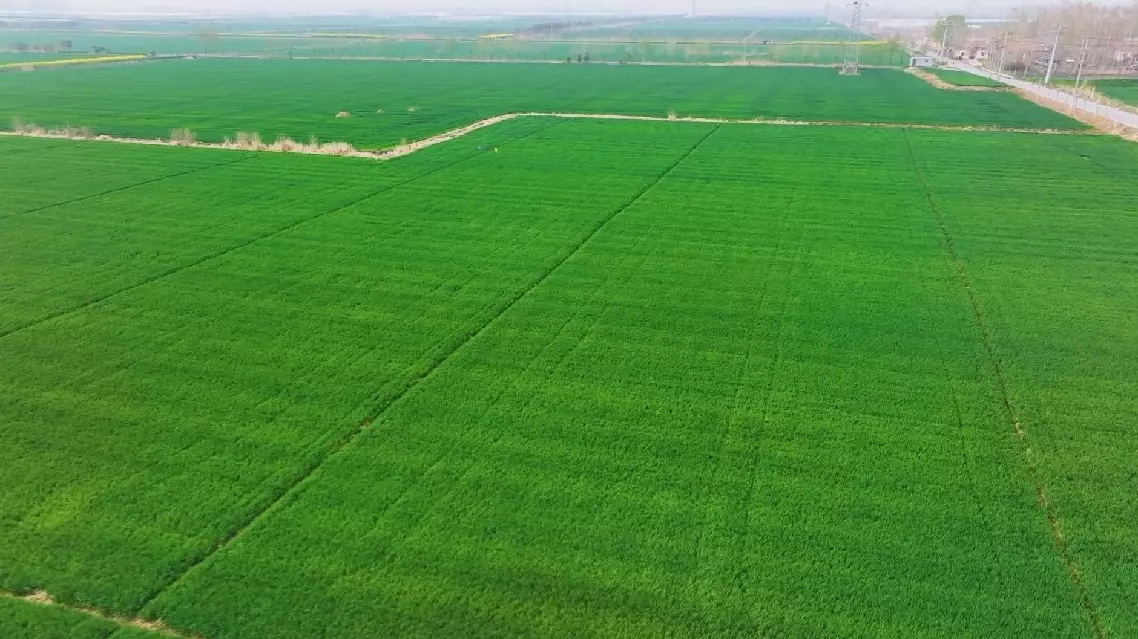
New technologies, government support help Chinese farmers with spring wheat, rice production