LONDON--(BUSINESS WIRE)--Apr 7, 2026--
Trent AI, an agentic security company, today announced its emergence from stealth with a layered security solution built for the agentic era. Following a $13M seed round led by LocalGlobe and Cambridge Innovation Capital, with participation from leaders at OpenAI, Spotify, Databricks, AWS and others, the product is the first multi-agent security solution designed to secure agents as they evolve. Led by strong conviction that security should be continuous, invisible and scalable, Trent AI’s leadership team brings deep experience from Spotify, AWS, Alcion (acquired by Veeam) and Confluent.
This press release features multimedia. View the full release here: https://www.businesswire.com/news/home/20260407796810/en/
“Organizations are deploying AI agents and autonomous workflows faster than their security can adapt, and most development teams using these agents and workflows have no security framework designed for their systems,” said Eno Thereska, Co-founder and CEO of Trent AI. “This is not an easy problem to solve. Trent AI is tackling these difficult and important problems, while building the necessary security foundations and frameworks for agentic systems now and through the next decade.”
According to Deloitte’s 2026 State of AI report, nearly 3 in 4 (74%) companies plan to deploy agentic AI within two years. Despite this, only 1 in 5 (21%) report having a mature model for governance of autonomous agents. The threat increases in complex environments with interconnected agents, with security holes risking the entire infrastructure; driving the need for a security and compliance solution that encompasses the entire agentic ecosystem.
Trent AI’s Unified Security Solution
Built for developers and security teams that want to develop and ship agents fast without compromising security, Trent AI’s layered, unified offering secures agents throughout the entire lifecycle. Every cycle makes Trent AI’s agents smarter about the systems they protect. As the feedback loop tightens, judgement improves and mitigations become more accurate, giving development and security teams a faster, more reliable path to safe deployment. Agents in the loop work to:
Design partners, companies with early access to the Trent AI agentic security solution, including Canopy, Commscentre, ML@Cam, Qbeast, Weblogic and others are already seeing tangible benefits to security and deployment. These partners have reported: immediate visibility into their security posture, a security audit report, fast response time identifying and presenting vulnerabilities, a clean and well laid out remediation scope and adaptive feedback.
Investors Back the Future of Agentic Security
In addition to LocalGlobe and Cambridge Innovation Capital, prominent angel investors involved in the launch include OpenAI Member of Technical Staff Joaquin Quiñonero Candela, former Head of Stripe Data Infrastructure and current Director at AWS Avinash Bhat, Databricks Distinguished Engineer Ippokratis Pandis, former Spotify VP Engineering and Head of AI/ML Tony Jebara and others.
“Agent adoption is outpacing enterprise security readiness. As autonomous workflows make decisions across critical systems, a new layer of infrastructure is needed to govern, observe, and enforce safe behavior,” said Cambridge Innovation Capital Partner Ian Lane. “We believe Trent AI is well placed to define this category.”
"The rise of agents goes hand in hand with the rise of new security threats,” said Saul Klein, Co-founder and Executive Chairman of Phoenix Court, the home of LocalGlobe. “Now is the right time to build the long-term foundations of security for agentic systems. Trent AI is uniquely positioned to do this, combining deep academic expertise with real-world experience building large-scale systems and working closely with design partners deploying agents today.”
"Agentic systems are quickly becoming part of the software stack, but the security infrastructure around them is still early,” said Avinash Bhat, Director at AWS. “Trent is building the foundations teams will need, to operate these systems safely at scale. I’m excited to support Eno and the team as they tackle this emerging challenge."
“AI models have led to an exponential growth in code being generated by companies big and small. That code brings along an exponential growth in security risks, vulnerabilities and threats... and human security teams just can't keep up,” said Tony Jebara, former Spotify VP Engineering and Head of AI/ML. “We desperately need specialized AI models that can analyze this flood of code, produce security assessments and provide mitigations. Trent AI is providing just that: securing your code at all stages, all the way from the initial design stage to large code repositories."
Trent AI is active in the security and AI community, currently a Partner Startup member of OWASP, the Open Worldwide Application Security Project, as well as a Startup Partner with Carnegie Mellon University’s CyLab Venture Network and is also engaged with providing a Security Agent for open-source platforms such as OpenClaw.
To learn more about Trent AI or sign up for the security solution waitlist, please visit trent.ai.
FAQ
About Trent AI
Trent AI is redefining agentic AI with context-driven agentic security. Its proprietary judgement layer and reinforcement learning technology power a collection of specialized security agents. By orchestrating these agents across customer workflows, Trent AI transforms agentic security into an effortless, continuous part of agent development. Trent AI was launched in 2025 by co-founders: Eno Thereska, former Distinguished Engineer at Alcion (acquired by Veeam), AWS, and Confluent, Neil Lawrence, DeepMind Professor of Machine Learning at the University of Cambridge and previous Director of ML at Amazon, and Zhenwen Dai, former Machine Learning Scientist at AWS and Senior Research Manager at Spotify.
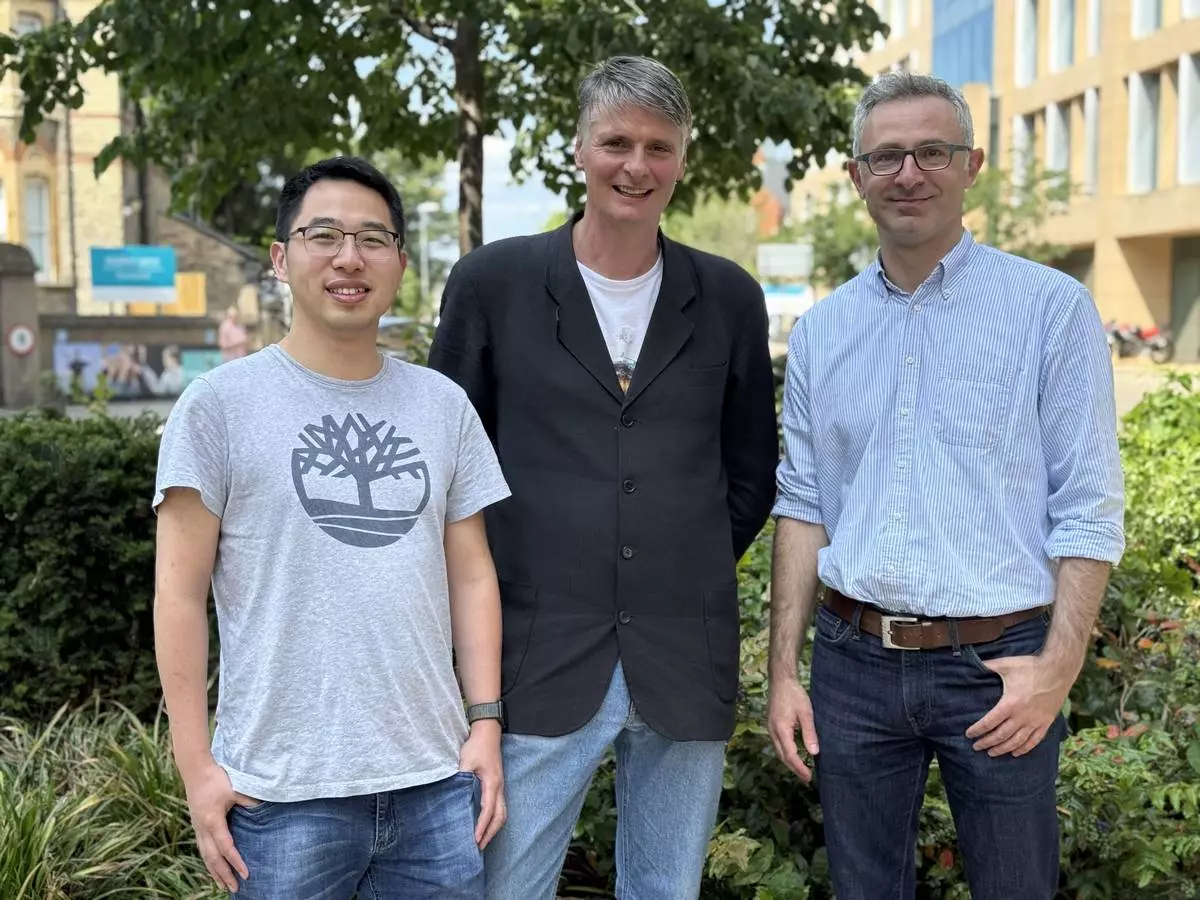
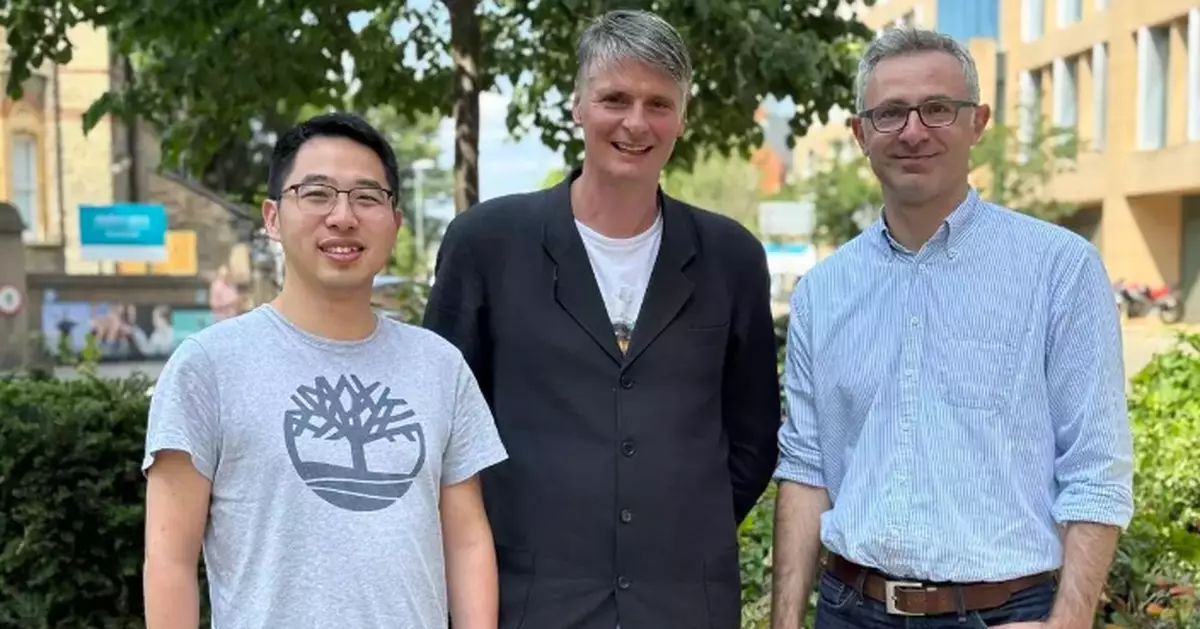
Co-founder and CTO Zhenwen Dai, Co-founder and Chief Scientist Neil Lawrence, Co-founder and CEO Eno Thereska.
NEW YORK (AP) — Wall Street is steadying Thursday following jarring drops for stocks worldwide in the artificial-intelligence industry on worries about how much longer the AI frenzy will last.
After initially falling to a loss following its worst day since July, the S&P 500 quickly erased it and added 0.1% to edge closer to its all-time high set last week. The weakness for AI stocks dragged the Nasdaq composite down 0.4%, but the Dow Jones Industrial Average was up 482 points, or 0.9%, as of 11:45 a.m. Eastern time as the majority of U.S stocks climbed.
Markets were much shakier earlier in the day. A sell-off for AI stocks that began on Wall Street Wednesday whipped around the world and sent South Korea’s Kospi stock index down 7.6% and Japan’s Nikkei 225 down 4.9%.
They're the latest swings for AI stocks after they led the market for years. Companies are pouring money into the technology in hopes of bigger profits and improved productivity. But data centers and AI chips cost money, and many companies have been borrowing the cash to get them.
Now, after yields in bond markets worldwide hit their highest levels in years, worries are rising about how resilient that boom in spending can be. Many AI-related companies have already taken on debt to build out their aspirations, and stocks are struggling under the debt loads.
CoreWeave, which offers AI computing power to customers over the cloud, fell 3.5% a day after tumbling 15.5%. It said in the summer that it had $4.41 billion in principal payments to make on its debt over the second half of this year and another $6.18 billion in 2027. It had more than $5.5 billion in cash, as of June 30.
High yields in the bond market also generally make investors less willing to pay high prices for stocks, particularly those seen as the most expensive.
Nvidia, the chip company that’s ridden the AI boom to become Wall Street’s most valuable company, fell 2% and was the heaviest weight on the S&P 500. It came into the day with a nearly 1,415% gain since the end of 2022.
The losses for AI stocks moderated as the day progressed, which helped broad U.S. indexes improve. CoreWeave had been down as much as 9.5% in the morning before more than halving its loss, while stocks outside of AI were much more resilient.
Marsh & McLennan helped lead the market after the insurance and professional services firm reported a stronger profit for the summer than analysts expected. The company, which updated its brand name to Marsh earlier this year, also delivered higher revenue than expected, and its stock climbed 6%.
Expectations are high for profits at all kinds of companies this reporting season, which began in earnest this week. That's what's allowed U.S. stocks to set records despite the high inflation and many other worries weighing on Wall Street. Now, companies will need to surpass those high expectations to drive their stock prices even higher.
Seven out of every 10 stocks within the S&P 500 rose. But because AI stocks have become so big in value, their stock movements have more effect on the index and can drown out the rest of the market.
In the bond market, Treasury yields fell, which means investors are willing to pay higher prices to buy U.S. government bonds. Treasurys have a reputation as a safer investment, one with less risk of the borrower going bankrupt, and investors often flock to them when feeling nervous.
The yield on the 10-year Treasury sank to 5.09% from 5.19% late Wednesday. It had topped 5.30% earlier this month and touched its highest level since 2002 because of worries about high inflation, signals of a strong U.S. economy and other factors.
The drop in yields came even though another report signaled inflation has worsened in the United States by even more than economists expected.
Several reports on the U.S. economy also came in stronger than economists expected, which typically push yields upward. One report said U.S. retailers made more money last month than economists expected, while another said fewer U.S. workers applied for unemployment benefits last week than expected.
In stock markets abroad, South Korea’s loss was the headliner. Its Kospi index is dominated by two chip companies, Samsung Electronics and SK Hynix, and it fell to its worst day since July. It has dropped 39% since setting a record in June.
Indexes were stronger in Europe, and London's FTSE 100 rallied 1.1% for one of the world's biggest gains.
AP Business Writers Chan Ho-him and Matt Ott contributed to this report.
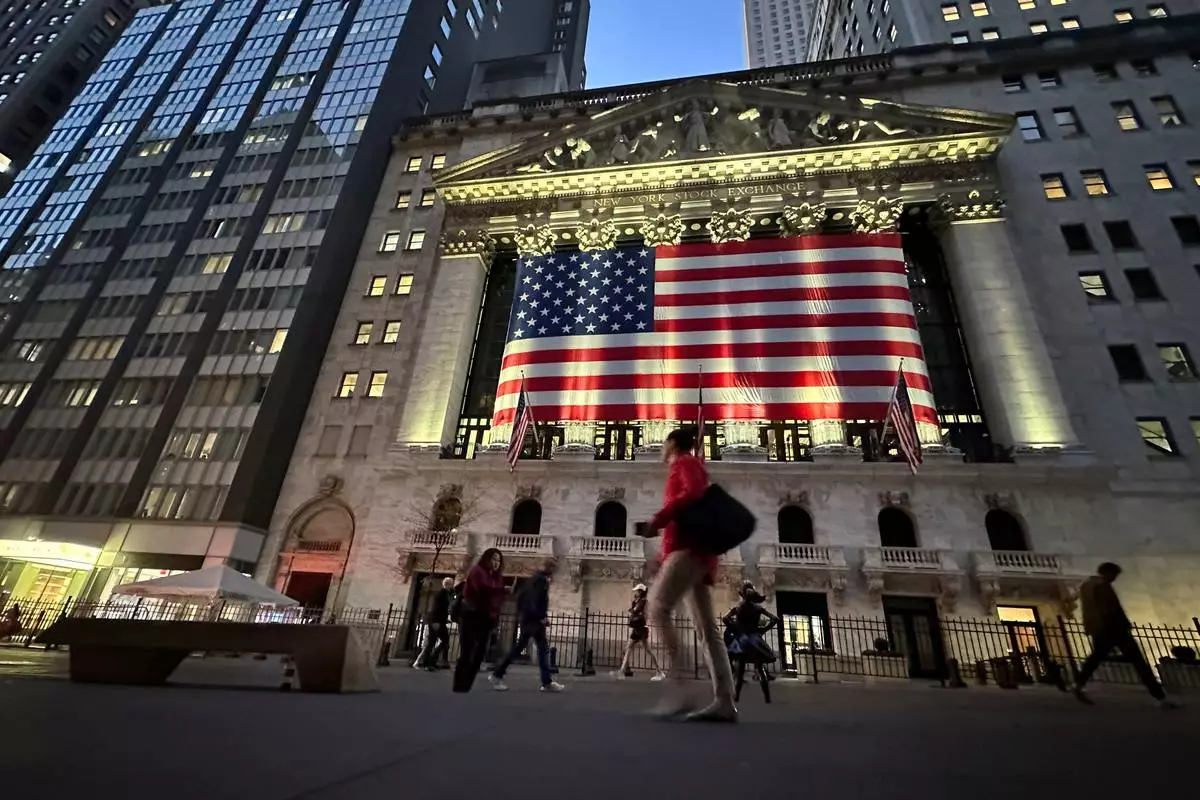
FILE - People pass the New York Stock Exchange on Nov. 5, 2024, in New York. (AP Photo/Peter Morgan, File)
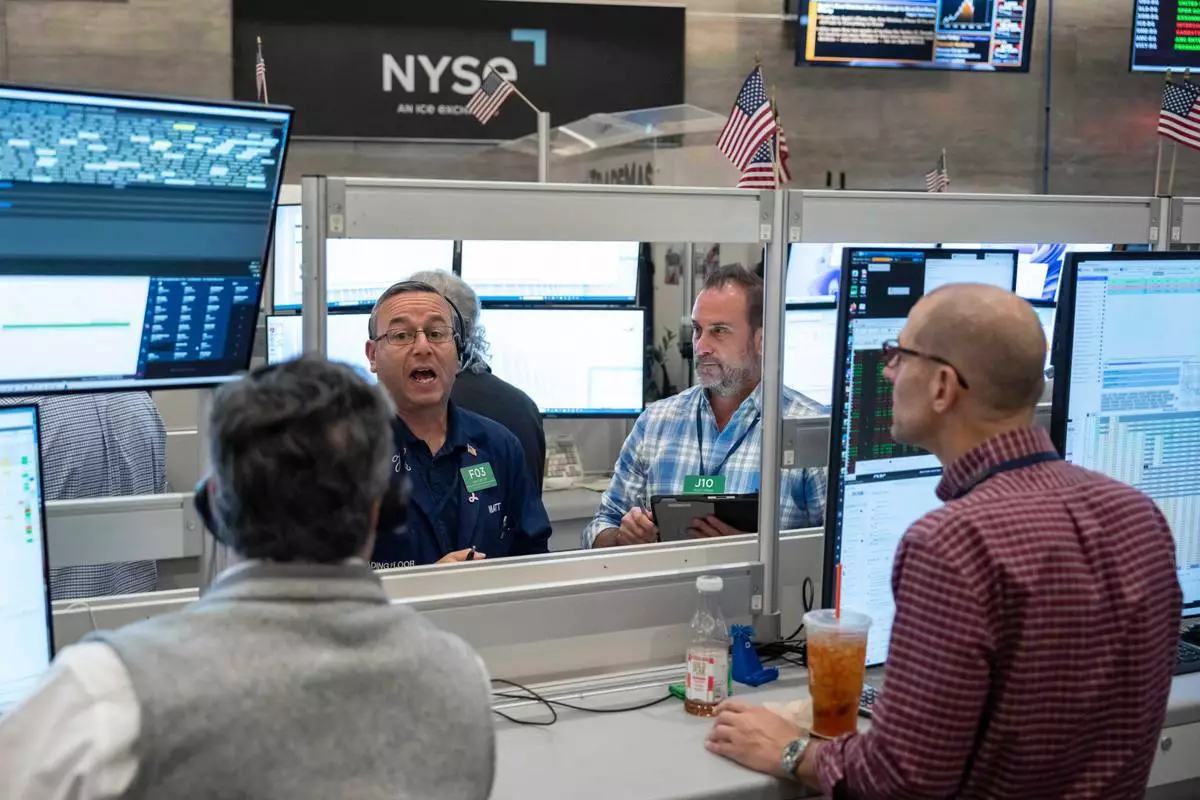
Options trader Matt Hefter works on the floor of the New York Stock Exchange, Thursday, Oct. 8, 2026, in New York. (AP Photo/Yuki Iwamura)
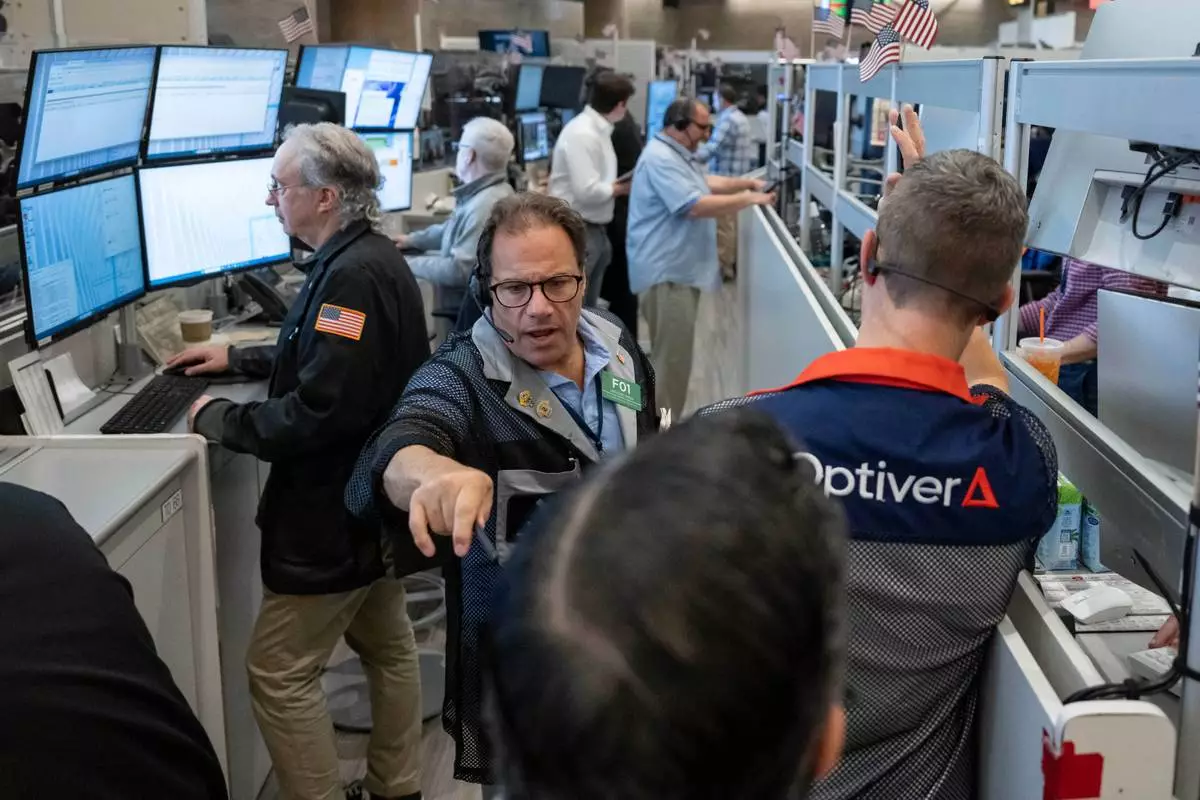
Options trader Anthony Spina works on the floor of the New York Stock Exchange, Thursday, Oct. 8, 2026, in New York. (AP Photo/Yuki Iwamura)
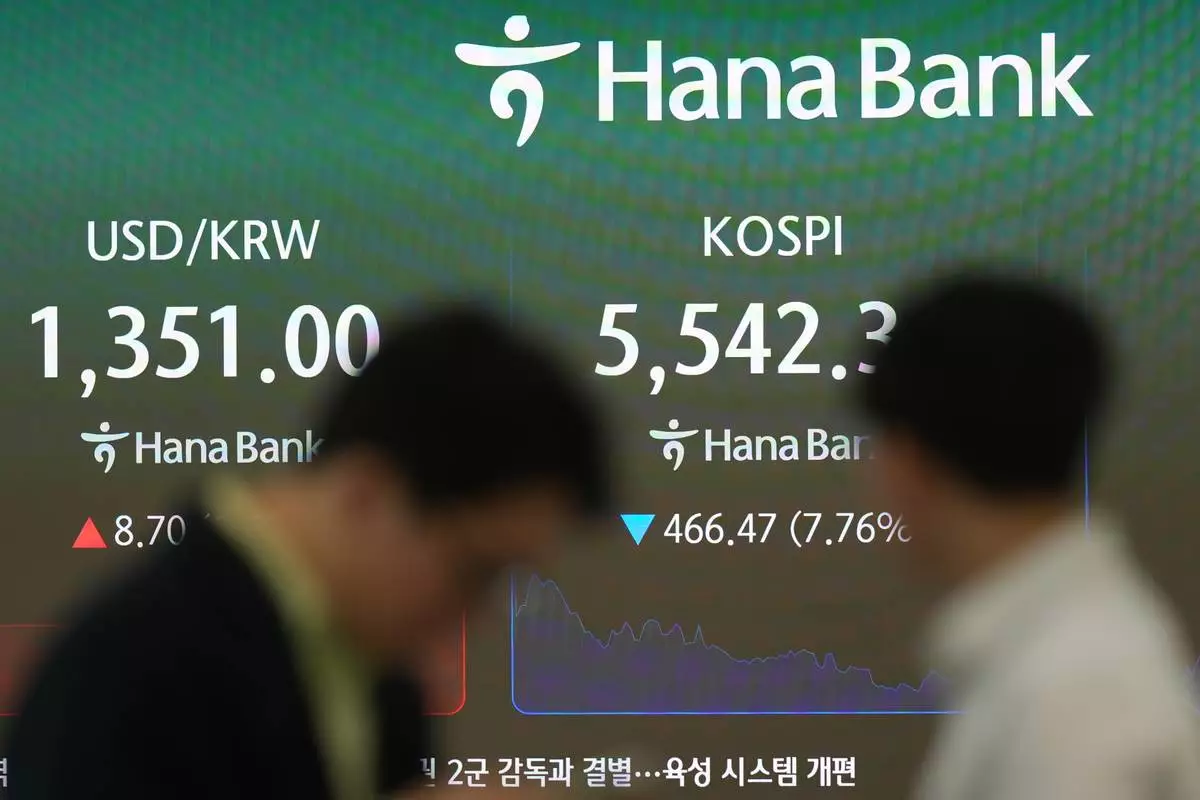
Dealers stand near the screens showing the Korea Composite Stock Price Index (KOSPI), left, and the foreign exchange rate between U.S. dollar and South Korean won at a dealing room of Hana Bank in Seoul, South Korea, Thursday, Oct. 15, 2026. (AP Photo/Lee Jin-man)
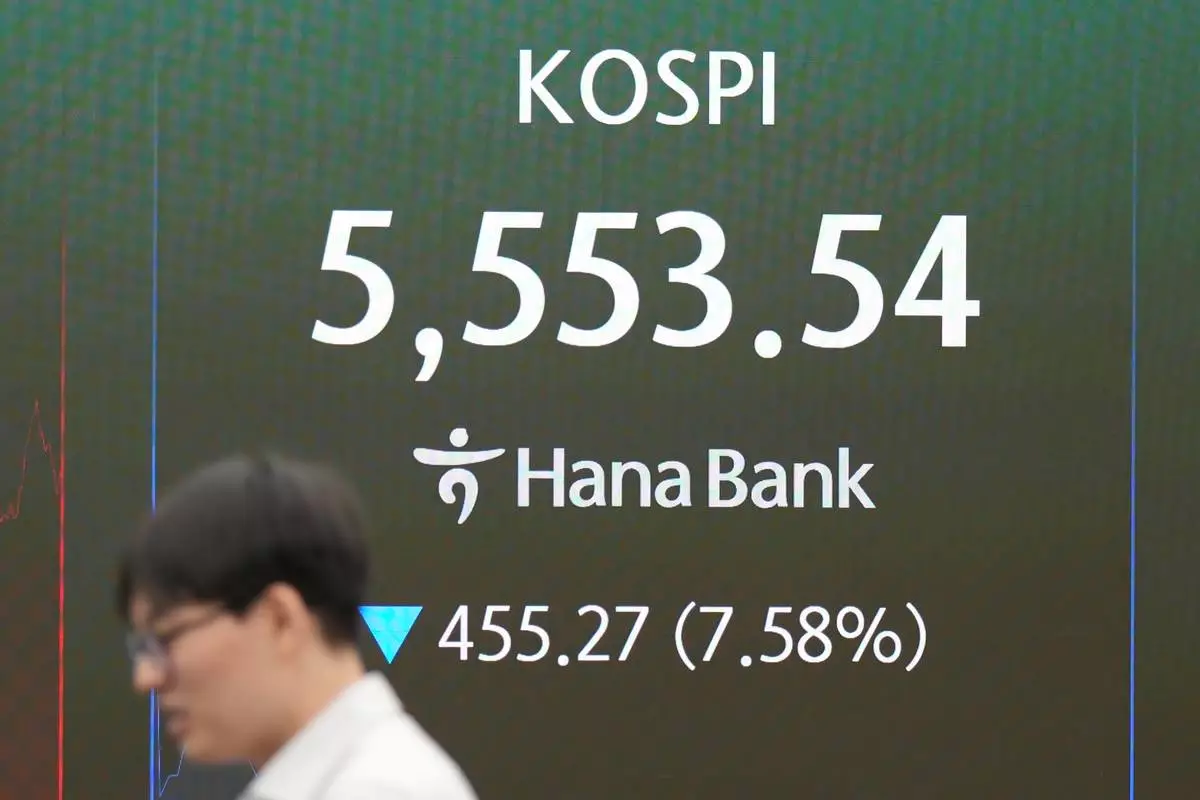
A dealer stands near the screen showing the Korea Composite Stock Price Index (KOSPI) at a dealing room of Hana Bank in Seoul, South Korea, Thursday, Oct. 15, 2026. (AP Photo/Lee Jin-man)
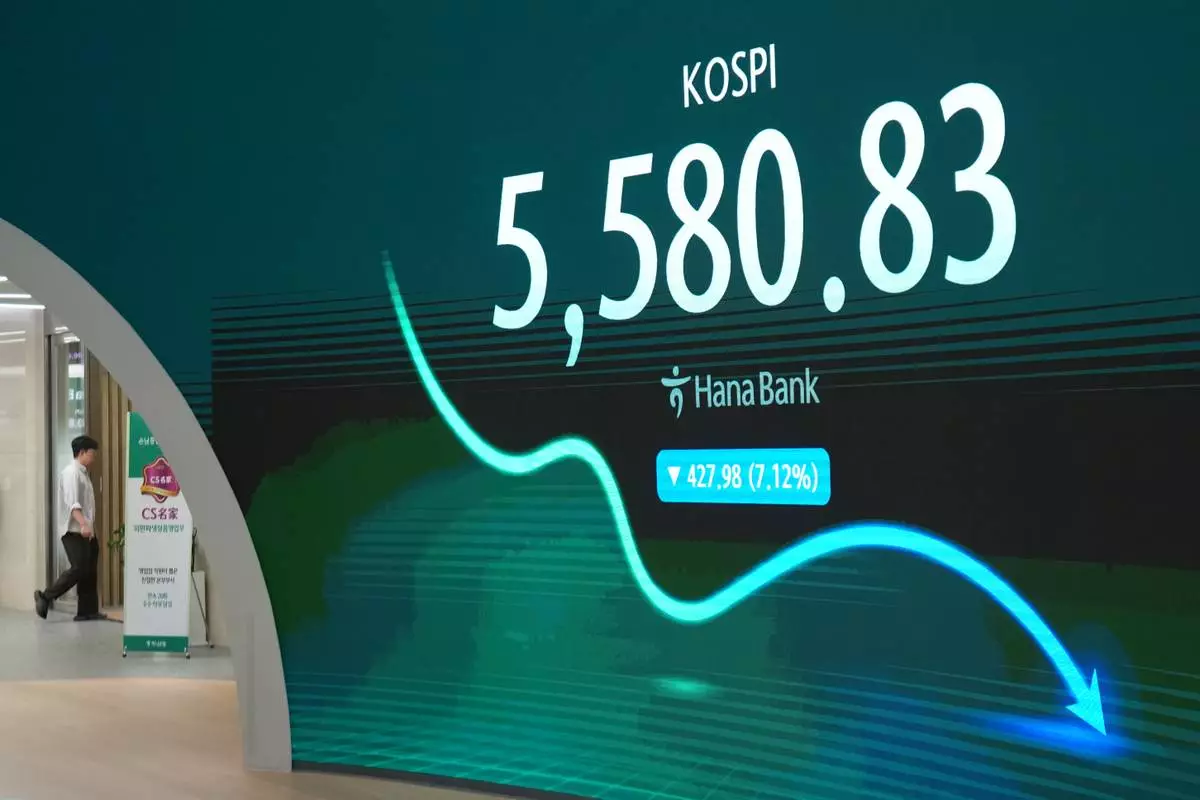
A dealer walks near the screen showing the Korea Composite Stock Price Index (KOSPI) at a dealing room of Hana Bank in Seoul, South Korea, Thursday, Oct. 15, 2026. (AP Photo/Lee Jin-man)
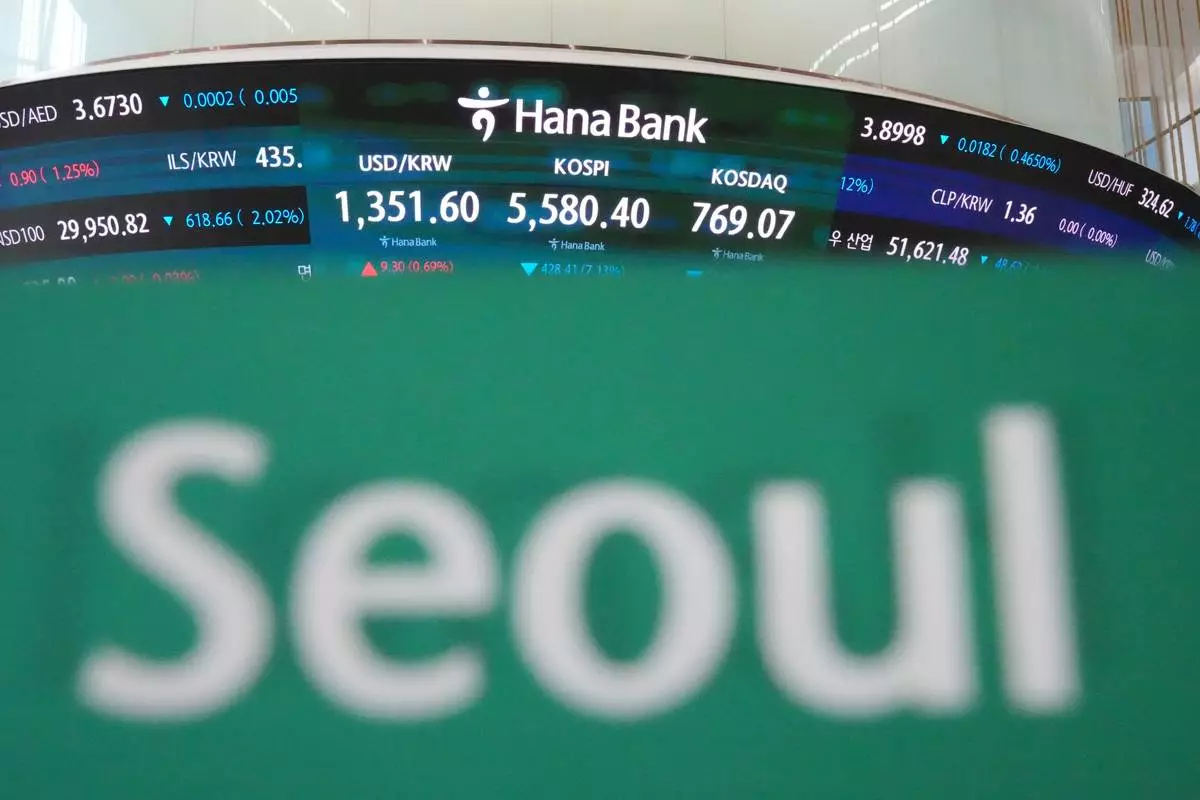
Screens showing the Korea Composite Stock Price Index (KOSPI), the Korean Securities Dealers Automated Quotations (KOSDAQ) and the foreign exchange rate between U.S. dollar and South Korean won are seen at a dealing room of Hana Bank in Seoul, South Korea, Thursday, Oct. 15, 2026. (AP Photo/Lee Jin-man)
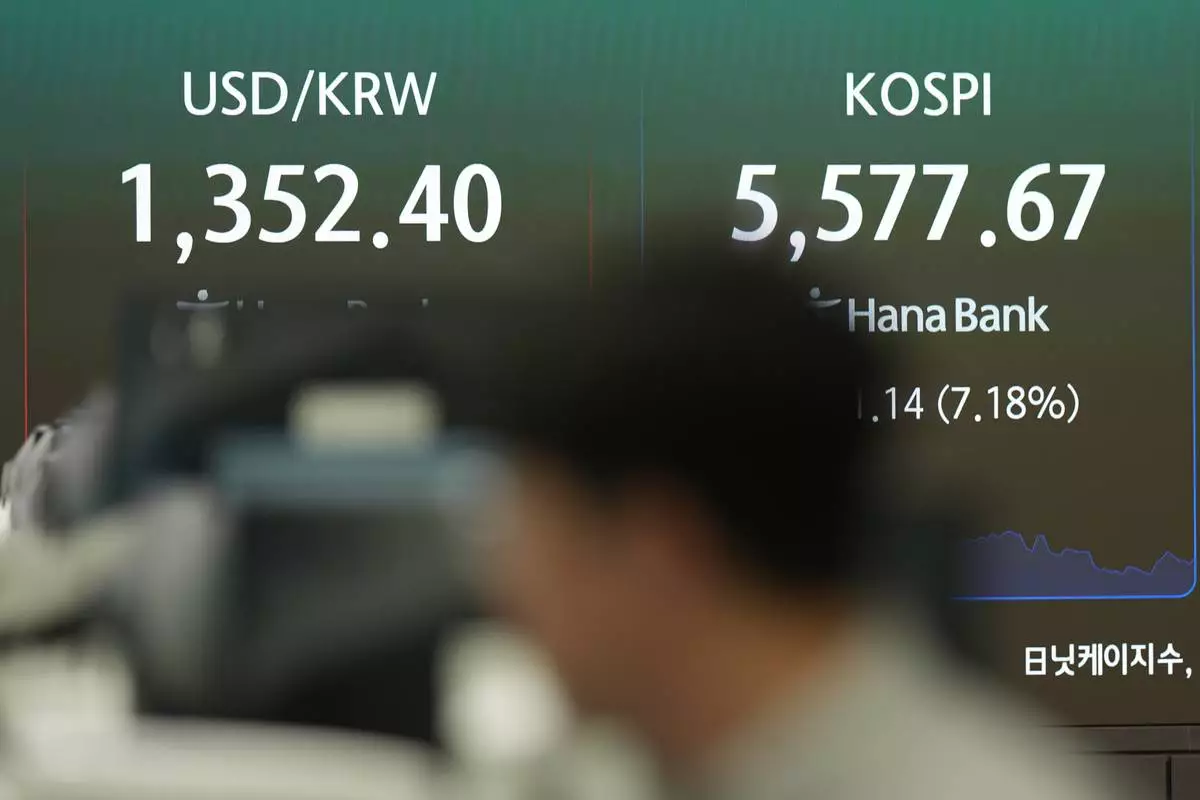
A dealer walks near the screens showing the Korea Composite Stock Price Index (KOSPI) and the foreign exchange rate between U.S. dollar and South Korean won at a dealing room of Hana Bank in Seoul, South Korea, Thursday, Oct. 15, 2026. (AP Photo/Lee Jin-man)
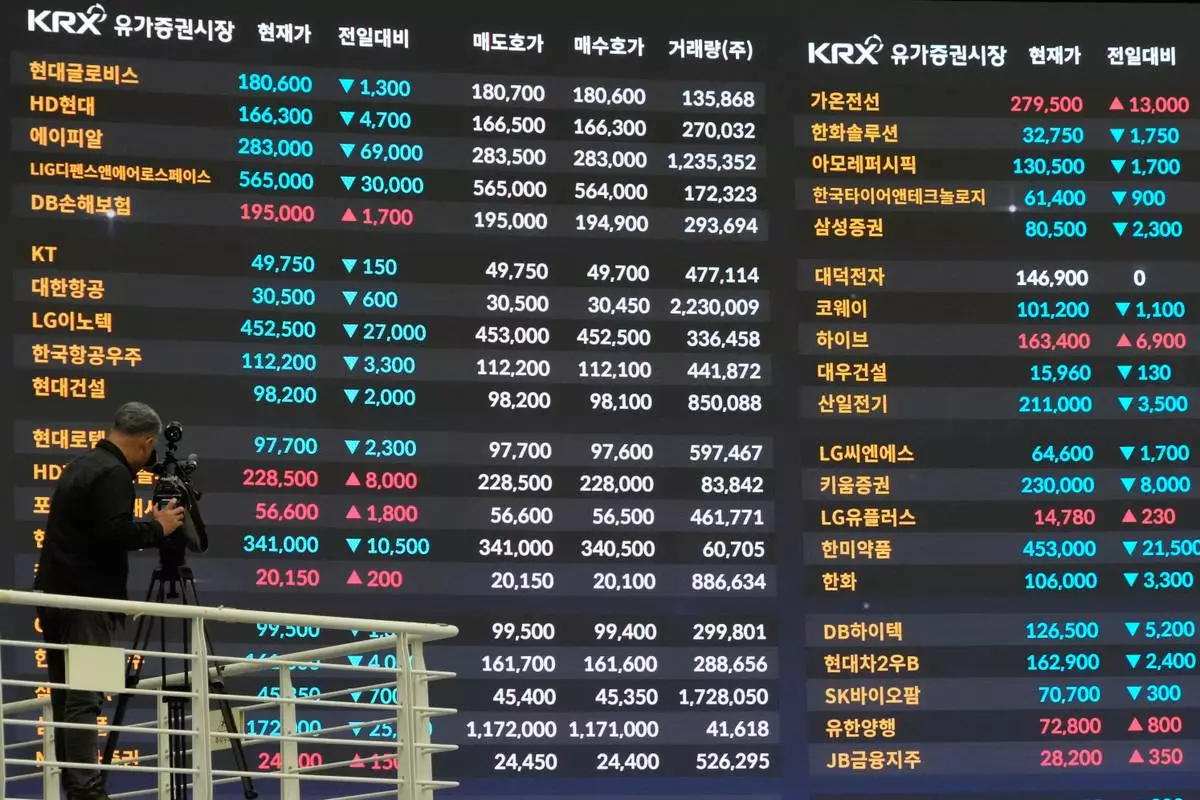
A TV camera man works in front of a screen showing stock prices at the Korea Exchange in Seoul, South Korea, Tuesday, Oct. 13, 2026. (AP Photo/Ahn Young-joon)