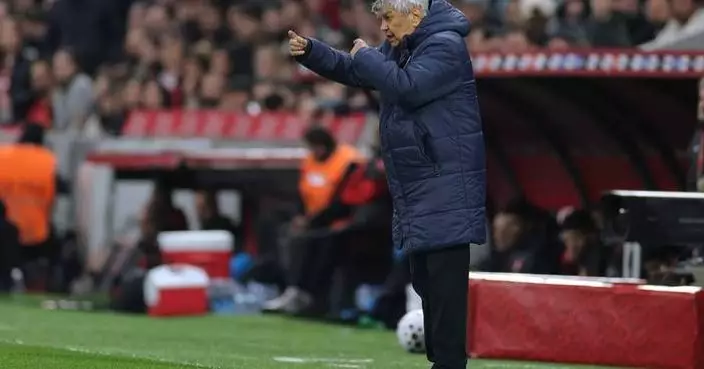
North Carolina has officially hired NBA championship-winning coach Michael Malone to lead the Tar Heels’ basketball program.
The school announced Malone's hiring on Tuesday and scheduled an introductory news conference for later in the day. Malone will replace Hubert Davis, who was fired March 24 after five seasons as the successor to retired Hall of Famer Roy Williams.
In a statement, UNC executive associate athletic director Steve Newmark described Malone as a “selfless teacher and innovator.”
"He is a brilliant coach who will deliver a modern and disciplined approach to leading our men’s basketball program, which is critical in the current landscape of college athletics," said Newmark, who will succeed Bubba Cunningham as AD on July 1. "Carolina Basketball is unique and special — and we have hired a leader well-suited to continuing our championship tradition.”
The 54-year-old Malone spent 12 seasons as a head coach in the NBA, including a 10-year run in Denver. He led the Nuggets to the 2023 championship behind three-time league MVP Nikola Jokic.
The Nuggets fired Malone last spring with less than a week left in that regular season. Almost a year to the day, in another surprise move, Malone is taking over a blueblood program with six national titles, a record 21 appearances in the Final Four and alums including Michael Jordan, James Worthy Vince Carter and Atlantic Coast Conference career scoring leader Tyler Hansbrough.
“Carolina is one of the most historic programs in college basketball, and I am honored to be the head coach of the Tar Heels,” Malone said in a statement. “It is humbling to follow so many legends in Chapel Hill.
“I know from the many Tar Heels in the NBA how special the Carolina Basketball Family is, and I will do everything I can to continue UNC’s championship legacy while preparing our players for professional careers and life after basketball.”
Davis’ firing opened one of the top jobs in college basketball for only the fourth time since the late Hall of Famer Dean Smith’s retirement after 36 seasons in October 1997. The job had stayed in the “Carolina Family” ever since. Longtime assistant Bill Guthridge replaced Smith, followed by former UNC player Matt Doherty, former Smith assistant Williams and then Davis, who played under Smith and worked on Williams’ staff.
Malone has never been a college head coach and has spent most of his career in the NBA. His primary connection to UNC athletics is the presence of daughter Bridget on the Tar Heels’ volleyball team, while he told the UNC athletic department’s “Carolina Insider” podcast in October that he had attended multiple recent basketball practices — with Davis even asking him to speak to the team at least once.
Get poll alerts and updates on the AP Top 25 throughout the season. Sign up here and here (AP News mobile app). AP college basketball: https://apnews.com/hub/ap-top-25-college-basketball-poll and https://apnews.com/hub/college-basketball

FILE - Denver Nuggets head coach Michael Malone stands on the sideline during the second half of an NBA basketball game April 1, 2025, in Denver. (AP Photo/David Zalubowski, File)
TEHRAN, Iran (AP) — U.S. President Donald Trump threatened Tuesday that a “whole civilization will die tonight” if Iran fails to meet his latest deadline to strike a deal that includes reopening the Strait of Hormuz, while the Islamic Republic urged young people to form human chains around power plants and other potential targets.
Trump’s expansive threat did not seem to account for potential harm to civilians, prompting Democrats in Congress, some United Nations officials and scholars in military law to say such strikes would violate international law.
Tehran’s representative at the U.N., Amir-Saeid Iravani, said the threats “constitute incitement to war crimes and potentially genocide” and that Iran would "take immediate and proportionate reciprocal measures” if Trump launches devastating strikes.
Pakistan's prime minister urged Trump to extend his deadline for Iran by two weeks, to allow diplomacy to advance. In a post on X, Shehbaz Sharif also asked Iran to open up the strait for two weeks.
Even before the deadline, airstrikes hit two bridges and a train station, and the U.S. hit military infrastructure on Kharg Island. It was the second time American forces struck the island, a key hub for Iranian oil production.
Since the war began, Trump has repeatedly imposed deadlines linked to threats, only to extend them. But the president insisted this one is final and will expire at 8 p.m. in Washington without a major diplomatic breakthrough.
He has also offered contradictory statements about what might actually happen.
Trump has made reopening the strait — through which a fifth of the world’s oil transits in peacetime — part of avoiding wider attacks and suggested that the waterway is not as vital to U.S. oil interests as it is to other countries. He has also said he would be willing to deploy ground troops to seize Iranian oil, while maintaining that major combat operations in that country could soon conclude.
That means the next moves by the U.S. are largely a mystery, even as rhetoric on both sides has reached a fever pitch.
Meanwhile, Iran’s president said 14 million people, including himself, have volunteered to fight. That's despite Trump saying that U.S. forces could wipe out all bridges in Iran in a matter of hours and reduce all power plants to smoking rubble in roughly the same time frame. He also suggested the entire country could be wiped off the map.
It was not clear if the latest airstrikes were linked to Trump’s threats to widen the civilian target list. At least two of the targets were connected to Iran’s rail network, and Israeli Prime Minister Benjamin Netanyahu said Israeli warplanes struck bridges and railways in Iran.
Tehran fired on Israel and Saudi Arabia, prompting the temporary closure of a major bridge.
While Iran cannot match the sophistication of U.S. and Israeli weaponry or their dominance in the air, its chokehold on the strait is roiling the world economy and raising the pressure on Trump both at home and abroad to find a way out of the standoff.
Officials involved in diplomatic efforts said talks were ongoing, but Iran has rejected the latest American proposal.
“A whole civilization will die tonight, never to be brought back again,” if a deal isn’t reached, Trump said in an online post Tuesday morning. But he also seemed to keep open the possibility of an off-ramp, saying that “maybe something revolutionarily wonderful can happen.”
Earlier, Iranian official Alireza Rahimi issued a video message calling on “all young people, athletes, artists, students and university students and their professors” to form human chains around power plants.
Iranians have formed human chains in the past around nuclear sites at times of heightened tensions with the West. State media posted videos online that showed hundreds of flag-waving people massed at two bridges and at a power plant hundreds of kilometers (miles) from Tehran, though it was not clear how widespread the practice was.
President Masoud Pezeshkian posted on X that 14 million Iranians had answered campaigns urging people to volunteer to fight — and said he would join them — while a Revolutionary Guard general urged parents to send their children to man checkpoints.
The Guard warned that Iran would “deprive the U.S. and its allies of the region’s oil and gas for years” and expand its attacks across the Gulf region if Trump carries out his threat.
In Tehran, the mood was bleak. A young teacher said that many opponents of Iran's Islamic system had hoped Trump's attacks would quickly topple it.
As the war drags on, she fears U.S. and Israeli strikes will spread chaos.
“If we don’t have the internet, and if we don’t have electricity, water, and gas, we’re really going back to the Stone Age, as Trump said,” she told The Associated Press, speaking on the condition of anonymity for her safety.
A growing chorus of international voices took exception to Trump's threats against Iran.
In Rome, Pope Leo XIV said Tuesday that the threats were “truly unacceptable” and that such attacks would violate international law. In some of his strongest comments yet against the war, Leo urged Americans and others to demand that political leaders reject war and work for peace.
French Foreign Minister Jean-Noël Barrot said that attacks targeting civilian and energy infrastructure could constitute a war crime. Such cases are notoriously difficult to prosecute. Trump has said he’s “not at all” concerned about committing war crimes.
Volker Türk, the U.N. high commissioner for human rights, said he deplored the rhetoric being used over the last two weeks “by all parties, including the latest threats to annihilate a whole civilization and to target civilian infrastructure.”
Intense airstrikes pounded Tehran, including in residential neighborhoods. In the past, such strikes have targeted Iranian government and security officials.
The Israeli military said it attacked an Iranian petrochemical site in Shiraz, the second day in a row it hit such a facility. The military later said it also struck bridges in Tehran, Karaj, Tabriz, Kashan and Qom that were being used by Iranian forces to transport weapons and military equipment.
A U.S. official, who spoke on condition of anonymity to discuss sensitive military operations, described the strikes on Kharg Island as hitting targets previously struck and not directed at oil infrastructure.
Saudi Arabia said it intercepted seven ballistic missiles and four drones launched by Iran. Saudi Arabia also temporarily closed the King Fahd Causeway, the only road connection between Bahrain, home to the U.S. Navy’s 5th Fleet, and the Arabian Peninsula. Iran also fired on Israel.
More than 1,900 people have been killed in Iran since the war began, but the government has not updated the toll for days.
In Lebanon, where Israel is fighting Iran-backed Hezbollah militants, more than 1,500 people have been killed. and more than 1 million people have been displaced. Eleven Israeli soldiers have died there.
In Gulf Arab states and the occupied West Bank, more than two dozen people have died, while 23 have been reported dead in Israel, and 13 U.S. service members have been killed.
Iran effectively blocked shipping through the strait after Israel and the U.S. attacked in February. That, and Iran’s attacks on the energy infrastructure of its Gulf Arab neighbors, have sent oil prices skyrocketing, raising the price of gasoline, food and other basics far beyond the Middle East.
Tehran has rejected a 45-day ceasefire proposal, saying it wants a permanent end to the war. But as Trump's deadline neared, an official said indirect communications between the United States and Iran remained underway. The official spoke on condition of anonymity to discuss ongoing diplomacy.
Gambrell reported from Dubai, United Arab Emirates. Corder reported from The Hague, Netherlands, and Magdy reported from Cairo. Associated Press writers David Rising in Bangkok; John Leicester in Paris; Rod McGuirk in Melbourne, Australia; Natalie Melzer in Jerusalem; and Konstantin Toropin, Seung Min Kim, Michelle L. Price and Will Weissert in Washington contributed to this report.
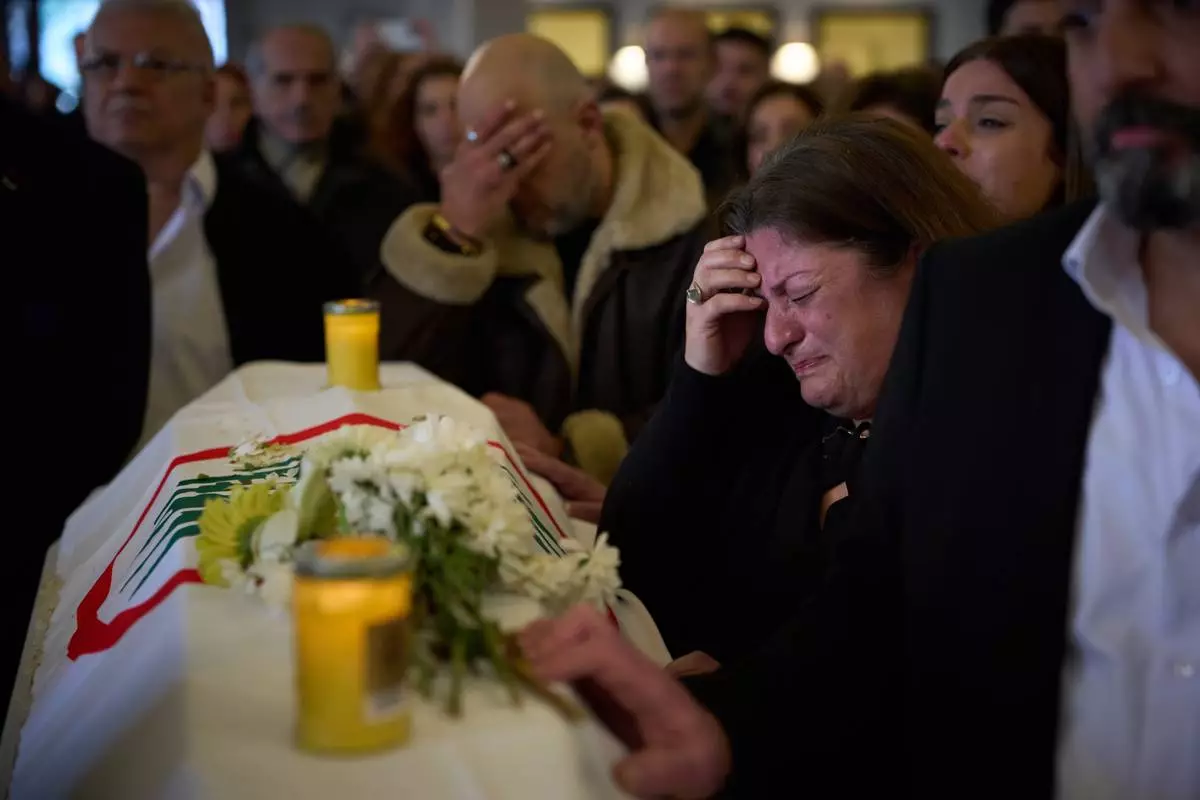
Relatives react next to the coffins with the bodies of Pierre Mouawad, an official with the anti-Hezbollah Lebanese Forces party, and his wife during their funeral in Yahshush, Lebanon, Tuesday, April 7, 2026. (AP Photo/Emilio Morenatti)
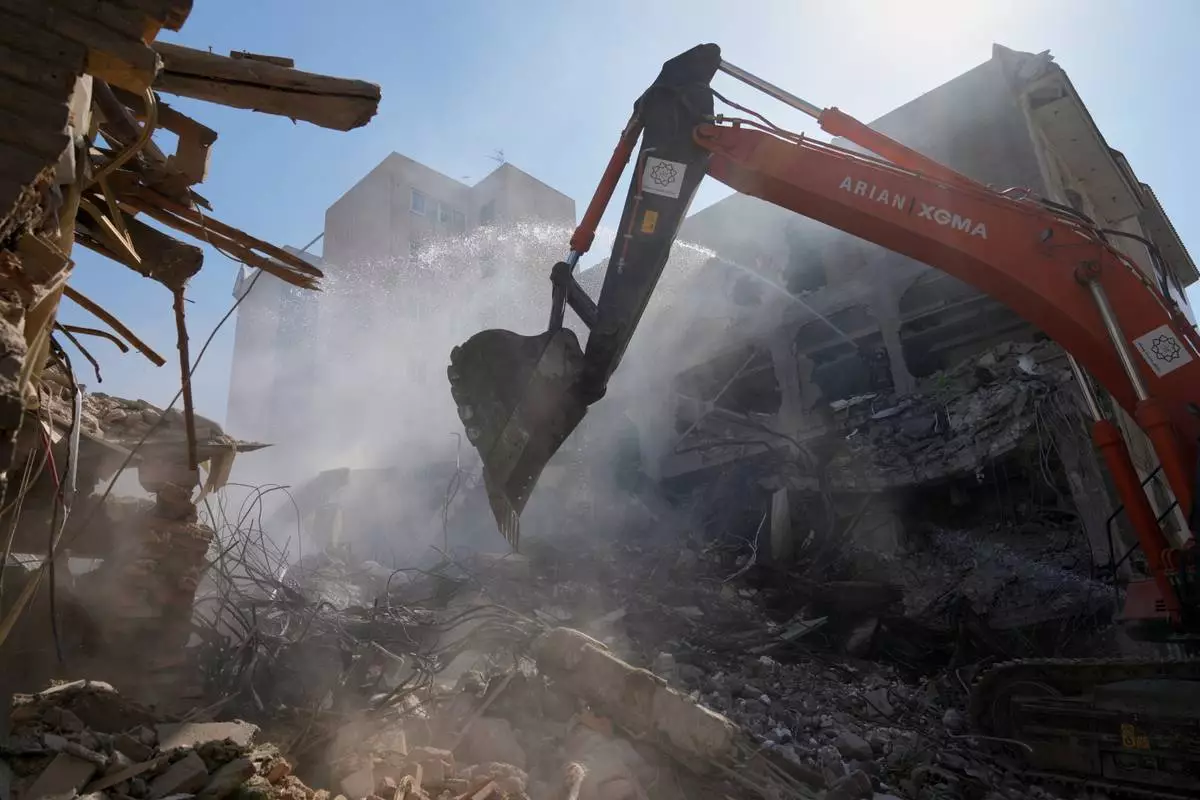
An excavator removes rubble at the site of a strike that, according to a security official at the scene, destroyed half of the Khorasaniha Synagogue and nearby residential buildings in Tehran, Iran, Tuesday, April 7, 2026. (AP Photo/Francisco Seco)
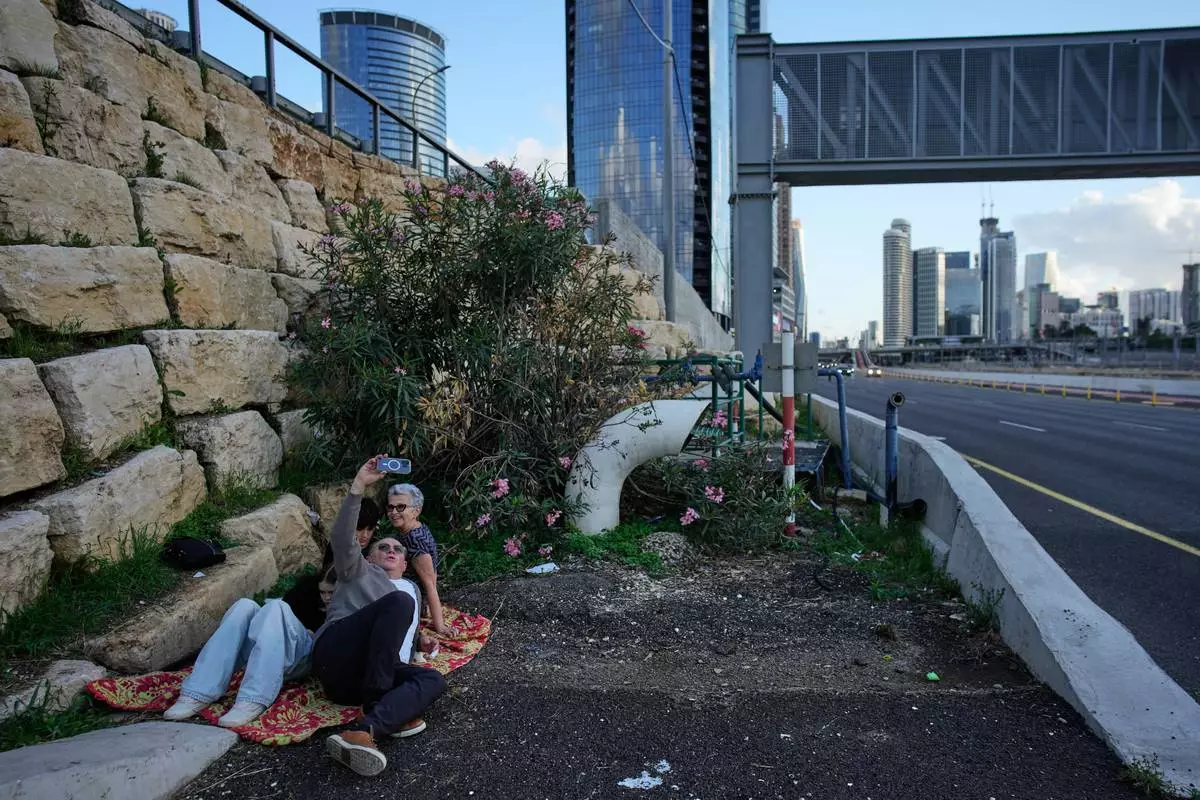
A man takes a selfie while taking cover with three others along a highway as air raid sirens warn of an incoming Iranian missile strike in Tel Aviv, Israel, Tuesday, April 7, 2026. (AP Photo/Ohad Zwigenberg)
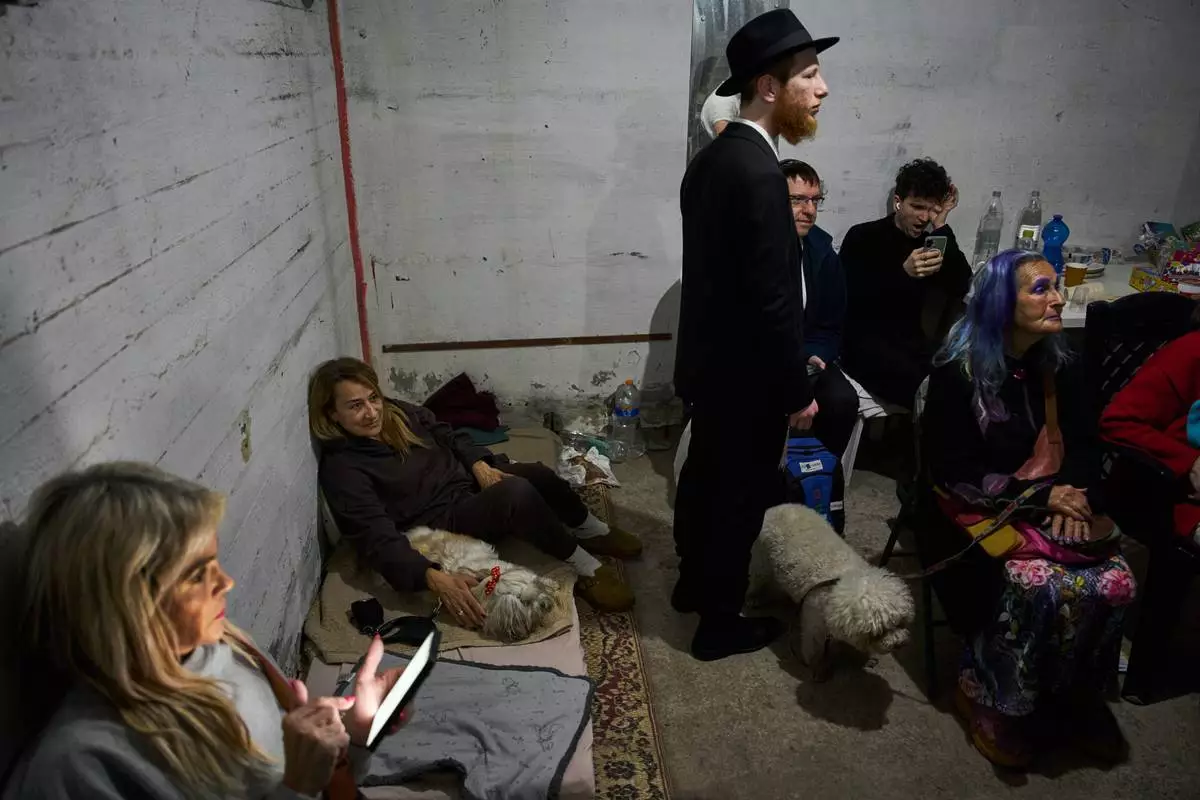
People take cover in a bomb shelter as air raid sirens warn of incoming Iranian missile strikes in Ramat Gan, Israel, Tuesday, April 7, 2026. (AP Photo/Oded Balilty)
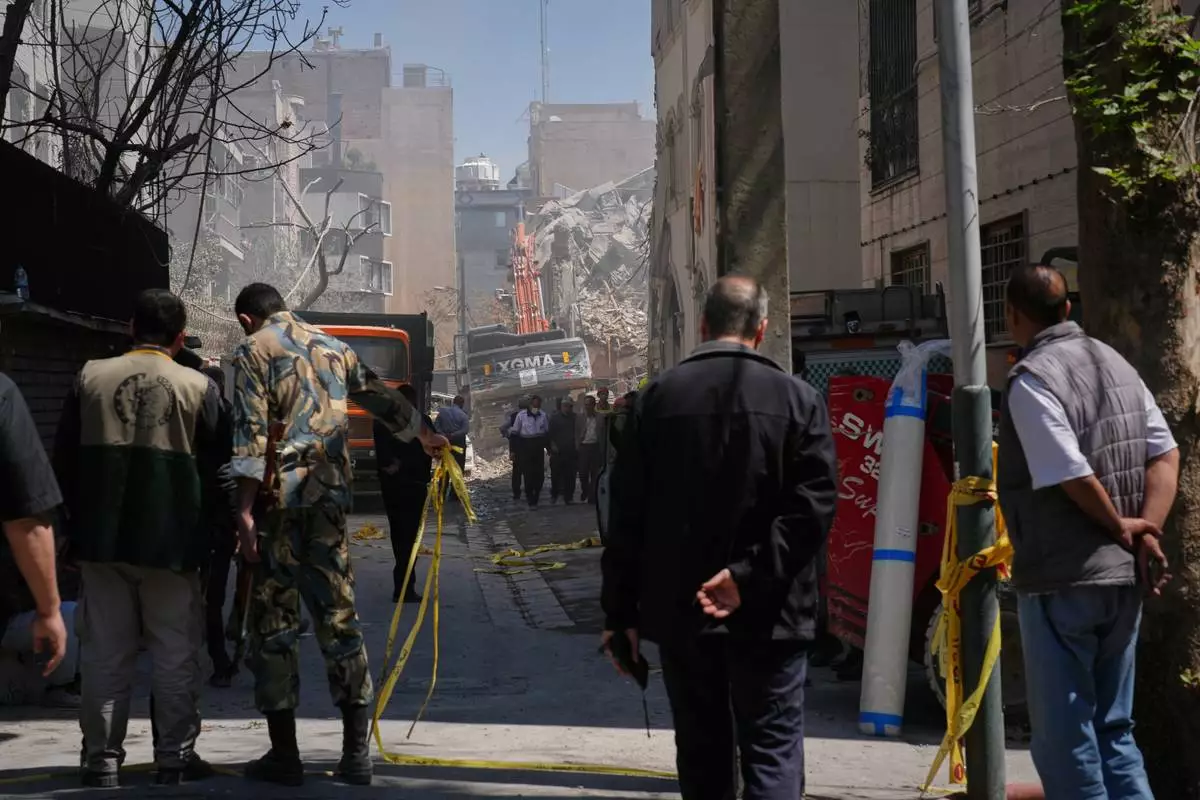
Bystanders watch from a distance as rescue teams and first responders work at the site of a strike that, according to a security official at the scene, destroyed half of the Khorasaniha Synagogue and nearby residential buildings in Tehran, Iran, Tuesday, April 7, 2026. (AP Photo/Francisco Seco)
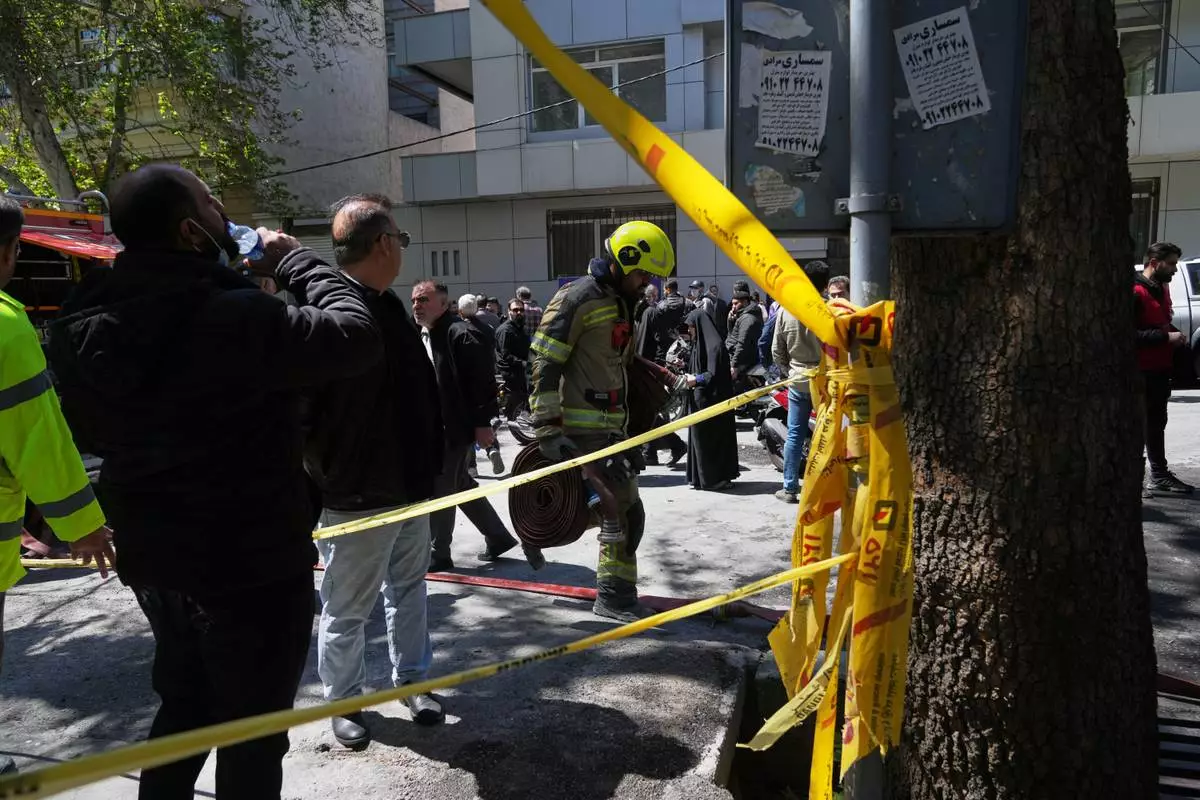
A first responder leaves the site of a strike that, according to a security official at the scene, destroyed half of the Khorasaniha Synagogue and nearby residential buildings in Tehran, Iran, Tuesday, April 7, 2026. (AP Photo/Francisco Seco)
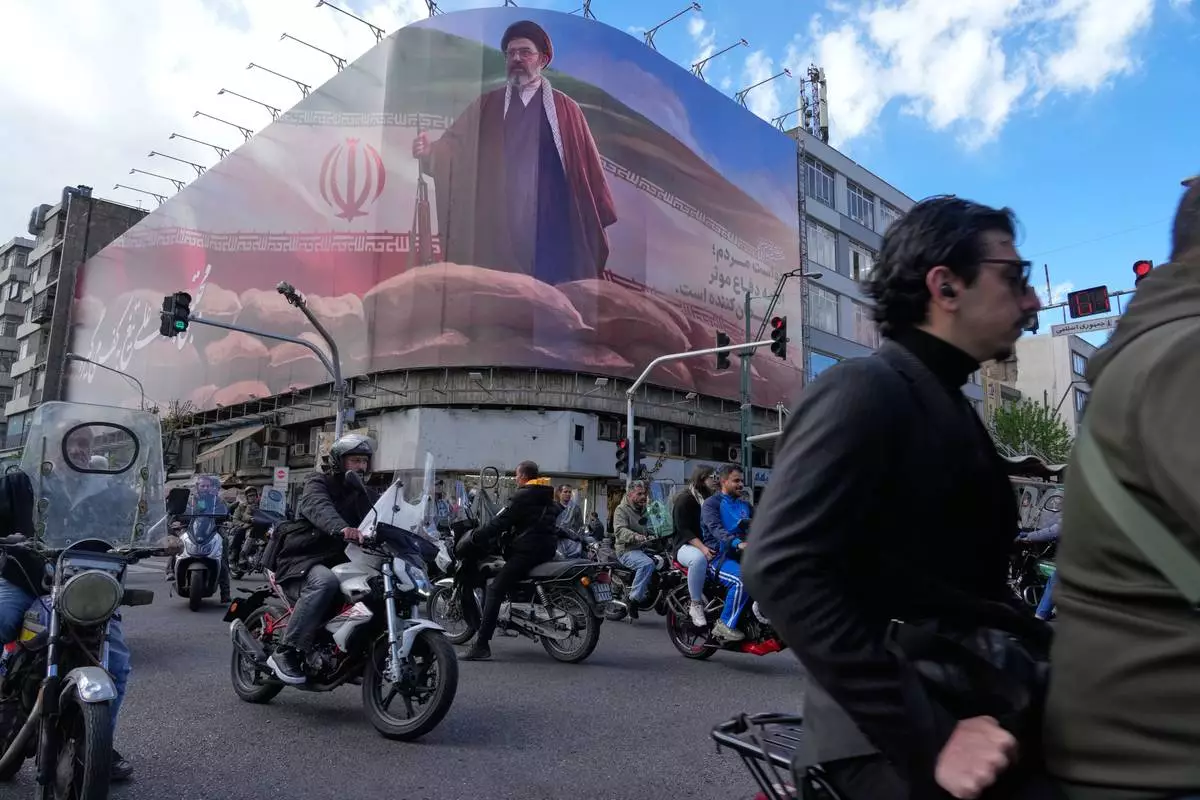
People drive their motorbikes past a billboard that shows a graphic depicting Iran's Supreme Leader Ayatollah Mojtaba Khamenei in downtown Tehran, Iran, Monday, April 6, 2026. (AP Photo/Vahid Salemi)
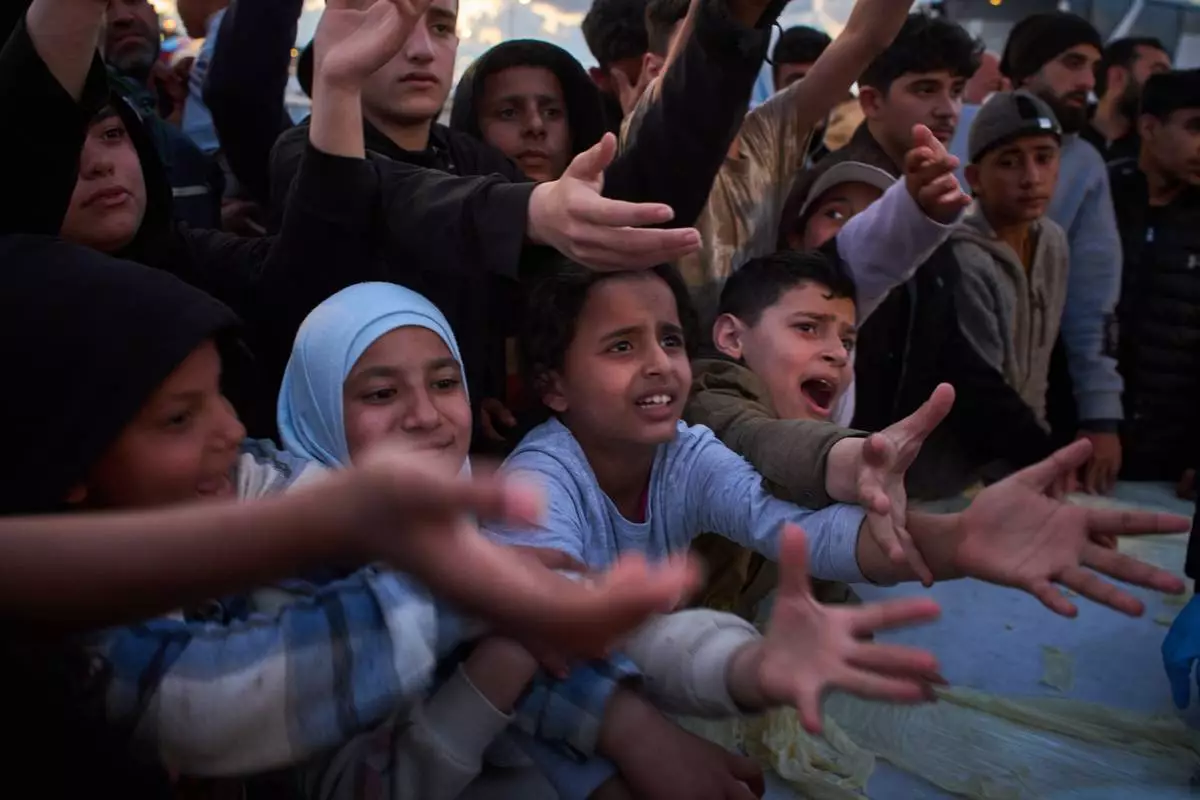
Displaced people wait to receive donated food beside the tents they use as shelters after fleeing Israeli bombardment in southern Lebanon, in Beirut, Lebanon, Monday, April 6, 2026. (AP Photo/Emilio Morenatti)
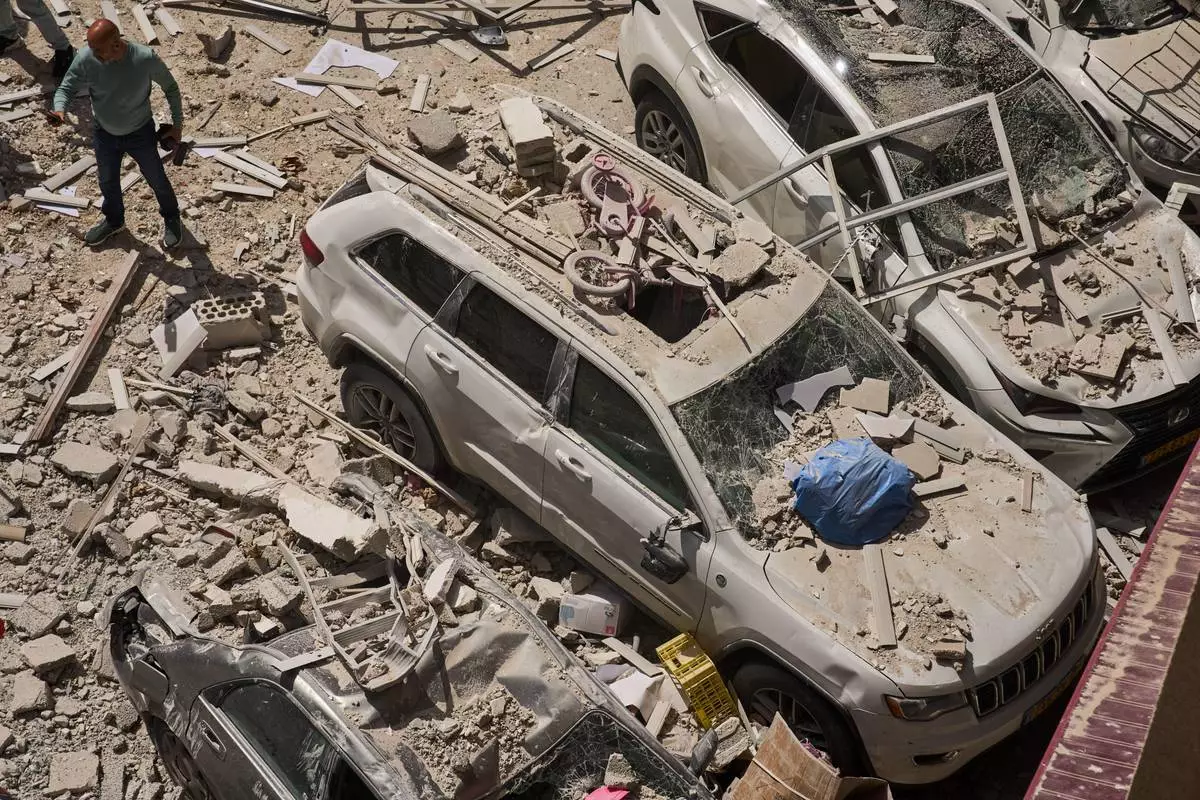
A man inspects the damage to cars and an apartment building struck by an Iranian missile in Ramat Gan, Israel, Monday, April 6, 2026. (AP Photo/Oded Balilty)