Tens of thousands of Japanese activists gathered in front of the National Diet building in Tokyo on Wednesday to protest against the Japanese government's push to revise the country's pacifist Constitution and expand military power.
Japan's Constitution, which took effect in 1947, is often referred to as the pacifist Constitution as Article 9 states that the Japanese people forever renounce war as a sovereign right of a nation which will not threaten or use force to settle international disputes.
Japanese Prime Minister Sanae Takaichi and other right-wing politicians have long sought to amend Article 9. The prime minister's recent remarks reaffirming her commitment to constitutional revision have sparked widespread concerns Across the country.
"It is because of Article 9 of the pacifist Constitution that we have been able to avoid being drawn into war for 80 years. But the Takaichi administration keeps calling for constitutional revision. This is extremely absurd," said a protester.
The Japanese government has also continued to push for increased defense spending and the deployment of long-range missiles in areas such as Kyushu, drawing discontent from the activists.
"I feel very concerned. Takaichi has taken a hardline stance, and she is vigorously pushing for increased defense spending. Without the consent of the Japanese people or sufficient discussion, she keeps advancing measures such as missile deployment. The Constitution exists precisely to prevent this situation. I strongly oppose making Japan a country capable of waging war," said a protester.
Japan's parliament on Tuesday passed a record 122.31 trillion yen (around 770 billion U.S. dollars) budget for fiscal 2026, earmarking more than 9 trillion yen for defense-related purposes for the first time, triggering public criticism.
The Japanese government also plans to revise the "three principles on transfer of defense equipment and technology" and its implementation guidelines to loosen restrictions on arms export.
Protesters said that these actions violate the pacifist spirit of the Japanese Constitution and would intensify regional tensions.
"If Japan exports lethal weapons without restriction, Japan's Self-Defense Forces (SDF) will no longer be solely for self-defense, but will become an army capable of launching attacks abroad. This violates the Japanese Constitution," said a protester.
"Many people are now living difficult lives. I hope the Japanese government will use tax revenue to better protect people's livelihoods instead of increasing defense spending," said another protester.
Also on Wednesday, similar rallies were held in nearly 100 places across Japan, with protesters demanding the Japanese government to uphold the principles of the pacifist constitution.
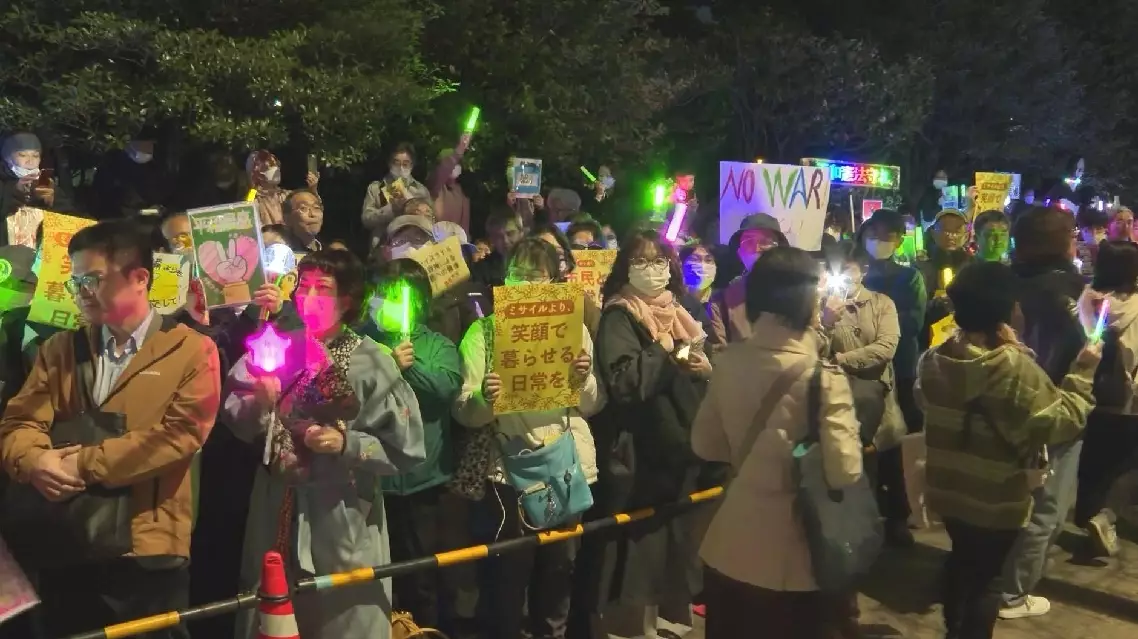
Japanese activists rally against gov't push to revise constitution