Skip to Content Facebook Feature Image

US filings for jobless aid jump to 219,00 last week but remain within stable range of past few years

Business

US filings for jobless aid jump to 219,00 last week but remain within stable range of past few years
Business

Business

US filings for jobless aid jump to 219,00 last week but remain within stable range of past few years

2026-04-09 21:28 Last Updated At:21:30

WASHINGTON (AP) — U.S. applications for unemployment benefits rose last week before Iran, Israel and the U.S. announced a two-week ceasefire deal that injected a degree of optimism into a still-clouded global economic picture.

The number of Americans applying for jobless aid for the week ending April 4 jumped by 16,000 to 219,000 from the previous week’s 203,000, the Labor Department reported Thursday. That’s more than the 210,000 new filings analysts surveyed by the data firm FactSet were expecting but within the range of the past several years.

Filings for unemployment benefits are considered representative of U.S. layoffs and are close to a real-time indicator of the health of the job market.

Tuesday night’s ceasefire announcement sent oil prices plummeting to $95 a barrel, though they jumped back up near $100 early Thursday over skepticism about the durability of the deal after Israel launched a wave of attacks on Lebanon and Iran re-closed the crucial Strait of Hormuz, where 20% of the world’s oil passes.

Financial markets also retreated Thursday following big gains a day earlier.

A barrel of U.S. crude had reached $112 dollars before the ceasefire was announced, up from about $67 in the days leading up to the conflict. Even with Wednesday’s big decline, businesses and consumers are still saddled with higher energy costs as the price of oil and gas remain elevated.

This comes at a time when U.S. inflation was already above the Federal Reserve’s 2% target, further diminishing the chances of an interest rate cut by central bank officials any time soon. The government issues its March consumer prices report on Friday.

Also Thursday, in a report delayed due to the federal shutdown, government data showed that a key inflation gauge remained elevated in February, even before the U.S. and Israel launched attacks on Iran.

Fed officials voted to raise the rate three times to close 2025 out of concern for a weakening job market but have held off lowering rates further this year.

The Labor Department reported last week that U.S. employers added an unexpectedly strong 178,000 new jobs in March, nudging the unemployment rate back down to 4.3%. That followed a surprisingly large loss of 92,000 jobs in February. Revisions also have trimmed 69,000 jobs from December and January payrolls, a sign that the labor market remains under strain.

A number of high-profile companies have cut jobs recently, including the software maker Oracle, which according to media reports cut thousands of workers last week. The Wall Street Journal reported Wednesday that The Walt Disney Co. is preparing to cull 1,000 positions from its workforce.

Others that have recently announced job cuts include Morgan Stanley,Block, UPSand Amazon.

Weekly jobless aid applications have stabilized in a range mostly between 200,000 and 250,000 since the U.S. economy emerged from the pandemic recession. However, hiring began slowing about two years ago and tapered further in 2025 due to President Donald Trump’s erratic tariff rollouts, his purge of the federal workforce and the lingering effects of high interest rates meant to control inflation.

Employers added fewer than 200,000 jobs last year, compared with about 1.5 million in 2024, according to the data firm FactSet.

The American labor market appears stuck in what economists call a “low-hire, low-fire” state that has kept the unemployment rate historically low, but has left those out of work struggling to find a new job.

The Labor Department’s report Thursday showed that the four-week moving average of jobless claims, which evens out some of the weekly volatility, rose by 1,500 to 209,500.

The total number of Americans filing for unemployment benefits for the previous week ending March 28 fell by 38,000 to 1.79 million, the fewest in nearly two years.

A hiring sign is displayed at a restaurant, in Niles, Ill., Tuesday, April 7, 2026. (AP Photo/Nam Y. Huh)

A hiring sign is displayed at a restaurant, in Niles, Ill., Tuesday, April 7, 2026. (AP Photo/Nam Y. Huh)

WASHINGTON (AP) — A key measure of inflation stayed high in February, before the war in Iran spiked gas prices, a sign that everyday costs were elevated even before the conflict began.

An inflation gauge monitored by the Federal Reserve rose 0.4% in February from January, up slightly from the previous month. Compared with a year ago, prices rose 2.8%, the same as January. Thursday's data was delayed by a backlog of economic reports created by the six-week government shutdown last fall.

Excluding the volatile food and energy categories, core inflation also rose 0.4% in February from January, and it was 3% higher than a year earlier. The annual figure is slightly below January's reading of 3.1%.

Still, the monthly increases are at a pace that if continued for a whole year, would easily top the Fed's 2% inflation target.

“Consumer inflation was firming even prior to the outbreak of war in the Middle East, and it is primed to jump sharply higher in March,” Kathy Bostjancic, chief economist at Nationwide, wrote in a client note. “Even if a long-lasting deal to end the war is reached and the Strait of Hormuz is fully reopened, it would take months for oil, gasoline, diesel and other commodity supplies to snap back to prewar levels and thus for prices to settle back to preconflict levels.”

Thursday's report is largely a warm-up for the more important inflation data to be released Friday, when the government will publish the higher-profile consumer price index for March. The Friday report will be the first to reflect the impact of the gas price spike from the Iran war. Economists forecast it will show a big increase of 0.9% just in March from February, and a 3.4% gain from a year earlier. The annual figure would be a big increase from 2.4% in February.

The large jump in inflation in March will heighten concerns at the Fed that prices are moving further away from their inflation target and make it much less likely the central bank will cut rates anytime soon. At their most recent meeting last month, some Fed officials supported opening the door to the potential for rate hikes if inflation didn't show signs of improving.

Thursday's report from the Commerce Department also showed that Americans' incomes slipped 0.1% in February, the first decline since October, while spending after adjusting for inflation barely increased.

Higher inflation is sapping Americans' purchasing power. Spending rose a solid 0.5% in February from the previous month before adjusting for higher prices. Bostjancic expects consumer spending, adjusted for inflation, will rise a modest 1.2% at an annual rate in the first three months of this year, below the 1.9% reached in last year's fourth quarter.

The economy may still grow a decent 2% in the first quarter, Bostjancic said, driven by investments in artificial intelligence and a bounceback in government spending after last year's shutdown. The government said Thursday growth was just 0.5% at the end of last year.

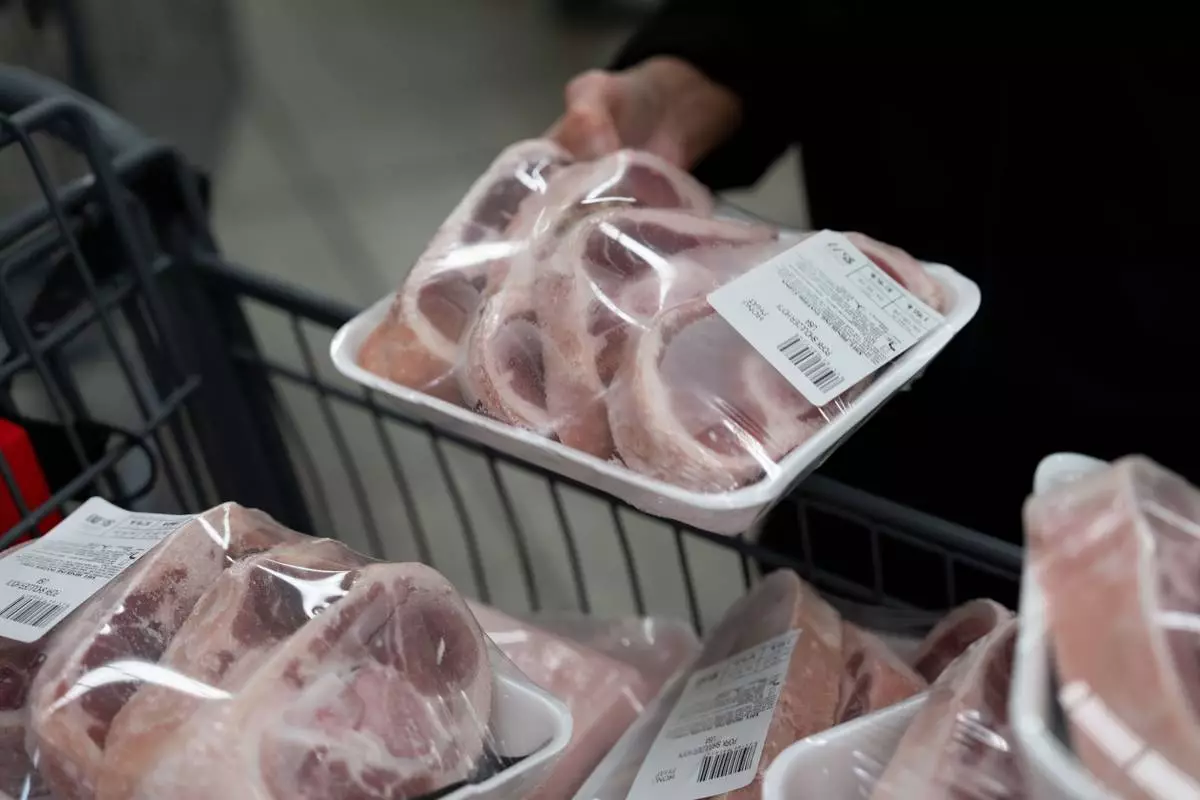
A customer picks up packaged pork at a grocery store in Portland, Ore., Wednesday, April 8, 2026. (AP Photo/Jenny Kane)

A customer picks up packaged pork at a grocery store in Portland, Ore., Wednesday, April 8, 2026. (AP Photo/Jenny Kane)

A customer walks by produce at a grocery store in Portland, Ore., Wednesday, April 8, 2026. (AP Photo/Jenny Kane)

A customer walks by produce at a grocery store in Portland, Ore., Wednesday, April 8, 2026. (AP Photo/Jenny Kane)

Recommended Articles