Skip to Content Facebook Feature Image

Venezuelan police block protesters demanding higher wages and pensions

News

Venezuelan police block protesters demanding higher wages and pensions
News

News

Venezuelan police block protesters demanding higher wages and pensions

2026-04-10 03:52 Last Updated At:04:01

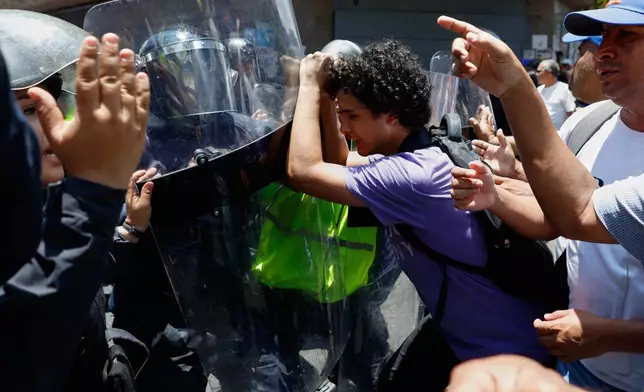
CARACAS, Venezuela (AP) — Union leaders, retirees and public sector workers in the Venezuelan capital marched Thursday toward the presidential palace to demand higher wages and dignified pensions, only to be met by police blockades.

The protests came the day after acting President Delcy Rodríguez went on national television to ask public and private sector workers for patience as her government works to improve the country’s economy.

More Images
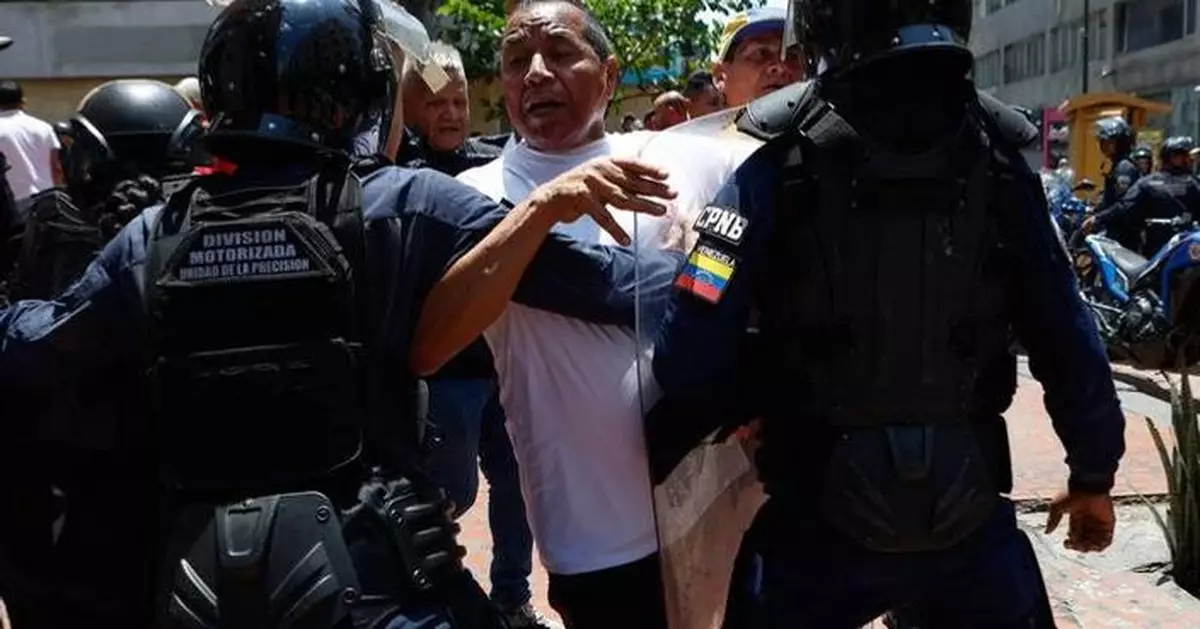
Bolivarian National Police prevent protesters who are demanding higher salaries, pensions and benefits, from continuing their march to the Miraflores Presidential Palace in Caracas, Venezuela, Thursday, April 9, 2026. (AP Photo/Pedro Mattey)
Bolivarian National Police prevent protesters who are demanding higher salaries, pensions and benefits, from continuing their march to the Miraflores Presidential Palace in Caracas, Venezuela, Thursday, April 9, 2026. (AP Photo/Pedro Mattey)

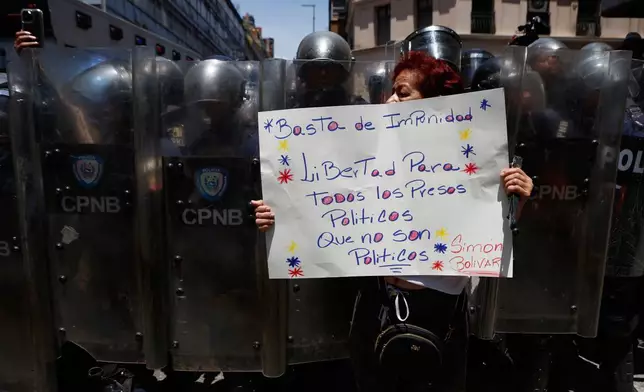
A protester holds up a sign demanding freedom for all political prisoners as she stands in front of a cordon of Bolivarian National Police, during a march demanding higher salaries, pensions and benefits, in Caracas, Venezuela, Thursday, April 9, 2026. (AP Photo/Pedro Mattey)
A protester holds up a sign demanding freedom for all political prisoners as she stands in front of a cordon of Bolivarian National Police, during a march demanding higher salaries, pensions and benefits, in Caracas, Venezuela, Thursday, April 9, 2026. (AP Photo/Pedro Mattey)

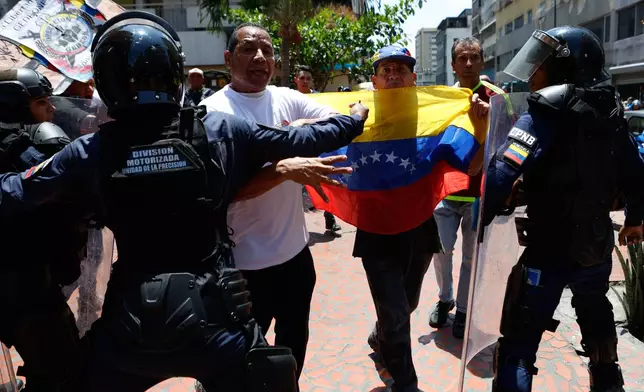
Bolivarian National Police stop protesters who are demanding higher salaries, pensions and benefits, from continuing their march to the Miraflores Presidential Palace in Caracas, Venezuela, Thursday, April 9, 2026. (AP Photo/Pedro Mattey)
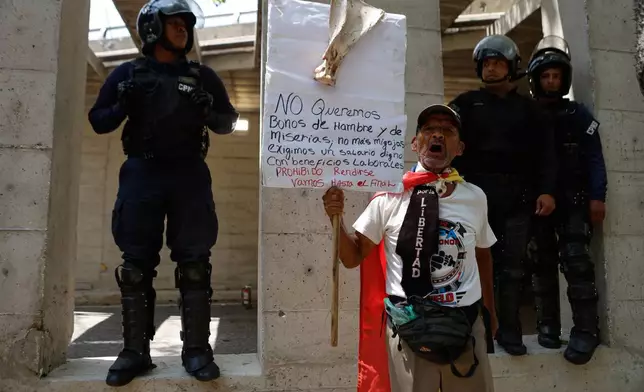
Bolivarian National Police stop protesters who are demanding higher salaries, pensions and benefits, from continuing their march to the Miraflores Presidential Palace in Caracas, Venezuela, Thursday, April 9, 2026. (AP Photo/Pedro Mattey)

Bolivarian National Police flank a protester who is taking part in a march demanding higher salaries, pensions and benefits, in Caracas, Venezuela, Thursday, April 9, 2026. (AP Photo/Pedro Mattey)
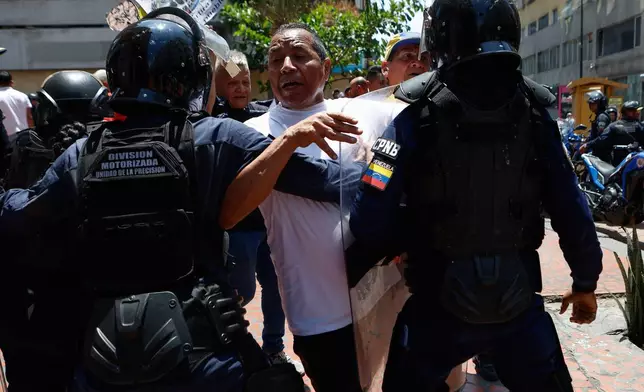
Bolivarian National Police flank a protester who is taking part in a march demanding higher salaries, pensions and benefits, in Caracas, Venezuela, Thursday, April 9, 2026. (AP Photo/Pedro Mattey)

Bolivarian National Police stop protesters who are demanding higher salaries, pensions and benefits, from continuing their march to the Miraflores Presidential Palace in Caracas, Venezuela, Thursday, April 9, 2026. (AP Photo/Pedro Mattey)

Bolivarian National Police stop protesters who are demanding higher salaries, pensions and benefits, from continuing their march to the Miraflores Presidential Palace in Caracas, Venezuela, Thursday, April 9, 2026. (AP Photo/Pedro Mattey)

Workers' wages for years have not allowed them to afford basic necessities. Many public sector workers survive on roughly $160 per month, while the average private sector employee earned about $237 last year.

“Call for elections and leave, that’s what the Venezuelan worker wants today,” said José Patines, a marching union leader, referring to the country’s government. “Because if on May 1 they come with an increase of a few dollars, no. We don't need it. We want a salary with purchasing power.”

National Police officers deployed early Thursday across downtown Caracas to intercept the march. Several times, demonstrators successfully breached initial barriers. Reinforced blockades eventually halted the crowd, leaving the majority of protesters roughly 2 kilometers (1.2 miles) from the Miraflores presidential palace.

There were no immediate reports of injuries or arrests during the scuffles between police and protesters.

Rodríguez in her address promised workers a wage increase on May 1. She did not disclose the amount but said it would be done in a way meant to avoid the inflationary spike that followed the last minimum wage increase.

“This increase, as we have indicated, will be a responsible increase,” Rodríguez said. “Likewise in the near future, as Venezuela enjoys more resources that allow for the sustainability of salary improvements and workers’ income, we will continue moving forward on this path.”

Venezuela’s minimum wage of 130 bolivars, or $0.27 a month, has not increased since 2022, putting it well below the United Nations’ measure of extreme poverty of $3 a day. However, many public employees earn more ⁠through bonuses and other stipends that can take their monthly ​incomes up to $160.

Follow AP’s coverage of Latin America and the Caribbean at https://apnews.com/hub/latin-america
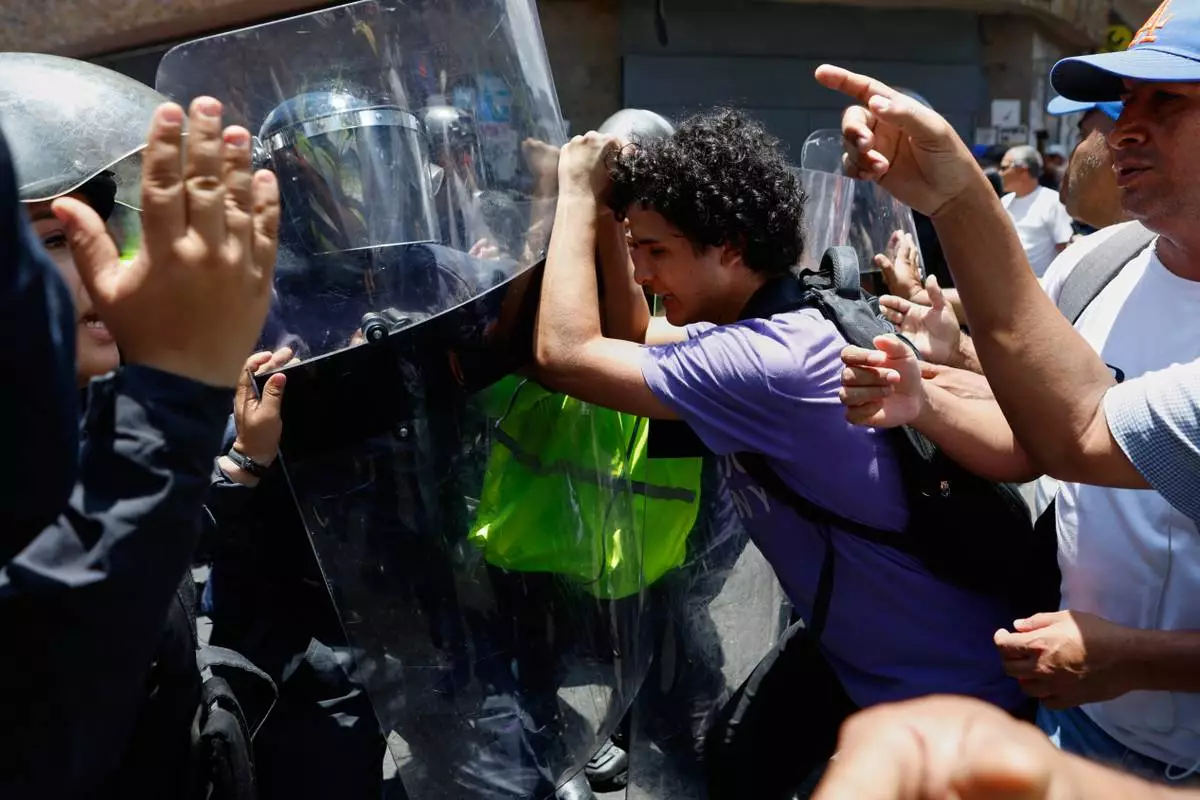
Bolivarian National Police prevent protesters who are demanding higher salaries, pensions and benefits, from continuing their march to the Miraflores Presidential Palace in Caracas, Venezuela, Thursday, April 9, 2026. (AP Photo/Pedro Mattey)
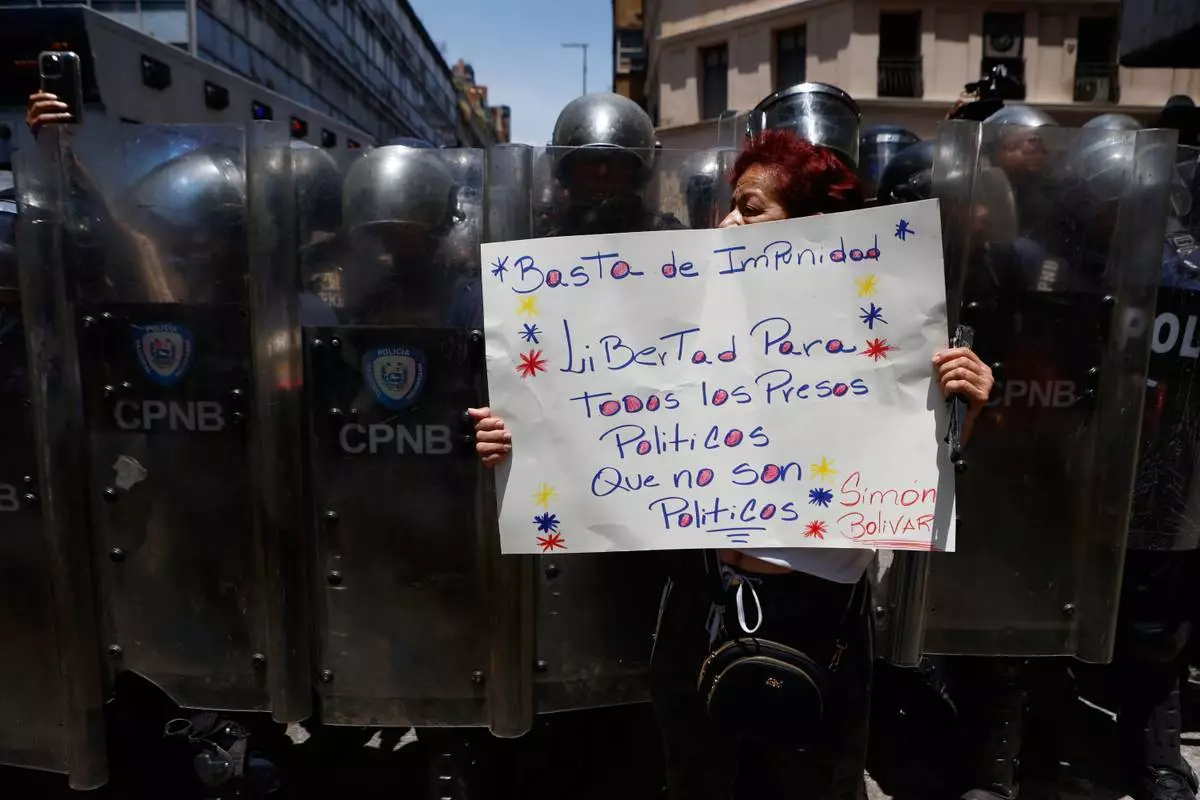
Bolivarian National Police prevent protesters who are demanding higher salaries, pensions and benefits, from continuing their march to the Miraflores Presidential Palace in Caracas, Venezuela, Thursday, April 9, 2026. (AP Photo/Pedro Mattey)

A protester holds up a sign demanding freedom for all political prisoners as she stands in front of a cordon of Bolivarian National Police, during a march demanding higher salaries, pensions and benefits, in Caracas, Venezuela, Thursday, April 9, 2026. (AP Photo/Pedro Mattey)
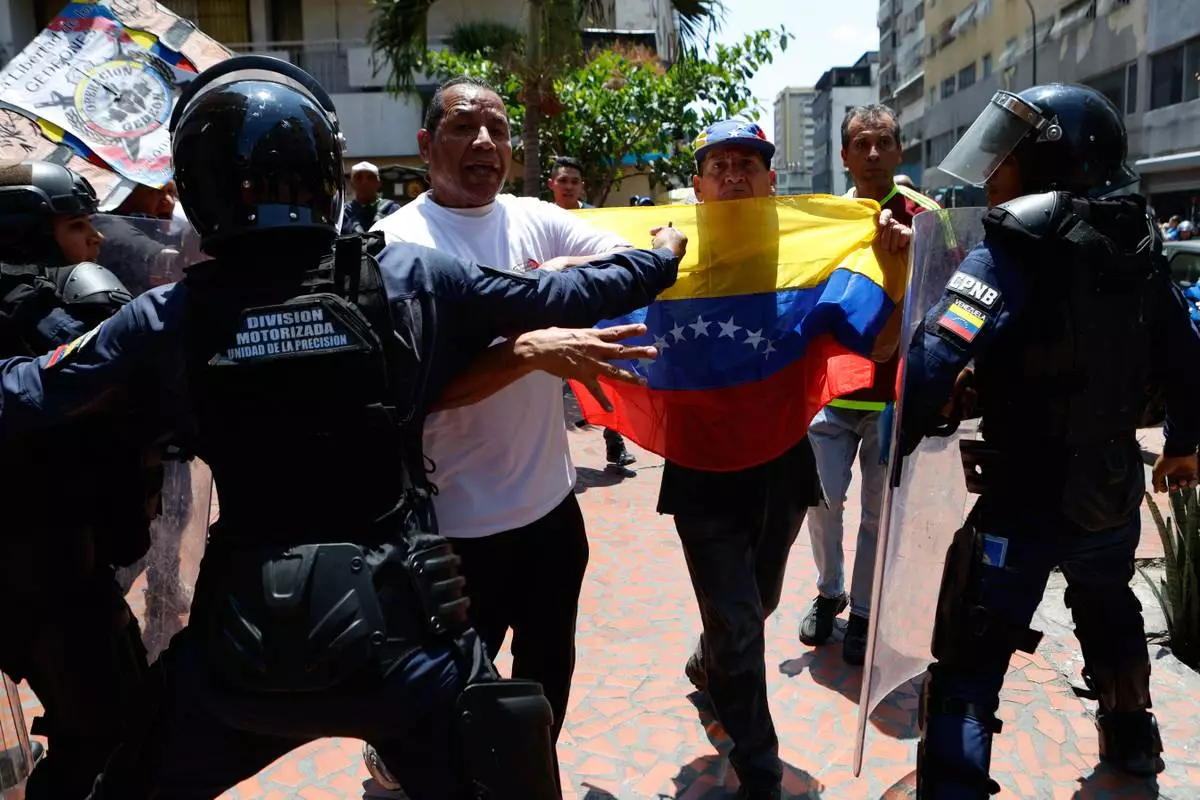
A protester holds up a sign demanding freedom for all political prisoners as she stands in front of a cordon of Bolivarian National Police, during a march demanding higher salaries, pensions and benefits, in Caracas, Venezuela, Thursday, April 9, 2026. (AP Photo/Pedro Mattey)

Bolivarian National Police stop protesters who are demanding higher salaries, pensions and benefits, from continuing their march to the Miraflores Presidential Palace in Caracas, Venezuela, Thursday, April 9, 2026. (AP Photo/Pedro Mattey)
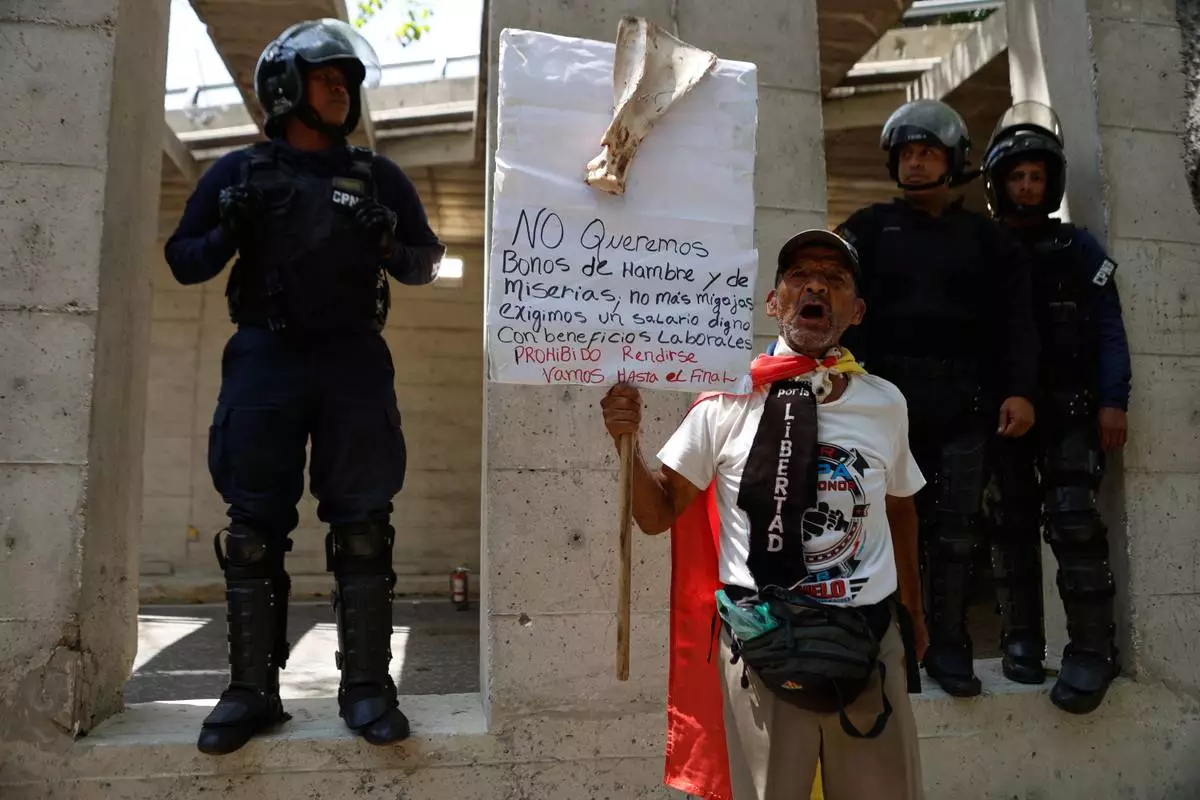
Bolivarian National Police stop protesters who are demanding higher salaries, pensions and benefits, from continuing their march to the Miraflores Presidential Palace in Caracas, Venezuela, Thursday, April 9, 2026. (AP Photo/Pedro Mattey)

Bolivarian National Police flank a protester who is taking part in a march demanding higher salaries, pensions and benefits, in Caracas, Venezuela, Thursday, April 9, 2026. (AP Photo/Pedro Mattey)
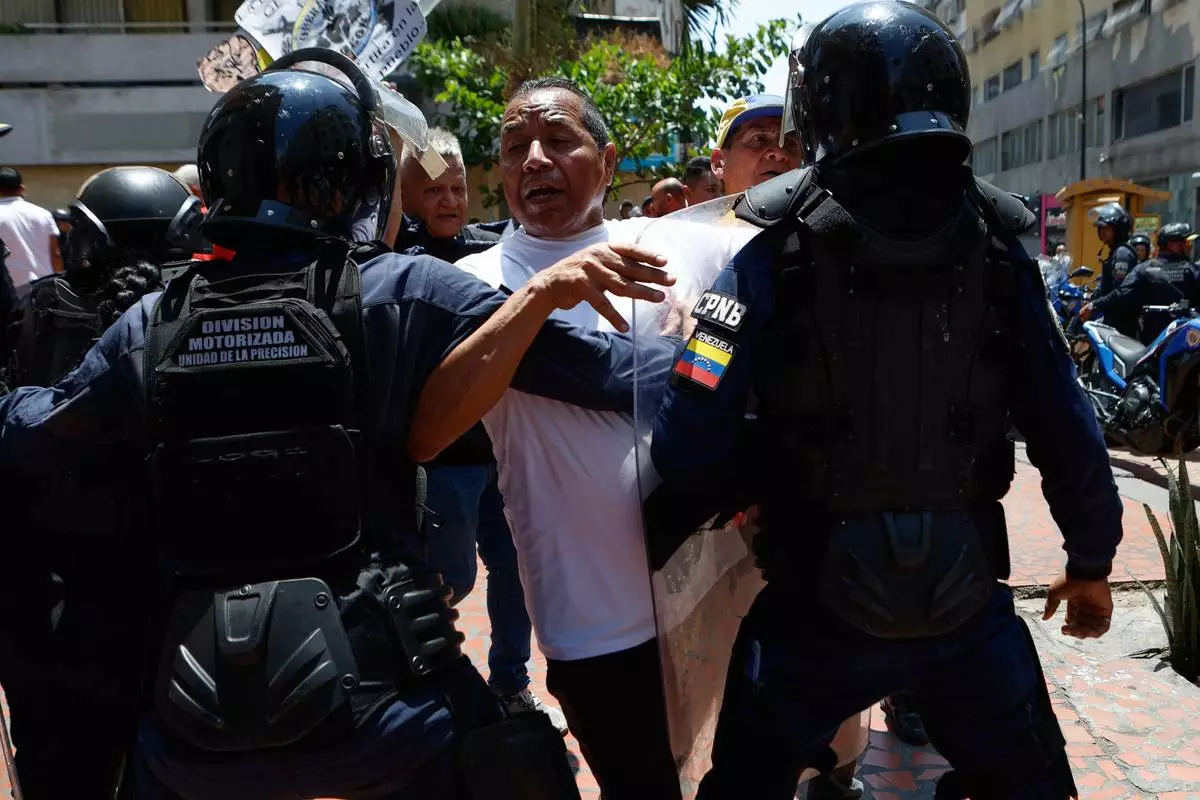
Bolivarian National Police flank a protester who is taking part in a march demanding higher salaries, pensions and benefits, in Caracas, Venezuela, Thursday, April 9, 2026. (AP Photo/Pedro Mattey)

Bolivarian National Police stop protesters who are demanding higher salaries, pensions and benefits, from continuing their march to the Miraflores Presidential Palace in Caracas, Venezuela, Thursday, April 9, 2026. (AP Photo/Pedro Mattey)
Bolivarian National Police stop protesters who are demanding higher salaries, pensions and benefits, from continuing their march to the Miraflores Presidential Palace in Caracas, Venezuela, Thursday, April 9, 2026. (AP Photo/Pedro Mattey)
In a dramatic video shared online by the Army ROTC, cadets at Virginia’s Old Dominion University are recounting how they stabbed and disarmed a gunman targeting their classroom, then frantically tried to save the life of the wounded instructor who grappled with the attacker.

In the 17-minute video posted Wednesday, the Army Reserve Officers’ Training Corps cadets tell how Lt. Col. Brandon Shah lunged at the shooter during the March 12 incident at the Norfolk school, placing himself between the gunman and the class.

Cadet Jah-Ire Urtarte said Shah, who was shot and did not survive, saved lives that day.

“If he didn’t lunge at him, you know, I wouldn’t be here right now,” he said. “There’s a possibility he could’ve turned his gun and I could’ve been next.”

The shooter, Army National Guard veteran Mohamed Bailor Jalloh, also died. He had pleaded guilty in 2016 to attempting to aid the Islamic State and was sentenced to 11 years in prison. He was on supervised release at the time of the attack.

The students say Jalloh walked into their classroom and nervously asked if it was an ROTC class. When someone confirmed that, they say he pulled a pistol from his waist, shouted 'Allahu akbar,’ and fired toward Shah.

Students dived for cover. As Shah struggled with Jalloh, Cadet Louis Ancheta said he pulled out his pocket knife, moved toward them and was hit in the chest by a round.

“It really didn’t feel like it hit me,” he said, pointing toward his sternum. “It felt like a graze. After that, I’m like, `I can keep on going.' ”

When Shah got the man turned around, Ancheta said he took action with the folding tactical knife that most cadets carry with them.

“So, I just go in there, just start stabbing him,” he said. “As I’m stabbing, other cadets jump in.”

Cadet Jeremy Rawlinson said he took out his knife, too, to help stop the threat.

Despite having several people on top of him, Jalloh still had the gun. Cadet Wesley Myers said he made that his priority, squeezing his fingers between Jalloh's hand and the weapon to pry it away and clear the final round from the chamber.

With the shooter disarmed, the cadets said they turned their attention to the wounded: Cadet Samuel Reineberg found a gunshot wound to Shah’s upper right thigh. Rawlinson handed him his belt for a tourniquet.

“On an instant, we switched over to doing combat care,” Rawlinson said.

Myers went to Ancheta.

“It’s different when it’s not a mannequin and it’s your friend,” Myers said. “So, myself and another cadet pull him to the side and lay him on his back and begin performing first aid.”

Ancheta said he asked them to call his mother.

He received the Purple Heart — one of several cadets awarded medals for their response.

They praised Shah for taking action to protect them and for preparing them for the moment.

“So, he got to see all the training that he and the rest of Cadre had been giving us for the past years. He got to see us instantly do that in action,” Rawlinson said. “He got see right then and there, like, hey, these guys didn’t panic. They immediately switched over."

Shah attended Old Dominion University as an ROTC student, according to his biography on the university’s website, and had returned in 2022 as a leader for the program. In the Army, Shah had flown helicopters over Iraq, Afghanistan and Eastern Europe as a pilot.

Two days before the shooting, Shah had told cadets not to wear their uniforms around campus as a precaution, another cadet previously told The Associated Press.

“Because of all the situation that’s happening with Iran and all of that stuff in the Middle East,” said Cadet Brandon Rebolledo, who was in the nearby ROTC building when the shooting occurred. “To make sure that we did not become a target and to make sure that we were keeping a low profile.”

The students say Shah was the real hero that day.

“So, he has a saying: 'Be bold, be quick, be gone,’ ” Rawlinson said.

Added Cadet Oshea Bego: “Col. Shah really set that example for what it means, not just as a warrior, leader and soldier, but also just as a human being.”

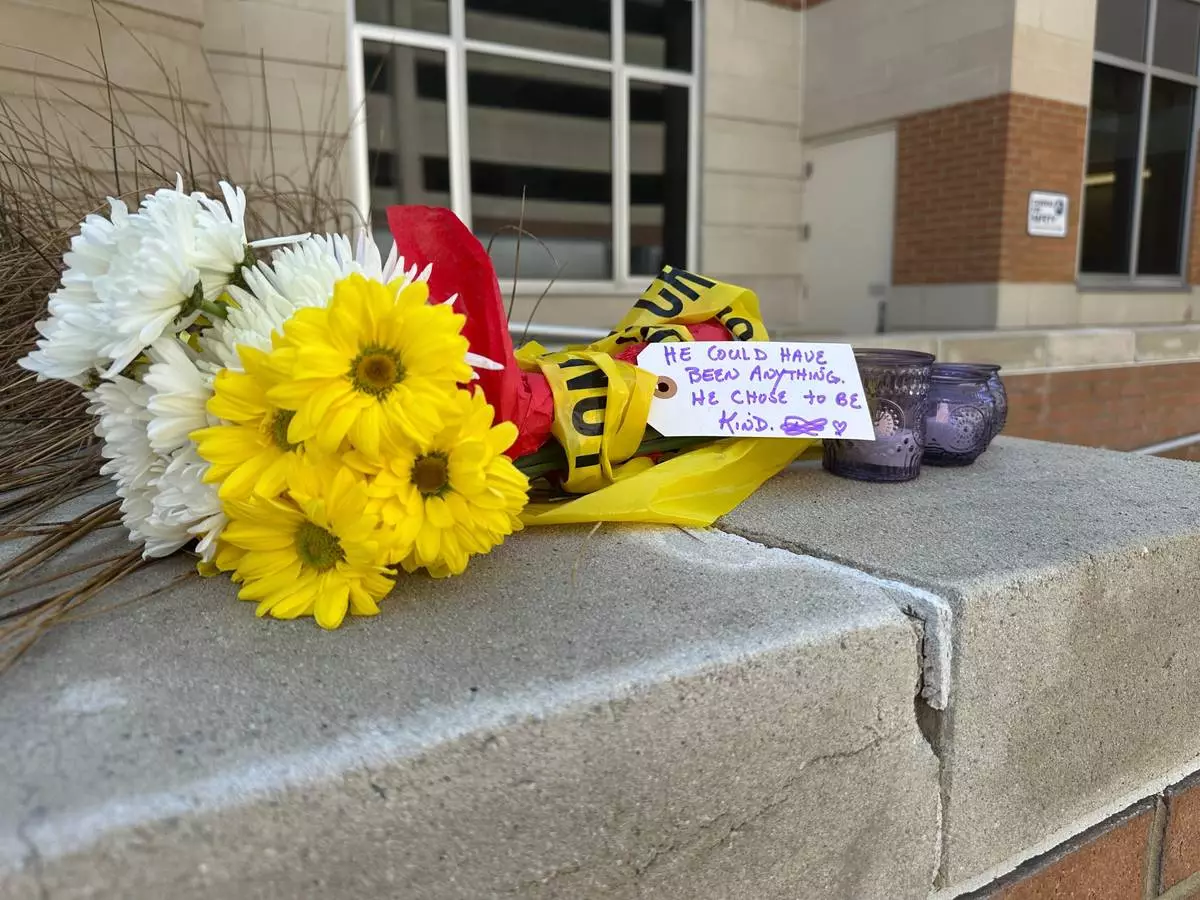
FILE - A bouquet of flowers with a note and votive candles sits at the entrance of Constant Hall at Old Dominion University in Norfolk, Va., on March 13, 2026. (AP Photo/Allen G. Breed, File)

FILE - A bouquet of flowers with a note and votive candles sits at the entrance of Constant Hall at Old Dominion University in Norfolk, Va., on March 13, 2026. (AP Photo/Allen G. Breed, File)

Recommended Articles