NEW YORK (AP) — Athletics pitcher Jeffrey Springs lost a no-hit bid Thursday with one out in the seventh inning against the New York Yankees when he allowed a single to Ben Rice.
Springs walked Giancarlo Stanton after catcher Austin Wynns lost an ABS challenge on the previous pitch that was called a ball. On his 84th pitch, Rice hit an 83 mph slider for a clean single to right field.
The A's held a 1-0 lead when Springs allowed Rice's hit.
Springs allowed two baserunners in the third and ended the inning by getting a called third strike on Aaron Judge with his changeup. He ended the fifth by getting José Caballero on a flyball to deep left field.
In the sixth, Springs won an ABS challenge that resulted in a called third strike to Ryan McMahon. He ended the sixth at 73 pitches after Judge softly grounded out to third.
The A’s have thrown 13 no-hitters in franchise history. The last was achieved by Mike Fiers on May 7, 2019, in Oakland against the Cincinnati Reds.
The Yankees have been no-hit eight times in team history. The last was a combined no-hitter by Houston’s Cristian Javier, Hector Neris and Ryan Pressly on June 25, 2022, at Yankee Stadium.
AP MLB: https://apnews.com/hub/MLB

Athletics pitcher Jeffrey Springs throws during the first inning of a baseball game against the New York Yankees, Thursday, April 9, 2026, in New York. (AP Photo/Adam Hunger)
ANNAPOLIS, Md. (AP) — Maryland has reached a settlement with the owner and operator of the massive cargo ship that crashed into a Baltimore bridge two years ago, causing its deadly collapse, state officials announced Thursday.
The settlement in principle was reached with Grace Ocean Private Limited and Synergy Marine Pte Ltd, owner and operator of the M/V Dali, Attorney General Anthony Brown said. The settlement resolves a portion of the state's claims arising from the ship's March 26, 2024, crash into the Francis Scott Key Bridge.
“For two years, Maryland workers, families, and communities have carried the weight of a disaster that should never have happened," Brown said in a news release. It did not give details of the settlement.
The attorney general noted that the Dali's crash into the bridge "disrupted the Port of Baltimore, devastated livelihoods, and sent economic shockwaves across our State that are still being felt today.”
“Our work is not finished, but this settlement is an important step toward making Maryland whole," Brown said.
The companies confirmed in a joint statement that significant progress has been made in resolving claims. Within the past week, the statement said, they have reached “two pivotal settlement agreements with the State of Maryland and ACE American Insurance Company that underscore their commitment to a reasonable and structured outcome to this unfortunate incident.”
The $350 million settlement with the insurance company matched the amount ACE paid to Maryland, an amount that represented the limit of the state's policy.
“These agreements represent a significant step towards resolving the complex litigation surrounding this event and Owners and Managers remain open to negotiating in good faith to reach equitable settlements with other involved parties holding meritorious claims,” the joint statement said.
The Maryland Transportation Authority late last year estimated the price range of a new bridge alone to be between $4.3 billion and $5.2 billion, with an anticipated open-to-traffic date in late 2030.
The settlement does not resolve any claims the state may have against the shipbuilder, Hyundai, the attorney general's office said.
The ship was leaving Baltimore for Sri Lanka when its steering failed because of a power loss. Six men on a road crew, who were filling potholes during an overnight shift, fell to their deaths when the bridge collapsed.
The state’s claims, filed in federal court in Maryland in September 2024, alleged that the disaster was the result of negligence, mismanagement, and the reckless operation of a vessel that was not seaworthy and should never have left port.
The state sought damages on behalf of its agencies for the destruction of the bridge, harm to the Patapsco River and surrounding environment, lost revenues, and the wide-ranging economic losses sustained by Maryland and its residents.
The collapse brought shipping at the Port of Baltimore to a complete halt, disrupted the livelihoods of thousands of workers, rerouted traffic through communities already bearing disproportionate burdens, and triggered economic ripple effects still being felt across the state, the attorney general's office noted.
The bridge, a longstanding Baltimore landmark, was a vital piece of transportation infrastructure that allowed drivers to easily bypass downtown. The original 1.6-mile (2.6-kilometer) steel span took five years to construct and opened to traffic in 1977. It was particularly important for the city’s port operations.
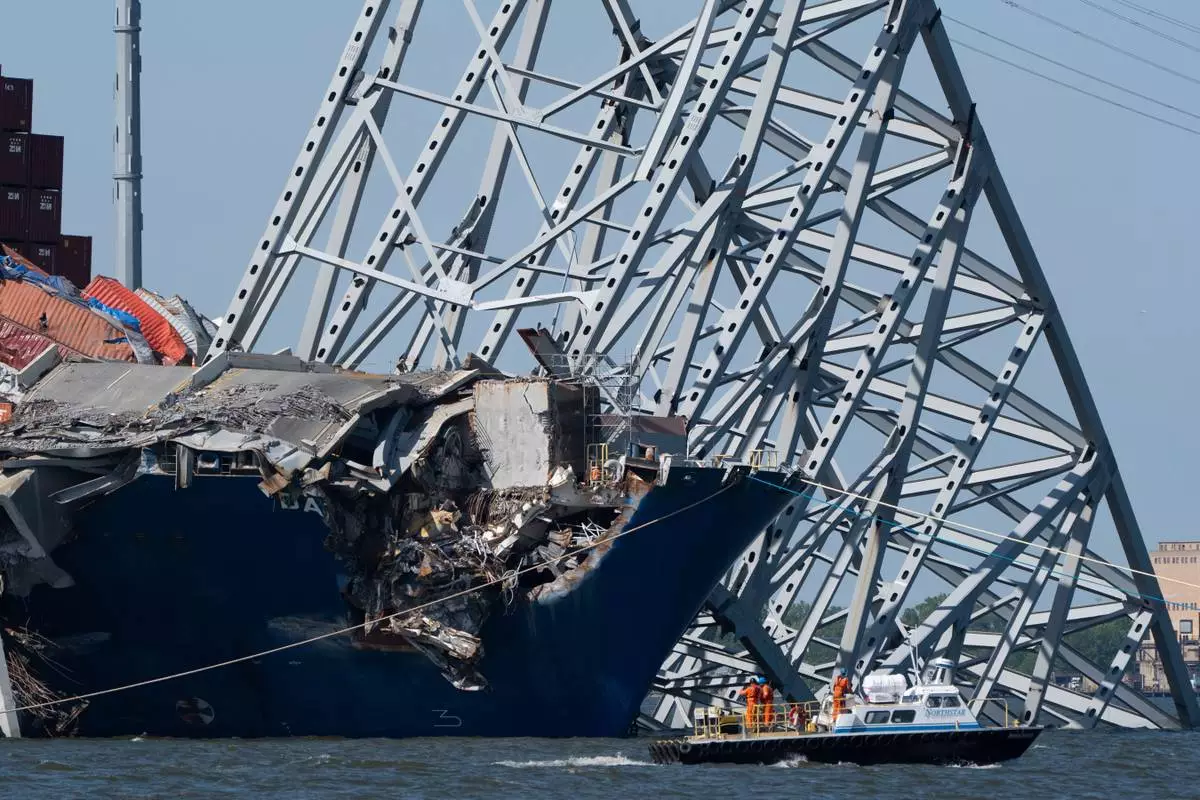
FILE - A boat moves past the bow of the container ship Dali prior to the detonation of explosive charges to bring down sections of the collapsed Francis Scott Key Bridge resting on the Dali, May 13, 2024, in Baltimore. (AP Photo/Mark Schiefelbein,File)