DALLAS--(BUSINESS WIRE)--Apr 10, 2026--
HomeVestors® presented a check for $20,000 to Treasure Valley Habitat for Humanity in honor of a Boise home winning The Ugliest House Of The Year® 2025. The national contest highlights the most dramatic “befores” and “afters” from the houses purchased and renovated by HomeVestors of America’s franchises around the country, and husband and wife team Paul and Tanice Myers won the 19 th annual heated competition.
This press release features multimedia. View the full release here: https://www.businesswire.com/news/home/20260410112515/en/
“It meant a lot to feel the enthusiasm and care HomeVestors brought to this project,” said Janessa Chastain, Chief Executive Officer Treasure Valley Habitat for Humanity. “Events like this don’t come together without a whole team of people willing to go above and beyond. It was clear every step of the way how invested everyone was in making a difference in our community.”
Through Treasure Valley Habitat for Humanity’s Women Build initiative, women in the Boise area have formed teams comprised of friends, colleagues and other associates to raise money and other resources to support Habitat and help build homes. Many Women Build volunteers were on-hand for the HomeVestors check presentation with other guests from the community joining to celebrate the donation at an existing Women Build project.
“The stars aligned beautifully this year with a women-owned business winning The Ugliest House Of The Year competition, which also helped bring attention to the Women Build initiative,” added Joshua Waltzer, Chief Executive Officer of HomeVestors. “This is the fifth year we have partnered with a local Habitat for Humanity chapter to donate in honor of the annual winner, and we couldn’t be happier with how our two missions have aligned as we both work towards a shared vision of a world where everyone has a decent and affordable place to live.”
HomeVestors marks a notable milestone this year as it celebrates 30 years as America’s Trusted Home Buyer. Founded in 1996, HomeVestors helped pioneer the professional real estate investor industry and the modern “house-flipping” business, and today the We Buy Ugly Houses® company helps revitalize communities across 47 states. The dual celebrations at a Women Build project during Women’s History Month also highlights the opportunities HomeVestors creates for women owners like Tanice.
About HomeVestors of America, Inc.
For 30 years, HomeVestors of America, Inc. has recruited, trained and supported its 900 independently owned and operated HomeVestors franchisees that specialize in building businesses based on buying, rehabbing, selling, and holding residential properties. The largest professional house buying franchise in the U.S. with more than 150,000 houses bought since 1996, HomeVestors is known as the We Buy Ugly Houses people, and strives to make a positive impact in each of the 47 states and the District of Columbia, in which it has franchises.

Over the years, the Myers have beautified more than 500 houses with their team of eight, bonding with grateful homeowners and neighbors as they caringly breathe new life into the homes they renovate. Treasure Valley Habitat for Humanity works in partnership with the community to provide decent, affordable homes and to promote responsible homeownership for people in need.
The Big Ten Conference amassed nearly $70 million from NCAA distributions that will be paid for team appearances and performances in the 2026 men's and women's basketball tournaments.
That is by far the most among conferences, largely because the Big Ten swept the national championships — Michigan won the men's and UCLA the women's — and had Illinois advance to the men's Final Four.
The NCAA, which has multibillion-dollar broadcast deals for the two tournaments, since 1991 has rewarded conferences for their number of tournament bids and how far those teams advance in the men’s tournament. A similar system for the women’s tournament began in 2025.
The dollars are piling up:
— For this year's tournaments, nine men's teams and 12 women's teams from the Big Ten combined to make at least $69.4 million, with $63 million coming from the men's side.
— The Southeastern Conference, which had 10 teams in each tournament, totaled at least $56.2 million ($50.4 million for men, $5.8 million for women).
— Distributions will total at least $42.9 million for the Big 12, $34.2 million for the Atlantic Coast Conference and $22.2 million for the Big East.
The NCAA sends payments directly to the conferences, which distribute the money among their teams according to their policies. Payments for the 2026 tournament will begin in April 2027.
Teams in each tournament earn what's known as a “unit” for making the field of 68 and an additional unit for each round in which it appears. The national champion is awarded an extra unit. The value of a unit increases each year. A portion of revenue from the tournaments' broadcast agreements are directed to distribution payments, 24% for the men and 41% for the women.
The estimated value of a unit for the 2026 men’s tournament will be about $350,000, an NCAA spokeswoman said, and that amount will be paid annually for six years. So a single unit earned in 2026 would have a total value of at least $2.1 million over those six years and probably more because Division I distribution funds — including the basketball funds — are scheduled to increase each year, typically by 2.9%.
For the women's tournament, full funding for units earned will be achieved in 2027. Payments for each unit earned will be made for three years rather than six. The unit value was $75,000 for 2026 and will decrease to about $63,000 next year as part of the NCAA’s formula for getting the fund fully up and running. Using $63,000 as an estimate for the 2028 value, a single unit earned in 2026 would be worth at least $201,000 by the time it is paid off over three years.
The Big Ten's nine teams in the men's tournament appeared in 29 games. Michigan earned $14.7 million for the conference by playing in six games and receiving a seventh unit for winning the championship. Illinois earned five units for making the Final Four ($10.5 million) and Iowa and Purdue four apiece for reaching the Elite Eight ($8.4 million each).
The Big Ten landed 12 teams in the women's tournament, and they combined to play in 31 games. UCLA earned just over $1.4 million by playing in six games and receiving an extra unit for winning the championship. Michigan's four games earned $804,000 and Minnesota's three earned $603,000.
The championships in men's and women's basketball continued what's been a banner 2025-26 for the Big Ten. Indiana won the conference's third straight College Football Playoff, and other national championships have been won in men's wrestling (Penn State), women's ice hockey (Wisconsin), men's water polo (UCLA), men's soccer (Washington) and field hockey (Northwestern). Wisconsin also reached Saturday's men's hockey championship game, where the Badgers will face Denver, a winner over Michigan.
AP college basketball: https://apnews.com/hub/ap-top-25-college-basketball-poll and https://apnews.com/hub/college-basketball
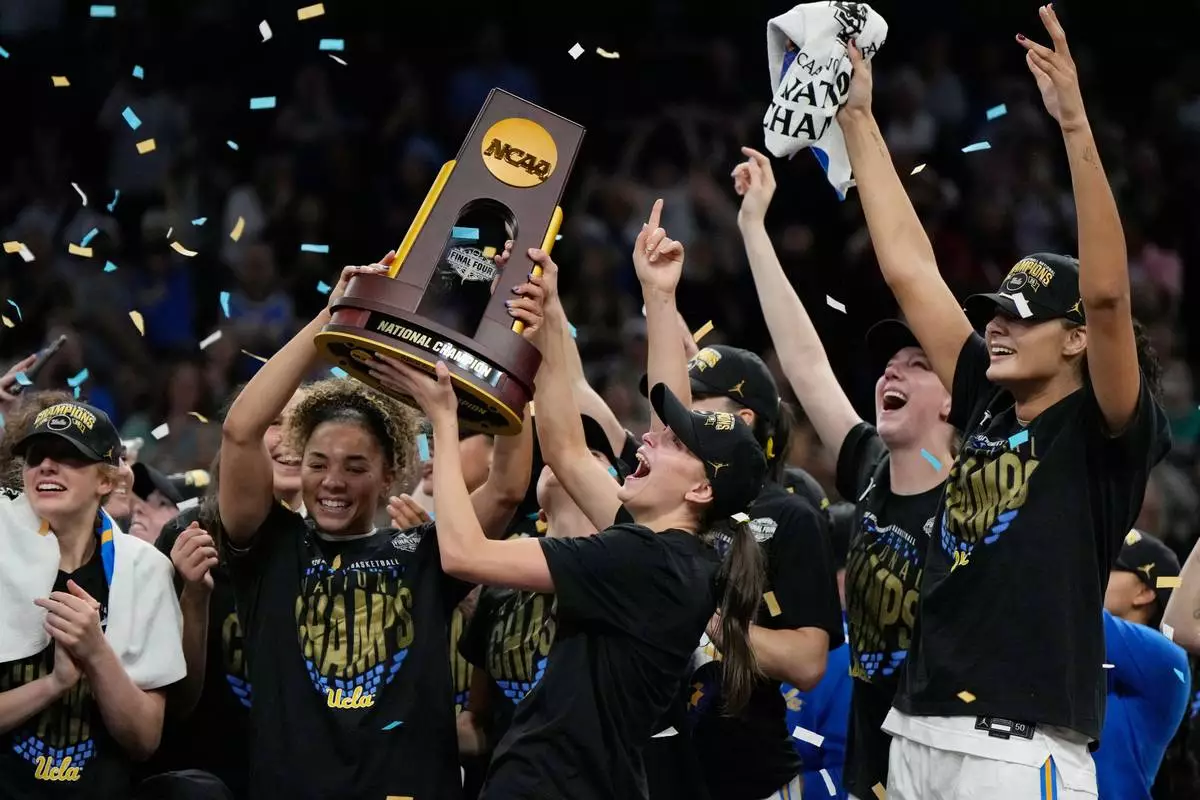
UCLA players celebrate after defeating South Carolina in the women's National Championship Final Four NCAA college basketball tournament game, Sunday, April 5, 2026, in Phoenix. (AP Photo/Ross D. Franklin)
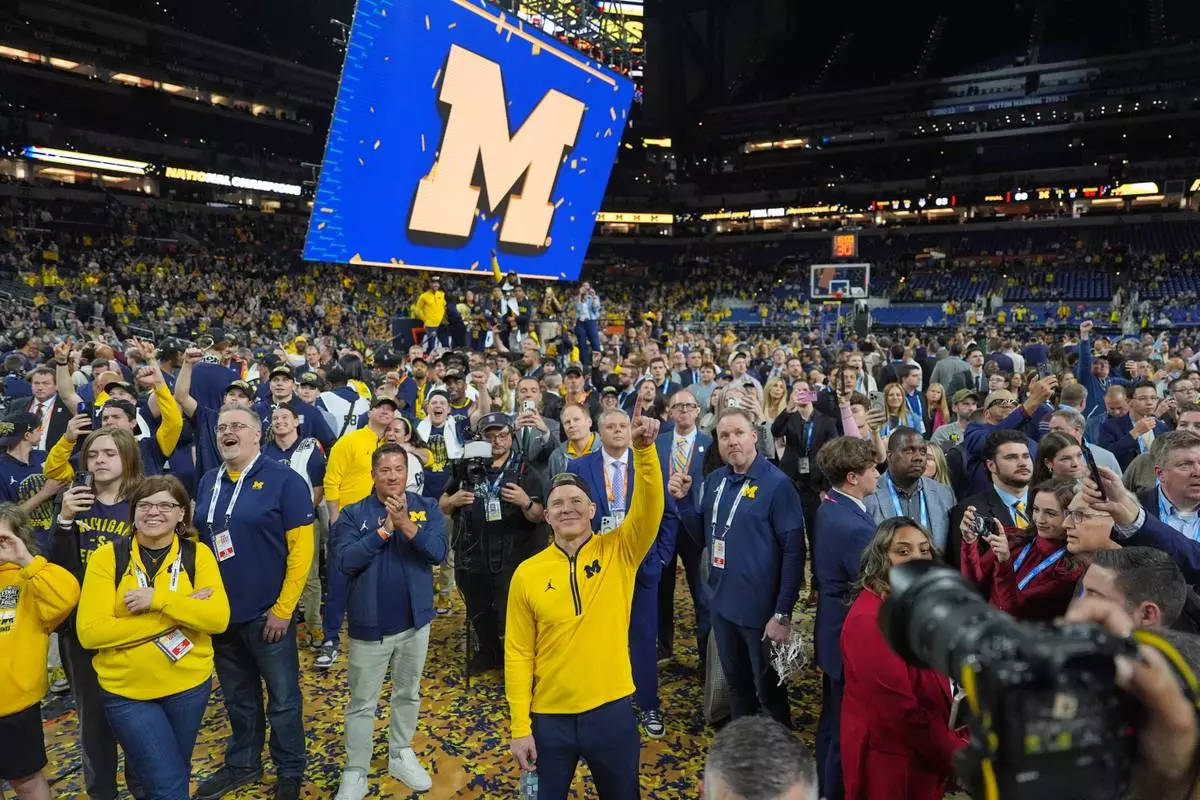
Michigan head coach Dusty May celebrates after defeating UConn in the NCAA college basketball tournament national championship game at the Final Four, Tuesday, April 7, 2026, in Indianapolis. (AP Photo/Michael Conroy)