Skip to Content Facebook Feature Image

China launches first offshore carbon injection project in Hainan Province

China

China

China

China launches first offshore carbon injection project in Hainan Province

2026-04-11 17:25 Last Updated At:18:37

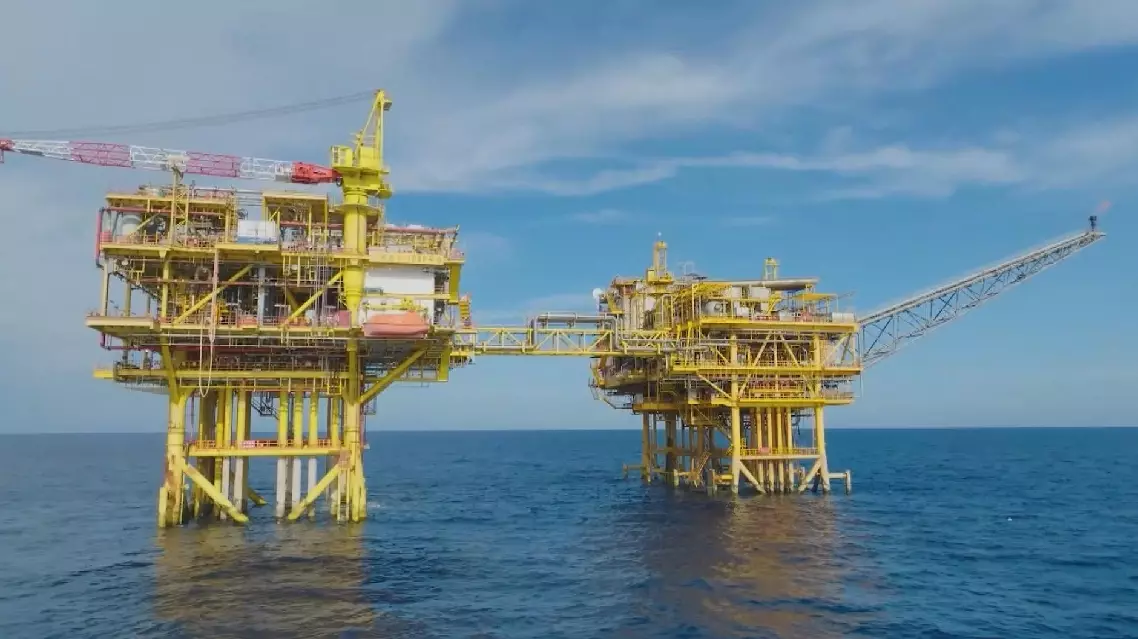
China National Offshore Oil Corporation (CNOOC) announced on Saturday that construction has officially started on a carbon capture, utilization and storage (CCUS) project at the Dongfang 1-1 gas field in south China's Hainan Province.

The project includes the construction of two new jacket platforms and an undersea pipeline connected to the existing production facilities of the Dongfang 1-1 gas field.

It marks China's first demonstration initiative applying offshore carbon injection technology to enhance natural gas production.

Carbon injection for enhanced gas recovery is a specialized branch of CCUS technology. Its core principle is to turn carbon dioxide emitted during natural gas extraction into a valuable resource. After being captured and purified, the carbon dioxide is pressurized and injected back into gas-bearing reservoirs, where it acts as a driving force to unlock hard-to-recover natural gas reserves.

"With the new project, we will move the decarbonization process, originally located at onshore processing plants, to the offshore platform itself, achieving carbon reduction at the source. Compared with traditional processes, the technology used here offers higher equipment integration, lower energy consumption, and better recovery of hydrocarbon components," said Yu Fasong, head of the Dongfang 1-1 CCUS project at CNOOC Hainan.

The Dongfang 1-1 gas field, China's first self-operated offshore gas field and the country's first offshore high-CO2 gas field, has been in production since 2003, with cumulative natural gas output exceeding 50 billion cubic meters.

"When fully operational, the project is expected to inject up to about 1.2 million tons of carbon dioxide into the formation annually. This is of great significance for enhancing marine energy and resource development capabilities and supporting China's dual carbon goals," Yu said.

Upon completion, the project will enhance the transportation capacity of the subsea pipeline network in the Yinggehai Sea, support the cost-effective development of more carbon-rich natural gas resources in the region, and help sustain long-term stable production of the entire Dongfang gas field cluster.
China launches first offshore carbon injection project in Hainan Province
China launches first offshore carbon injection project in Hainan Province
Former Italian prime minister Romano Prodi has urged the European Union to scrap unanimity in key decisions, warning that the bloc's leadership risks paralysis under its current rules.

Prodi, also former president of the European Commission, delivered the appeal in a China Media Group interview aired Friday, framing unanimity as the rule that has repeatedly left the Eropean Union (EU) unable to act decisively on foreign policy and crises such as Ukraine aid and sanctions against Russia.

The unanimity rule has repeatedly stalled EU action, most visibly in foreign policy and Ukraine aid, where Hungary's vetoes have blocked or delayed major packages and sanctions. This has led to frustration among EU leaders and calls for reform toward majority voting.

"The case of Europe, in my opinion, is very simple. Because of old compromise, the great decisions must be taken at unanimity. And this is impossible. We have simply to change our rules. We have 27 countries. It is enough to have one to stop any decision. If we go on with this way of dealing, we shall never arrive to some sort of synergy," he said.

Prodi believes the deeper risk is that Europe cannot exercise leadership unless it achieves unity, since leadership depends on collective recognition and cohesion.

"The unity of Europe, I was telling you that our problem is unanimity, so we cannot play anymore our role. And when you have a veto right, it is difficult to have a leadership. Leadership means recognizing some sort of unity," he said.

EU leaders have debated extending qualified majority voting to foreign policy and taxation, but treaty change remains politically sensitive. The debate over unanimity, and whether unity can be preserved without it, is expected to intensify as the bloc confronts crises from Ukraine to sanctions.

Former Italian PM says EU unity, leadership at risk under unanimity rule

Former Italian PM says EU unity, leadership at risk under unanimity rule

Recommended Articles