Known as the country's "motorcycle capital," Jiangmen City of south China's Guangdong Province is experiencing a surge in exports as global riders increasingly recognize the quality of Chinese-made motorcycles.
Official data shows that in the first two months of 2026 alone, Jiangmen’s motorcycle exports reached 3.26 billion yuan (about 477 million U.S. dollars), a year-on-year increase of 32.4 percent. This accounts for 10.8 percent of the city’s total export value.
For every five motorcycles exported from China, one comes from Jiangmen. As one of the nation’s three major production hubs, the city has emerged as a dominant force in the global market.
Jiangmen’s manufacturing prowess was highlighted on the international stage just two weeks ago at the World Superbike Championship (WSBK) in Portugal. The ZXMOTO 820RR-RS racing motorcycle secured victory, with key components, including its exhaust system and engine cylinders, supplied by Jiangmen-based manufacturers. Additionally, the champion rider wore an LS2 helmet, also produced in Jiangmen.
Even before making the recent international headlines, Jiangmen’s motorcycle firms were expanding their global footprint, backed by supportive policies and continuous product innovation. This resulted in an influx of orders that has created sustained peak periods for manufacturers across the city.
Wang Jing, an overseas marketing manager at a Jiangmen motorcycle firm, says her workload has intensified significantly since early 2025. To keep pace with soaring export demand, she now manages extensive order logs while coordinating production schedules and communicating with overseas clients around the clock.
"Our exports mainly go to Africa, South America, and Central Asia, covering more than 50 countries and regions. Our company's sales in the first quarter of this year grew by 50 percent compared with the same period last year. The time difference with Latin America is 12 hours, so we often work evenings to respond to clients during their business day," said Wang.
To capture a wider overseas market share, many motorcycle companies are offering products customized to meet the specific demands of different regions.
"Currently, 90 percent of our business comes from overseas markets, focused mainly on Europe, North America, and Southeast Asia. Our strategy is to penetrate these markets through personalized customization. For instance, we offer bespoke designs for wheel hubs, air suspension systems, and decals. We want the motorcycle to be more than just a vehicle -- it should be a statement of the rider’s personal style," said Qi Anwei, general manager of a motorcycle company in Jiangmen.
High quality is a major driver of overseas demand for Chinese motorcycles, bolstered by strict factory-level quality control and rigorous customs oversight.
"Jiangmen Customs has established a monitoring point for the export quality and safety of motorcycles, conducting monitoring of regulatory policy from 143 major exporting countries and regions in real time. Based on this data, we carry out sample testing of imported and exported motorcycle components and conduct compliance investigations to help companies improve the quality and safety of their exported products," said Wei Wei, section chief of the inspection department at Jiangmen Customs.
While traditional fuel-powered motorcycles still account for over 90 percent of Jiangmen’s exports, a growing number of manufacturers are carving out a presence in the international electric motorcycle market.
"The electric motorcycle market is growing very rapidly -- more than 400 percent -- which is clearly reflected in our order volume. We have already secured agreements with several major operators in Africa, and many orders have already been shipped. We are also advancing research and development plans for high-speed electric motorcycles," said Zhang Hongming, head of the planning department at a Jiangmen motorcycle firm.
This local boom mirrors a national trend. According to the General Administration of Customs, China exported 8.08 million complete motorcycles in the first two months of 2026, a 32.5 percent year-on-year increase. The total export value reached 24.55 billion yuan (about 3.6 billion U.S. dollars), up 30.2 percent over the previous year.
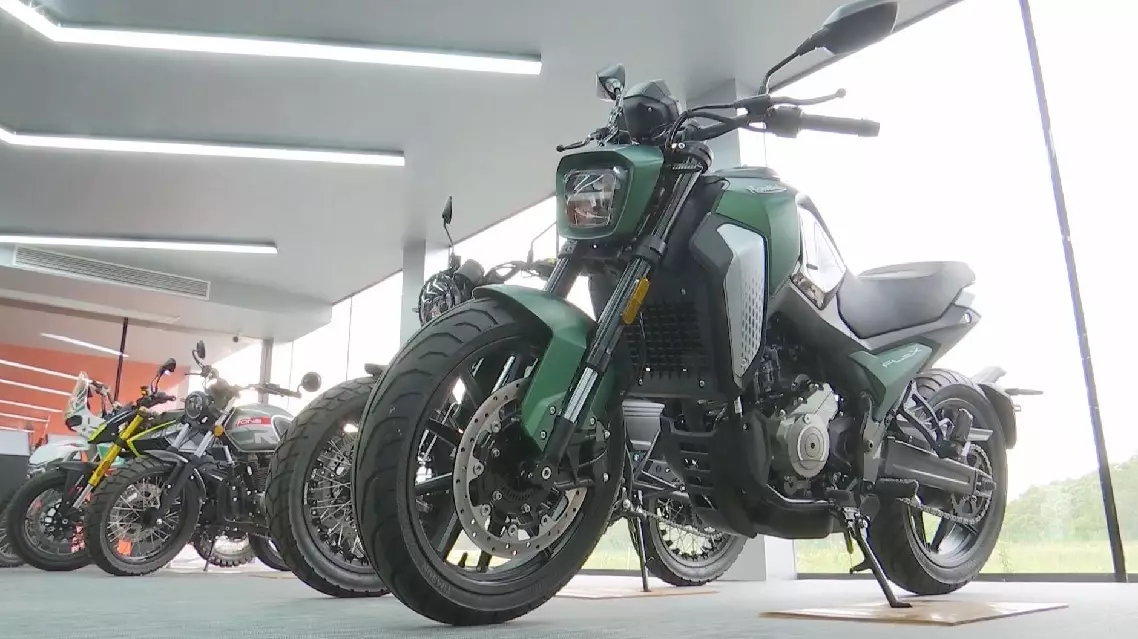
China's "motorcycle capital" sees surge in exports of homegrown bikes