WASHINGTON (AP) — The Iran war has stalled the world's economic momentum this year, likely pushing growth lower compared to 2025, the International Monetary Fund warned Tuesday.
The IMF downgraded its forecast for global growth to 3.1% in 2026 from the 3.3% it had forecast back in January. The expected growth would mark a deceleration from a 3.4% expansion in 2025.
U.S. and Israeli strikes on Iran — and Tehran's closing of the Strait of Hormuz and retaliatory strikes on oil refineries and other energy infrastructure in neighboring countries — have driven oil and gas prices sharply higher around the world.
As a result, the IMF marked up its expectation for global inflation this year to 4.4% from 4.1% in 2025 and from the 3.8% it had forecast for this year in January.
Until the war, the world economy had shown surprising resilience in the face of President Donald Trump's protectionist policies, which built a wall of import taxes around the United States, the world's biggest economy and once a market practically wide open to imports. The damage was less than feared partly because Trump's tariffs last year ended up being lower than what he'd originally announced.
A tech boom, marked by massive investment in data centers and artificial intelligence, and rising productivity also combined to strengthen the world economy.
"War in the Middle East has halted this momentum,'' IMF chief economist Pierre-Olivier Gourinchas wrote in a blog post accompanying the fund's latest World Economic Outlook.
The IMF's forecast assumes that conflict in the Persian Gulf is short-lived and that energy prices rise "a moderate 19%'' this year. Things could be much worse. In a “severe scenario'' in which the energy shocks spill into next year and central banks are forced to raise interest rates to combat inflation, global growth could drop to 2% in 2026 and 2027. ”Despite the recent news of a temporary ceasefire, some damage is already done, and the downside risks remain elevated,'' Gourinchas wrote.
The fund slightly downgraded its forecast for U.S. growth this year to 2.3%. The 21 European countries that share the euro currency, hard hit by soaring natural gas prices, will collectively grow 1.1% this year, down from 1.4% in 2025, the IMF forecast.
Hardest hit are likely to be deeply indebted poorer countries that import energy and can't afford to buffer their economies with stepped-up government spending and tax relief. The IMF sharply lowered the outlook for Sub-Saharan Africa, for instance, to 4.3% this year from the 4.6% it had expected in January.
One winner that's emerging from the conflict is Russia, an energy exporter that stands to benefit from higher prices. The IMF upgraded its forecast for the Russian economy, hard hit by sanctions following the invasion of Ukraine in 2022, to a still-modest 1.1%.
Meanwhile, the governor of the National Bank of Ukraine has tried to keep Russia’s war in his country at the center of talks among global economic leaders. But in a Monday interview with reporters, Andriy Pyshnyy noted how higher oil prices due the war in Iran are hurting his country.
He said through a translator that annual inflation in March hit 7.9% in Ukraine, well above the forecast of 7% in large part because of higher fuel costs. He estimated that fuel prices could push up annual inflation by 1.5 percentage points to 2.8 percentage points.
Pyshnyy noted that there could also be higher fertilizer and production costs in an economy that is seeking stable prices as part of the ongoing war with Russia, which attacks Ukraine by air on average every 3 to 4 minutes.
“We are trying to walk on a razor blade,” he said of a mission complicated by external factors.
The IMF is a 191-nation lending organization that works to promote economic growth and financial stability and to reduce global poverty.

FILE - Kristalina Georgieva, managing director of the International Monetary Fund (IMF), listens during a briefing in Beijing, China, Dec. 10, 2025. (AP Photo/Ng Han Guan, File)
BETHLEHEM, West Bank (AP) — Mohamad Al-Assi ran beneath the concrete wall as the sun rose over Bethlehem. His Nikes pounded the gravel, his breath fogging the air as graffiti and paint splatter blurred past with each stride.
The road along the barrier separating Israel from the occupied West Bank makes up a stretch of a marathon route that Al-Assi and thousands of others ran on Friday. The event is open to people in other parts of the world running in solidarity with the Palestinians and another, shorter race was happening in Gaza.
The race, known as the Palestine Marathon, was held for the first time in three years and was among the first big international events in the West Bank since the start of the Israel-Hamas war. Festivals, conferences and holiday festivities that once drew thousands have been scaled back or canceled because of the war in Gaza and heightened Israeli restrictions.
It marked a turning point for Al-Assi, 27, who was released from Israeli detention six months ago. Video from that day shows him gaunt-faced and hollow-eyed, his once muscular legs weakened after more than two and a half years of prison.
He began training in December, gradually upping his mileage every month since. He ran 62 miles (100 kilometers) that first month, and in April reached 135 miles (217 kilometers), according to his account on the tracking app Strava.
He jogs in the morning after his mother wakes him up in their home in Dheisheh, a Palestinian refugee camp made up of graffiti-covered cinderblock homes in tangled alleyways.
“The main difficulties we face are the cars on the roads and the presence of Israeli security forces along the route where I train,” Al-Assi said.
He had to suspend his training several times because of military operations in the camp.
“I would return home feeling hopeless because I couldn't do what I had intended to do,” Al-Assi said.
In the West Bank, runners cannot complete a 26.2-mile (42.2-kilometer) course without hitting a checkpoint or military gate, which is why Friday's marathon route looped around the same circuit twice.
They ran up through the narrow streets of two Palestinian refugee camps and down to a farming town next to Bethlehem where fields are divided by the concrete wall, barbed wire and cameras. The course hooked back to finish at Bethlehem’s Manger Square.
Organizers say the race highlights restrictions facing Palestinians in the occupied West Bank, where checkpoints can disrupt even routine commutes and where open land for hiking, biking and running is increasingly taken by Israeli settlements and outposts.
“Marathon runners anywhere may ‘hit a wall’ under the physical and emotional strain of completing the 42-kilometer race course," they said on the marathon's website.
But in the West Bank, they added, "runners literally hit the Wall.”
At a time when the West Bank’s economy is struggling and in the shadow of Gaza's fragile ceasefire and stalled rebuilding efforts, the atmosphere in Bethlehem was celebratory. Crowds gathered near the Church of the Nativity to cheer runners at the race's early morning start and finish. Bagpipes blared and drummers pounded out traditional rhythms through streets along the route.
On a beachside road in Nuseirat in central Gaza — which is roughly the length of a marathon — 15 disabled people, including amputees, ran a 2K, and a couple thousand of people ran a 5K. Thirteen years after the U.N. agency for Palestinian refugees, known as UNRWA, canceled a 2013 marathon because Hamas forbade women from participating, the women were back.
Haya Alnaji, a 22-year-old woman who ran in the 5K, said the number of people taking part reflected that Palestinians in Gaza were determined to live and persevere despite the devastation wrought by more than two years of war.
“All of Gaza loves sports,” she said.
Al-Assi was arrested in April 2023, and imprisoned under administrative detention, which allows Israel to hold detainees for months without charge. Between 3,000 and 4,000 Palestinians are being held under that system, according to Israeli rights groups and the Palestinian Prisoners Society.
In October 2023, Al-Assi was sentenced for transferring money to suspicious entities, a charge he denies. Israel closely monitors money transfers — particularly to Gaza — for fear that funds could end up in the hands of militants. Palestinians, however, say donations and charitable contributions are often swept up in the dragnet. Israel’s military, Shin Bet and Prison Service did not answer questions about Al-Assi's charges.
In Israeli prisons — where detainees routinely complain of inadequate diets — Al-Assi said nearly everyone goes hungry. The weight he lost eroded the endurance built through 10 years of training.
“I have more muscle mass than fat, so when I lost weight, the loss came from my muscles rather than fat,” he said. “This had a major impact on my physical fitness.”
He also had to regain the mental fortitude to run a marathon.
“I was emotionally shattered after spending such a long period in prison,” he said.
On Friday, he collapsed to his knees, bowing and thanking God after finishing second overall, as supporters and journalists encircled him. He dedicated his run to Palestinians still in Israeli detention.
“After 32 months in prison, Mohamad Al-Assi is first in his class!” he shouted through tears, raising his hands and looking up to the sky.
__ Imad Isseid contributed from Bethlehem, West Bank and Abdel Kareem Hana from Nuseirat, Gaza Strip.
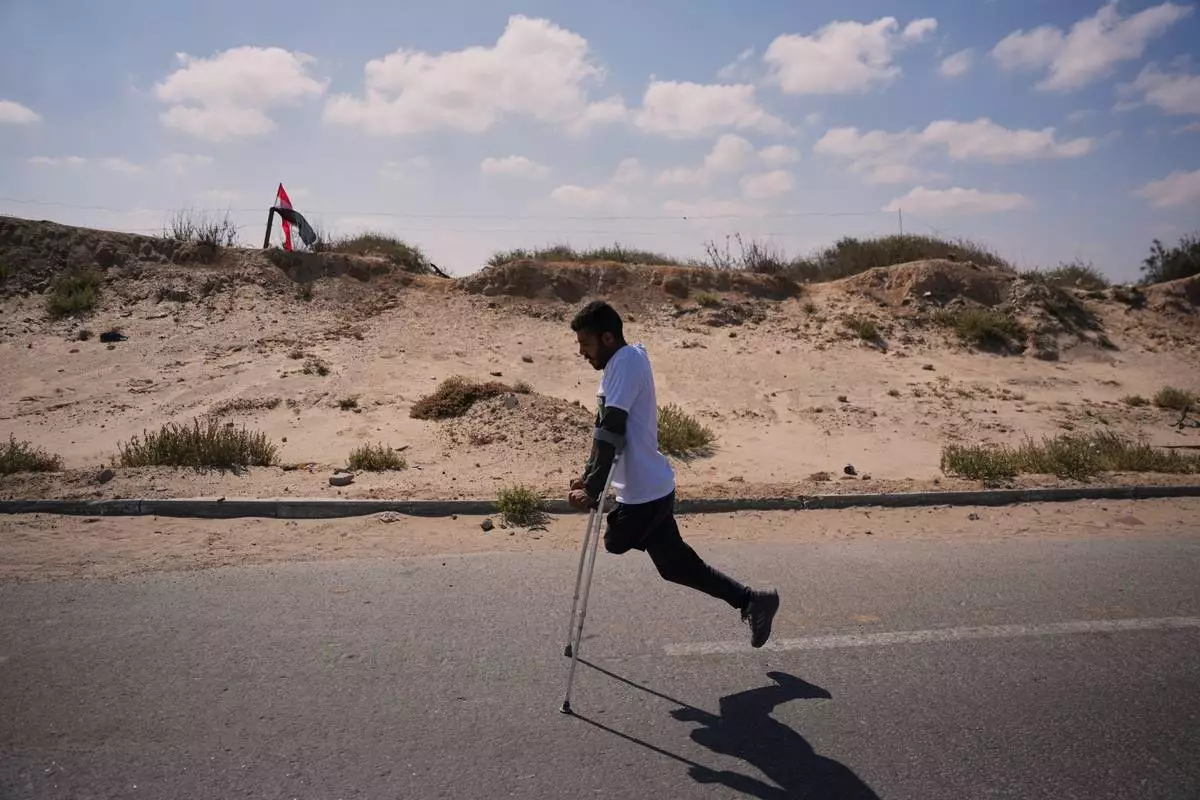
A Palestinian amputee runner takes part in the 2-kilometer Palestine Marathon along the coastal road near Nuseirat in the central Gaza Strip, Friday, May 8, 2026. (AP Photo/Abdel Kareem Hana)
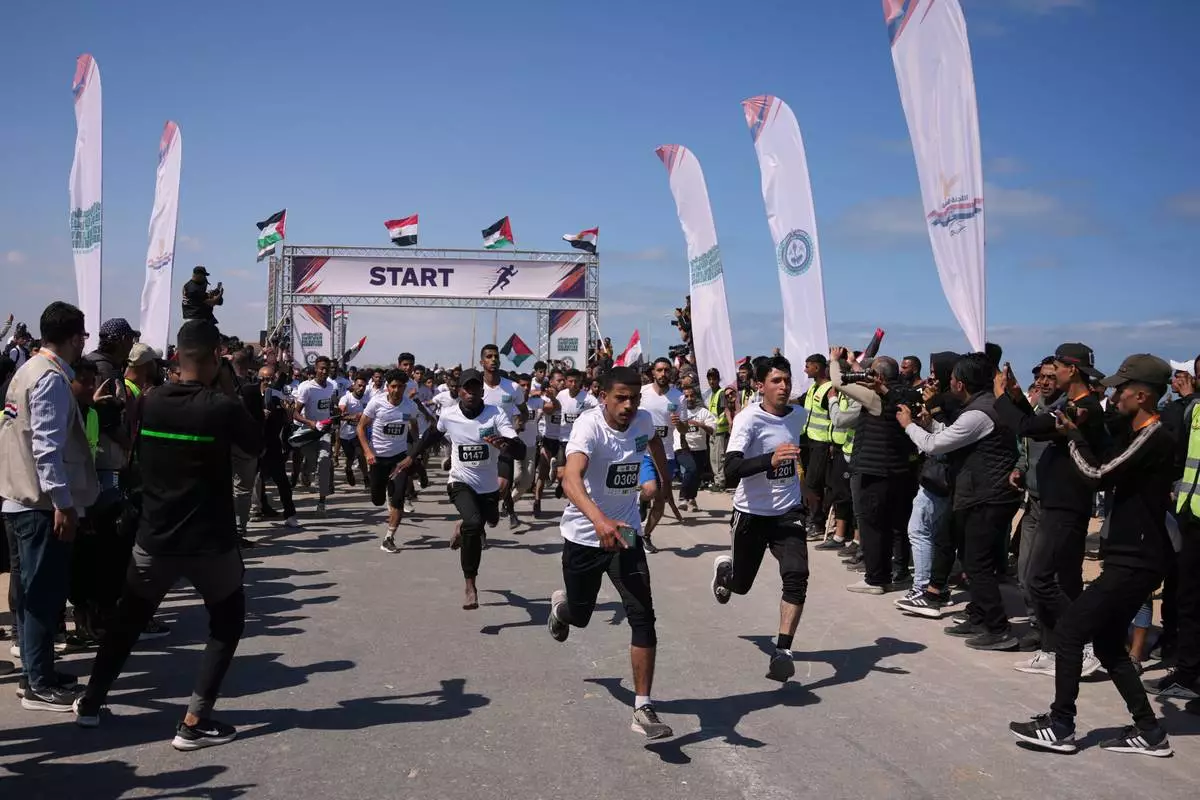
Palestinian runners take part in the 5-kilometer Palestine Marathon along the coastal road near Nuseirat in the central Gaza Strip, Friday, May 8, 2026. (AP Photo/Abdel Kareem Hana)
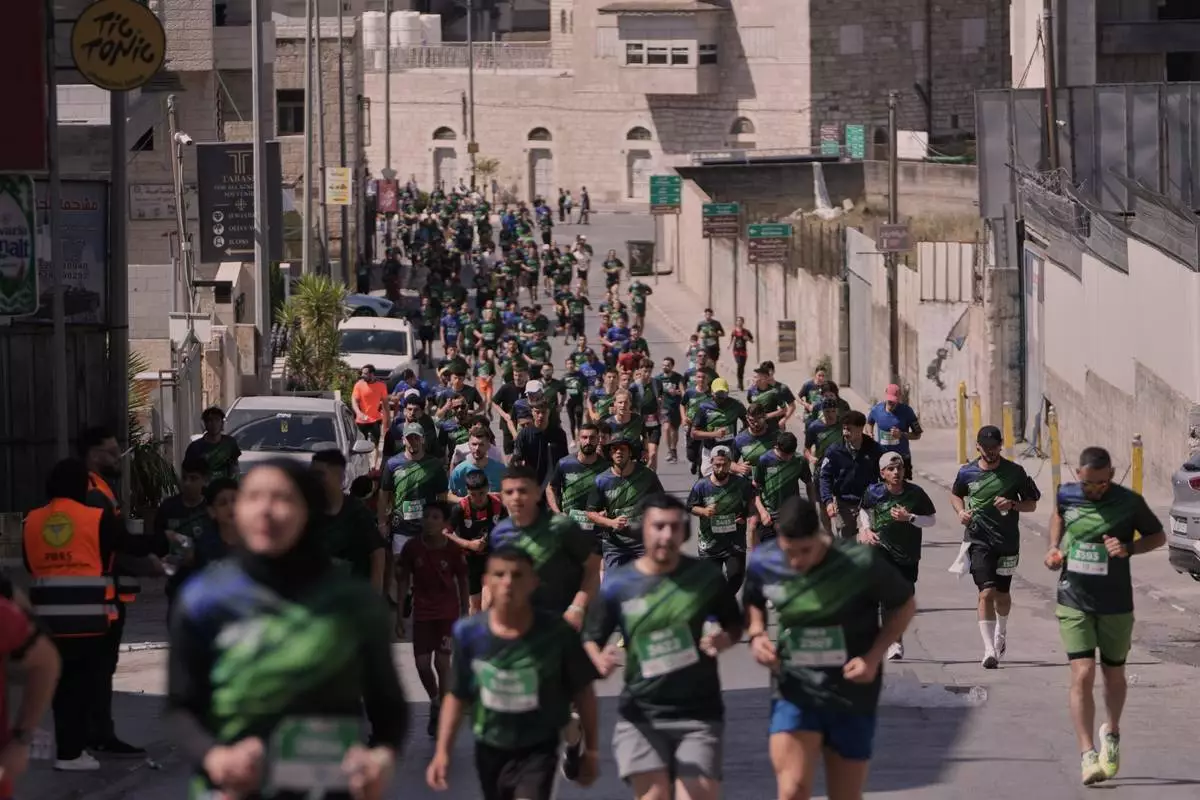
Runners participate in the Palestine Marathon in the West Bank city of Bethlehem, Friday, May 8, 2026. (AP Photo/Mahmoud Illean)
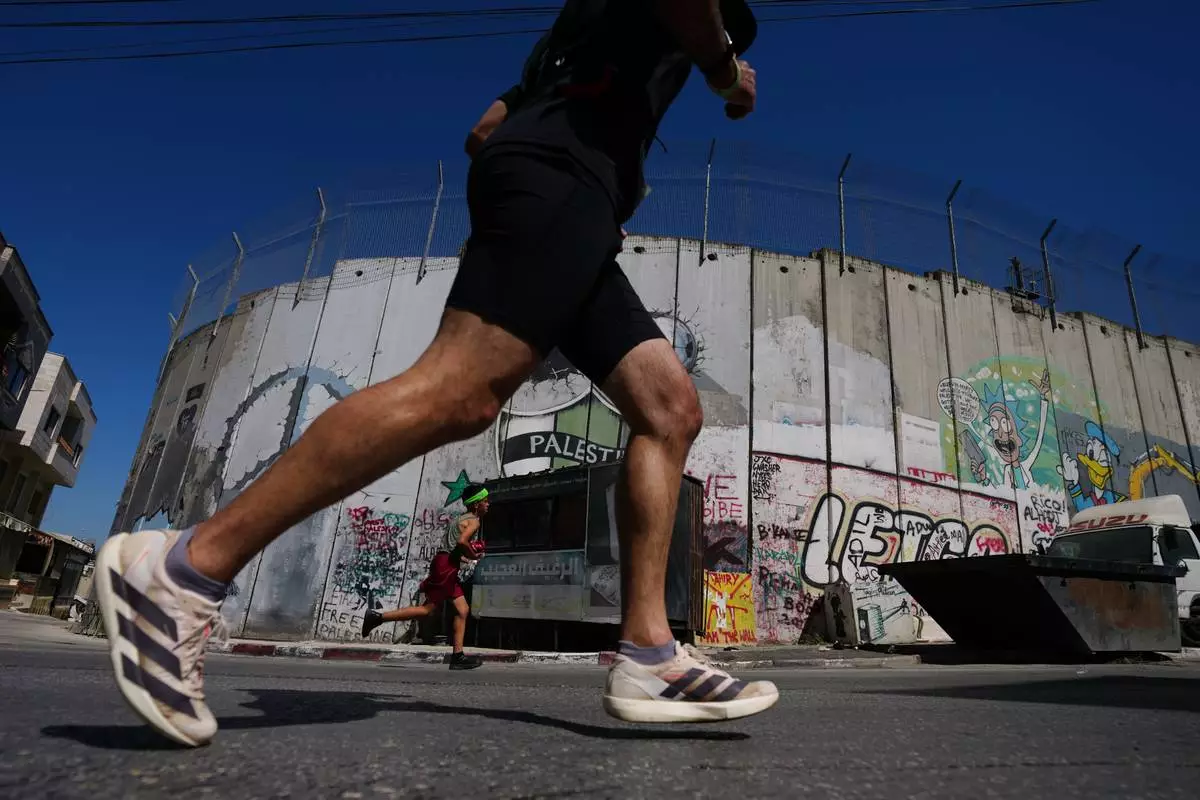
Runners pass by Israel's separation wall as they compete in the Palestine Marathon in the West Bank city of Bethlehem, Friday, May 8, 2026. (AP Photo/Mahmoud Illean)

Palestinian Mohamad Al-Assi, who was released from Israeli detention six months ago, runs past Israel's separation wall as he trains ahead of the Palestine Marathon in the West Bank city of Bethlehem, Thursday, May 7, 2026. (AP Photo/Sam Metz)