Speech by SJ at National Security Legal Forum (with photo/video)
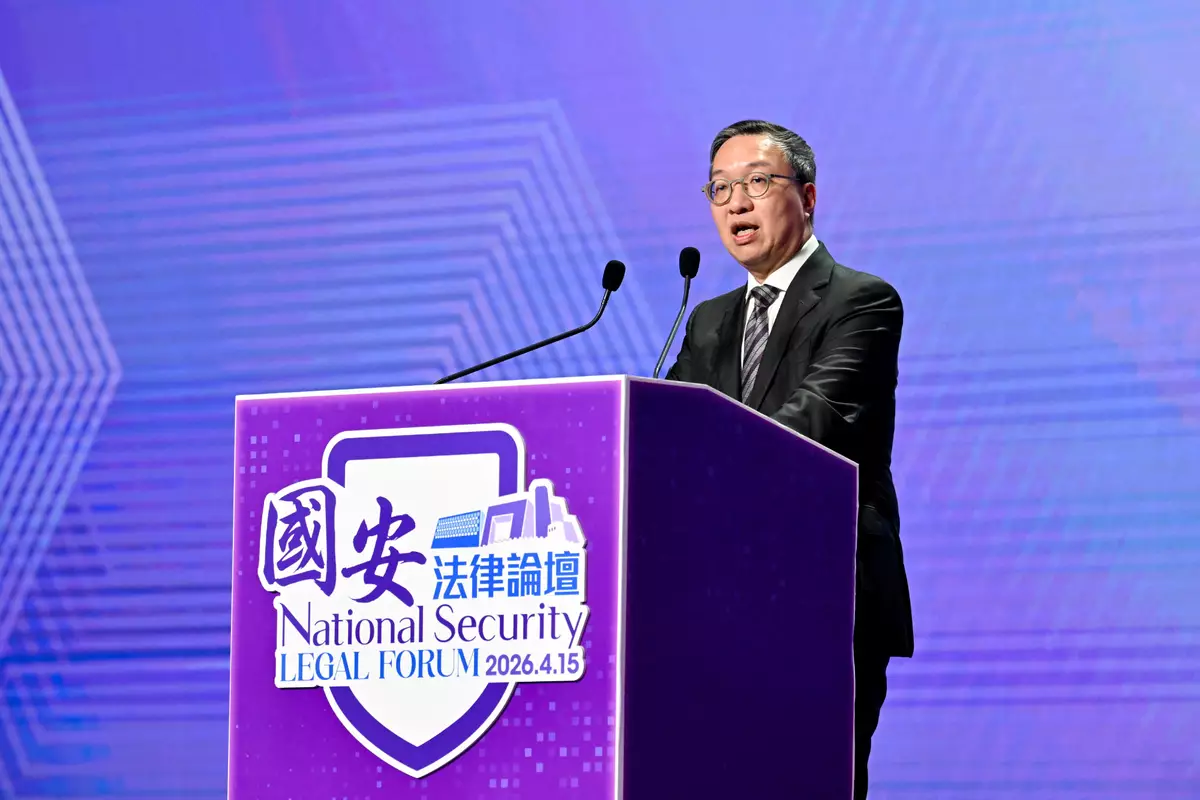
Below are the opening remarks by the Secretary for Justice, Mr Paul Lam, SC, at the National Security Legal Forum today (April 15):
Professor Wang (Vice President of the Chinese Association of Hong Kong and Macao Studies, and Professor of the School of Law of Tsinghua University, Professor Wang Zhenmin), distinguished guests, ladies and gentleman,
Good afternoon. Welcome to the National Security Legal Forum organised by the Department of Justice. The theme for this year is the white paper published on February 10 titled "Hong Kong: Safeguarding China's National Security Under the Framework of One Country, Two Systems".
Introduction
This is an extremely important document, being the third white paper issued by the Central People's Government on Hong Kong, after "The Practice of the One Country Two Systems Policy in the Hong Kong Special Administrative Region" in June 2014 and "Hong Kong: Democratic Progress under the Framework of One Country Two Systems" in December 2021.
One must know the past to understand the present. The white paper clears up confusion and misunderstandings by comprehensively reviewing Hong Kong's endeavours in safeguarding national security, and the experience and insights gained in the process. In addition, to build high-standard security in order to support the high-quality development of Hong Kong, the white paper sets out six fundamental principles. They are: upholding the unity of the Central Government's fundamental responsibility and the HKSAR (Hong Kong Special Administrative Region)'s constitutional responsibility; keeping the power of governing the HKSAR firmly in the hands of patriots; respecting and ensuring human rights; safeguarding security under the rule of law; following a holistic approach to development and security; and safeguarding security with greater openness. I would like to share my views on some of the most salient features among these principles.
Not "absolute" or "generalised" security
First and foremost, it is made crystal clear that Hong Kong does not pursue "absolute" or "generalised" security. This is indeed, and has always been, the crux of our country's approach to national security. To begin with, as stated in an outline for the study of a holistic approach to national security published four years ago on April 15, 2022, it is necessary to respect and safeguard the security of each and every country; hence, it should not be the case that one country is safe whereas other countries are unsafe, or that some countries are safe whereas others are unsafe; it is also wrong to pursue one country's so-called "absolute security" by sacrificing other countries' security. Second, in the Global Security Initiative (GSI) Concept Paper published by the Ministry of Foreign Affairs on February 21, 2023, it reaffirms that China stays committed to taking the legitimate security concerns of all countries seriously: The security of one country should not come at the expense of that of others; all countries are equal in terms of security interests; the legitimate and reasonable security concerns of all countries should be taken seriously and addressed properly; any country, while pursuing its own security, should take into account the reasonable security concerns of others. Lastly, in the white paper published by the State Council on May 12, 2025, titled "China's National Security in the New Era", apart from referring to the content of the GSI, it pointed out that pursuing power supremacy and "absolute security" will only result in a security dilemma.
Relative security
Therefore, instead of "absolute security", China pursues "relative security". This fundamental approach is given the force of law. Article 2 of the National Security Law of the People's Republic of China, which is reproduced in section 4 of Hong Kong's Safeguarding National Security Ordinance, defines national security as a reference to the status in which the state's political regime, sovereignty, unity and territorial integrity, the welfare of the people, sustainable economic and social development, and other major interests of the state are relatively free from danger and internal or external threats, and the capability to maintain a sustained status of security. It is vital to note that it says "relatively free from danger and internal or external threats", but not "absolutely free from danger and such threats".
Security and development
To pursue "absolute security" is not only contrary to the fundamental principle of peaceful coexistence under international law and international relations; it is also unsustainable in practice and will stifle development which is against the interests of a country's own people. Hence, another important principle set out in the white paper is to follow a holistic approach to development and security. It highlights the causal link between security and development: Security is a prerequisite for development, whereas development provides a guarantee for security. We strive to strike a dynamic balance between development and security so that the two reinforce each other. Such a holistic approach is based on common sense and simple logic, and it is also proved by empirical evidence of events taking place in other parts of the world at this very moment.
Open security
This fundamental approach is of particular importance to Hong Kong. Under the principle of "one country, two systems", Hong Kong enjoys various unique strengths, all of which aim at enabling Hong Kong to serve as an international centre in different areas such as finance, trade, shipping as well as legal and dispute resolution services. The keyword to Hong Kong's success is "international". To serve as a genuine international city, it is essential to gain and maintain people's trust and confidence that Hong Kong is an open, inclusive, and diversified society. This is why another principle laid down by the white paper is that Hong Kong aims at developing "open security", which emphasises safeguarding national security in an open environment. Examples given include that Hong Kong will continue to employ judges and other judicial professionals from other common law areas, and its Court of Final Appeal will continue to invite such judges to participate in trials as needed; lawyers from other areas will continue to work and practise law in Hong Kong in accordance with the law; and the lawful rights and interests of investors from all countries and regions will continue to receive equal protection.
Respect for human rights and the rule of law
To achieve "relative security" and "open security" in Hong Kong, the white paper lays down two further important principles, namely, first, respecting and ensuring human rights and, second, safeguarding security under the rule of law. These two principles also enjoy the force of law. Article 4 of the Law of the People's Republic of China on Safeguarding National Security in the Hong Kong Special Administrative Region (NSL) provides that human rights shall be respected and protected in safeguarding national security in Hong Kong; the rights and freedoms which residents of Hong Kong enjoy under the Basic Law and the provisions in the International Covenant on Civil and Political Rights as applied to Hong Kong shall be protected in accordance with the law. Article 5 provides that the principle of the rule of law shall be adhered to in preventing, suppressing, and imposing punishment for offences endangering national security: Hence, a person is presumed innocent until convicted by a judicial body; the right to defend himself or herself and other rights in judicial proceedings that a criminal suspect, defendant and other parties in judicial proceedings are entitled to under the law shall be protected. Articles 4 and 5 of the NSL have been reproduced virtually verbatim in section 2 of the Safeguarding National Security Ordinance as the principles on which the Ordinance is based.
Judiciary exercising independent judicial power
One may ask how one can be reassured that these legal requirements will be faithfully followed in the enactment and implementation of national security laws. Again, the white paper provides the answer. It specifically states that the judicial authorities of the HKSAR exercise adjudicative power independently and, in trying cases pertaining to national security in accordance with the law, are free from any interference.
The important role played by the Hong Kong courts in this respect was explained by the Court of Appeal in Secretary for Justice v. Persons Conducting Themselves In Any Of The Acts Prohibited Under Paragraph 1(a), (b), (c) Or (d) Of The Indorsement Of Claim [2024] HKCA 442, [2024] 3 HKLRD 32. The Chief Judge of the High Court, giving the judgment, held that, in discharging its judicial function in cases involving national security, the court will give appropriate deference to the executive but will make its own judgment on the issue as required. There are at least three areas where the court has been held to be qualified to make its own judgment while giving the executive deference, and they involve issues of a constitutional or legal nature or content: first, where a fundamental right of the person affected by the measure is engaged; second, where the requirement of a fair trial is in issue; and third, where the question of open justice is raised. In HKSAR v Tang Ngok Kwan and others [2025] HKCFA 3, (2025) 28 HKCFAR 29, the Court of Final Appeal held that our courts have frequently acknowledged their duty under Article 3 of the NSL to effectively "prevent, suppress and impose punishment for any act or activity endangering national security" and the importance of that duty. However, it bears emphasising that carrying out that duty requires the courts faithfully to give effect to the provisions of the NSL and other applicable laws, including the safeguards provided for a fair trial.
Conclusion
As the white paper aptly observes, national security, like air and sunshine, is something without which we cannot survive but too often, mistakenly, taken for granted. We must therefore arouse the awareness and vigilance of people in this respect. We must also provide people with a proper and sufficient understanding of the fundamental principles that Hong Kong follows in safeguarding national security. This is to ensure that the national security laws of Hong Kong will be assessed objectively and rationally, and that they will be accepted and followed voluntarily and willingly, out of a genuine belief and conviction that they are essential and beneficial to our well-being, but not something that one may feel apprehensive about. To achieve this objective, I urge all of you, and all who are genuinely concerned about Hong Kong, to study the white paper carefully.
Before I conclude, I would like to thank Professor Wang, and all the guest speakers for agreeing to share their insights with us this afternoon. I wish you a constructive and productive forum. Thank you very much.
Speech by SJ at National Security Legal Forum Source: HKSAR Government Press Releases

Source: AI-found images