Skip to Content Facebook Feature Image

Chinese Language Day celebrations open at UN Vienna

China

China

China

Chinese Language Day celebrations open at UN Vienna

2026-04-15 16:43 Last Updated At:04-16 12:07

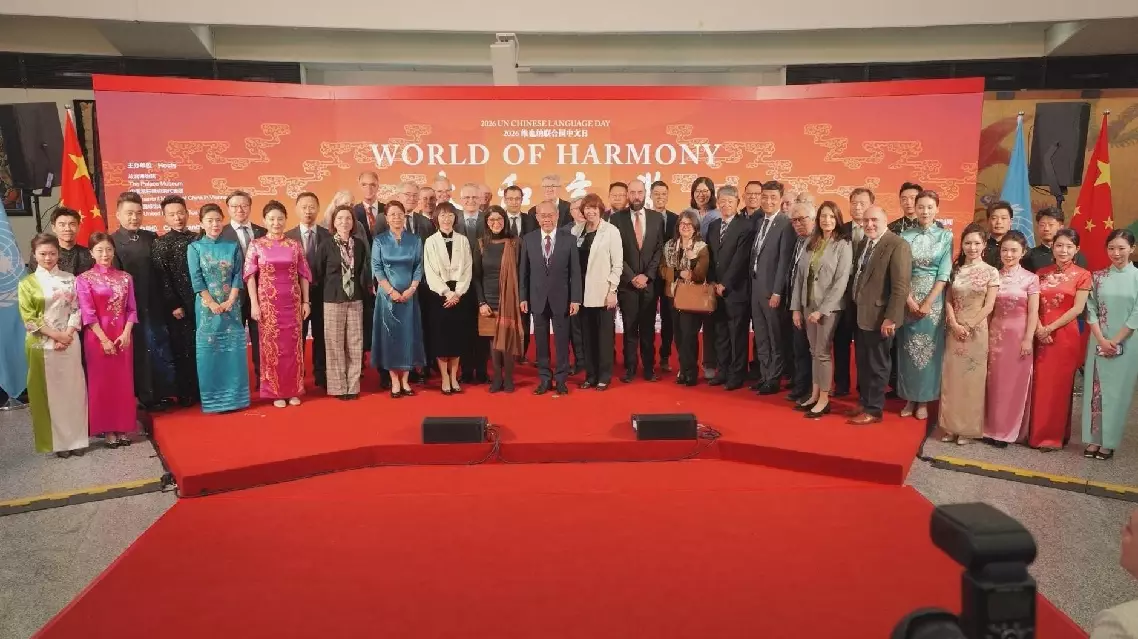
A series of events marking the United Nations Chinese Language Day, themed "World of Harmony: Encountering the Palace Museum in VIC (Vienna International Center)," were launched in Vienna on Monday.

More than 800 guests, including heads of international organizations, permanent representatives of different countries, senior diplomats, international staff, and people from all walks of life in Vienna, attended the opening ceremony for the events co-hosed by the Permanent Mission of China to Vienna, the Palace Museum and the UN Office at Vienna.

Li Song, China's permanent representative to the UN and other international organizations in Vienna, addressed the ceremony, saying that "World of Harmony" connotes a world brimming with righteousness and harmonious governance, which is particularly important in today's volatile and tumultuous world.

Guests at the ceremony said Chinese, as one of the official languages of the United Nations, carries profound historical and cultural heritage.

They said that international organizations in Vienna look forward to working with China and other UN members to further promote multilateralism, facilitate harmonious coexistence, exchanges and cooperation among different civilizations, and make joint efforts to promote world development and harmony.

"I think for us, it's important to get to know more about Chinese culture, and values that China brings to the table, and brings to the international community. When we talk about harmony, it's a lot about understanding, it's about cooperation, it's about respect, and it's also about how we really all despite differences can work together," said Bo Mathiasen, director of the Division for Operations at the United Nations Office on Drugs and Crime.

"Chinese language, so few of us can understand it. It's one collection, one part of the population that can understand it, but it's through language and through music, in particular, that we can get a sense of the culture and so on. But it makes us realize that diversity is so valuable," said Aarti Holla-Maini, director of the United Nations Office for Outer Space Affairs.

At Monday's events, the Palace Museum presented its century-old collections and architectural aesthetics in a panoramic way to the world for the first time at the UN Headquarters in Vienna through immersive digital exhibitions and real-scene restorations, while a lecture on the Palace Museum in the digital age was popular among the guests.

The China National Traditional Orchestra also gave a concert themed "the Sounds of the Palace Museum," along with the display of classic calligraphic works of the museum. China's homegrown robots also staged a Taichi performance.

The Chinese Language Day events will last till April 17.
Chinese Language Day celebrations open at UN Vienna
Chinese Language Day celebrations open at UN Vienna
The Navy of Iran's Islamic Revolution Guards Corps (IRGC) said that the Strait of Hormuz has been blocked since Saturday evening and will not reopen until the United States lifts its naval blockade on the waterway.

In a statement carried by its official news outlet Sepah News, the IGRC said that the move came after the United States violated its commitments under the two-week ceasefire, which took effect on April 8, and failed to end its naval blockade against Iranian vessels and ports.

The IRGC Navy called on all vessels and their owners to follow official updates via its channel and VHF Channel 16, the international maritime distress, safety, and calling frequency. The statements by U.S. President Donald Trump hold no credibility in the strait and the Gulf, it added.

The IRGC warned that no vessel should move from its anchorage in the Gulf or the Gulf of Oman, and any approach to the strait would be deemed "cooperation with the enemy" and targeted accordingly.

Tehran's political leadership echoed the IRGC's firm position. Parliament Speaker Mohammad Bagher Ghalibaf asserted that the Strait of Hormuz is under Iran's control, revealing that during previous negotiations, Iran had firmly countered U.S. attempts to carry out minesweeping operations, which Tehran viewed as a ceasefire violation.

He said the situation had come close to conflict, but the U.S. had eventually backed off.

Calling the U.S. maritime blockade "reckless and ignorant," Ghalibaf warned that passage through the strait would certainly be restricted if Washington does not lift the blockade.

Underpinning these public announcements, Iran's Supreme National Security Council on Saturday affirmed the country's resolve to exercise control and supervision over traffic through the Strait of Hormuz until the war is definitively ended and lasting peace is achieved in the region.

For its part, the United States pressed ahead with its own military measures.

The U.S. Central Command (CENTCOM) said in a statement on Saturday that the U.S. military is imposing a maritime blockade on ships entering and exiting Iranian ports and nearby coastal areas. Since the blockade began on April 13, 23 ships have complied with U.S. directions to turn around.

Meanwhile, the U.S. military is preparing in the coming days to board Iran-linked oil tankers and seize commercial ships in international waters, The Wall Street Journal reported on Saturday, citing U.S. officials.

The move will enable the U.S. to take control of Iran-linked vessels around the world, including ships carrying Iranian oil that are already sailing outside the Persian Gulf and those carrying arms that could support Tehran, the report said.

Iran's IRGC says Strait of Hormuz blocked, demands end to US naval blockade

Iran's IRGC says Strait of Hormuz blocked, demands end to US naval blockade

Recommended Articles