
Skip to Content Facebook Feature Image

Scoot, Qatar, and Ryanair Top Cirium Global Airline Emissions Rankings in 2025

Business

Scoot, Qatar, and Ryanair Top Cirium Global Airline Emissions Rankings in 2025
Business

Business

Scoot, Qatar, and Ryanair Top Cirium Global Airline Emissions Rankings in 2025

2026-04-15 17:00 Last Updated At:04-16 12:14

LONDON--(BUSINESS WIRE)--Apr 15, 2026--

Singapore-based Scoot has been named the world’s most emissions-efficient airline in Cirium’s 2025 EmeraldSky Annual Review, taking the top position from last year’s leader, Wizz Air. Qatar Airways, Ryanair, and Turkish Airlines were each recognized as the top three most efficient global airlines, ranked by available seat kilometres (ASK).

This press release features multimedia. View the full release here: https://www.businesswire.com/news/home/20260415951838/en/

Cirium’s industry leading ranking is based on CO₂ per available ASK across the world’s 100 largest airlines. The methodology is independently assured by PwC to ISAE 3000. It groups airlines into Gold, Silver and Bronze tiers based on global performance, which covers the top 15 airlines as well as key regional and route performers.

“Airline emissions performance comes down to decisions airlines can control — fleet choices, seat configuration and how aircraft are deployed on routes,” said Jeremy Bowen, CEO of Cirium. “The airlines at the top of these rankings have got those fundamentals right, and it shows. Better emissions efficiency and lower fuel bills go hand in hand.”

Scoot is the first Southeast Asian carrier to lead in global airline emissions efficiency rankings. Its average seat density of 242 seats per aircraft, operating on longer average sectors, placed it in the lead position this year. The results reinforce a consistent pattern across the industry. Airlines operating younger fleets with higher seat density continue to outperform their peers on emissions efficiency, with low-cost carriers dominating the top of the rankings. Wizz Air placed second (after placing first in 2024), followed by TUI Airways, Air Europa and Frontier Airlines, with all five carriers ranking in the top five globally and earning Gold status. Each has young fleets of aircraft compared to their peers.

Wizz Air remains among the strongest performers with a fleet averaging under five years, similar to other performers such as Frontier Airlines and IndiGo.

Long-haul operators, in contrast, are closing the gap primarily through fleet renewal, by removing from service older, less-fuel-efficient aircraft. Airlines such as Virgin Atlantic demonstrate that newer widebody aircraft and higher-capacity configurations can deliver competitive emissions performance even on long-distance routes.

Top Airlines by ASK

The table below reflects the top three most efficient global airlines, ranked by available seat kilometres (ASK). The top 10 global airlines as ranked by ASK, are listed in the full report.

Regional and Key Intra Regional Rankings

The table below reflects regional rankings, as well as for well-trafficked corridors, the Transatlantic and Transpacific. Across every region, airlines with younger fleets and higher seat density continue to lead within their markets. Results in each region carry their own story as metrics of comparison change.

Airlines Closing the Gap: Capacity Growth Without Emissions Growth

Cirium’s 2025 review shows whether airlines are growing capacity faster than emissions. The table below ranks individual routes by the largest year-on-year reductions in CO2 per ASK and identifies the specific aircraft transition that drove each result. To qualify, a route must have operated at least 300 round trips in the year.

The metric highlights carriers making measurable progress, not just those already operating efficient fleets. Korean Air recorded the largest long-haul route improvements globally, driven by the transition to next-generation aircraft on key transpacific routes.

"The route-level data tells a clear story," said Bowen. "When airlines swap older widebodies for next-generation aircraft, emissions per seat kilometre can fall by as much as 27 percent on that route within a year. This isn't theoretical — we're measuring it on real routes with real operational data."

About the EmeraldSky emissions report

Now in its second year, Cirium’s EmeraldSky Annual Review evaluates airline emissions intensity using CO₂ per available seat kilometre (ASK), based on analysis of the world’s 100 largest scheduled passenger airlines.

The 2025 edition also tracks year-on-year progress, measuring whether airlines are increasing capacity faster than emissions. The methodology uses flight-level operational data and is independently assured under ISAE 3000 by PwC. EmeraldSky is also accredited by the Rocky Mountain Institute as a qualified flight emissions data provider under the Pegasus Guidelines, the first climate-aligned finance framework for aviation.

About Cirium

Cirium is the world’s leading aviation analytics company. It delivers aviation analytics that power decision-making for airlines, airports, travel companies, aircraft manufacturers, and financial institutions. The company provides critical and timely information, analysis, and data including airline schedules, global aircraft and fleet developments, and operational, environmental, and financial performance for companies in the sector. Cirium is part of LexisNexis Risk Solutions, a RELX business that provides information-based analytics and decision tools for professional and business customers. RELX PLC shares trade on the London, Amsterdam, and New York Stock Exchanges (ticker symbols: London: REL; Amsterdam: REN; New York: RELX).

For more information, visit cirium.com or follow Cirium on LinkedIn.

EmeraldSky Bronze 2025: Awarded to airlines ranked 11–15 globally for emissions efficiency, based on CO₂ per available seat kilometre (ASK).

EmeraldSky Bronze 2025: Awarded to airlines ranked 11–15 globally for emissions efficiency, based on CO₂ per available seat kilometre (ASK).

EmeraldSky Silver 2025: Awarded to airlines ranked 6–10 globally for emissions efficiency, based on CO₂ per available seat kilometre (ASK).

EmeraldSky Silver 2025: Awarded to airlines ranked 6–10 globally for emissions efficiency, based on CO₂ per available seat kilometre (ASK).

EmeraldSky Gold 2025: Awarded to the world’s top five most emissions-efficient airlines, based on CO₂ per available seat kilometre (ASK).
EmeraldSky Gold 2025: Awarded to the world’s top five most emissions-efficient airlines, based on CO₂ per available seat kilometre (ASK).
WASHINGTON (AP) — U.S. forces have boarded an oil tanker previously sanctioned for smuggling Iranian crude oil in Asia, the Pentagon said Tuesday, as it puts into place a global warning to track down vessels tied to Tehran.

U.S. forces “conducted a right-of-visit maritime interdiction” of the M/T Tifani “without incident,” the Pentagon said on social media.

The tanker was captured in the Bay of Bengal — between India and Southeast Asia — and it was carrying Iranian oil, according to a U.S. defense official who spoke on condition of anonymity to discuss an ongoing military operation. The military will decide in the next four days what to do with the vessel, such as tow it back to the U.S. or turn it over to another country, the official said.

It's the latest move by the U.S. to stop any ship tied to Iran or those suspected of carrying supplies that could help its government, from weapons and oil to metals and electronics. The tanker was seized before President Donald Trump announced that the U.S. was extending a tenuous ceasefire in the Iran war at mediator Pakistan’s request but was keeping the blockade in place.

The tanker is the second vessel linked to Iran that has been interdicted by the U.S. military. The U.S. Navy attacked and seized an Iranian-flagged cargo ship on Sunday that it said had tried to evade its blockade of Iranian ports, with Trump saying an American destroyer blew a hole in the ship’s engine room.

The Pentagon on social media described the Tifani as “stateless” despite it being a Botswana-flagged vessel.

“As we have made clear, we will pursue global maritime enforcement efforts to disrupt illicit networks and interdict sanctioned vessels providing material support to Iran — anywhere they operate,” the Pentagon announcement said, echoing previous statements from Trump administration officials. “International waters are not a refuge for sanctioned vessels.”

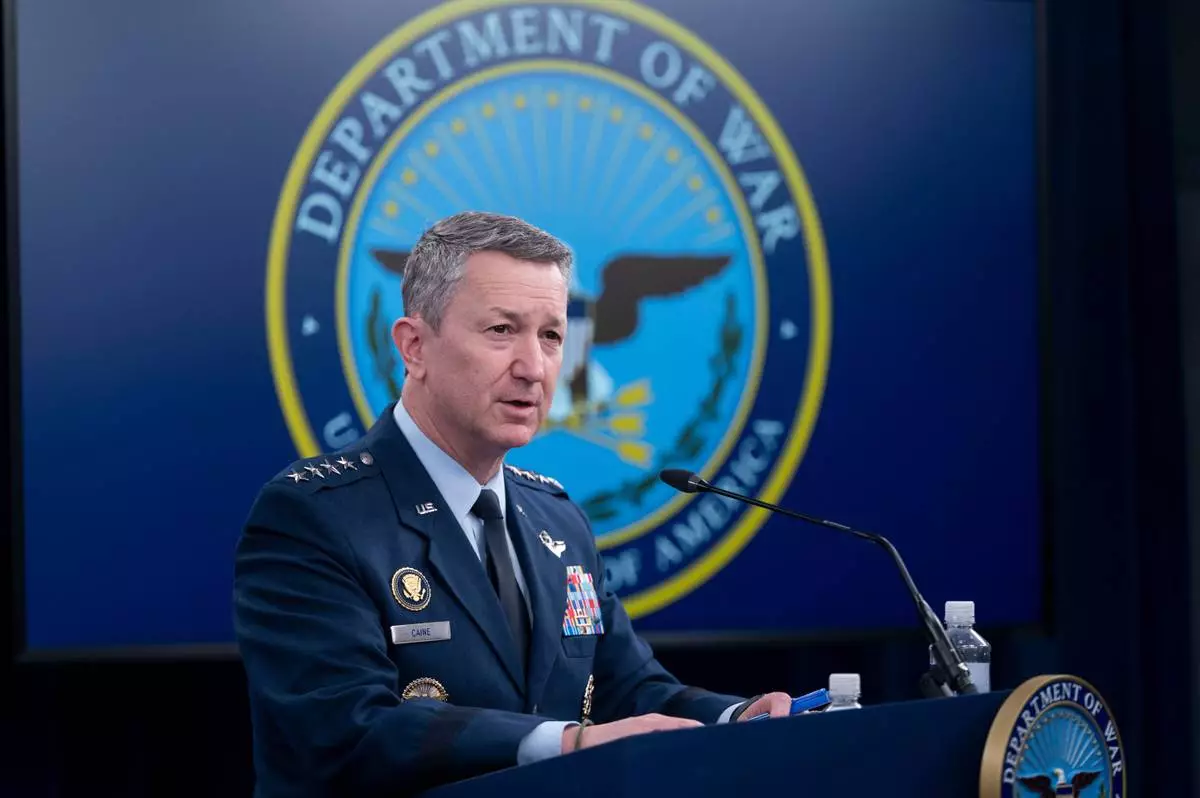
Gen. Dan Caine, chairman of the Joint Chiefs of Staff, said last week that the enforcement actions would extend beyond Iranian waters and the area under control of U.S. Central Command.

U.S. forces in other areas of responsibility, he told reporters at the Pentagon, “will actively pursue any Iranian-flagged vessel or any vessel attempting to provide material support to Iran.” He specifically pointed to operations in the Pacific and said the U.S. would target vessels that left before the blockade began outside the Strait of Hormuz, a crucial waterway for energy and other shipments.

The military also detailed an expansive list of goods that it considers contraband, declaring that it will board, search and seize them from merchant vessels “regardless of location.” A notice published Thursday says any “goods that are destined for an enemy and that may be susceptible to use in armed conflict” are “subject to capture at any place beyond neutral territory.”

The U.S. military’s actions against Iranian-linked vessels, namely the attack over the weekend on the cargo ship named the Touska, have raised questions about the two-week ceasefire.

The U.S. and Iran are operating in “an awkward space where the law doesn’t give you a clean yes-or-no answer” on whether the ceasefire was violated, said Jason Chuah, a law professor at the City University of London and the Maritime Institute of Malaysia.

“The United States seems to take the line that the conflict never fully switched off — that is there is still a state of armed conflict,” Chuah said. “By saying that, it can keep doing things like enforcing a blockade and even using limited force at sea.”

Iran is treating the ceasefire as a pause on all hostile acts, Chuah said.

Iranian Foreign Minister Abbas Araghchi on Tuesday called the U.S. blockade a breach of the ceasefire and said “striking a commercial vessel and taking its crew hostage is an even greater violation.” In a letter, Iran's U.N. Mission asked the U.N. Security Council and U.N. chief António Guterres to condemn the U.S. for seizing the Touska and its crew.

The U.S. earlier had instituted a blockade against sanctioned oil tankers linked to Venezuela but had never fired on those vessels.

Blockades and even limited attacks on vessels can be lawful in wartime, with merchant vessels becoming legitimate targets if they contribute to military actions, carry contraband or are incorporated into enemy logistics, Chuah said.

It's harder to prove that a ship such as the Touska is realistically contributing to military action against the U.S., Chuah said.

“The whole dispute really turns on a deceptively simple question: Did the ceasefire actually suspend the right to use force?” Chuah said. “If it did, then firing on vessels or seizing them is very hard to square with the United Nations Charter.”

Mark Cancian, a retired Marine colonel and a senior defense adviser with the Center for Strategic and International Studies, said a violation of the ceasefire is up for interpretation because there were no defined terms.

“Trump announced it. The Iranians agreed. But there’s no formal agreement,” Cancian said. “So whether it broke the ceasefire or not depends on your perspective. ... Nothing was written down.”

Michael O’Hanlon, a defense and foreign policy analyst at the Brookings Institution, said the U.S. did not violate the ceasefire because it was limited to bombing Iran, not the blockade.

“We agreed to stop dropping bombs on them, and that’s the basic thing they wanted,” O’Hanlon said, adding that the U.S. still had to enforce the blockade “if you’re going to make it mean anything.”

AP writer Farnoush Amiri at the United Nations contributed to this report.

Chairman of the Joint Chiefs of Staff Gen. Dan Caine speaks to members of the media during a press briefing at the Pentagon, Thursday, April 16, 2026 in Washington. (AP Photo/Kevin Wolf)

Chairman of the Joint Chiefs of Staff Gen. Dan Caine speaks to members of the media during a press briefing at the Pentagon, Thursday, April 16, 2026 in Washington. (AP Photo/Kevin Wolf)

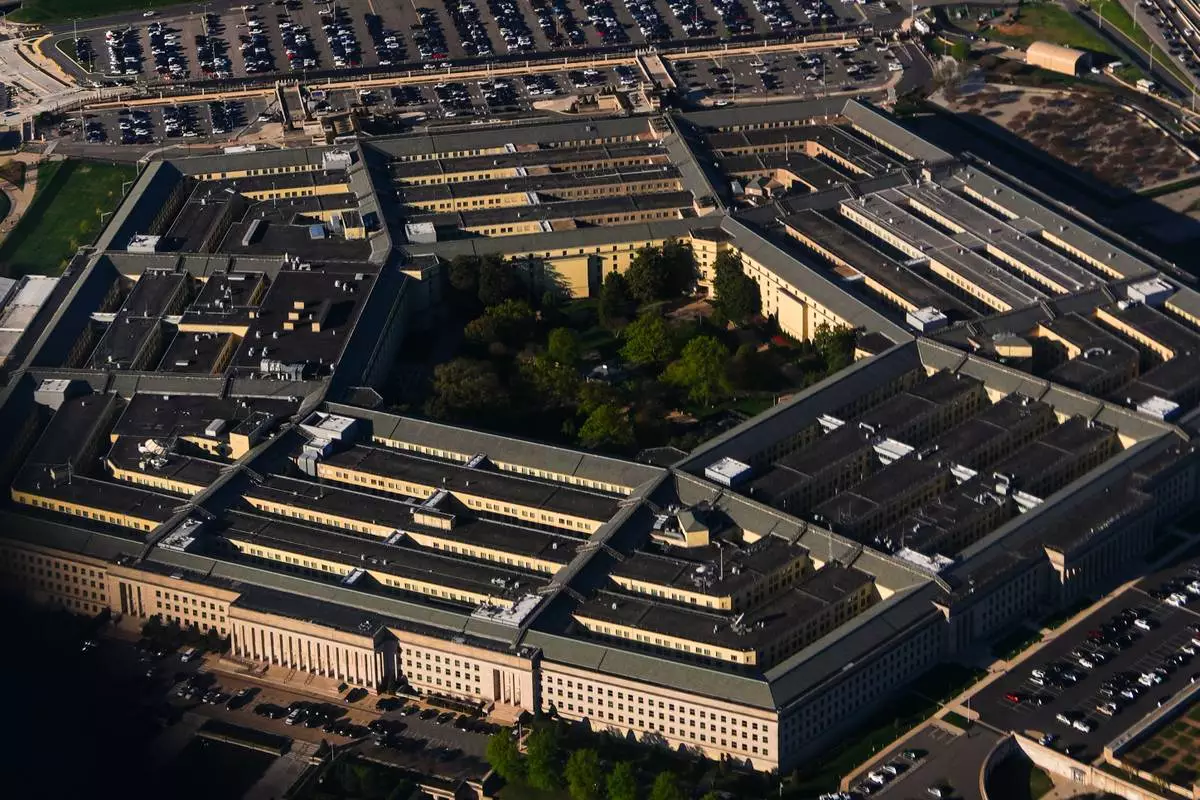
The Pentagon is seen from an airplane, Tuesday, April 7, 2026, in Washington. (AP Photo/Julia Demaree Nikhinson)

The Pentagon is seen from an airplane, Tuesday, April 7, 2026, in Washington. (AP Photo/Julia Demaree Nikhinson)

Recommended Articles